⚔️ Post-Gupta & Early Medieval UP
Maukhari dynasty, Harshavardhana, Tripartite Struggle for Kannauj, Gurjara-Pratiharas, Chandelas, Gahadavala dynasty in Uttar Pradesh for Uttar Pradesh GK.
The Post-Gupta Transition (6th Century CE)
After the Gupta Empire collapsed around 550 CE — weakened by Huna invasions and internal revolts — Uttar Pradesh fragmented into several competing kingdoms. The city of Kannauj (Kanyakubja) emerged as one of the most coveted prizes in north Indian politics, a status it would hold for centuries.
Exam Fact: Kannauj became the main prestige capital of early medieval north India. Control over Kannauj symbolized political supremacy in the Gangetic plain.
The Maukhari Dynasty (6th Century CE)
The Maukharis were the first major dynasty to establish Kannauj as a capital after the Gupta decline.
| Ruler | Achievement |
|---|---|
| Ishanavarman | Defeated the Hunas; expanded Maukhari territory |
| Grahavarman | Last Maukhari king; married Rajyashri (Harsha's sister) |
- Grahavarman was killed by the Malwa king Devagupta, and Rajyashri was imprisoned
- This event directly led to Harshavardhana's rise to power
Harshavardhana (606 — 647 CE)
Harsha is one of the most celebrated rulers in Indian history. Originally from Thaneshwar (Haryana), he took the throne after his brother Rajyavardhana was treacherously killed.
Key Facts
| Feature | Detail |
|---|---|
| Capital | Kannauj |
| Reign | 606-647 CE (41 years) |
| Dynasty | Pushyabhuti / Vardhana |
| Religion | Initially Shaiva, later became a patron of Buddhism |
| Court Poet | Banabhatta (wrote Harshacharita and Kadambari) |
Harsha's Achievements in UP
- Made Kannauj a leading political and cultural centre of north India — Xuanzang described it as a great city with many monasteries
- Held grand religious assemblies at Prayag (Prayagraj) at regular intervals, where he performed large acts of charity
- Patronized Nalanda University — built new monasteries and funded thousands of students
- Wrote three Sanskrit plays: Ratnavali, Priyadarshika, and Nagananda
- Established diplomatic relations with Tang Dynasty China
Xuanzang (Hiuen Tsang) — The Chinese Pilgrim
Xuanzang visited India during Harsha's reign (630-645 CE) and left the most detailed account of 7th-century UP.
| City Visited | Xuanzang's Observations |
|---|---|
| Kannauj | Grand capital with many monasteries and scholars |
| Prayagraj | Described the Triveni Sangam and mass bathing rituals |
| Varanasi | 30 monasteries but Hinduism dominant; Shiva worship widespread |
| Shravasti | Mostly in ruins, few monks remaining |
| Kushinagar | Desolate, few inhabitants |
| Mathura | Mix of Buddhist and Hindu activity |
Exam Tip: Xuanzang attended Harsha's grand religious assembly at Kannauj, which became one of the best-known events linking UP with Buddhist intellectual history.
After Harsha — Power Vacuum
Harsha died in 647 CE without an heir, and his empire collapsed immediately. This created a power vacuum in the Ganga plains that triggered the most famous political conflict of early medieval India.
- A minister named Arunashva seized the throne briefly
- The Chinese ambassador Wang Xuance was attacked; he returned with Tibetan and Nepali troops to punish the usurper
The Tripartite Struggle for Kannauj (8th-10th Century)
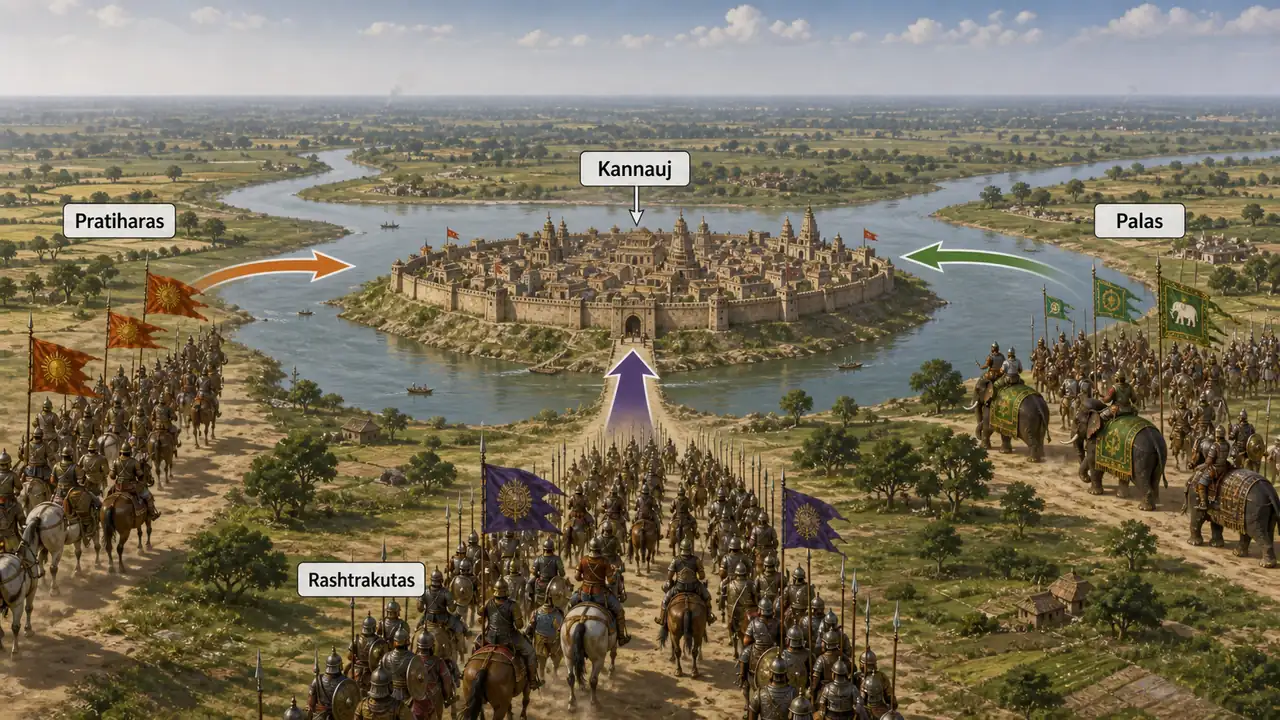
The Tripartite Struggle was a long conflict among three dynasties fighting for control of Kannauj — the symbolic seat of north Indian power.
| Dynasty | Region | Capital | Outcome |
|---|---|---|---|
| Gurjara-Pratiharas | Western India / Rajasthan | Kannauj (in later phase) | Eventually emerged strongest in Kannauj |
| Palas | Bengal and Bihar | Monghyr / Vikramapura | Lost the struggle |
| Rashtrakutas | Deccan (Maharashtra-Karnataka) | Manyakheta | Powerful but could not hold Kannauj |
How the Struggle Played Out
- Phase 1 (8th century): Palas under Dharmapala briefly installed a puppet ruler at Kannauj
- Phase 2 (early 9th century): Rashtrakuta king Govinda III marched north and defeated both Palas and Pratiharas
- Phase 3 (mid 9th century): The Gurjara-Pratiharas, especially under rulers like Mihira Bhoja, emerged as the dominant power in Kannauj
The Gurjara-Pratihara Dynasty at Kannauj
The Pratiharas ruled Kannauj for a long period and became one of the dominant powers of north India.
Key Pratihara Rulers
| Ruler | Achievement |
|---|---|
| Nagabhata I | Repelled the Arab invasion of Sindh from advancing east |
| Mihira Bhoja | Greatest Pratihara king; consolidated control over Kannauj |
| Mahendrapala | Expanded to Magadha; patron of poet Rajashekhara |
| Mahipala | Last powerful ruler; after him, decline began |
The Pratiharas are widely remembered for checking Arab expansion from Sindh toward the deeper north Indian plains. Arab writers such as Al-Masudi described them as major opponents in the region.
The Chandela Dynasty (9th-13th Century)
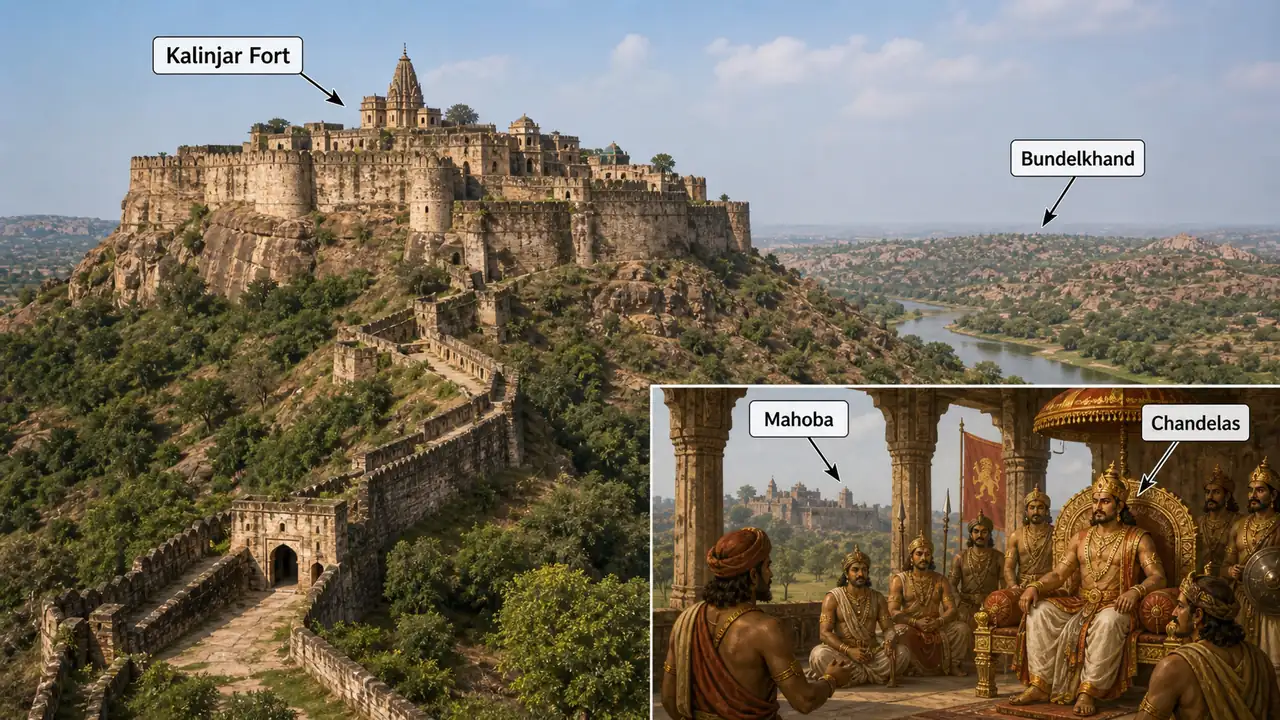
The Chandelas ruled the Bundelkhand region (southern UP and northern MP) from the 9th to 13th century.
| Feature | Detail |
|---|---|
| Capital | Mahoba (UP) and Khajuraho (MP) |
| Famous For | Khajuraho temples (UNESCO World Heritage Site) |
| UP Territory | Mahoba, Kalinjar Fort, parts of Jhansi, Hamirpur, Banda |
| Notable Ruler | Dhanga — built many Khajuraho temples |
- Kalinjar Fort (Banda district, UP) was a major Chandela stronghold — one of the most impregnable forts in India
- While Khajuraho is in MP, the Chandelas administered significant parts of southern UP
- The warrior Alha-Udal ballads of Bundelkhand celebrate Chandela-era heroes
The Gahadavala Dynasty (11th-12th Century)
The Gahadavalas were among the last major north Indian dynasties to rule the middle Ganga plain before Turkish expansion.
| Feature | Detail |
|---|---|
| Capital | Varanasi and Kannauj |
| Period | 1089-1194 CE |
| Founder | Chandradeva |
| Greatest Ruler | Govindachandra |
| Last Ruler | Jayachandra (defeated by Muhammad Ghori) |
Key Facts
- Govindachandra's queen Kumaradevi built Buddhist monasteries at Sarnath — showing religious tolerance
- The dynasty maintained Varanasi as a centre of Hindu learning and pilgrimage
- Jayachandra was defeated at the Battle of Chandawar (1194 CE) in the Ghurid expansion phase, a turning point in the political history of the region
Summary Cheat Sheet
| Dynasty / Ruler | Period | Capital | Key Fact |
|---|---|---|---|
| Maukharis | 6th century | Kannauj | First dynasty to make Kannauj capital |
| Harshavardhana | 606-647 CE | Kannauj | Xuanzang visited; Banabhatta was court poet |
| Gurjara-Pratiharas | Early medieval period | Kannauj | Emerged strongest in Tripartite Struggle; checked Arab advance |
| Chandelas | 9th-13th century | Mahoba | Khajuraho temples; Kalinjar Fort |
| Gahadavalas | 1089-1194 CE | Varanasi / Kannauj | Important late dynasty; Jayachandra fell at Chandawar |
Lesson Doubts
Ask questions, get expert answers