🏺 Maurya & Gupta Empires in UP
Maurya empire Ashoka pillars, Gupta Golden Age, Prayagraj Prashasti, Deogarh Dashavatara Temple, Bhitargaon brick temple and their connections to Uttar Pradesh for Uttar Pradesh GK.
The Maurya Empire and UP (322 — 185 BCE)
The Maurya Empire, founded by Chandragupta Maurya around 322 BCE, was India's first pan-subcontinental empire. While the capital was at Pataliputra (modern Patna, Bihar), the Ganga-Yamuna region of present-day Uttar Pradesh formed an important core zone of the empire.
Chandragupta Maurya's Connection
- Chandragupta overthrew the Nanda dynasty with the guidance of Chanakya (Kautilya)
- UP's major cities — Varanasi, Mathura, Kaushambi — became important administrative centres
- Trade routes through the Ganga-Yamuna Doab connected the Maurya capital to the northwest frontier
Ashoka's Pillars and Edicts in UP
Emperor Ashoka (269-232 BCE) left the most visible Maurya legacy in UP through inscribed pillars and Buddhist commemorative sites. UP is one of the most important states for studying Ashokan pillar traditions.
| Pillar Location | District | Special Feature |
|---|---|---|
| Sarnath | Varanasi | Four-lion capital = National Emblem of India |
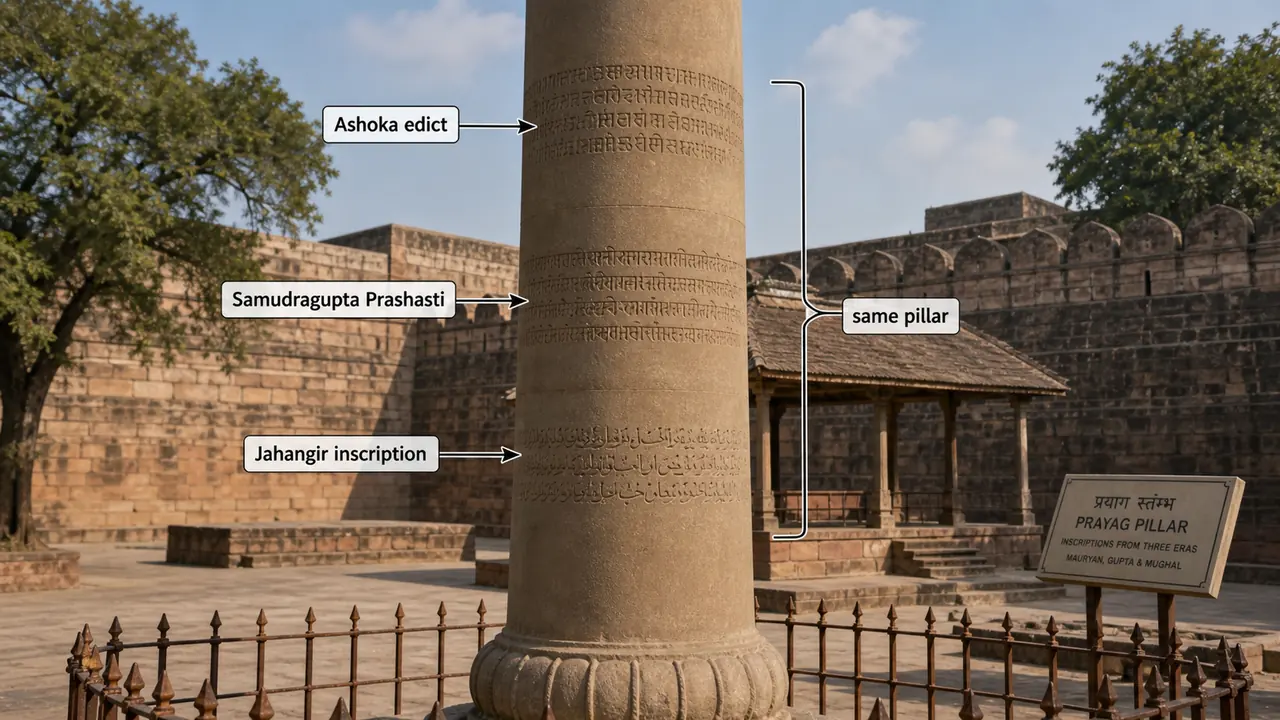
| Prayagraj (Allahabad) | Prayagraj | Now inside Allahabad Fort; later inscribed by Samudragupta and Jahangir |
| Meerut / Delhi | Meerut | Originally from Meerut, moved to Delhi by Firoz Shah Tughlaq |
| Sankassa / Sankisa tradition | Farrukhabad | Associated with an elephant-capital tradition |
| Kaushambi | Kaushambi region | Pillar and inscriptional association with Ashokan memory |
| Sarnath Minor Pillar Edict | Varanasi | Warning against schism in the Sangha |
The Queen's Edict is famous because it contains the best-known inscriptional reference to Ashoka's queen Karuvaki, mother of Prince Tivara.
Ashoka's Major Rock Edicts
Ashokan inscriptions and pillar traditions promoted a moral-political message known as Dhamma. The main ideas students should remember are:
- Dhamma (moral law) — non-violence, respect for all religions
- Ban on animal sacrifice
- Medical facilities for humans and animals
- Planting of trees along roads
The Gupta Empire — Golden Age of India (320 — 550 CE)
The Gupta Empire is often called the "Golden Age of India" because of major achievements in science, art, literature, and philosophy. Many of the most important Gupta inscriptions, temples, sculptures, and urban centres are linked with present-day UP.
Key Gupta Rulers
| Ruler | Period | UP Connection |
|---|---|---|
| Chandragupta I | 320-335 CE | Married Licchavi princess Kumaradevi; Prayagraj region under control |
| Samudragupta | 335-380 CE | Prayagraj Prashasti — major record of imperial expansion |
| Chandragupta II (Vikramaditya) | 380-415 CE | Patron of Kalidasa; Mathura as second capital |
| Kumaragupta I | 415-455 CE | Founded Nalanda University |
| Skandagupta | 455-467 CE | Repelled Huna invasions; Junagadh inscription |
The Prayagraj Prashasti (Allahabad Pillar Inscription)
The Prayagraj Prashasti is one of the most important inscriptions in Indian history. Key facts:
- Composed by Harisena, court poet of Samudragupta
- Inscribed on the same Ashokan pillar at Prayagraj (now in Allahabad Fort)
- Written in Sanskrit, Gupta Brahmi script
- Records Samudragupta's military conquests across India — lists defeated kings by name
- Later historians such as V.A. Smith described him as the "Indian Napoleon"
Exam Tip: The Prayagraj pillar has three inscriptions from three eras: Ashoka's edicts (3rd century BCE), Samudragupta's Prashasti (4th century CE), and Jahangir's inscription (17th century CE).
Chinese Traveller Fa-Hien in UP
Fa-Hien (Faxian) visited India during the reign of Chandragupta II (399-414 CE). His observations about UP:
- Visited Mathura — described it as a prosperous city with many Buddhist monasteries
- Visited major Ganga plain centres and Buddhist sites associated with the region
- Visited Shravasti and Kapilvastu — found them in decline compared to their earlier glory
- Described parts of the Ganga plains as prosperous and relatively orderly from his perspective
- His account should be read as a Buddhist pilgrim's travel narrative, not as a perfect statistical report
Art and Architecture of the Gupta Period in UP
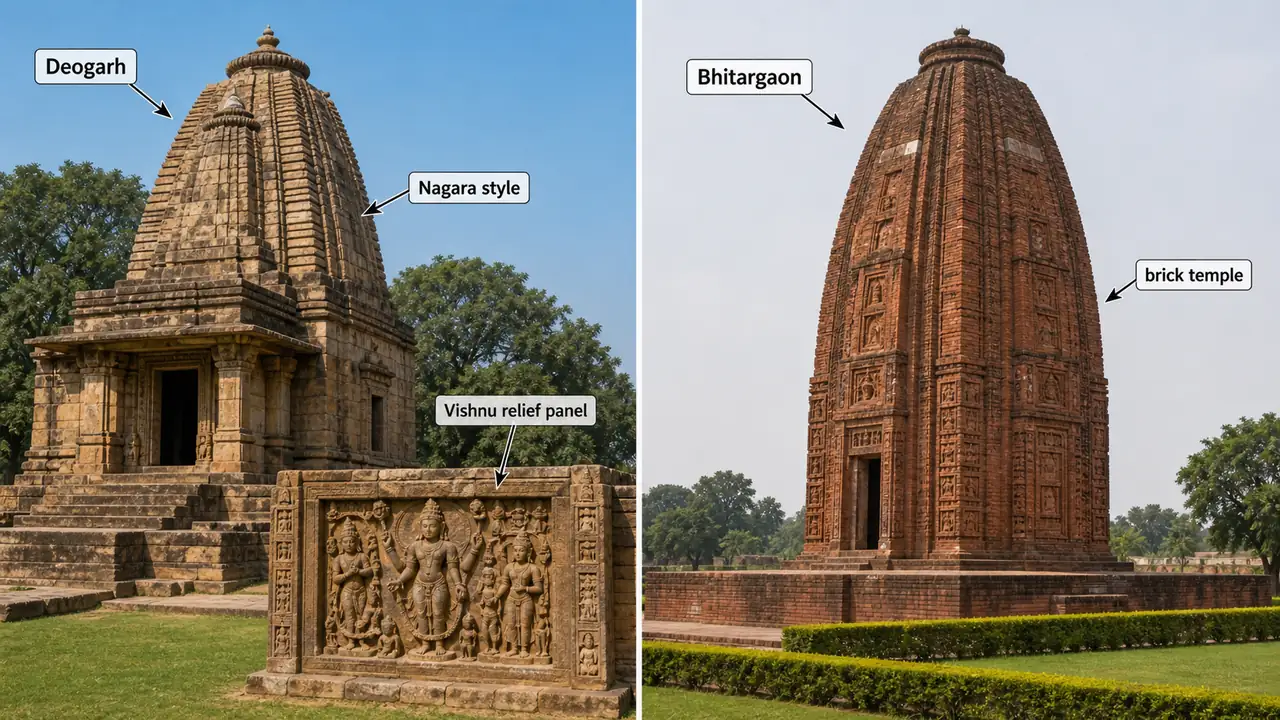
Deogarh Dashavatara Temple (Lalitpur)
The Dashavatara Temple at Deogarh (Lalitpur district) is a masterpiece of Gupta architecture:
- Dedicated to Vishnu and his ten avatars
- Built around the 6th century CE
- Features exquisite relief panels: Sheshashayi Vishnu (reclining on Shesha), Gajendramoksha, Nara-Narayana
- One of the earliest examples of the North Indian Nagara-style temple
Bhitargaon Brick Temple (Kanpur Dehat)
Bhitargaon temple is the oldest surviving brick Hindu temple in India:
- Built during the Gupta period (5th century CE)
- Located in Kanpur Dehat district
- Remarkable terracotta panels depicting Vishnu, Shiva, and river goddesses
- Demonstrates advanced Gupta-era brick construction techniques
| Monument | Location | Period | Distinction |
|---|---|---|---|
| Dashavatara Temple | Deogarh, Lalitpur | 6th century CE | Finest Gupta sculpture panels |
| Bhitargaon Temple | Kanpur Dehat | 5th century CE | Oldest surviving brick Hindu temple in India |
| Mathura School | Mathura | 1st-6th century CE | Produced iconic Buddha and Vishnu statues |
Gupta Achievements Connected to UP
| Field | Achievement | UP Link |
|---|---|---|
| Literature | Kalidasa's Meghdootam, Shakuntala | Gupta court culture influenced the wider north Indian region, including UP |
| Science | Aryabhata — astronomy and mathematics | Part of the broader intellectual flowering of the Gupta age |
| Art | Mathura School of Art | Indigenous red sandstone Buddha statues |
| Medicine | Sushruta Samhita compilations | Varanasi tradition of medical learning |
| Coins | Gold coins (Dinara) | Found across UP sites |
Summary Cheat Sheet
| Feature | Detail |
|---|---|
| Sarnath Pillar | Lion Capital = National Emblem (Ashoka) |
| Prayagraj Pillar | Three inscriptions: Ashoka + Samudragupta + Jahangir |
| Queen's Edict | Best-known inscriptional reference to Queen Karuvaki |
| Prayagraj Prashasti | By Harisena; later linked with the title "Indian Napoleon" |
| Fa-Hien | Visited under Chandragupta II (399-414 CE) |
| Deogarh Temple | Vishnu panels, Nagara-style, 6th century CE |
| Bhitargaon | Oldest surviving brick Hindu temple, 5th century CE |
| Mathura School | Red sandstone, indigenous style Buddha statues |
Lesson Doubts
Ask questions, get expert answers