📜 British Conquest of Awadh
Battle of Buxar, Treaty of Allahabad, Subsidiary Alliance, and the final annexation of Awadh under Dalhousie for Uttar Pradesh GK.
Awadh Before the British
Awadh (Oudh) was one of the richest provinces of Mughal India. After the decline of the Mughal Empire in the early 18th century, Awadh became a semi-independent state under the Nawabs. The first independent Nawab was Saadat Khan Burhan-ul-Mulk (appointed 1722), who laid the foundation of the Awadh dynasty.
The Nawabs of Awadh were known for patronizing art, music, and architecture. Lucknow became a cultural centre rivalling Delhi. However, the growing power of the East India Company soon cast its shadow over Awadh.
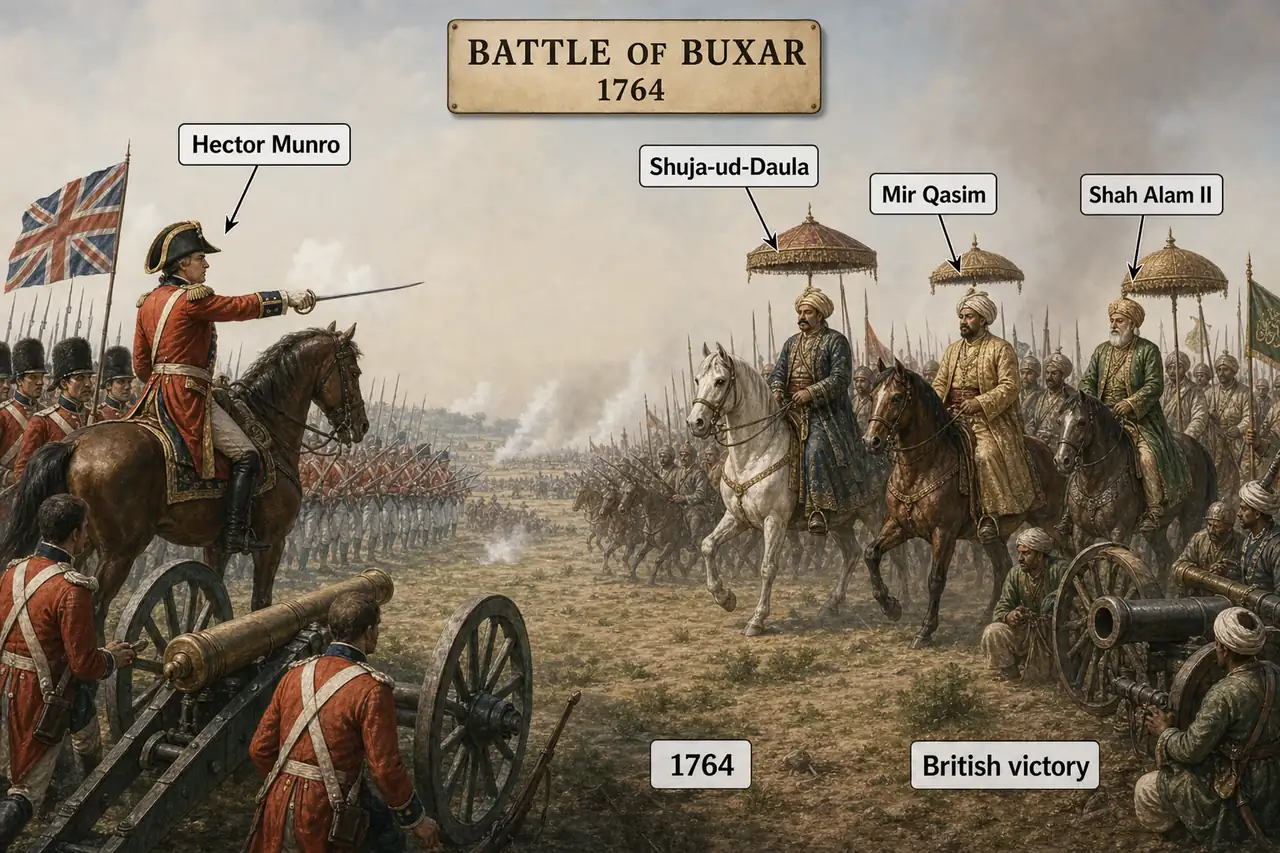
The Battle of Buxar (1764)
The Battle of Buxar was one of the decisive military engagements that established British supremacy in northern India.
| Detail | Fact |
|---|---|
| Date | 22 October 1764 |
| Location | Buxar, present-day Bihar |
| British Commander | Major Hector Munro |
| Allied Indian Forces | Nawab Shuja-ud-Daula (Awadh) + Mir Qasim (Bengal) + Mughal Emperor Shah Alam II |
| Result | Decisive British victory |
Why Buxar matters more than Plassey: While the Battle of Plassey (1757) opened British power in Bengal, Buxar was a larger military confrontation whose consequences directly reshaped Awadh and north Indian politics.
The defeated Shuja-ud-Daula fled westward, and Shah Alam II surrendered to the British. This battle greatly increased Company interference in Awadh's affairs.
Treaty of Allahabad (1765)
After Buxar, Robert Clive negotiated two separate treaties at Allahabad (modern Prayagraj) in 1765.
Treaty with Shah Alam II
- The Mughal Emperor granted the Diwani (revenue collection rights) of Bengal, Bihar, and Orissa to the East India Company
- In return, the Company paid him an annual tribute of Rs 26 lakh
- Districts of Kora and Allahabad were given to Shah Alam II
Treaty with Shuja-ud-Daula
- Shuja-ud-Daula paid a war indemnity of Rs 50 lakh
- He ceded Kora and Allahabad to the Emperor (effectively to the Company)
- A British Resident was posted at Lucknow
- Awadh became a buffer state between Company territories and the Marathas
Subsidiary Alliance and Gradual Control
The Company tightened its grip on Awadh through a series of treaties over the next decades.
| Year | Event | Impact |
|---|---|---|
| 1773 | Treaty of Benares | Shuja-ud-Daula paid Rs 40 lakh for Rohilkhand campaign support |
| 1775 | Treaty of Faizabad | Nawab Asaf-ud-Daula ceded Benares to the Company |
| 1798 | Subsidiary Alliance under Wellesley | Nawab Saadat Ali Khan accepted; Company troops stationed at Nawab's cost |
| 1801 | Treaty of Lucknow | Nawab surrendered half of Awadh including Rohilkhand, Gorakhpur, and the Doab |
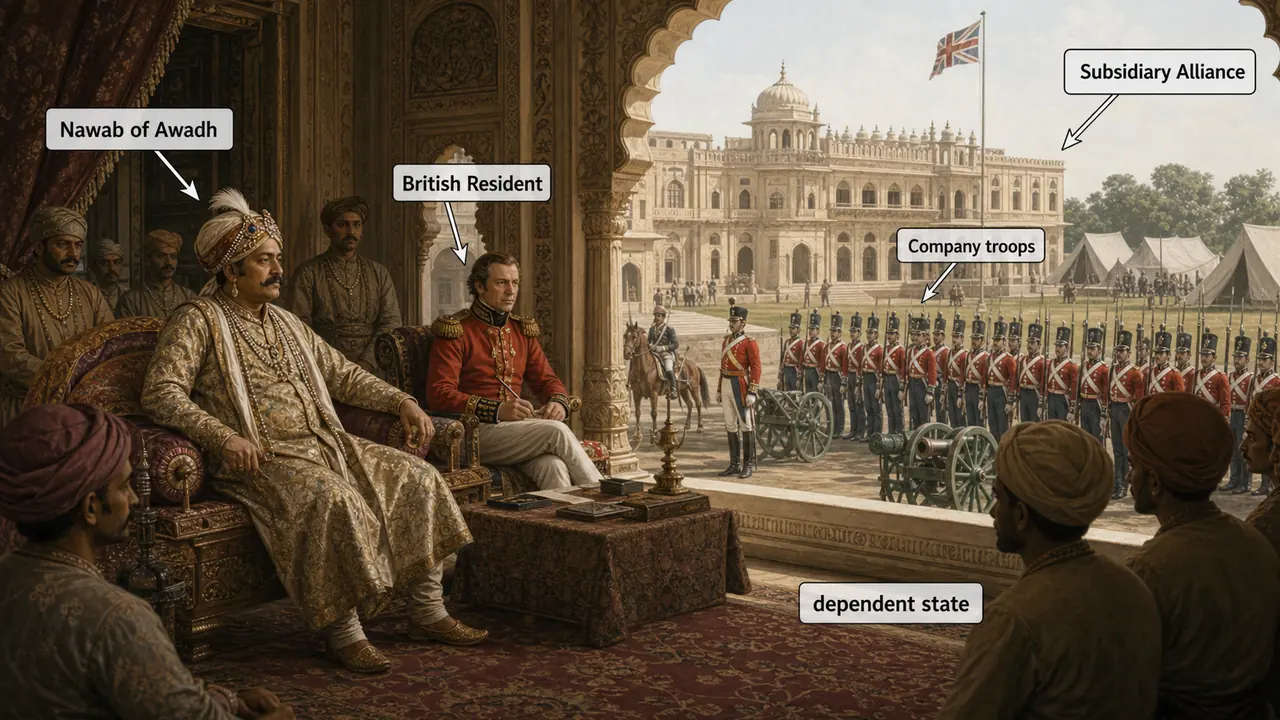
Under the Subsidiary Alliance system of Lord Wellesley, the Nawab had to:
- Maintain a British military force in Awadh at his own expense
- Accept a British Resident who controlled foreign affairs
- Dismiss all European employees except British
- The Nawab lost control over external relations entirely
This transformed Awadh from a semi-independent kingdom into a heavily dependent allied state.
Revenue Exploitation
The Company extracted increasing financial and political concessions from Awadh:
- Forced loans: Nawabs were pressured to give enormous loans to the Company, sometimes never repaid
- Taluqdari system: Revenue was collected through taluqdars (landlords) who squeezed peasants mercilessly
- Trade privileges: British merchants enjoyed tariff advantages that harmed sections of local trade and revenue
- The Nawab's treasury, once among the richest in India, was steadily emptied
Awadh became a heavily exploited allied state whose resources increasingly served Company interests while Nawabi autonomy kept shrinking.
Dalhousie, Doctrine of Lapse, and the Annexation of Awadh (1856)
Lord Dalhousie (Governor-General, 1848-1856) used two tools to annex Indian states: the Doctrine of Lapse and the charge of "misgovernance."
Doctrine of Lapse
- If a ruler died without a natural heir, his adopted heir would not be recognized
- The state would "lapse" (be absorbed) into British territory
- States annexed: Satara, Jhansi, Nagpur, Sambhalpur, and others
Annexation of Awadh
Dalhousie did not use the Doctrine of Lapse for Awadh. Instead, he cited "misgovernance" as the reason.
| Detail | Fact |
|---|---|
| Year of Annexation | February 1856 |
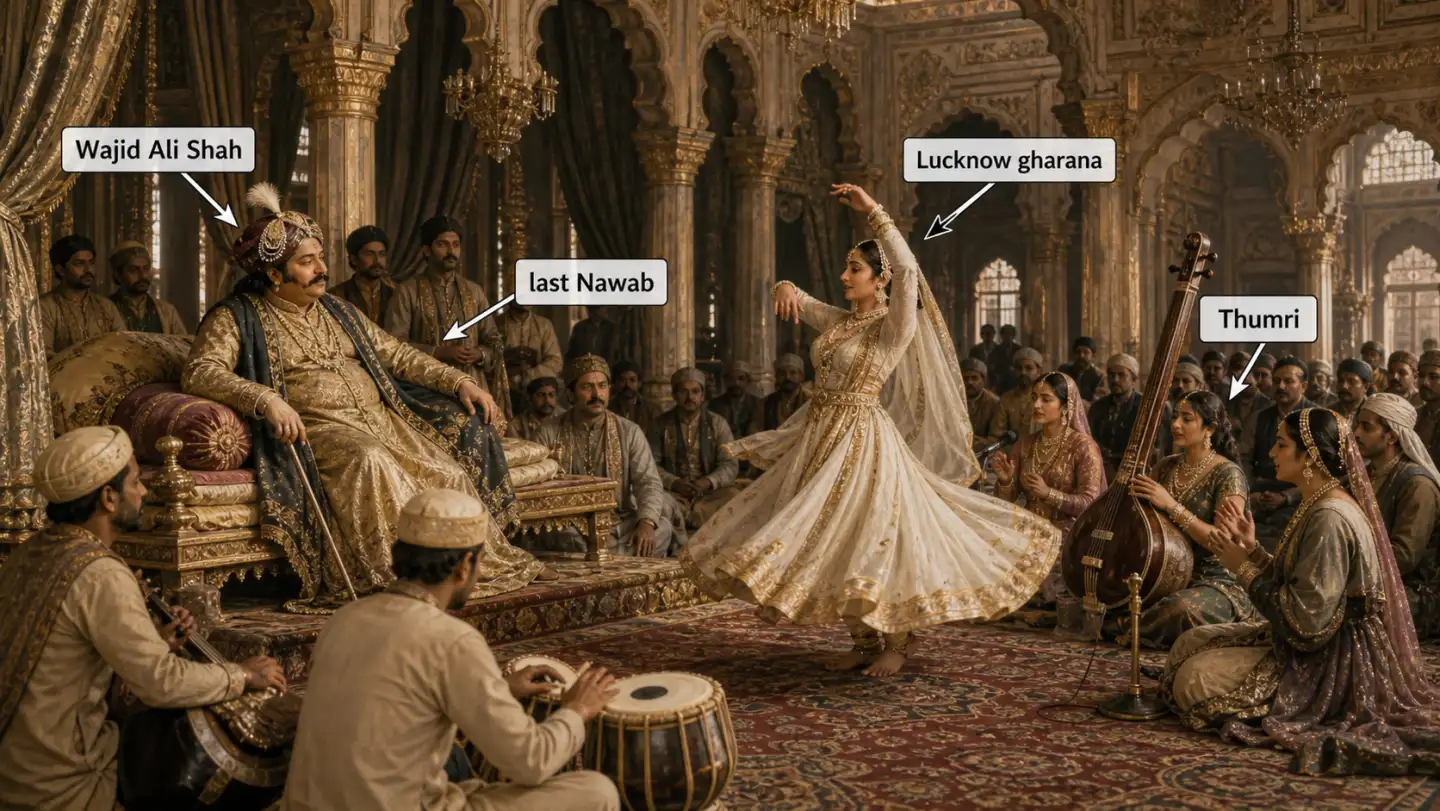
| Last Nawab | Wajid Ali Shah |
| Pretext | Alleged misrule and neglect of administration |
| British Agent | General Outram presented the annexation order |
| Wajid Ali Shah's Response | Refused to legitimize the annexation; went to Calcutta, while appeals were later pursued unsuccessfully |
Wajid Ali Shah was a poet, musician, and patron of Kathak dance. His deposition outraged the people of Awadh and became a major cause of the Revolt of 1857.
Consequences of Annexation
- The entire Awadh nobility (taluqdars, courtiers) lost their positions overnight
- Thousands of soldiers in the Nawab's army became unemployed
- The sepoys of the Bengal Army, many of whom came from Awadh, felt deep resentment
- The common people lost their cultural symbol — the Nawab's court at Lucknow
- Awadh became one of the primary centres of the 1857 Revolt
Summary Cheat Sheet
| Item | Key Fact |
|---|---|
| Battle of Buxar | 1764, Hector Munro defeated Shuja-ud-Daula + Mir Qasim + Shah Alam II |
| Treaty of Allahabad | 1765, Diwani of Bengal to Company, Awadh became buffer state |
| Subsidiary Alliance | 1798, Lord Wellesley, Nawab lost military autonomy |
| Treaty of Lucknow | 1801, half of Awadh ceded to Company |
| Annexation of Awadh | February 1856, Lord Dalhousie, charge of misgovernance |
| Last Nawab | Wajid Ali Shah, deposed and exiled |
| Result | Massive resentment leading to 1857 Revolt |
Lesson Doubts
Ask questions, get expert answers