🧵 Banarasi Silk & Weaving Traditions
Study the rich heritage of Banarasi silk sarees and Varanasi's weaving traditions — types, techniques, Mughal motifs, GI status, and challenges facing handloom weavers.
Introduction
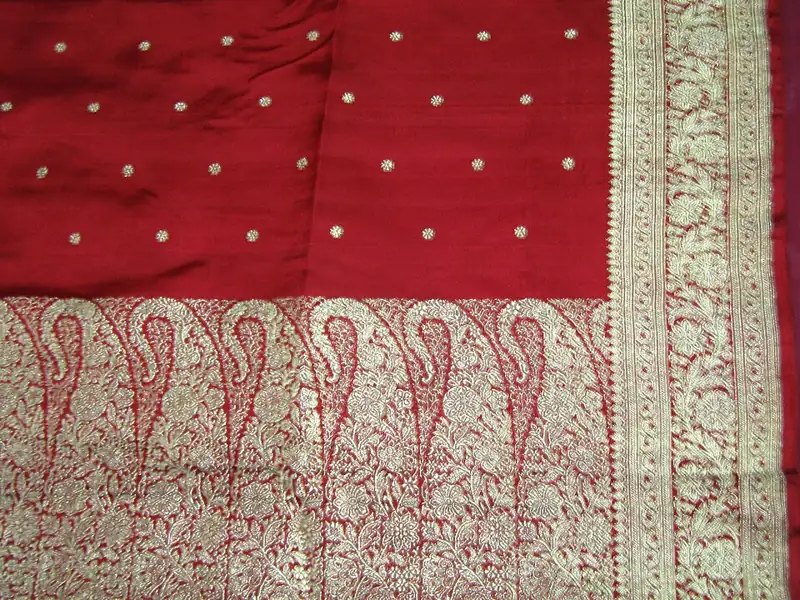
The Banarasi saree is one of India's most celebrated textiles, woven in Varanasi (Benaras) through a long and rich weaving tradition that flowered especially in the medieval and Mughal periods. Known for brocade work, intricate motifs, and luxurious silk, these sarees are deeply associated with Indian wedding culture and with the handloom identity of eastern Uttar Pradesh.
Historical Background
Varanasi has been associated with textile production since ancient times, but the Banarasi silk-brocade tradition is most strongly linked with Mughal-era patronage from roughly the 16th to 18th centuries. During this period, local weaving traditions absorbed Persian-influenced floral and geometric design elements.
The Mughal court's demand for rich woven fabrics helped make Varanasi a major brocade centre. Even after Mughal decline, the tradition survived through local patronage, religious-cultural demand, and the wedding market.
Types of Banarasi Sarees
Banarasi sarees are classified into four main types based on fabric composition:
| Type | Fabric | Characteristics |
|---|---|---|
| Katan | Pure silk warp & weft | Heaviest, most expensive, twisted silk threads |
| Organza (Kora) | Sheer silk | Transparent, lightweight, crisp texture |
| Georgette | Twisted crêpe silk | Slightly crinkled surface, good drape |
| Shattir | Silk warp, art-silk weft | More affordable, retains brocade look |
Additionally, Tanchoi sarees (originating from a Parsi-Chinese technique) feature single or double warp weaving with coloured weft patterns.
Zari Work & Brocade Technique
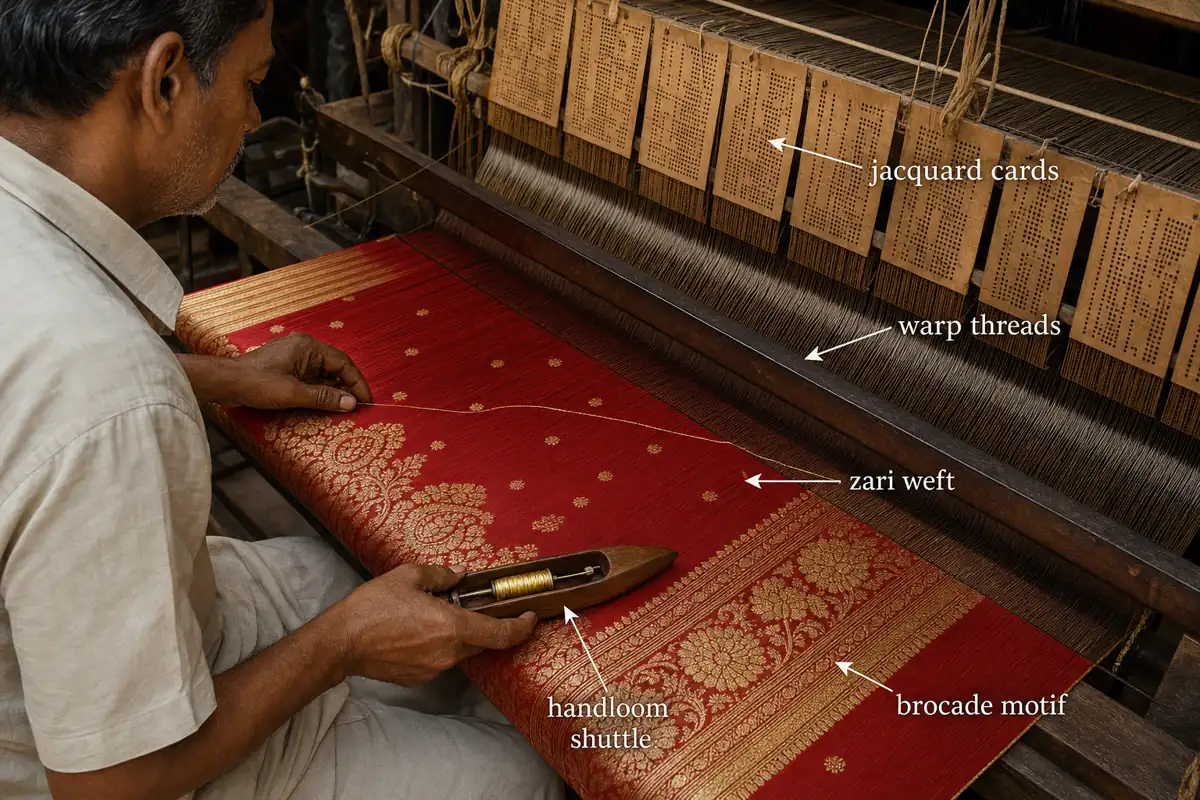
The hallmark of a Banarasi saree is its zari (metallic thread) brocade. Traditional zari uses real gold or silver wire flattened and wound around a silk core. The weaving process involves:
- Design creation on graph paper (naqsha)
- Punching cards (jacquard) to encode the pattern
- Setting up the loom with warp threads
- Interlacing zari weft by hand using throw-shuttle technique
- Finishing — cutting extra threads (kadhua technique preserves motifs individually)
A single handwoven Banarasi saree may take from several days to many months to complete, depending on intricacy.
Signature Motifs
Banarasi saree motifs draw heavily from Mughal art:
| Motif | Description |
|---|---|
| Kalga | Mango/paisley border design |
| Bel | Flowing creeper/vine along the border |
| Jhal | Net-like interlocking pattern in the body |
| Jangla | Dense, jungle-like all-over floral pattern |
| Shikargah | Hunting scenes with animals and trees |
| Butidar | Small, evenly spaced individual motifs |
The Jangla and Shikargah patterns are considered the most intricate and valuable.
GI Tag & Legal Protection
Banarasi Brocades and Sarees received the Geographical Indication (GI) tag in 2009, protecting the brand from imitation products. Key provisions:
- Only sarees woven in Varanasi, Jaunpur, Mirzapur, Chandauli, Bhadohi, and Azamgarh districts qualify
- Must meet specific weaving and material standards
- GI registration helps protect authenticity and gives genuine producers a stronger identity in the market
Mubarakpur — The Other Silk Centre
Mubarakpur in Azamgarh district is an important silk weaving centre of Uttar Pradesh beyond Varanasi. Known for:
- Lighter, more affordable silk sarees
- Distinctive bright colour combinations
- Predominant Muslim weaver community
- A long-standing weaving tradition linked to regional textile markets
Handloom vs Powerloom Debate
| Parameter | Handloom | Powerloom |
|---|---|---|
| Time per saree | 15 days–6 months | 1–3 days |
| Cost | ₹5,000–₹5,00,000+ | ₹500–₹5,000 |
| Zari quality | Real gold/silver possible | Mostly artificial zari |
| Employment | Sustains individual weavers | Factory-based |
| Texture | Soft, breathable, unique | Uniform, stiffer |
Powerloom production has captured a very large part of the market, severely undercutting handloom weavers. The Handloom Mark and Silk Mark schemes help consumers identify genuine products.
Comparison with Other Indian Silks
| Silk Tradition | State | Unique Feature |
|---|---|---|
| Banarasi | Uttar Pradesh | Gold zari brocade, Mughal motifs |
| Kanchipuram | Tamil Nadu | Heavy, temple border, contrast pallu |
| Mysore | Karnataka | Pure silk, minimal zari, KSIC brand |
| Baluchari | West Bengal | Mythological scenes in pallu |
| Muga | Assam | Natural golden colour, world-exclusive |
| Patola | Gujarat | Double-ikat, geometric precision |
Challenges & Way Forward
- A very large weaving community in and around Varanasi faces income pressure from powerlooms
- Chinese silk yarn imports have undercut local silk production
- GST implementation created initial compliance burden for small weavers
- Government initiatives: MUDRA loans, Bunkar Mitra helpline, Handloom Census, e-commerce partnerships
Summary Cheat Sheet
| Fact | Detail |
|---|---|
| Historical base | Ancient textile city; Banarasi brocade flourished especially under Mughal patronage |
| Purest type | Katan (100% silk) |
| GI tag year | 2009 |
| GI-covered districts | Varanasi, Jaunpur, Mirzapur, Chandauli, Bhadohi, Azamgarh |
| Key motifs | Kalga, Bel, Jhal, Jangla, Shikargah |
| Other silk centre | Mubarakpur, Azamgarh |
| Handwoven time | Several days to many months, depending on complexity |
| Main challenge | Powerloom competition and weak returns for handloom weavers |
Lesson Doubts
Ask questions, get expert answers