🧶 Carpet Weaving — Bhadohi-Mirzapur Belt
Study the Bhadohi-Mirzapur carpet belt — one of the world's major handmade carpet regions, its Mughal origins, weaving techniques, exports, and socio-economic impact.
Introduction
The Bhadohi-Mirzapur belt in eastern Uttar Pradesh is one of the world's most important hubs for handmade carpet production. The region contributes significantly to India's carpet exports and is one of UP's most important craft industries. The tradition combines Mughal-Persian design influence with a large regional weaving workforce.
Historical Background
Carpet weaving in India was introduced in an organised form during the Mughal era, particularly under Emperor Akbar (16th century), who invited Persian master weavers to establish workshops (karkhanas) in Agra, Lahore, and the Gangetic plains.
The Bhadohi-Mirzapur belt emerged as a major centre in the 19th century when East India Company merchants recognised the region's potential for export-quality carpets. By the early 20th century, this belt had become the primary supplier of hand-knotted carpets to Western markets.
Geography of the Carpet Belt
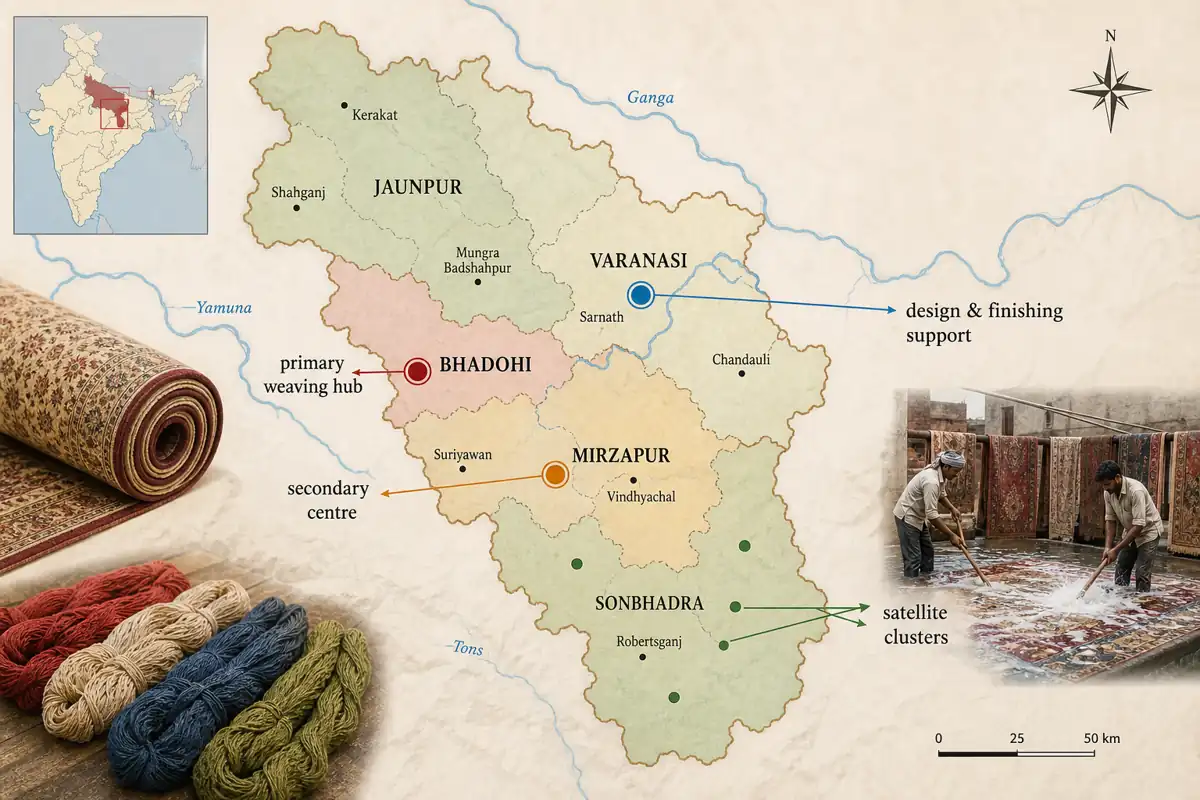
The Bhadohi-Mirzapur carpet belt stretches across Bhadohi (Sant Ravidas Nagar), Mirzapur, and nearby weaving and finishing clusters in eastern UP.
| District | Role |
|---|---|
| Bhadohi | Primary weaving hub, maximum concentration of looms |
| Mirzapur | Second major centre, GI-tagged carpets |
| Varanasi | Design development, finishing units |
| Jaunpur | Satellite weaving clusters |
| Sonbhadra | Smaller linked production pockets |
Types of Carpets Produced
| Type | Technique | Features |
|---|---|---|
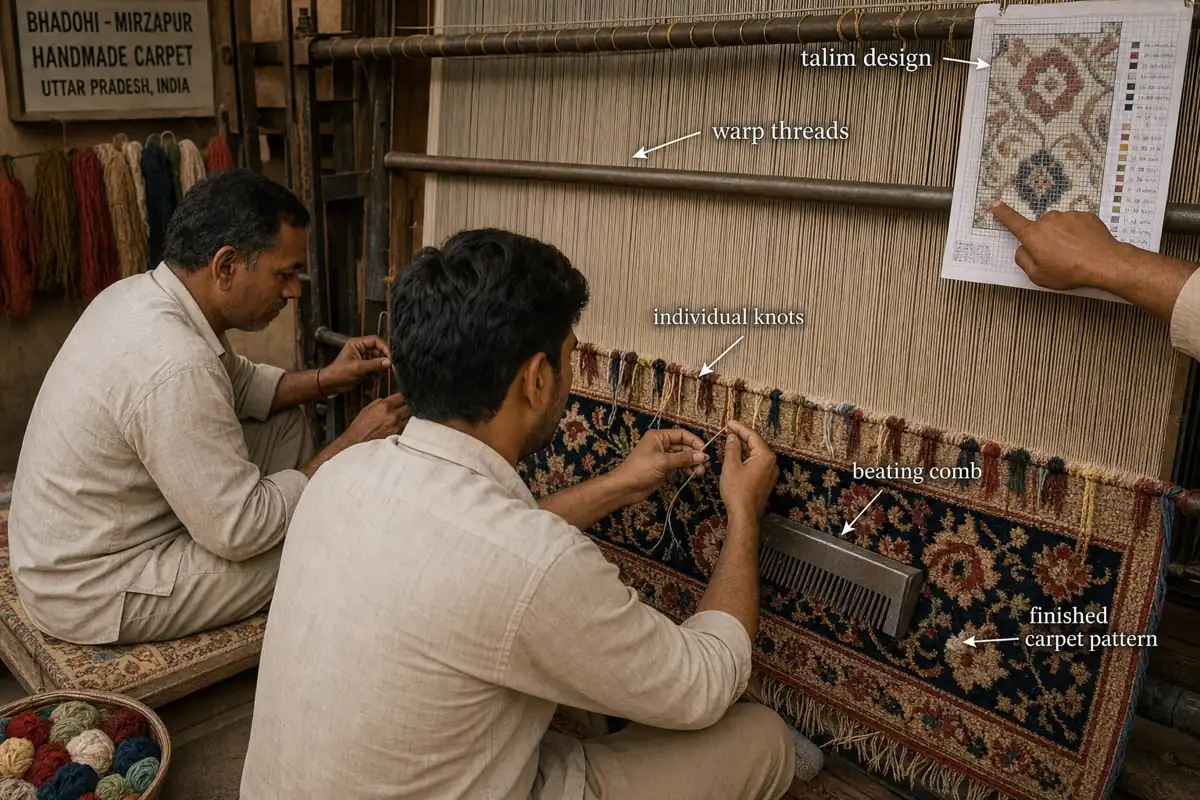
| Hand-knotted | Individual knots tied on warp threads | Highest quality, most labour-intensive, 100-400 knots per sq. inch |
| Hand-tufted | Yarn punched into backing fabric with a tufting gun | Faster production, lower cost than knotted |
| Flat-weave (Dhurrie) | Warp and weft interlaced without knots | Reversible, lighter, used as floor spreads |
| Chainstitch | Embroidery on a cotton base | Decorative wall hangings and rugs |
Hand-knotted carpets are the flagship product — a fine carpet with very high knot density can take many months, and sometimes much longer, to complete.
Weaving Process
The step-by-step carpet weaving process:
- Design (Talim) — master designer creates the pattern on graph paper; each square represents one knot
- Talim calling — a reader calls out colour codes to weavers row by row
- Warp setting — vertical cotton or silk threads stretched on the loom
- Knotting — weavers tie individual knots (Persian/Senneh or Turkish/Ghiordes knot) around warp threads
- Weft insertion — horizontal threads passed after each row of knots
- Beating — knots compressed with a heavy comb for density
- Shearing — pile trimmed to uniform height
- Washing & finishing — chemical wash for softness, stretching for flatness
Design Motifs
Bhadohi-Mirzapur carpets feature designs rooted in Mughal-Persian tradition:
| Motif Category | Examples |
|---|---|
| Floral | Shah Abbas palmettes, lotus, rosettes, arabesque vines |
| Geometric | Medallion centre, repeating hexagons, stars |
| Mughal garden | Char Bagh (four-garden) layout, tree of life |
| Pictorial | Hunting scenes, bird motifs, architectural elements |
| Contemporary | Abstract, modern minimalist, custom designer patterns |
The "Tree of Life" and "Mughal Garden" patterns are the most iconic and internationally sought-after designs.
Economic Significance
The carpet industry is one of UP's major employment generators and export earners:
| Parameter | Detail |
|---|---|
| Employment | Very large workforce of weavers, dyers, finishers, washers, traders |
| Annual export value | Multi-thousand-crore export sector |
| Export destinations | USA (largest), Germany, UK, Middle East, Australia |
| India's global role | India is among the major carpet exporters of the world |
| Number of looms | Very large concentration of looms in the Bhadohi-Mirzapur region |
The Carpet Export Promotion Council (CEPC), headquartered in New Delhi with a strong presence in Bhadohi, coordinates exports and quality standards.
GI Tag & Institutional Support
- Mirzapur Handmade Dari (flat-weave carpet) received a GI tag, protecting its regional identity
- Bhadohi has dedicated carpet-training and technical-support institutions linked with the industry
- Carpet Training Institute run by the government trains new weavers
- ODOP identifies carpets as the key product for Bhadohi and Mirzapur districts
Challenges & Reforms
Child Labour Issue
The carpet industry historically faced international criticism for child labour. Reforms include:
- Rugmark/GoodWeave certification — guarantees no child labour in production
- International buyers increasingly require social compliance audits
- Government enforcement of child labour laws has improved significantly
- The Rugmark (now GoodWeave) label was launched in 1994 specifically for the Indian carpet industry
Other Challenges
- Competition from machine-made carpets (China, Turkey)
- Rising raw material costs — wool, silk, and cotton prices
- Health issues — weavers suffer from back problems, eye strain, and respiratory issues due to long loom hours
- Wage concerns — many weavers earn below minimum wage
- Design piracy — copied designs undercut original artisans
Summary Cheat Sheet
| Fact | Detail |
|---|---|
| Main districts | Bhadohi, Mirzapur, Varanasi, Jaunpur |
| Origin in India | Mughal era, Emperor Akbar |
| Flagship product | Hand-knotted carpets (100-400 knots/sq. inch) |
| Production scale | One of the world's major handmade carpet belts |
| Export value | Multi-thousand-crore export sector |
| Largest buyer | USA |
| GI tag | Mirzapur Handmade Dari |
| Anti-child-labour label | GoodWeave (Rugmark, since 1994) |
| Key support base | Carpet training and technical institutions in Bhadohi |
Lesson Doubts
Ask questions, get expert answers