🏫 Literary Movements & Institutions
Hindi Sahitya Sammelan, Nagari Pracharini Sabha, Chhayavaad, Progressive Writers' Movement, Jnanpith Award winners, and literary institutions of UP for Uttar Pradesh GK.
Hindi's Institutional Backbone in UP
Uttar Pradesh is important not only because of its writers, but also because many institutions and literary movements linked with modern Hindi grew here. From the late 19th century onward, literary societies, academies, universities, and public debates helped standardise Hindi, expand Devanagari usage, and shape modern literary culture.
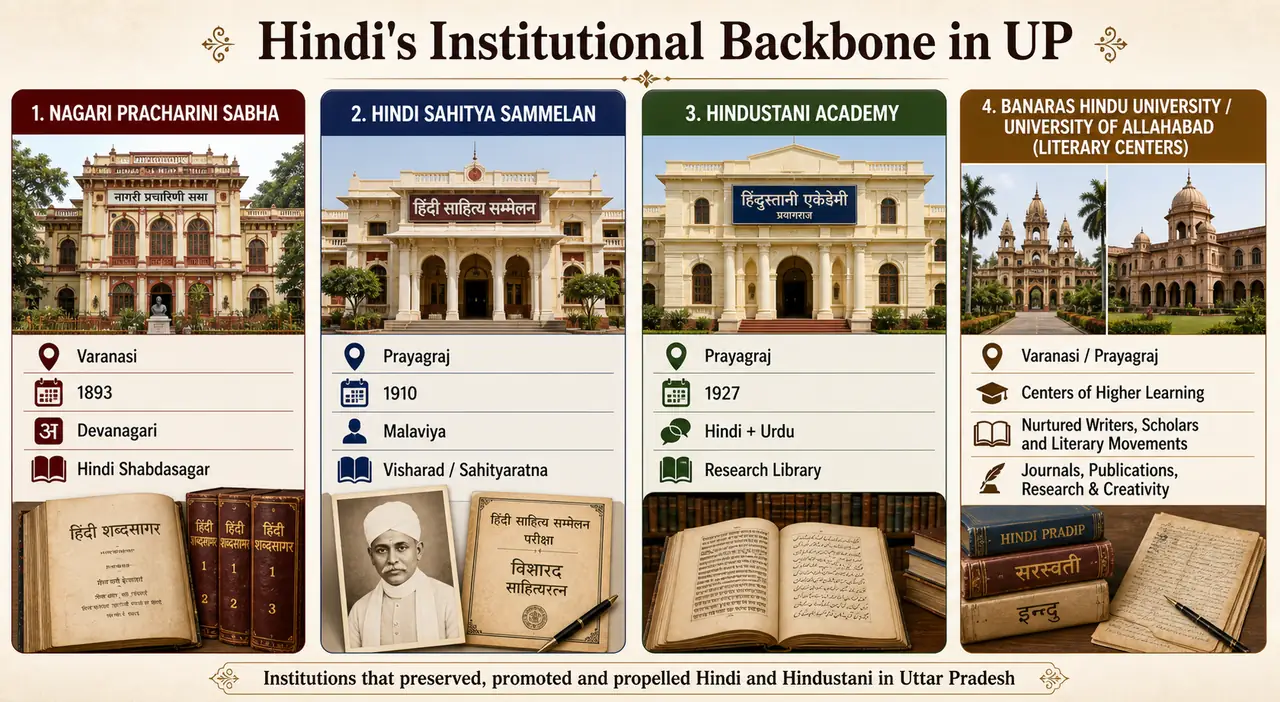
Nagari Pracharini Sabha (1893)
The Nagari Pracharini Sabha was founded in 1893 in Varanasi by Babu Shyam Sundar Das and others. It is remembered as one of the earliest major institutions dedicated to promoting Hindi and the Devanagari script.
| Detail | Fact |
|---|---|
| Founded | 1893, Varanasi |
| Purpose | Standardising Hindi, promoting Devanagari script |
| Key project | Hindi Shabdasagar — a landmark comprehensive Hindi dictionary |
| Current status | Still active; runs a library and publishes journals |
- The Sabha played a critical role in the Hindi-Urdu controversy of the late 19th century, advocating for Hindi in Devanagari script to replace Urdu in courts and administration of the United Provinces.
- It petitioned the British government and is strongly associated with the 1900 Macdonnell order, which allowed Devanagari script alongside Urdu in courts of the United Provinces.
Hindi Sahitya Sammelan (1910)
The Hindi Sahitya Sammelan was established in 1910 in Prayagraj (Allahabad) under the patronage of nationalist leaders including Madan Mohan Malaviya.
| Detail | Fact |
|---|---|
| Founded | 1910, Prayagraj |
| First President | Madan Mohan Malaviya |
| Purpose | Promoting Hindi as a national language |
| Examinations | Conducts Visharad and Sahityaratna exams in Hindi |
- Mahatma Gandhi served as the Sammelan's president and strongly supported Hindi as the national language.
- The Sammelan runs Hindi certification examinations recognised by many state governments.
For exams, the Sammelan is best remembered through the cluster Prayagraj - Malaviya - Hindi promotion - Visharad/Sahityaratna.
Hindustani Academy (1927)
The Hindustani Academy was founded in 1927 in Prayagraj with the aim of promoting both Hindi and Urdu — the "Hindustani" synthesis.
- It was backed by leaders who believed Hindi and Urdu were two styles of the same language.
- The Academy publishes scholarly works in both Hindi and Urdu and maintains an important research library.
- Mahatma Gandhi favoured the Hindustani approach — a middle ground between pure Sanskrit-heavy Hindi and Persian-heavy Urdu.
The Hindi-Urdu Debate
The Hindi-Urdu controversy shaped the linguistic politics of the United Provinces throughout the late 19th and early 20th centuries.
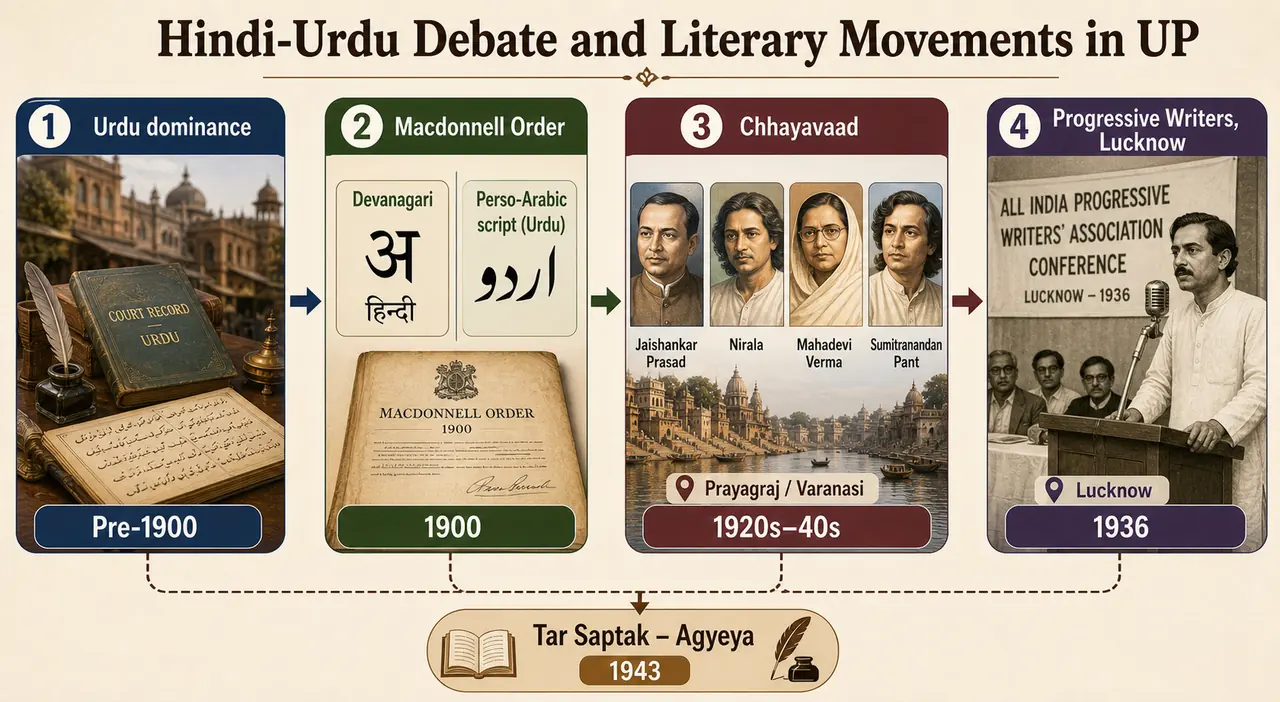
| Phase | Period | Key Event |
|---|---|---|
| Urdu dominance | Pre-1900 | Urdu in Nastaliq script was the court and administrative language |
| Hindi recognition | 1900 | Macdonnell's order allowed Devanagari in UP courts |
| Constitutional settlement | 1950 | Hindi in Devanagari declared official language of India (Article 343) |
- Bharatendu Harishchandra was an early champion of Hindi in Devanagari.
- The debate ultimately led to Hindi and Urdu developing separate literary identities despite shared grammar.
Literary Movements Based in UP
Chhayavaad (1920s-1940s)
Chhayavaad ("Shadow-ism" or Romanticism) was one of the most influential poetry movements in modern Hindi literature. Its strongest centres were associated with Prayagraj and Varanasi.
| Pillar | Key Work | Location |
|---|---|---|
| Jaishankar Prasad | Kamayani | Varanasi |
| Nirala | Ram Ki Shakti Puja | Prayagraj |
| Mahadevi Verma | Yama | Prayagraj |
| Sumitranandan Pant | Pallav | Prayagraj |
- Chhayavaad emphasised subjectivity, nature imagery, inner emotion, and lyrical expression, marking a shift from the more didactic style of the Dwivedi Yug.
Progressive Writers' Movement (1930s)
The Progressive Writers' Association (Pragativadi Lekhak Sangh) was formally launched at a conference in Lucknow in 1936, presided over by Munshi Premchand.
- The movement advocated for social realism — literature that addressed poverty, caste oppression, gender injustice, and colonial exploitation.
- Key figures with UP connections: Premchand, Yashpal (Lucknow), Ismat Chughtai (born Badayun, UP).
- It influenced both Hindi and Urdu literature deeply.
Prayogvaad / Experimentalism (1940s-50s)
Prayogvaad was a post-Chhayavaad literary movement emphasising experimentation in form and content. The landmark anthology "Tar Saptak" (1943) edited by Agyeya (S.H. Vatsyayan) launched this movement.
- It rejected both the romanticism of Chhayavaad and the ideology-driven approach of Progressivism.
- UP remained central — Agyeya was born in Deoria district.
Universities as Literary Centres
UP's universities have been foundational in Hindi literary scholarship.
| University | Location | Literary Significance |
|---|---|---|
| Banaras Hindu University (BHU) | Varanasi | Founded 1916 by Malaviya; premier Hindi department |
| University of Allahabad | Prayagraj | Hub of Chhayavaad poets; Hindi research |
| Lucknow University | Lucknow | Urdu and Hindi literary studies |
| AMU | Aligarh | Centre of Urdu literature and criticism |
Hindi Divas and National Recognition
Hindi Divas is celebrated on 14 September every year, marking the date in 1949 when the Constituent Assembly adopted Hindi in Devanagari as the official language of India under Article 343.
Jnanpith Award Winners from UP
The Jnanpith Award is India's highest literary honour. UP-connected winners in Hindi include:
| Writer | Year | Key Work |
|---|---|---|
| Sumitranandan Pant | 1968 | Chidambara |
| Agyeya | 1978 | Kitni Navon Mein Kitni Baar |
| Mahadevi Verma | 1982 | Yama |
- These names matter because literary-institution questions often overlap with award-and-author questions in UP GK.
Sahitya Akademi
The Sahitya Akademi (National Academy of Letters), headquartered in Delhi, is India's national literary academy and awards major honours in multiple Indian languages. In UP GK, it is safer to remember it as the national literary academy, while specific awardee lists should be checked carefully if asked in detail.
Summary Cheat Sheet
| Exam Fact | Answer |
|---|---|
| Nagari Pracharini Sabha founded | 1893, Varanasi |
| Hindi Sahitya Sammelan founded | 1910, Prayagraj |
| Landmark Hindi dictionary | Hindi Shabdasagar |
| Macdonnell order year | 1900 |
| Chhayavaad hub | Prayagraj & Varanasi |
| Progressive Writers' first conference | Lucknow, 1936 |
| Tar Saptak editor | Agyeya (1943) |
| Hindi Divas date | 14 September |
| Article for Hindi as official language | Article 343 |
Lesson Doubts
Ask questions, get expert answers