🏛️ State Legislature — Vidhan Sabha & Parishad
Bicameral legislature of UP — Vidhan Sabha (403 seats), Vidhan Parishad (100 MLCs), legislative process, Speaker, budget session for Uttar Pradesh GK.
Bicameral Legislature of UP
Uttar Pradesh has a bicameral legislature — meaning it has two houses. UP is one of only 6 states in India with a bicameral system. The other five are Bihar, Karnataka, Maharashtra, Andhra Pradesh, and Telangana.
The two houses of the UP Legislature are:
- Vidhan Sabha (Legislative Assembly) — the lower and more powerful house.
- Vidhan Parishad (Legislative Council) — the upper house.
The legislature functions under the provisions of Articles 168-212 of the Indian Constitution.
Vidhan Sabha (Legislative Assembly)
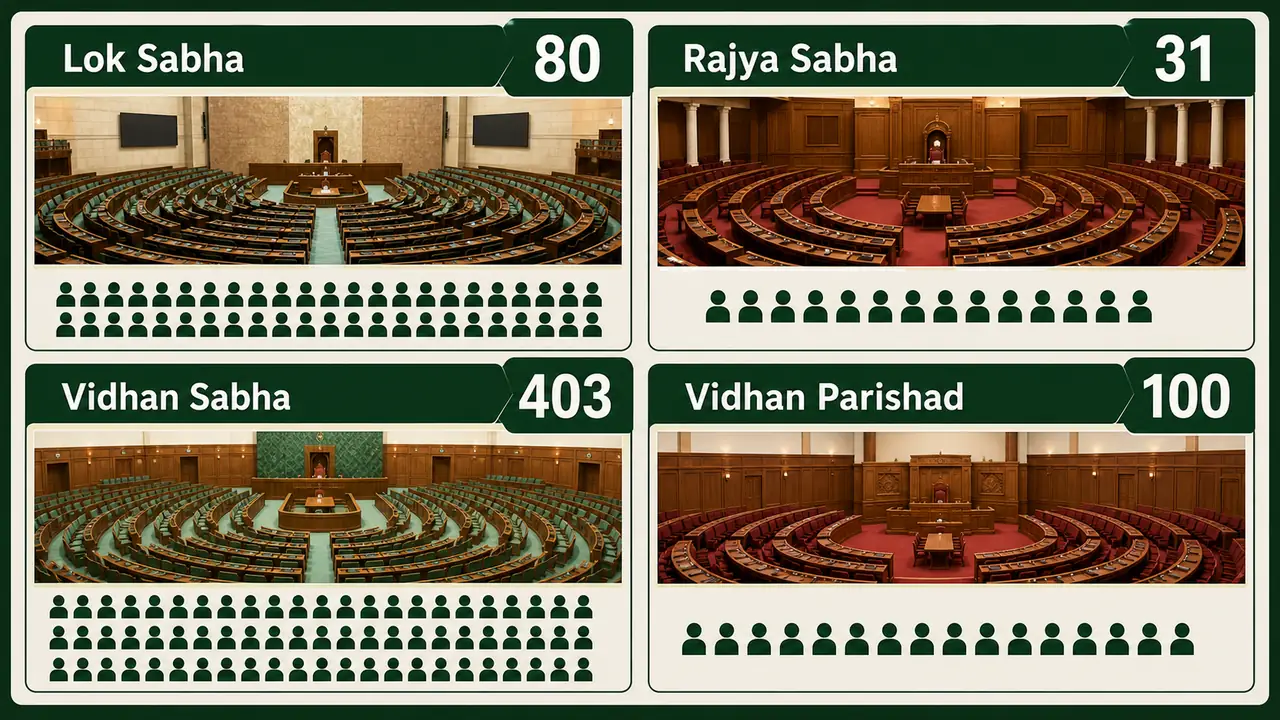
The UP Vidhan Sabha is the largest state legislative assembly in India by number of seats.
| Feature | Detail |
|---|---|
| Total seats | 403 elected members |
| Election method | Direct election by adult franchise from single-member constituencies |
| Term | 5 years (unless dissolved earlier) |
| Minimum age | 25 years |
| Presiding officer | Speaker (Adhyaksha) |
Reserved Seats
Reserved-seat counts can change with delimitation or readjustment orders, so students should remember the pattern more firmly than one frozen number:
| Category | Seats |
|---|---|
| Scheduled Castes (SC) | A substantial block of Assembly seats is reserved for SC constituencies |
| Scheduled Tribes (ST) | ST reservation in UP Assembly representation has historically been very limited |
| General / Unreserved | Remaining seats |
Speaker of the Vidhan Sabha
The Speaker is elected by the MLAs from among themselves. Key powers include:
- Presiding over sessions and maintaining order.
- Deciding on anti-defection matters (Tenth Schedule).
- Casting a deciding vote in case of a tie.
- Certifying a Bill as a Money Bill.
Exam Tip: The Speaker does not vote in the first instance — only when there is a tie. This is called the Speaker's casting vote.
Vidhan Parishad (Legislative Council)
The UP Vidhan Parishad is one of the oldest legislative councils in India and its roots go back to the colonial period. For exam purposes, the safest memory point is that UP has had a council tradition for a very long time and retained it after independence.
| Feature | Detail |
|---|---|
| Total members | 100 MLCs |
| Term | 6 years (1/3 retire every 2 years) |
| Minimum age | 30 years |
| Presiding officer | Chairman (Sabhadhipati) |
Composition of the Vidhan Parishad
The 100 members are elected/nominated from five categories:
| Category | Number | Elected By |
|---|---|---|
| MLAs | 1/3 (≈34) | Members of Vidhan Sabha |
| Local Bodies | 1/3 (≈34) | Municipal corporations, district boards, etc. |
| Teachers | 1/12 (≈8) | Teachers of secondary schools and above |
| Graduates | 1/12 (≈8) | Graduates of 3+ years standing |
| Governor's nominees | 1/6 (≈16) | Nominated by Governor — persons with expertise in literature, science, art, cooperative movement, social service |
Exam Tip: The Vidhan Parishad is a permanent house — it is never dissolved. Only 1/3 of its members retire every 2 years.
Legislative Process
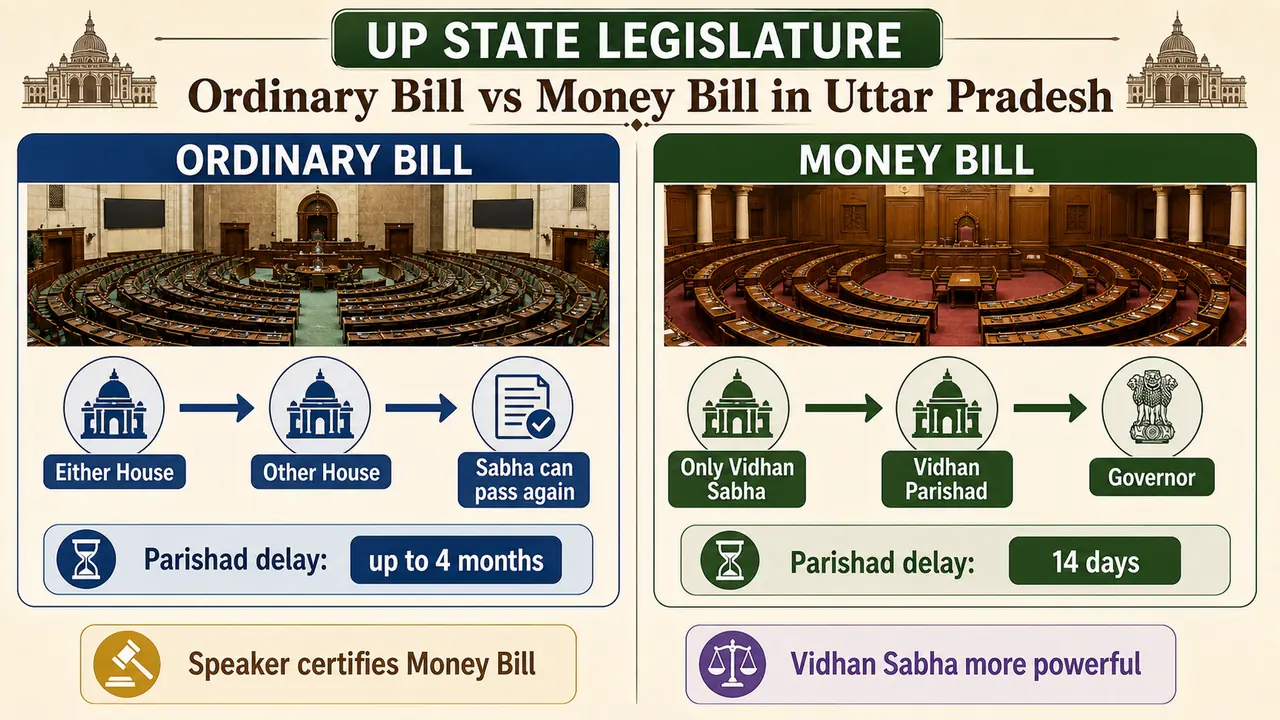
Ordinary Bill
- A Bill can be introduced in either house.
- It passes through three readings: Introduction, Committee/Discussion, and Voting.
- After passing one house, it goes to the other house.
- If the Vidhan Parishad rejects or delays an Ordinary Bill, the Vidhan Sabha can pass it again. In effect, the Parishad can delay such a Bill for a maximum of about 4 months in total, but it cannot permanently block it.
Money Bill
- Can be introduced only in the Vidhan Sabha.
- The Parishad can delay it for a maximum of 14 days.
- The Speaker certifies whether a Bill is a Money Bill — this decision is final.
Key Sessions
| Session | Typical Period | Purpose |
|---|---|---|
| Budget Session | February-March | Presentation and passing of state budget |
| Monsoon Session | July-August | Legislative business |
| Winter Session | November-December | Legislative business |
- The Question Hour is the first hour of each sitting day when MLAs pose questions to ministers — a critical accountability mechanism.
- Zero Hour begins immediately after Question Hour and allows raising urgent matters without prior notice.
Comparison: Vidhan Sabha vs Vidhan Parishad
| Parameter | Vidhan Sabha | Vidhan Parishad |
|---|---|---|
| Members | 403 | 100 |
| Election | Direct | Indirect/Nominated |
| Term | 5 years (dissolvable) | 6 years (permanent) |
| Presiding Officer | Speaker | Chairman |
| Money Bill power | Full | Can delay 14 days only |
| Ordinary Bill | Final authority | Can delay 4 months |
| Min. age | 25 | 30 |
Comparison with Parliament
| Feature | Lok Sabha (Centre) | Vidhan Sabha (UP) |
|---|---|---|
| Total seats | 543 | 403 |
| Term | 5 years | 5 years |
| Upper House | Rajya Sabha (250) | Vidhan Parishad (100) |
| Upper House creation | Constitutional | Article 169 — can be created or abolished by Parliament |
Historical Note
The United Provinces Legislative Council existed during British rule. After independence, UP retained the bicameral system. Several states have attempted to create or abolish their Legislative Councils over the years, but UP has continued with its Parishad structure.
Summary Cheat Sheet
| Exam Fact | Answer |
|---|---|
| UP Legislature type | Bicameral |
| Vidhan Sabha seats | 403 |
| Vidhan Parishad members | 100 |
| Vidhan Sabha status | Largest state assembly in India by seats |
| Parishad delay for Money Bill | 14 days |
| Parishad delay for Ordinary Bill | 4 months |
| Parishad member term | 6 years |
| Sabha minimum age | 25 years |
| Parishad minimum age | 30 years |
| States with bicameral legislature | 6 (UP, Bihar, Karnataka, Maharashtra, AP, Telangana) |
Lesson Doubts
Ask questions, get expert answers