👤 Governor & Chief Ministers of UP
Role of the Governor, Raj Bhavan, notable Governors including Sarojini Naidu, complete list of key Chief Ministers from GB Pant to Yogi Adityanath for Uttar Pradesh GK.
The Governor of Uttar Pradesh
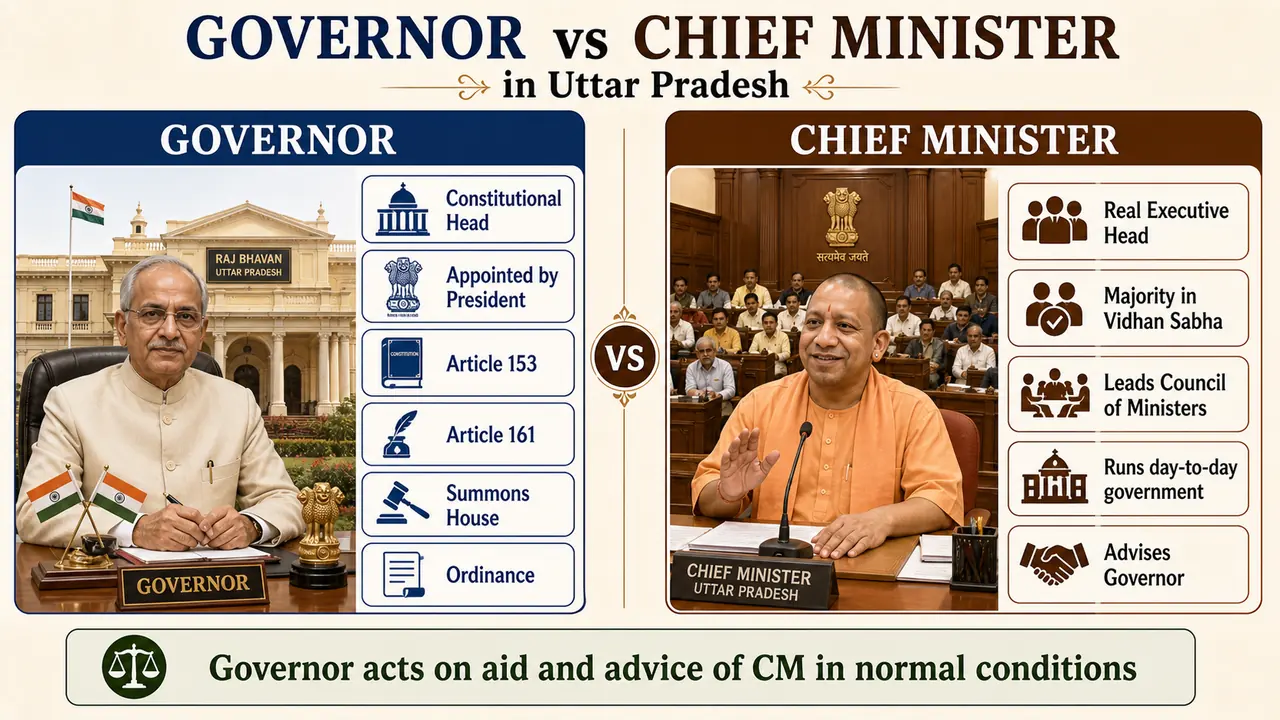
The Governor is the constitutional head of the state, appointed by the President of India under Article 153 of the Constitution. The Governor's office is located at the Raj Bhavan in Lucknow.
For exam preparation, it is helpful to separate two layers:
- timeless constitutional facts such as appointment, powers, and articles
- current officeholder facts, which can change and should always be read with a date
As per official UP government websites checked on June 3, 2026:
- Governor of Uttar Pradesh: Anandiben Patel
- Chief Minister of Uttar Pradesh: Yogi Adityanath
Qualifications and Tenure
| Feature | Detail |
|---|---|
| Appointment | By President of India (on advice of Union Council of Ministers) |
| Minimum age | 35 years |
| Term | 5 years (serves at pleasure of the President) |
| Oath administered by | Chief Justice of the High Court |
Powers of the Governor
Executive Powers:
- All executive action of the state is taken in the Governor's name.
- Appoints the Chief Minister and Council of Ministers (on CM's advice for other ministers).
- Appoints the Advocate General, State Election Commissioner, UPPSC Chairman.
Legislative Powers:
- Summons, prorogues, and dissolves the Vidhan Sabha.
- Addresses the first session of each year (Governor's Address).
- Nominates 1/6 members of the Vidhan Parishad (16-17 MLCs).
- Can reserve a Bill for the President's consideration.
- Promulgates Ordinances when the legislature is not in session (Article 213).
Judicial Powers:
- Can grant pardons, reprieves, and commutations under Article 161 (for offences against state laws).
Discretionary Powers:
- Recommending President's Rule (Article 356).
- Choosing the CM when no party has a clear majority.
Notable Governors of UP
| Governor | Period | Significance |
|---|---|---|
| Sarojini Naidu | 1947-1949 | First woman Governor in India — poetess, freedom fighter, "Nightingale of India" |
| Kanailal Maneklal Munshi | 1952-1957 | Writer, freedom fighter |
| B. Gopala Reddy | 1957-1960 | Former CM of Andhra Pradesh |
| Bishambhar Nath Pande | 1967-1971 | Scholar-politician |
| Motilal Vora | 1993-1996 | Oversaw multiple political transitions |
| T.V. Rajeshwar | 2004-2009 | Former IB Director |
| Ram Naik | 2014-2019 | Former Union Minister |
| Anandiben Patel | 2019-present | Former CM of Gujarat, first woman Governor of UP since Sarojini Naidu |
Exam Tip: Sarojini Naidu as UP's first Governor is an extremely high-frequency exam question. She served from 15 August 1947 until her death on 2 March 1949.
Chief Ministers of Uttar Pradesh
The Chief Minister is the real executive head of the state, appointed by the Governor. The CM must enjoy the confidence of the majority in the Vidhan Sabha.
This topic becomes easier if students remember the contrast clearly:
- Governor = constitutional head
- Chief Minister = real executive head
- Council of Ministers = runs day-to-day government in the Governor's name
Key Chief Ministers — Historical Table
| # | Chief Minister | Party | Tenure | Key Facts |
|---|---|---|---|---|
| 1 | Govind Ballabh Pant | INC | 1950-1954 | First CM of UP; later Home Minister of India; Bharat Ratna (1957) |
| 2 | Sampurnanand | INC | 1954-1960 | Educationist, Sanskrit scholar |
| 3 | C.B. Gupta | INC | 1960-1963 | Two separate terms |
| 4 | Sucheta Kriplani | INC | 1963-1967 | First woman Chief Minister in India; freedom fighter |
| 5 | Chaudhary Charan Singh | BLD/Janata | 1967-68, 1970 | Later became Prime Minister of India (1979-80); Bharat Ratna (2024) |
| 6 | Hemvati Nandan Bahuguna | INC | 1973-1975 | Known for administrative reforms |
| 7 | N.D. Tiwari | INC | 1976-77, 1984-85, 1988-89 | Three-time CM |
| 8 | Veer Bahadur Singh | INC | 1985-1988 | Oversaw Ram Janmabhoomi dispute period |
| 9 | Mulayam Singh Yadav | SP | 1989-91, 1993-95, 2003-07 | Three-time CM; founded Samajwadi Party |
| 10 | Kalyan Singh | BJP | 1991-92, 1997-99 | CM during Babri Masjid demolition (1992) |
| 11 | Mayawati | BSP | 1995, 1997, 2002-03, 2007-12 | First Dalit woman CM in India; four-time CM |
| 12 | Ram Prakash Gupta | BJP | 1999-2000 | Brief tenure |
| 13 | Rajnath Singh | BJP | 2000-2002 | Later Union Home Minister |
| 14 | Akhilesh Yadav | SP | 2012-2017 | Youngest CM of UP (at age 38) |
| 15 | Yogi Adityanath | BJP | 2017-present | Head Priest of Gorakhnath Math; re-elected 2022 |
Records and Firsts
| Record | Person |
|---|---|
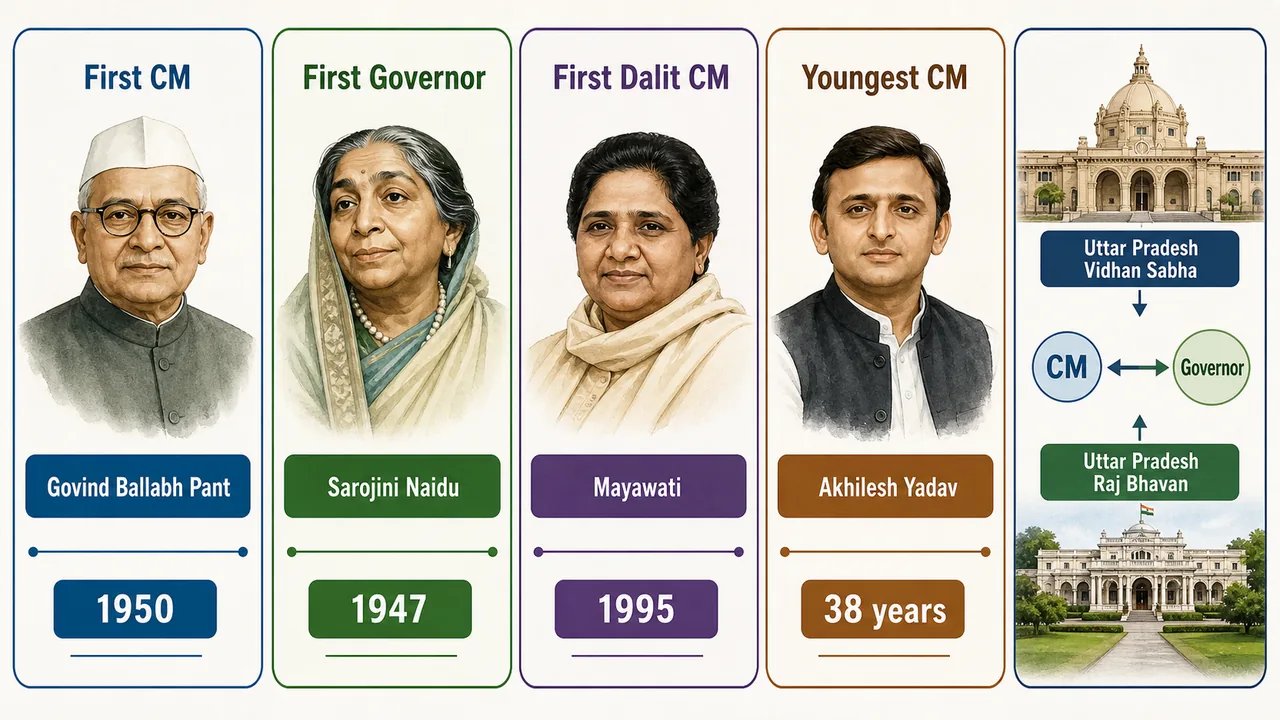
| First CM of UP | GB Pant (1950) |
| First woman CM in India | Sucheta Kriplani (1963) |
| First Dalit woman CM | Mayawati (1995) |
| UP CM who became PM | Chaudhary Charan Singh |
| Most separate terms as CM | Mayawati (4 terms) |
| Youngest CM of UP | Akhilesh Yadav |
| First Governor of UP | Sarojini Naidu (1947) |
| First woman Governor in India | Sarojini Naidu |
President's Rule in UP
UP has been placed under President's Rule (Article 356) multiple times. A UP Vidhan Parishad page listing the state's President's Rule periods shows 10 instances. This is a common exam fact and reflects phases of political instability, especially in the coalition era.
| Notable Instance | Year | Reason |
|---|---|---|
| Post Babri demolition | 1992 | Kalyan Singh government dismissed |
| Political instability | 1995 | Hung assembly |
| BSP-BJP split | 1997 | Government collapse |
Council of Ministers
The Council of Ministers in UP consists of:
- Cabinet Ministers — head major departments.
- Ministers of State (Independent Charge) — head smaller departments independently.
- Ministers of State — assist Cabinet Ministers.
The total number of ministers (including CM) cannot exceed 15% of the total strength of the Vidhan Sabha (i.e., ~60 ministers for UP's 403-member house), as per the 91st Constitutional Amendment (2003).
Summary Cheat Sheet
| Exam Fact | Answer |
|---|---|
| Current Governor of UP (as of June 3, 2026) | Anandiben Patel |
| Current CM of UP (as of June 3, 2026) | Yogi Adityanath |
| Governor appointed by | President of India |
| Governor's pardoning power | Article 161 |
| First CM of UP | GB Pant |
| First woman CM (India) | Sucheta Kriplani (UP, 1963) |
| First woman Governor (India) | Sarojini Naidu (UP, 1947) |
| UP CM who became PM | Chaudhary Charan Singh |
| Most separate terms as UP CM | Mayawati (4) |
| Council of Ministers cap | 15% of Sabha strength |
| President's Rule article | Article 356 |
| Times President's Rule in UP | 10 times |
Lesson Doubts
Ask questions, get expert answers