⚖️ High Court & Judicial System
Allahabad High Court — history, Lucknow bench, largest High Court by judge strength, subordinate courts, Lok Adalats, and legal services in UP for Uttar Pradesh GK.
Allahabad High Court — Overview
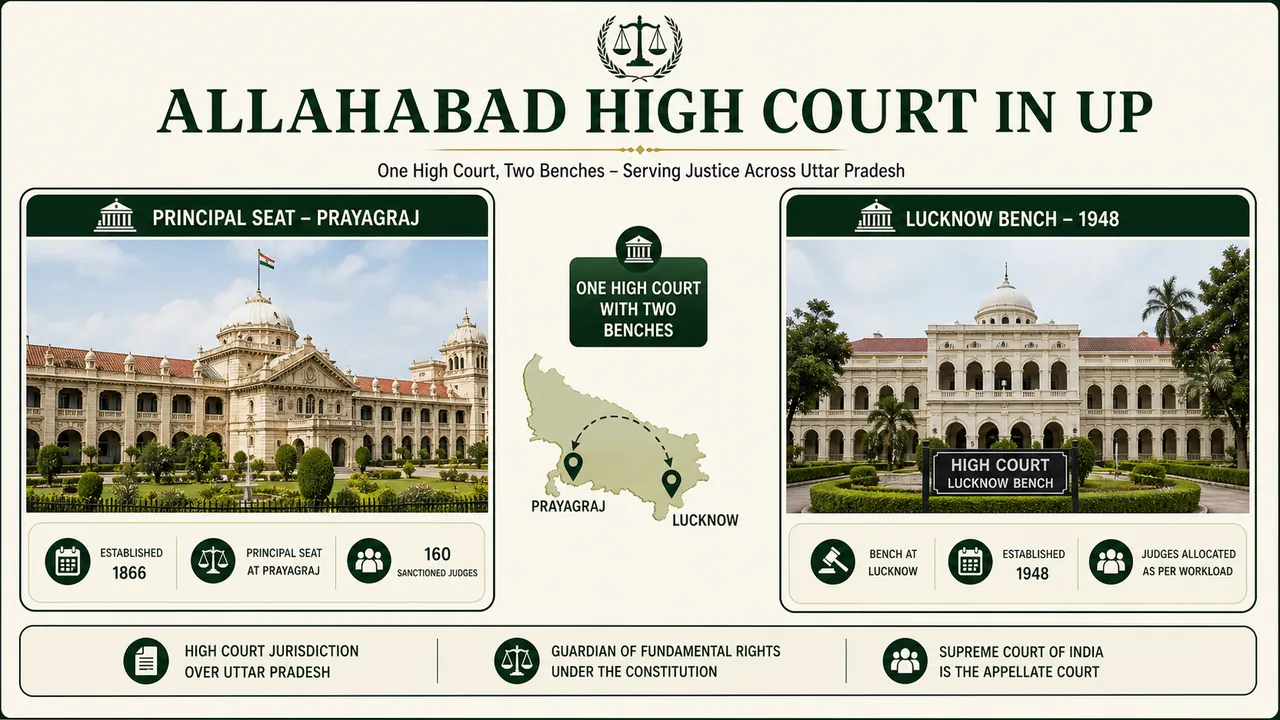
The Allahabad High Court is one of the oldest and most significant High Courts in India. It exercises jurisdiction over the entire state of Uttar Pradesh.
| Feature | Detail |
|---|---|
| Established | 24 March 1866 |
| Principal seat | Prayagraj (Allahabad) |
| Bench | Lucknow Bench (established 1948) |
| Distinction | Often noted as the High Court with the highest sanctioned judge strength |
| Sanctioned judges | 160 |
The High Court was originally called the High Court of Judicature at Allahabad and was established under the framework created by the Indian High Courts Act, 1861, with the actual establishment taking place in 1866.
Historical Background
The judicial system in the United Provinces evolved through several stages:
| Year | Development |
|---|---|
| 1831 | Sadar Diwani Adalat and Sadar Nizamat Adalat established at Allahabad |
| 1866 | Allahabad High Court established — merged the two Sadar Adalats |
| 1948 | Lucknow Bench of the High Court established |
| 2000 | Uttaranchal (now Uttarakhand) carved out — separate Nainital High Court created |
Exam Tip: Before 2000, the Allahabad High Court also had jurisdiction over what is now Uttarakhand. The Nainital Bench became the independent Uttarakhand High Court in 2000.
Principal Seat — Prayagraj
The principal seat at Prayagraj handles cases from most districts of UP. The imposing High Court building, built in Indo-Saracenic architecture, is a landmark of Prayagraj city.
Lucknow Bench
The Lucknow Bench was created in 1948 to provide easier access to justice for litigants from the Awadh-Central UP side of the state. It hears cases from a defined set of notified districts.
| Seat | Districts Covered |
|---|---|
| Prayagraj (Principal) | Most districts of Uttar Pradesh outside the Lucknow Bench jurisdiction |
| Lucknow Bench | Lucknow Bench-notified districts of central / Awadh region |
Composition and Appointment
| Feature | Detail |
|---|---|
| Chief Justice | Appointed by the President of India (in consultation with CJI and Governor) |
| Judges | Appointed by the President on recommendation of the Collegium system |
| Retirement age | 62 years |
| Qualifications | Citizen of India, 10 years as advocate in High Court OR 10 years in judicial service |
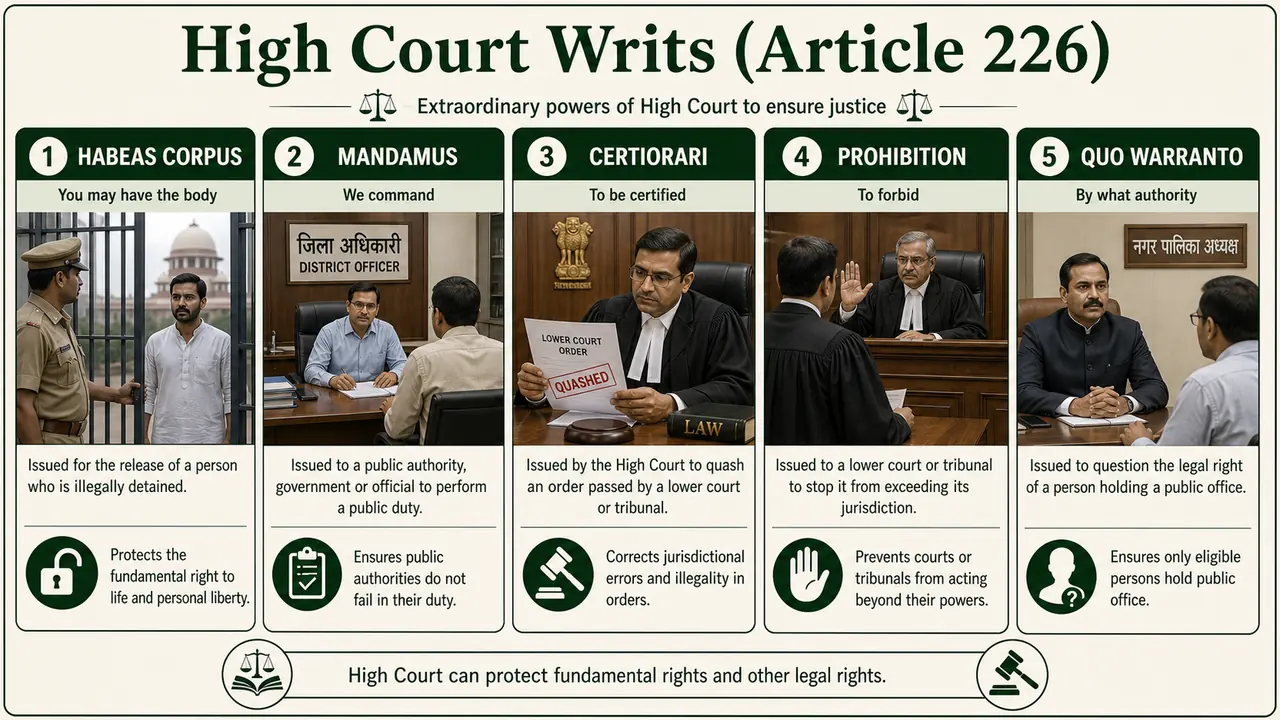
The High Court has both original jurisdiction (for writ petitions under Article 226) and appellate jurisdiction (appeals from subordinate courts).
For exams, the most important conceptual point is:
- Article 32 is linked with the Supreme Court
- Article 226 is linked with the High Court
- the High Court can issue writs not only for fundamental rights, but also for other legal rights
Writ Jurisdiction (Article 226)
The High Court can issue five types of writs to protect fundamental rights and for other purposes:
| Writ | Purpose |
|---|---|
| Habeas Corpus | Release of illegally detained person |
| Mandamus | Directing a public authority to perform its duty |
| Certiorari | Quashing an order of a lower court/tribunal |
| Prohibition | Preventing a lower court from exceeding jurisdiction |
| Quo Warranto | Questioning a person's right to hold public office |
Subordinate Courts
Below the High Court, UP has a multi-layered subordinate court system:
| Court | Head | Jurisdiction |
|---|---|---|
| District & Sessions Court | District Judge / Sessions Judge | Highest court at district level; civil and criminal cases |
| Civil Courts | Civil Judge (Senior/Junior Division) | Property disputes, contracts, civil suits |
| Criminal Courts | Chief Judicial Magistrate, Judicial Magistrate | Criminal cases below Sessions Court level |
| Family Courts | Family Court Judge | Divorce, maintenance, custody, domestic disputes |
- The District Judge is the highest judicial authority at the district level.
- As Sessions Judge, the same officer tries serious criminal cases (murder, robbery, etc.) and can award sentences up to life imprisonment or death (subject to High Court confirmation for death sentences).
This dual designation is a high-yield exam point:
- District Judge = civil side
- Sessions Judge = criminal side
Revenue Courts
UP has a parallel system of revenue courts that deal with land and agrarian disputes:
| Court | Officer |
|---|---|
| Board of Revenue | Chairman (highest revenue court in UP) |
| Commissioner's Court | Divisional Commissioner |
| Collector's Court | District Collector/DM |
| Tehsildar's Court | Tehsildar |
- The Board of Revenue, Prayagraj is the apex revenue court. It hears final appeals in land revenue and tenancy matters.
- Revenue courts handle mutation, land partition, tenancy disputes, and land ceiling cases.
Lok Adalat System
Lok Adalats (People's Courts) provide alternative dispute resolution — settling cases through compromise and conciliation rather than adversarial litigation.
| Feature | Detail |
|---|---|
| Legal basis | Legal Services Authorities Act, 1987 |
| Court fee | No court fee |
| Appeal | No appeal against Lok Adalat decisions — they are final and binding |
| Cases handled | Motor accident claims, matrimonial disputes, compoundable criminal cases, bank recovery |
- Permanent Lok Adalats exist for public utility services (electricity, transport, telecom, insurance).
- UP holds National Lok Adalats (quarterly), where thousands of cases are settled in a single day across all districts.
Legal Services Authority
The UP State Legal Services Authority (UPSLSA), headquartered in Prayagraj, provides free legal aid to eligible persons:
| Eligible Category |
|---|
| SC/ST members |
| Women and children |
| Persons with disabilities |
| Victims of trafficking |
| Industrial workers |
| Persons earning below prescribed income limit |
- At the district level, the District Legal Services Authority (DLSA) operates under the chairmanship of the District Judge.
- Taluka Legal Services Committees function at the tehsil level.
Consumer Forums
| Level | Forum |
|---|---|
| District | District Consumer Disputes Redressal Commission |
| State | UP State Consumer Disputes Redressal Commission, Lucknow |
| National | National Consumer Disputes Redressal Commission, Delhi |
Consumer forums operate under the Consumer Protection Act, 2019.
Summary Cheat Sheet
| Exam Fact | Answer |
|---|---|
| Allahabad HC established | 1866 |
| Lucknow Bench established | 1948 |
| Sanctioned judge strength | 160 |
| Key distinction | Principal seat at Prayagraj + Lucknow Bench |
| HC judge retirement age | 62 years |
| Writ jurisdiction article | Article 226 |
| Five writs | Habeas Corpus, Mandamus, Certiorari, Prohibition, Quo Warranto |
| Highest revenue court in UP | Board of Revenue, Prayagraj |
| Lok Adalat appeal | No appeal (final & binding) |
| Consumer Protection Act | 2019 |
Lesson Doubts
Ask questions, get expert answers