🛍️ ODOP & Cottage Industries
One District One Product scheme, cottage industries, MSME clusters, and handloom-handicraft sectors of Uttar Pradesh for Uttar Pradesh GK.
Introduction
The One District One Product (ODOP) scheme is one of Uttar Pradesh's best-known industrial and livelihood initiatives. Launched in 2018, it links each district with a product that already has local skill, tradition, or market identity, and then tries to strengthen that base through training, credit support, design improvement, packaging, branding, and market access.
Students should understand ODOP as more than a slogan. It is a bridge between traditional craft clusters and modern market support.
ODOP Scheme — Design and Objectives
| Feature | Details |
|---|---|
| Launched | 2018 by UP Government |
| Scope | 75 districts, each mapped to one product |
| Implementing body | MSME & Export Promotion Department, UP |
| Support provided | Subsidies, Common Facility Centres, design inputs, marketing |
| Policy importance | Became a model later echoed in national-level ODOP discussions |
The idea behind ODOP is simple but powerful:
- identify a district's best-known product,
- improve quality and productivity,
- support artisans and small producers,
- and connect the product to wider domestic and export markets.
District-Product Mapping — Key Examples
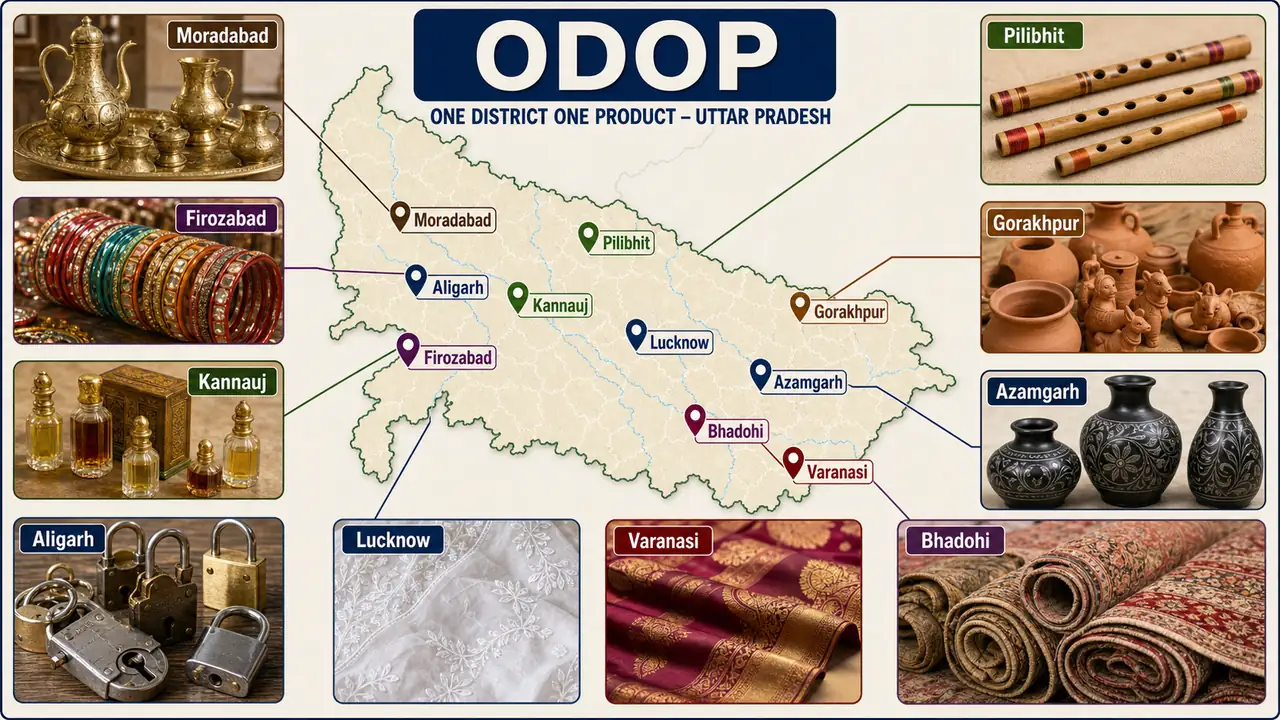
This is an extremely high-frequency exam topic. The safest strategy is to memorize the most famous district-product pairs first and treat them as identity markers of UP.
| District | ODOP Product | Special Note |
|---|---|---|
| Lucknow | Chikankari embroidery | GI-tagged; strongly associated with women's craft work |
| Varanasi | Banarasi silk sarees | GI-tagged; one of the state's most famous textile traditions |
| Moradabad | Brassware | Famous as the Brass City |
| Agra | Leather footwear | Major footwear and leather-goods centre |
| Firozabad | Glassware & bangles | Famous as Suhag Nagari |
| Kannauj | Perfume (Attar) | Traditional distillation method |
| Bhadohi | Hand-knotted carpets | Famous as the state's leading carpet centre |
| Gorakhpur | Terracotta | Traditional clay art |
| Mathura | Dairy products | Peda, milk-based sweets |
| Meerut | Sports goods | Cricket bats, footballs |
| Farrukhabad | Block printing (hand) | Textile printing on fabric |
| Azamgarh | Black pottery | Unique black-fired ceramics |
| Pilibhit | Flutes (bansuri) | Bamboo flute-making tradition |
| Aligarh | Locks & hardware | India's best-known lock-making centre |
| Khurja (Bulandshahr) | Pottery & ceramics | "Ceramic City" |
| Pratapgarh | Amla (gooseberry) products | Well known for amla-based processing |
| Etawah | Dairy (Jamunapari goat) | Famous goat breed |
| Sultanpur | Moon dal (arhar) | Pulse processing |
| Sitapur | Dastarkhwan (tablecloth) | Traditional woven fabric |
| Barabanki | Handloom (tant/muslin) | Fine cotton weaving |
The best way to revise this section is by grouping the products mentally:
- textiles and embroidery: Lucknow, Varanasi, Barabanki, Sitapur
- metal, glass, and hardware: Moradabad, Firozabad, Aligarh
- craft and clay traditions: Gorakhpur, Azamgarh, Khurja
- agro-based / natural products: Kannauj, Pratapgarh, Mathura
Common Facility Centres (CFCs)
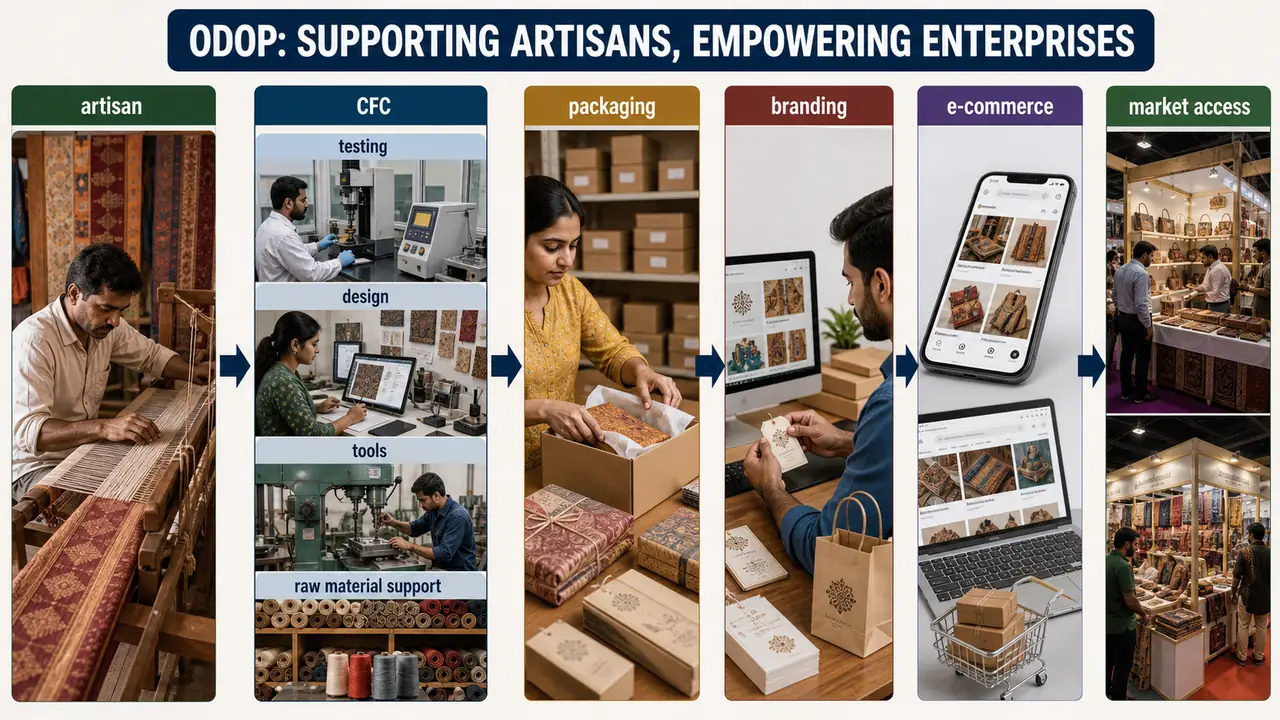
The ODOP scheme establishes Common Facility Centres in each district to provide shared infrastructure that individual artisans cannot afford.
- Testing labs for quality certification
- Design studios for contemporary product adaptation
- Raw material banks for bulk procurement at reduced cost
- Tool rooms with modern machinery
These centres matter because most ODOP producers are not large factories. They are small artisans, weavers, craft workers, or family units. Shared machinery, testing, finishing, training, and packaging support can therefore improve quality without forcing each artisan to make a large private investment.
E-commerce and Market Access
ODOP products have been given special visibility on major e-commerce platforms.
- Amazon Saheli and Amazon ODOP storefronts for UP products
- Flipkart Samarth programme onboards ODOP artisans
- GeM (Government e-Marketplace) — ODOP products listed for government procurement
- ODOP Mart — physical and online stores operated by UP government
- International exhibitions through Export Promotion Councils
This part is important conceptually: ODOP is not only about production. It is also about market linkage. Without branding, packaging, and digital selling, many traditional products remain trapped in local markets.
Khadi and Village Industries
The Khadi and Village Industries Commission (KVIC) has a significant presence in UP, which is one of the important khadi and village-industry states in India.
| Parameter | Details |
|---|---|
| UP position in khadi activity | One of the important khadi-producing states |
| Key centres | Lucknow, Varanasi, Azamgarh, Gorakhpur |
| KVIC schemes | PMEGP (Prime Minister's Employment Generation Programme) |
| Employment | Lakhs of spinners and weavers |
| Khadi India stores | Multiple outlets across UP cities |
Khadi and village industries matter in UP GK because they connect rural employment, self-employment, hand-spinning, weaving, and micro-enterprise support with the larger MSME ecosystem.
Handloom Clusters
UP has one of the largest handloom and weaving ecosystems in India, especially in eastern and central UP.
| Cluster | Product | Location |
|---|---|---|
| Varanasi | Banarasi brocade, silk | Eastern UP |
| Mubarakpur (Azamgarh) | Silk sarees | Eastern UP |
| Mau | Power loom textiles | Eastern UP |
| Barabanki | Cotton muslin | Central UP |
| Sitapur | Dastarkhwan | Central UP |
The handloom sector is a critical livelihood source in many districts, especially where weaving traditions and household production remain strong.
MSME Contribution to UP Economy
| Metric | Value |
|---|---|
| Total MSME units | Very large base running into tens of lakhs |
| Share in state economy / industry | Important contributor through small enterprises and clusters |
| Employment generated | Major non-farm employment source |
| Key policy | UP MSME Promotion Policy 2017 |
| Registration portal | Nivesh Mitra / Udyam Registration |
Summary Cheat Sheet
| Fact | Answer |
|---|---|
| ODOP launch year | 2018 |
| Number of districts covered | 75 |
| Main idea of ODOP | One district linked with one signature product |
| Lucknow ODOP | Chikankari |
| Kannauj ODOP | Perfume (Attar) |
| Bhadohi ODOP | Carpets |
| Pilibhit ODOP | Flutes |
| Azamgarh ODOP | Black Pottery |
| Gorakhpur ODOP | Terracotta |
| Moradabad identity | Brassware |
| Firozabad identity | Glassware and bangles |
| Aligarh identity | Locks and hardware |
| Market-support tools | CFCs, e-commerce, branding, packaging |
| MSME role in UP | Major source of cluster-based and non-farm employment |
Lesson Doubts
Ask questions, get expert answers