💼 Employment & Skill Development
Unemployment trends, skill development missions, ITIs, migration patterns, startup policy, and self-employment schemes in UP for Uttar Pradesh GK.
Introduction
Uttar Pradesh faces the twin challenge of generating employment for its massive young population while improving skill levels to match modern industry demands. The key fact for students is that UP has a very large and youthful labour force, but a large share of workers are still concentrated in agriculture, informal work, low-paid services, and migration-led livelihoods.
Employment Profile of UP
| Parameter | Value |
|---|---|
| Working-age population | Very large, running into many crores |
| Labour-force pattern | Large pool, but uneven participation across gender and region |
| Unemployment pattern | Changes over time and fluctuates with surveys and seasons |
| Youth employment challenge | More severe than overall unemployment |
| Female labour participation | Comparatively low and a major structural concern |
Sectoral Employment Distribution
Despite the shift in GSDP toward services, agriculture still dominates employment.
| Sector | Share of Employment | Nature |
|---|---|---|
| Agriculture & Allied | ~65% | Mostly informal, seasonal |
| Industry & Construction | ~15-18% | MSME, construction labour |
| Services | ~17-20% | Trade, transport, government, IT |
The major structural point is that a large share of UP's workforce remains in the unorganized sector, where workers often lack formal contracts, social security, or stable wages.
Migration — UP as India's Largest Source
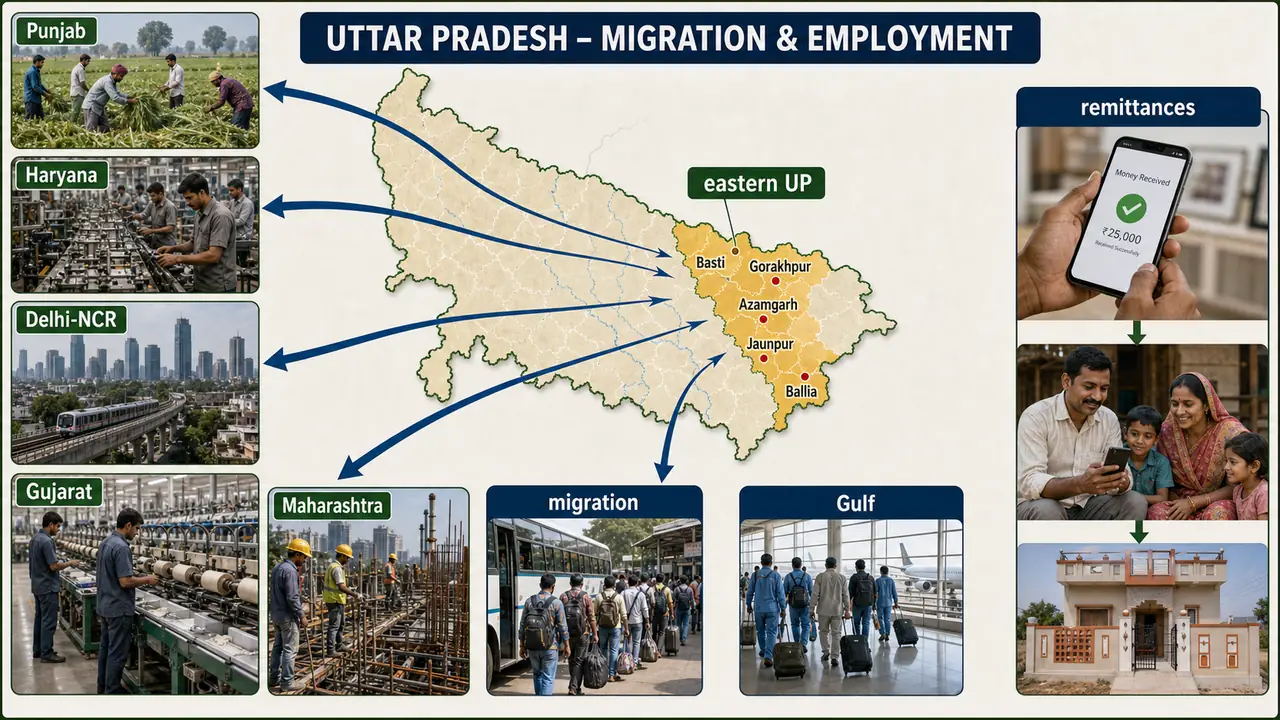
Uttar Pradesh is the single largest source of internal migration in India, according to Census and NSSO data.
| Migration Pattern | Details |
|---|---|
| Domestic outmigration | To Delhi-NCR, Maharashtra, Gujarat, Punjab, Haryana |
| Key source districts | Eastern UP: Azamgarh, Jaunpur, Gorakhpur, Basti, Ballia |
| Economic importance | Remittances support many rural households |
| Gulf migration | Significant from eastern UP to UAE, Saudi Arabia, Qatar |
| COVID reverse migration (2020) | Large-scale return migration exposed worker vulnerability |
Migration is driven by lack of local employment opportunities, particularly in eastern UP and Bundelkhand.
Skill Development Ecosystem
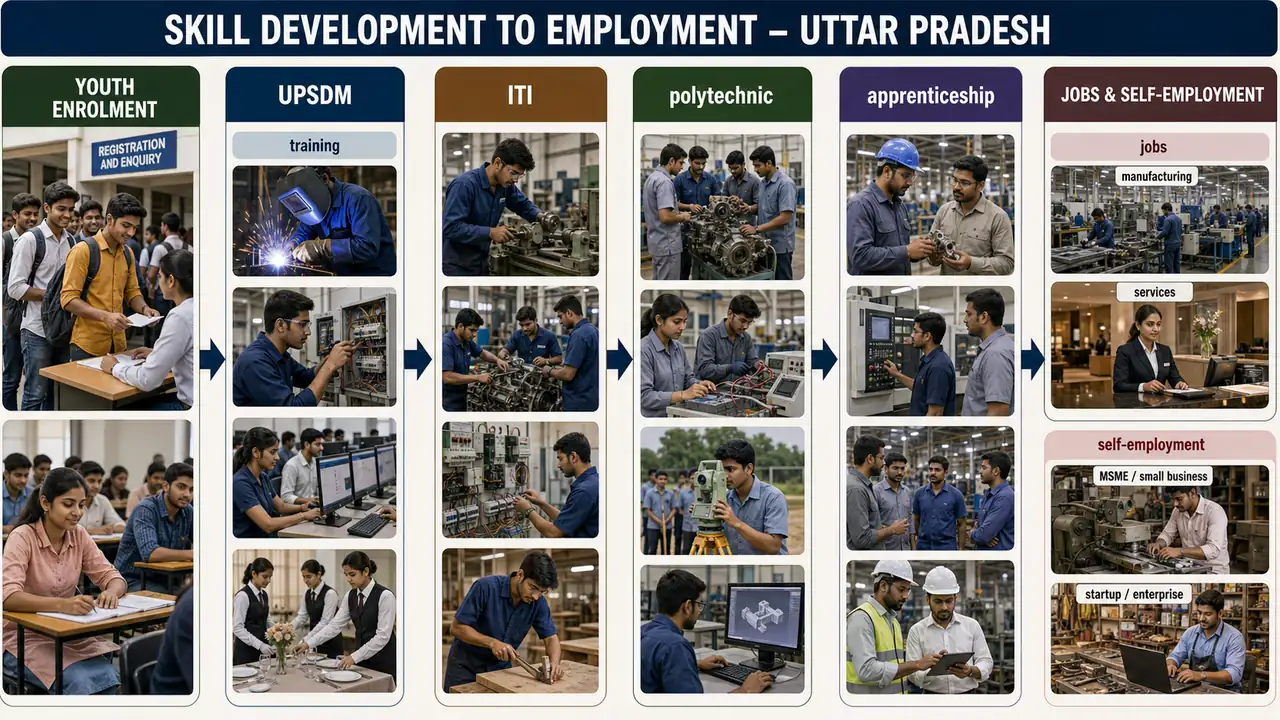
UP Skill Development Mission (UPSDM)
Launched to coordinate all skill development efforts across the state.
| Feature | Details |
|---|---|
| Established | 2013 |
| Target | Large-scale youth skilling across the state |
| Approach | Public-private partnership with training providers |
| Certification | NSDC (National Skill Development Corporation) aligned |
| Key sectors | IT, retail, hospitality, construction, healthcare, agriculture |
Kaushal Vikas Mission
Part of the wider skill-development ecosystem, including Pradhan Mantri Kaushal Vikas Yojana (PMKVY), it offers short-term training courses with placement-oriented design.
Industrial Training Institutes (ITIs) and Polytechnics
| Institution | Count in UP | Details |
|---|---|---|
| Government ITIs | Large statewide network | Two-year courses in multiple trades |
| Private ITIs | Very large parallel network | Varying quality, NCVT affiliated |
| Polytechnics | ~300+ | Diploma in engineering trades |
| Skill centres | Wide multi-district presence | Short-term training under UPSDM |
UP has one of the largest vocational training networks in India. Major government ITIs are located in Kanpur, Lucknow, Varanasi, Prayagraj, and Agra.
Government Recruitment Bodies
Two principal bodies conduct recruitment for state government positions.
| Body | Full Form | Recruitment Level |
|---|---|---|
| UPPSC | UP Public Service Commission | Group A & B officers (PCS, RO/ARO, etc.) |
| UPSSSC | UP Subordinate Services Selection Commission | Group C posts (Lekhpal, AGTA, Junior Assistant, etc.) |
UPSSSC conducts the Preliminary Eligibility Test (PET) as a qualifying gateway for multiple Group C recruitments.
Startup and Entrepreneurship
Startup UP Policy (2020)
| Feature | Details |
|---|---|
| Launched | 2020 (revised from 2017 policy) |
| Incentives | Seed funding up to ₹10 lakh, patent cost reimbursement |
| Incubators | IIT Kanpur, IIM Lucknow, IIIT Allahabad based |
| Key sectors | Agritech, fintech, edtech, healthtech |
| Recognition | DPIIT Startup India recognition for UP startups |
UP was recognized as an "Emerging Startup Ecosystem" by DPIIT in its State Startup Rankings.
Self-Employment and Welfare Schemes
| Scheme | Target Group | Benefit |
|---|---|---|
| Vishwakarma Shram Samman Yojana | Traditional artisans, craftsmen | Free toolkit + training + ₹10,000-10 lakh loan |
| Mukhyamantri Yuva Swarozgar Yojana | Youth (18-40 years) | Loan subsidy for self-employment projects |
| Mukhyamantri Apprenticeship Promotion Scheme | ITI graduates | Stipend during apprenticeship |
| Seva Yojana | Unemployed graduates | Unemployment allowance (₹1,000-1,500/month) |
| PMEGP | Entrepreneurs | Subsidy on bank loans for micro enterprises |
The Vishwakarma Shram Samman Yojana is uniquely designed for traditional artisans (carpenters, blacksmiths, potters, weavers) and provides both skill upgradation and financial support.
Summary Cheat Sheet
| Fact | Answer |
|---|---|
| Core employment challenge | Underemployment and informality |
| Main labour-market pattern | Large share in agriculture and unorganized work |
| Largest migration source | UP (eastern UP especially) |
| Skill mission | UP Skill Development Mission (UPSDM) |
| ITI strength | Very large statewide vocational network |
| UPPSC recruits | Group A & B |
| UPSSSC recruits | Group C |
| Startup UP Policy | 2020 |
| Vishwakarma Yojana for | Traditional artisans |
| UPSSSC gateway exam | PET |
Lesson Doubts
Ask questions, get expert answers