🤖 AI & Future Skills
Artificial Intelligence, Machine Learning steps, Supervised vs Unsupervised learning, Smart Cities, NLP, neural networks for UPSSSC AGTA.
What is Artificial Intelligence?
Artificial Intelligence (AI) is the science of creating machines and software that can perform tasks that normally require human intelligence — such as learning, reasoning, problem-solving, understanding language, and recognizing images.
The term "Artificial Intelligence" was coined by John McCarthy in 1956 at the Dartmouth Conference — considered the birth of AI as a field.
The Turing Test
In 1950, Alan Turing proposed a test: if a machine can converse with a human and the human cannot tell whether they are talking to a machine or a person, the machine is considered "intelligent." This is called the Turing Test.
Types of AI
| Type | Description | Status | Example |
|---|---|---|---|
| Narrow AI (Weak AI) | Designed for one specific task only | Exists today | Google Search, Siri, Alexa, chess engines, spam filters |
| General AI (Strong AI) | Can perform any intellectual task a human can | Does not exist yet | Theoretical — would think, learn, and reason like humans |
| Super AI | Surpasses all human intelligence | Hypothetical | Science fiction concept — may or may not be possible |
Every AI you use today — Google Maps, voice assistants, face unlock, ChatGPT, self-driving cars — is Narrow AI. General AI remains a research goal.
Branches of AI
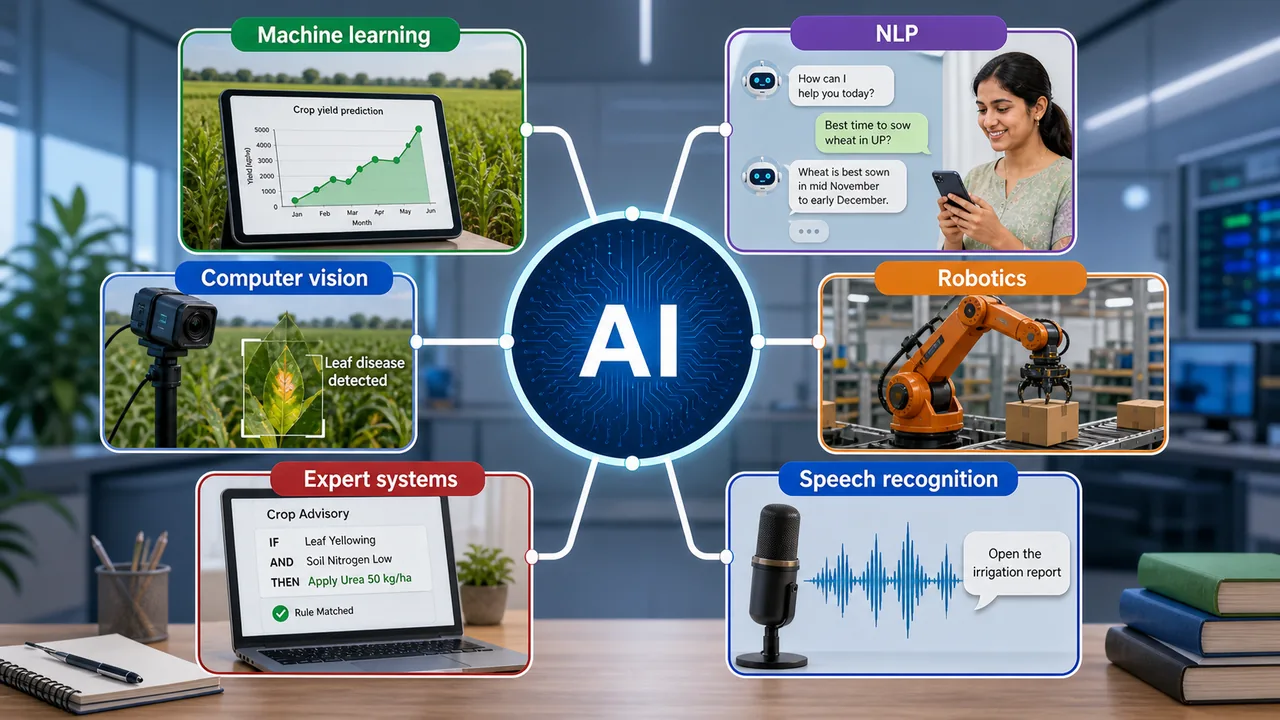
| Branch | What It Does | Example |
|---|---|---|
| Machine Learning | Computers learn from data without explicit programming | Crop yield prediction, spam filtering |
| NLP (Natural Language Processing) | Machines understand and generate human language | Chatbots, Google Translate, voice assistants |
| Computer Vision | Machines "see" and interpret images/videos | Face recognition, crop disease detection from photos |
| Robotics | Physical machines that can sense and act | Industrial robots, drone spraying in farms |
| Expert Systems | Rule-based programs that mimic human expert decisions | Medical diagnosis systems, crop advisory systems |
| Speech Recognition | Converting speech to text | Siri, Google Assistant |
Machine Learning — How Machines Learn
Machine Learning (ML) is a subset of AI where computers learn patterns from data and make predictions or decisions without being explicitly programmed for each scenario.
How ML Works — Step by Step
| Step | What Happens | Agriculture Example |
|---|---|---|
| 1. Collect Data | Gather historical data | 10 years of crop yields, weather, soil data |
| 2. Prepare Data | Clean, organize, split into training and testing sets | Remove incomplete records, normalize values |
| 3. Choose Algorithm | Select appropriate ML model | Decision tree, neural network, etc. |
| 4. Train Model | Feed training data, model learns patterns | ML discovers: "high rainfall + NPK = high wheat yield" |
| 5. Evaluate | Test on unseen data, check accuracy | Compare predictions with actual yields |
| 6. Predict | Deploy model to make predictions on new data | Predicts next season's yield from current conditions |
Types of Machine Learning
| Type | How It Learns | Key Tasks | Example |
|---|---|---|---|
| Supervised Learning | From labeled data (input + correct answer) | Classification (is this spam?), Regression (predict price) | Email spam filter, crop disease identification |
| Unsupervised Learning | From unlabeled data (finds hidden patterns) | Clustering (group similar items), Association (find relationships) | Customer segmentation, soil type grouping |
| Reinforcement Learning | Through trial and error (reward/penalty) | Decision-making in dynamic environments | Game-playing AI (AlphaGo), robotic farming |
Exam tip: Supervised = teacher provides answers; Unsupervised = student finds patterns alone; Reinforcement = learns by rewards/punishments.
Neural Networks & Deep Learning
What is a Neural Network?
A neural network is a computing system inspired by the human brain. It consists of interconnected nodes (neurons) arranged in layers that process information.
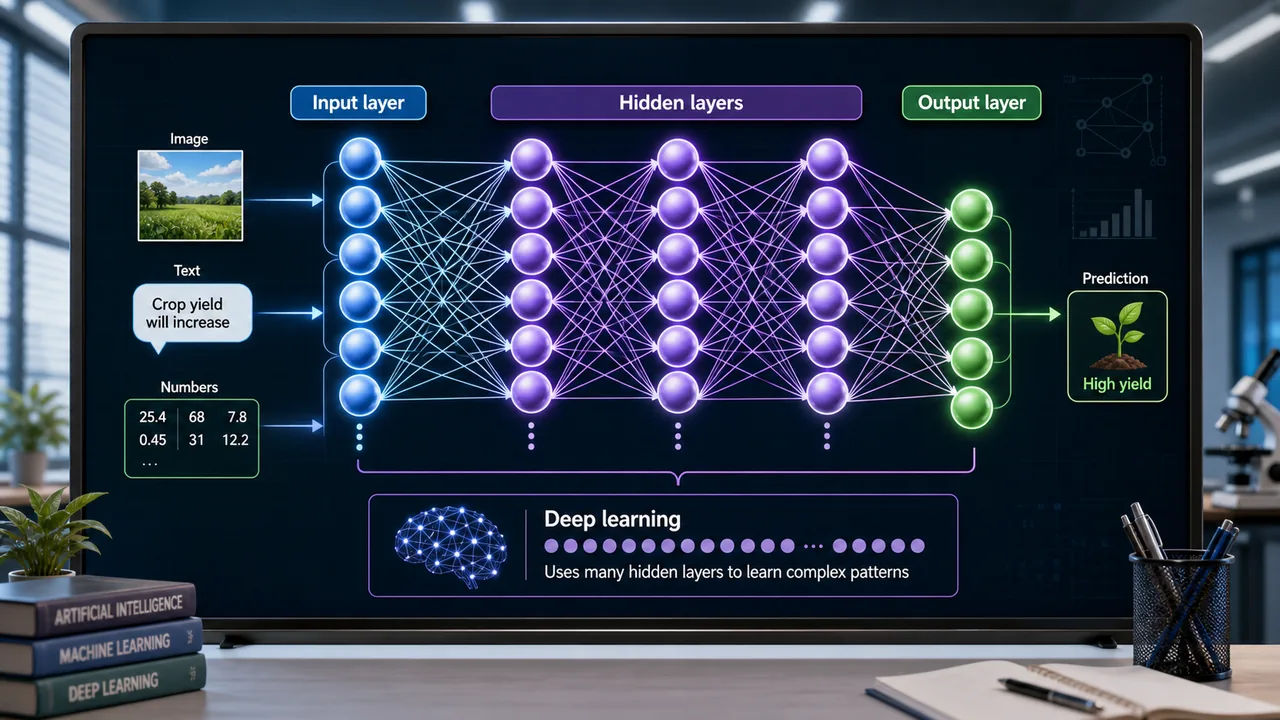
| Layer | Role |
|---|---|
| Input Layer | Receives raw data (images, numbers, text) |
| Hidden Layer(s) | Processes data, extracts features, learns patterns |
| Output Layer | Produces the final result (classification, prediction) |
What is Deep Learning?
Deep Learning is Machine Learning using neural networks with many hidden layers (hence "deep"). More layers = ability to learn more complex patterns.
| ML vs Deep Learning | Machine Learning | Deep Learning |
|---|---|---|
| Data Needed | Works with smaller datasets | Requires large datasets |
| Feature Extraction | Manual (human selects features) | Automatic (learns features itself) |
| Hardware | Regular CPU sufficient | Needs GPU for training |
| Use Cases | Tabular data, simple predictions | Images, speech, video, complex patterns |
Important Neural Network Types
| Type | Full Form | Best For |
|---|---|---|
| CNN | Convolutional Neural Network | Images, computer vision |
| RNN | Recurrent Neural Network | Sequences, time-series data |
| LSTM | Long Short-Term Memory | Long sequences, memory retention |
| GAN | Generative Adversarial Network | Creating images, deepfakes |
| Transformer | — | Language models (GPT, BERT, Gemini) |
Natural Language Processing (NLP)
NLP enables machines to understand, interpret, and generate human language — both text and speech.
| NLP Application | What It Does | Example |
|---|---|---|
| Chatbots | Automated conversation with users | Customer service bots, Alexa, ChatGPT |
| Machine Translation | Translates between languages | Google Translate |
| Sentiment Analysis | Detects emotion in text (positive/negative) | Social media monitoring, product reviews |
| Speech Recognition | Converts speech to text | Siri, Google Voice Typing |
| Text Summarization | Condenses long text into key points | News summary apps |
Applications of AI
| Field | AI Application |
|---|---|
| Agriculture | Crop disease detection, yield prediction, precision farming, drone spraying, soil analysis, automated irrigation |
| Healthcare | Disease diagnosis from scans, drug discovery, robotic surgery |
| Finance | Fraud detection, algorithmic trading, credit scoring |
| Education | Personalized learning, AI tutors, automated grading |
| Self-driving Cars | Tesla Autopilot, Waymo — uses computer vision + ML |
| Cybersecurity | Threat detection, anomaly identification |
| E-commerce | Product recommendations (Amazon, Flipkart) |
Smart Cities
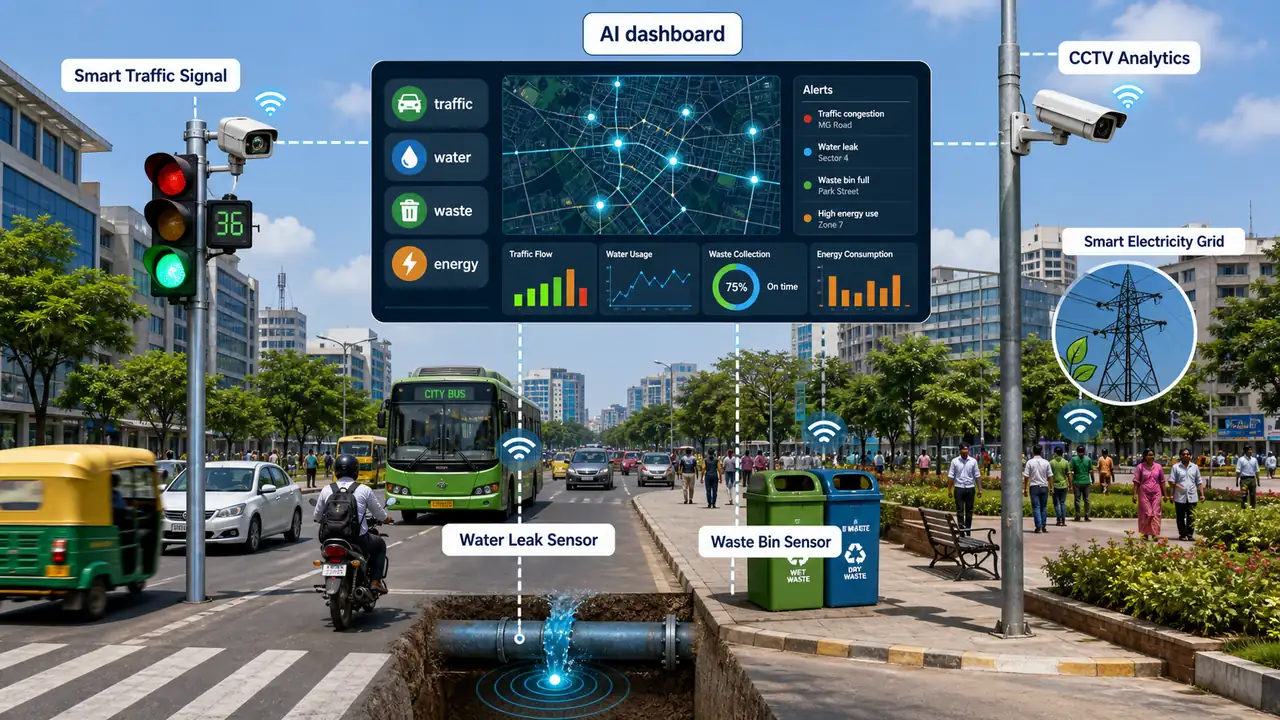
A Smart City integrates IoT + AI + Data Analytics to improve urban infrastructure, public services, and quality of life.
| Smart City Component | How AI/IoT Helps |
|---|---|
| Smart Traffic | AI-controlled signals reduce congestion; real-time route optimization |
| Smart Grid | Intelligent electricity distribution; reduces wastage |
| Smart Water | Leak detection using sensors; automated supply management |
| Smart Waste | IoT sensors on bins alert when full; optimized collection routes |
| Smart Surveillance | AI-powered CCTV for security and crowd management |
| Smart Governance | E-services, digital citizen IDs, paperless administration |
Smart Cities in India
India launched the Smart Cities Mission in June 2015 by PM Modi — selected 100 cities for smart development.
| City | Notable Smart Feature |
|---|---|
| GIFT City (Gujarat) | India's first operational smart city; international financial hub |
| Pune | Smart traffic management, Wi-Fi zones, e-governance |
| Bhubaneswar | First city selected under Smart Cities Mission |
| Indore | Smart sanitation, waste management |
| Surat | Flood monitoring, smart surveillance |
Foundation Models & Large Language Models (LLMs)
A Foundation Model is an AI model trained on massive data that can be adapted to many tasks. These form the "foundation" for multiple applications.
Transformer Architecture
The Transformer, introduced in the 2017 paper "Attention Is All You Need", revolutionized AI using self-attention to process all input simultaneously.
| Component | Function |
|---|---|
| Encoder | Reads and understands input (used by BERT) |
| Decoder | Generates output text (used by GPT) |
| Self-Attention | Weighs importance of each word relative to others |
Key Foundation Models
| Model | Developer | Type | Key Feature |
|---|---|---|---|
| GPT (1→5) | OpenAI | Decoder-only | Text generation, powers ChatGPT |
| BERT | Google (2018) | Encoder-only | Text understanding, search ranking |
| Gemini | Google (2023) | Multimodal | Text + image + code + video |
| Claude | Anthropic | Decoder-based | 1M token context, coding, safety |
| LLaMA | Meta | Open-source LLM | Free for research |
| DeepSeek | DeepSeek (China) | Open-source | Competitive reasoning, low cost |
BERT = Encoder only (understands text). GPT = Decoder only (generates text). This distinction is frequently tested.
What is an LLM?
A Large Language Model (LLM) is a foundation model trained on massive text data. LLMs have billions of parameters (learned values).
| Term | Meaning |
|---|---|
| Parameter | Learned value in neural network — more = more knowledge |
| Token | Unit of text the model processes (word or sub-word) |
| Context Window | Max tokens processed at once (GPT-4: 128K, Claude: 1M) |
| Prompt | Input/instruction given to an LLM |
| Fine-tuning | Adapting pre-trained model for a specific task |
| RLHF | Reinforcement Learning from Human Feedback — makes AI safer and more helpful |
| Hallucination | When AI generates plausible but incorrect information |
Generative AI (GenAI)
Generative AI creates new content — text, images, audio, video, code — rather than just analyzing data.
| Type | What It Creates | Tools |
|---|---|---|
| Text | Articles, code, answers | ChatGPT, Claude, Gemini |
| Image | Pictures from text descriptions | DALL-E, Midjourney, Stable Diffusion |
| Video | Videos from text prompts | Sora (OpenAI), Runway |
| Audio | Speech, music, voice | ElevenLabs, Suno AI |
| Code | Programming code | GitHub Copilot, Claude |
Multimodal AI
Multimodal AI processes multiple data types simultaneously — text, images, audio, video in one model.
- GPT-4o — text + images + audio together
- Gemini — native multimodal (text, image, video, code)
Agentic AI (2025–26 Trend)
Agentic AI = AI that can act autonomously — plan, make decisions, use tools, and complete multi-step tasks with minimal human input.
BharatGen AI (India)
BharatGen — India's first government-funded multimodal LLM (launched June 2025), supports 22 Indian languages, integrates text, speech, and image understanding.
AI in India — Government Initiatives
| Initiative | Details |
|---|---|
| NITI Aayog National AI Strategy | 2018 — identified 5 priority sectors: Healthcare, Agriculture, Education, Smart Cities, Transportation |
| IndiaAI Mission | Rs 10,372 crore budget; 38,000+ GPUs at ₹65/hour; AI compute, datasets, and skilled workforce |
| AIRAWAT | AI Research Analytics and Knowledge Dissemination Platform |
| BharatGen | First govt-funded multimodal LLM — 22 Indian languages (text, speech, image) |
| India AI Impact Summit | February 2026 — showcased India's AI capabilities and innovation |
| Responsible AI | NITI Aayog published "Responsible AI for All" principles |
| National Data Governance Policy | Framework for non-personal data sharing for AI research |
| Union Budget 2025-26 | Centre of Excellence in AI for Education — Rs 500 crore; 50,000 Atal Tinkering Labs |
AI Tools — Know the Names
| Tool | What It Does | Developer |
|---|---|---|
| ChatGPT | AI chatbot — answers questions, writes content, codes (GPT-4o, GPT-5) | OpenAI |
| Google Gemini | Multimodal AI — text, image, code, video, search integration | |
| Claude | AI assistant — 1M token context, coding, analysis, safety-focused | Anthropic |
| DALL-E 3 | Generates images from text descriptions | OpenAI |
| Midjourney | AI art and image generation | Midjourney Inc. |
| GitHub Copilot | AI code assistant for programmers | Microsoft/GitHub |
| DeepSeek | Open-source reasoning model, cost-effective | DeepSeek (China) |
| Sora | AI video generation from text prompts | OpenAI |
GPT Timeline (Frequently Asked)
| Model | Year | Key Milestone |
|---|---|---|
| GPT-1 | 2018 | First generative pre-trained transformer |
| GPT-2 | 2019 | 1.5B parameters, text generation |
| GPT-3 | 2020 | 175B parameters, few-shot learning |
| ChatGPT | Nov 2022 | First public AI chatbot — went viral globally |
| GPT-4 | Mar 2023 | Multimodal (text + images), much more capable |
| GPT-4o | May 2024 | Omni — text + image + audio in real-time |
| GPT-5 | Aug 2025 | Auto-routing between fast and reasoning modes |
The ChatGPT Movement — How AI Changed the World
Launch & Record-Breaking Growth
ChatGPT was launched by OpenAI on November 30, 2022 as a free research preview. What followed was unprecedented:
| Milestone | Time Taken | Comparison |
|---|---|---|
| 1 million users | 5 days | Netflix took 3.5 years |
| 100 million users | 2 months | TikTok: 9 months, Instagram: 2.5 years |
| 200 million weekly users | Aug 2024 | — |
| 400 million weekly users | Feb 2025 | — |
| 900 million weekly users | Feb 2026 | More than doubled in one year |
ChatGPT became the fastest-growing internet application in history — no app had ever reached 100 million users in just 2 months.
OpenAI & Sam Altman
| Fact | Details |
|---|---|
| OpenAI Founded | 2015 — as a non-profit AI research lab |
| Co-founders | Sam Altman, Elon Musk, Ilya Sutskever, and others |
| CEO | Sam Altman |
| Revenue (2025) | $10 billion annual recurring revenue (ARR) |
| ChatGPT Plus | Launched Feb 2023 — $20/month subscription for faster access |
The Sam Altman Board Crisis (Nov 2023)
On November 17, 2023, OpenAI's board abruptly fired Sam Altman as CEO — a decision that shook the entire AI industry:
- Board cited concerns about AI safety and Altman's handling of rapid commercialization
- Over 700 of 770 employees threatened to resign and join Microsoft
- Massive pressure from investors (Microsoft had invested $13 billion)
- Altman was reinstated on November 22 — just 5 days later
- Board was restructured; new members added
This event highlighted the tension between AI safety (slow, careful development) and AI commercialization (fast deployment for business).
ChatGPT's Global Impact
| Area | Impact |
|---|---|
| Education | 20% of US users use ChatGPT as a personal tutor; many schools initially banned it, then started integrating AI literacy |
| Jobs | Accelerated automation concerns for entry-level white-collar jobs (content writing, coding, customer support) |
| Business | Every major tech company launched AI chatbots — Google (Gemini), Meta (LLaMA), Anthropic (Claude) |
| Research | Scientists use LLMs for literature review, data analysis, and hypothesis generation |
| Governments | India launched BharatGen; China launched Ernie Bot; EU passed the AI Act (2024) |
Countries That Banned/Restricted ChatGPT
| Country/Region | Action |
|---|---|
| Italy | First country to temporarily ban ChatGPT (March 2023) over GDPR privacy concerns; lifted after OpenAI added privacy controls |
| China | ChatGPT inaccessible; China launched its own AI (Ernie Bot, DeepSeek) |
| Russia, Iran, North Korea | Blocked by OpenAI itself |
| EU | Passed EU AI Act (2024) — world's first comprehensive AI regulation law |
Key Lessons from the ChatGPT Revolution
- AI democratization — made advanced AI accessible to ordinary users for the first time
- Prompt engineering emerged as a new skill — how you ask AI matters
- AI hallucination became a known risk — AI can generate confident but wrong answers
- Data privacy concerns led to new regulations globally
- AI literacy became essential — understanding AI's capabilities and limitations
Future Skills — What Matters Ahead
For government exams and career growth, these skills are increasingly important:
| Skill | Why It Matters |
|---|---|
| Data Literacy | Ability to read, analyze, and interpret data — essential in data-driven governance |
| Digital Literacy | Using computers, internet, and digital tools effectively |
| Critical Thinking | Evaluating information for accuracy — vital in the AI/fake-news era |
| Self-efficacy | Confidence in learning new technologies — adaptability |
| Computational Thinking | Breaking problems into smaller, solvable parts |
| Cybersecurity Awareness | Protecting data and systems from cyber threats |
| AI Literacy | Understanding how AI works, its capabilities and limitations |
| Cyber Hygiene | Safe online practices — strong passwords, 2FA, avoiding phishing |
Ethical Concerns in AI
| Concern | Description |
|---|---|
| Bias | AI trained on biased data makes biased decisions (e.g., unfair loan rejection) |
| Job Displacement | Automation may replace routine human jobs |
| Privacy | AI systems collect and process massive personal data |
| Deepfakes | AI-generated fake videos/audio — misinformation risk |
| Accountability | Who is responsible when an AI makes a wrong decision? |
AI Winters — When AI Research Stalled
AI Winter refers to periods when funding and interest in AI research significantly declined due to unmet expectations.
| Period | What Happened |
|---|---|
| First AI Winter (1974–1980) | Early AI could not handle real-world complexity; governments (UK Lighthill Report, US DARPA) cut funding |
| Second AI Winter (late 1980s–1993) | Expert systems were expensive and brittle; desktop computers outperformed specialized AI hardware |
After each AI Winter, new breakthroughs (neural networks, big data, GPUs) revived the field. The current AI boom began around 2012 with deep learning.
Expert Systems — Classic AI
Expert Systems are rule-based programs that mimic the decision-making of a human expert using an if-then rule base and an inference engine.
| Expert System | Domain | What It Did |
|---|---|---|
| MYCIN | Medical diagnosis | Identified bacterial infections and recommended antibiotics (Stanford, 1970s) |
| DENDRAL | Chemistry | Determined molecular structures from mass spectrometry data (first expert system, 1965) |
| XCON (R1) | Computer configuration | Configured VAX computer orders for DEC |
Generative AI
Generative AI refers to AI systems that can create new content — text, images, code, music, video — rather than just analyzing existing data.
| Tool | Type of Content | Developer |
|---|---|---|
| ChatGPT | Text, code, conversation | OpenAI |
| DALL-E | Images from text descriptions | OpenAI |
| Stable Diffusion | Images (open-source) | Stability AI |
| GitHub Copilot | Code suggestions | Microsoft/GitHub |
| Sora | Videos from text prompts | OpenAI |
Exam tip: Generative AI creates new content; Traditional AI classifies or predicts from existing data.
AI in Indian Agriculture
| Initiative | Details |
|---|---|
| Kisan e-Mitra Chatbot | AI-powered chatbot providing crop advisory, weather info, and market prices to farmers in local languages |
| ICAR-IARI Crop Prediction Models | ML models for forecasting crop yields using satellite imagery and weather data |
| Drone-based Pest Detection | Drones with AI-powered cameras identify pest infestations early, enabling targeted spraying |
| Plantix App | AI-based crop disease identification from phone photos |
| DeHaat / CropIn | Agri-tech platforms using AI for crop monitoring and market linkage |
NLU vs NLG
| Concept | Full Form | What It Does | Example |
|---|---|---|---|
| NLU | Natural Language Understanding | Machine comprehends human language — extracts meaning, intent, entities | Alexa understanding "What is the weather today?" |
| NLG | Natural Language Generation | Machine produces human-readable text from structured data | ChatGPT generating a paragraph, auto-generated weather reports |
NLU + NLG together form the core of NLP (Natural Language Processing).
Computer Vision — Applications
Computer Vision enables machines to interpret and make decisions based on visual data (images, videos).
| Application | How It Works |
|---|---|
| OCR (Optical Character Recognition) | Converts printed/handwritten text in images to digital text (Google Lens, Adobe Scan) |
| Facial Recognition | Identifies or verifies a person from their face — used in phone unlock, airport security |
| Autonomous Vehicles | Cars use cameras + LIDAR + CV to detect lanes, pedestrians, traffic signs |
| Medical Imaging | AI analyzes X-rays, MRIs, CT scans to detect tumors, fractures, diseases |
| Crop Disease Detection | Identifies plant diseases from leaf photos using CNN models |
AI Ethics — Bias & Explainability
| Concept | Description |
|---|---|
| AI Bias | If training data is biased (e.g., underrepresents certain groups), the AI output will also be biased — leading to unfair decisions in loans, hiring, policing |
| Explainability (XAI) | Explainable AI — users and regulators should be able to understand why an AI made a particular decision, not just the result |
| Fairness | AI systems should treat all groups equitably |
| Transparency | Organizations should disclose when AI is being used for decision-making |
The EU AI Act (2024) classifies AI systems by risk level and mandates transparency for high-risk applications.
Digital Literacy Mission — PMGDISHA
PMGDISHA (Pradhan Mantri Gramin Digital Saksharta Abhiyan) is the world's largest digital literacy programme.
| Feature | Details |
|---|---|
| Goal | Make 6 crore rural adults digitally literate |
| Target | One person per household in rural areas |
| Training | 20 hours — covers operating digital devices, internet, digital payments, government services |
| Launched | 2017, under Digital India programme |
| Implementing Agency | CSC e-Governance Services India Limited |
Key Terms — Quick Glossary
| Term | Meaning |
|---|---|
| Algorithm | Step-by-step instructions to solve a problem |
| Training Data | Historical data used to teach an ML model |
| Model | The trained ML program that makes predictions |
| Prediction | Output of an ML model for new input data |
| Dataset | Collection of data used for training or testing |
| Feature | Individual measurable property in data (e.g., soil pH, rainfall) |
| Label | The correct answer in supervised learning (e.g., "healthy" or "diseased") |
| Epoch | One complete pass through the entire training dataset |
Summary Points
| Concept | Key Details |
|---|---|
| AI | Machines that mimic human intelligence |
| John McCarthy | Coined "Artificial Intelligence" in 1956 |
| Turing Test | Can machine fool human in conversation? (Alan Turing, 1950) |
| Narrow AI | One task — Siri, Google Search, spam filter (all current AI) |
| General AI | Human-level intelligence — does not exist yet |
| Super AI | Surpasses all human intelligence — hypothetical |
| Machine Learning | Learns from data — subset of AI |
| Supervised Learning | Labeled data — classification + regression |
| Unsupervised Learning | Unlabeled data — clustering + association |
| Reinforcement Learning | Trial & error — reward/penalty (AlphaGo) |
| Neural Network | Brain-inspired — Input, Hidden, Output layers |
| Deep Learning | Many hidden layers — images, speech, video; needs GPU |
| CNN | Images — Convolutional Neural Network |
| RNN/LSTM | Sequences — memory for long data |
| GAN | Generative Adversarial Network — deepfakes, image creation |
| Foundation Model | Large pre-trained model adaptable to many tasks |
| Transformer | "Attention Is All You Need" (2017) — self-attention mechanism |
| BERT | Google (2018) — Encoder only — text understanding, search |
| GPT | OpenAI — Decoder only — text generation, powers ChatGPT |
| Token | Unit of text model processes (word or sub-word) |
| Parameter | Learned value in neural network — more = more knowledge |
| Context Window | Max tokens at once (GPT-4: 128K, Claude: 1M) |
| RLHF | Reinforcement Learning from Human Feedback — makes AI safer |
| Fine-tuning | Adapting pre-trained model for a specific task |
| Hallucination | AI generates plausible but incorrect information |
| Generative AI | Creates new content — text, images, video, code |
| Multimodal AI | Processes text + images + audio + video together (GPT-4o, Gemini) |
| Agentic AI | AI that acts autonomously — plans, decides, uses tools (2025-26 trend) |
| BharatGen | India's first govt-funded multimodal LLM — 22 Indian languages |
| ChatGPT Launch | Nov 30, 2022 — OpenAI — free research preview |
| ChatGPT 1M users | 5 days (Netflix took 3.5 years) |
| ChatGPT 100M users | 2 months — fastest-growing app in history |
| ChatGPT 900M weekly | Feb 2026 — more than doubled in one year |
| Sam Altman Crisis | Fired Nov 17, 2023; reinstated Nov 22; 700/770 staff threatened to quit |
| Italy ChatGPT Ban | First country to ban (Mar 2023) — GDPR privacy concerns |
| EU AI Act (2024) | World's first comprehensive AI regulation law |
| GPT-1 | 2018 — first generative pre-trained transformer |
| GPT-3 | 2020 — 175B parameters, few-shot learning |
| GPT-4 | Mar 2023 — multimodal (text + images) |
| GPT-5 | Aug 2025 — auto-routing fast/reasoning modes |
| NLP | Language understanding — chatbots, translation |
| NLU vs NLG | NLU = comprehends language; NLG = generates text; NLU + NLG = NLP |
| Computer Vision | Image recognition — OCR, face unlock, disease detection |
| OCR | Optical Character Recognition — image text to digital text |
| Expert Systems | Rule-based AI — MYCIN (medical), DENDRAL (chemistry, 1965) |
| AI Winters | 1st (1974-80), 2nd (late 1980s-93) — funding cuts |
| Smart Cities Mission | 100 cities, launched June 2015 |
| GIFT City | India's first operational smart city (Gujarat) |
| NITI Aayog AI Strategy | 5 sectors: Health, Agriculture, Education, Smart Cities, Transport |
| IndiaAI Mission | Rs 10,372 crore; 38,000+ GPUs at Rs 65/hour |
| AIRAWAT | AI Research Analytics Platform |
| Google Gemini | Google's multimodal AI (text, image, video, code) |
| Claude | Anthropic — 1M token context, safety-focused |
| DALL-E | AI image generator (OpenAI) |
| Sora | AI video generation from text (OpenAI) |
| DeepSeek | Open-source reasoning model from China |
| AI Bias | Biased data → biased decisions |
| Explainability (XAI) | Understanding why AI made a decision |
| Self-efficacy | Belief in own learning ability |
| Data Literacy | Ability to read, analyze, interpret data |
| PMGDISHA | Digital literacy — 6 crore rural adults, 20-hour training |
| Algorithm | Step-by-step problem-solving instructions |
| Training Data | Data used to teach ML model |
| Kisan e-Mitra | AI chatbot for crop advisory in local languages |
| AI in Agriculture | Disease detection, yield prediction, drone spraying, precision farming |
Lesson Doubts
Ask questions, get expert answers