🏛️ E-Governance & Digital India
E-governance models (G2C, G2B, G2G), Digital India programme, DigiLocker, UMANG, Aadhaar, digital platforms for UPSSSC AGTA.
What is E-Governance?
E-Governance (Electronic Governance) is the use of Information and Communication Technology (ICT) to deliver government services, exchange information, and conduct transactions between the government and citizens, businesses, and other government agencies.
The goal is to make government services more accessible, efficient, transparent, and accountable — reducing corruption, paperwork, and delays.
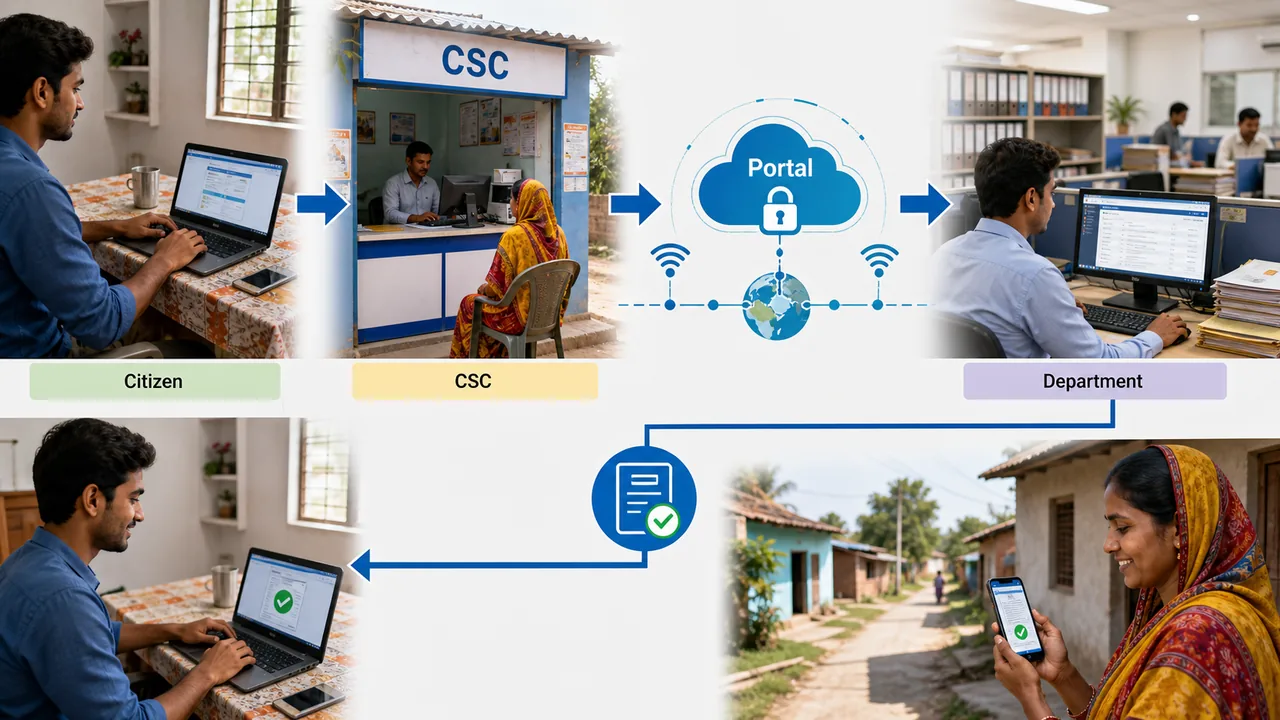
Types of E-Governance
| Type | Full Form | Direction | Example |
|---|---|---|---|
| G2C | Government to Citizen | Govt → People | Online passport application, income tax e-filing, DigiLocker |
| G2B | Government to Business | Govt → Companies | GeM (procurement), GST filing, company registration (MCA21) |
| G2G | Government to Government | Dept → Dept | Data sharing between state and central departments, e-Office |
| G2E | Government to Employee | Govt → Staff | e-payroll, leave management, HRMS portals |
Stages of E-Governance
E-Governance evolves through four stages of maturity:
| Stage | Name | Description |
|---|---|---|
| 1 | Presence | Government creates websites with basic information (one-way) |
| 2 | Interaction | Citizens can search, download forms, email queries (two-way communication) |
| 3 | Transaction | Citizens can complete transactions online — pay taxes, apply for certificates |
| 4 | Transformation | Full integration — all departments connected, single-window services |
National e-Governance Plan (NeGP)
NeGP was launched in 2006 by the Government of India to make all government services accessible to citizens through common service delivery outlets (CSCs) and ensure efficiency, transparency, and reliability.
- Managed by: Department of Electronics and IT (DeitY) — now MeitY
- Had 31 Mission Mode Projects (MMPs) covering central, state, and integrated services
- Examples of MMPs: Income Tax, Passport, Land Records, Agriculture, Health, Education
Digital India Programme
Digital India was launched on 1 July 2015 by Prime Minister Narendra Modi. It is a flagship programme to transform India into a digitally empowered society and knowledge economy.
9 Pillars of Digital India
| # | Pillar | Purpose |
|---|---|---|
| 1 | Broadband Highways | High-speed internet to all gram panchayats (BharatNet) |
| 2 | Universal Access to Mobile | Mobile connectivity to all villages |
| 3 | Public Internet Access | Common Service Centres (CSCs) as access points |
| 4 | e-Governance | Reforming government through technology |
| 5 | e-Kranti | Electronic delivery of services (education, health, agriculture, finance) |
| 6 | Information for All | Open data, proactive information sharing |
| 7 | Electronics Manufacturing | Make in India for electronics — NET ZERO imports |
| 8 | IT for Jobs | Training youth in IT skills for employment |
| 9 | Early Harvest Programmes | Quick-win projects — biometric attendance, WiFi in universities, e-Greetings |
Key Digital India Initiatives
DigiLocker
DigiLocker is a cloud-based platform for storing, sharing, and verifying digital documents and certificates issued by the government.
- Citizens get 1 GB free storage linked to their Aadhaar number
- Documents: driving license, vehicle registration, mark sheets, Aadhaar, PAN
- Eliminates need for carrying physical documents
- Legally valid under IT Act, 2000
UMANG
UMANG (Unified Mobile Application for New-age Governance) provides access to multiple government services through a single mobile app.
- Launched in November 2017
- Offers 1,200+ services from 300+ government departments
- Services: EPFO, Aadhaar, DigiLocker, PM-KISAN status, soil health card, income tax
MyGov
MyGov is a citizen engagement platform where people can share ideas, participate in discussions, tasks, and polls on government policies.
- Launched: 26 July 2014
- Promotes participatory governance — "Government by the people"
GeM (Government e-Marketplace)
GeM is an online marketplace for procurement of goods and services by all government departments and organizations.
- Launched: August 2016
- Replaces DGS&D (Directorate General of Supplies and Disposals)
- Transparent, efficient, cashless procurement
- All central/state government departments mandated to procure through GeM
Other Digital Platforms
| Platform | Purpose |
|---|---|
| e-Hospital | Online registration, appointment, and patient record management for government hospitals |
| e-Pathshala | Digital textbooks and e-content for students (by NCERT) |
| DIKSHA | Digital Infrastructure for Knowledge Sharing — QR-coded textbooks, teacher training, e-content |
| SWAYAM | Free online courses by UGC/AICTE professors (India's MOOC platform) |
| National Digital Library | Repository of academic content — books, articles, thesis |
| Common Service Centres (CSC) | Physical access points in villages delivering 300+ digital services |
BharatNet
BharatNet (formerly National Optical Fibre Network — NOFN) is the world's largest rural broadband connectivity programme.
- Goal: Connect all 2.5 lakh+ gram panchayats with optical fibre broadband
- Provides backbone for rural internet, online education, telemedicine, e-governance
- Implemented by: Bharat Broadband Network Limited (BBNL)
Aadhaar
Aadhaar is a 12-digit unique identification number issued by the UIDAI (Unique Identification Authority of India) to every resident of India.
| Feature | Details |
|---|---|
| Digits | 12-digit unique number |
| Issuing Authority | UIDAI (established 2009, statutory body under Aadhaar Act 2016) |
| First Chairman | Nandan Nilekani |
| Data Collected | Demographic (name, address, DOB, gender) + Biometric (fingerprints, iris scan, photograph) |
| Not Proof of | Citizenship or domicile — it is a proof of identity only |
| Uses | Bank KYC, Direct Benefit Transfer (DBT), mobile verification, PAN linkage, ration distribution |
Aadhaar-based Authentication
- Demographic — name + DOB/address matching
- Biometric — fingerprint or iris scan verification
- OTP — one-time password sent to registered mobile
IndiaStack
IndiaStack is a set of open APIs and digital infrastructure built on top of Aadhaar to enable paperless, presence-less, and cashless service delivery.
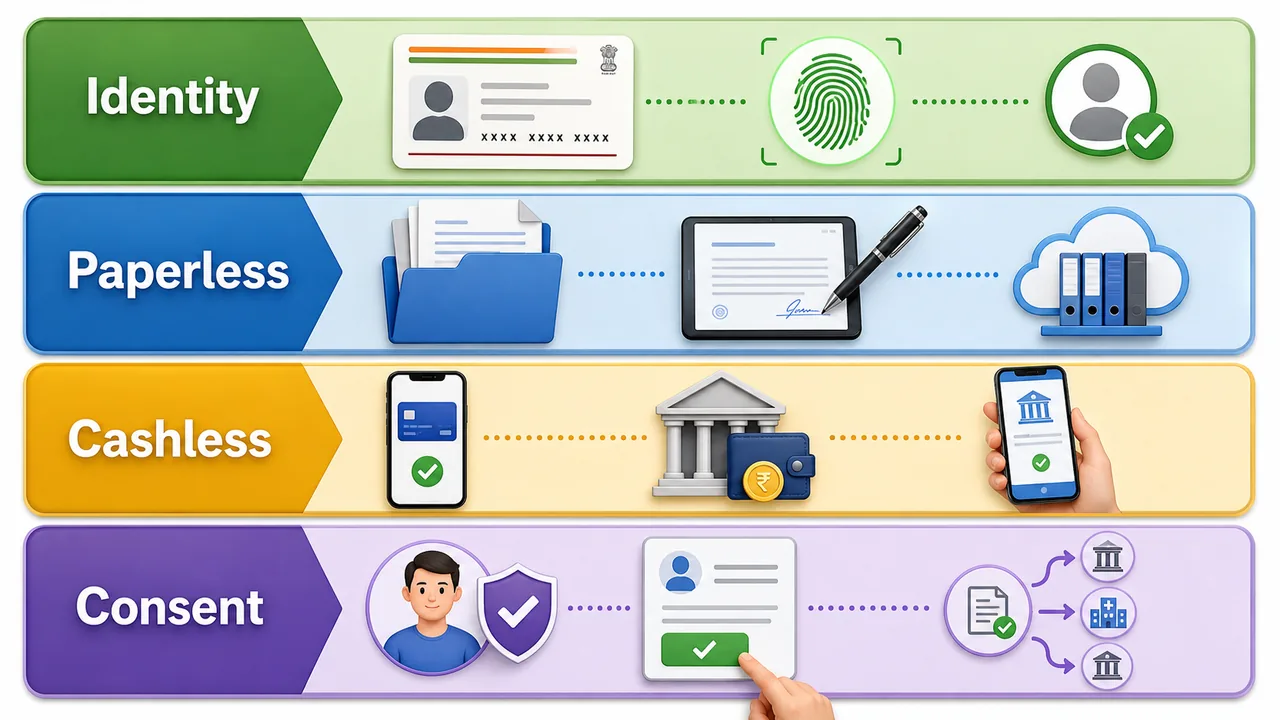
| Layer | Component | Purpose |
|---|---|---|
| Identity | Aadhaar | Unique digital identity for authentication |
| Payments | UPI (Unified Payments Interface) | Instant real-time money transfers |
| Documents | DigiLocker | Digital document storage and verification |
| Signatures | eSign | Aadhaar-based digital signatures |
| Consent | Account Aggregator | Secure sharing of financial data with consent |
Other Important Government Portals
| Portal/Initiative | Purpose |
|---|---|
| IRCTC | Indian Railway online ticket booking |
| Passport Seva | Online passport application and tracking |
| Income Tax e-filing | Online income tax return filing (incometax.gov.in) |
| MCA21 | Ministry of Corporate Affairs — company registration, filings |
| GSTN | GST Network — filing GST returns, invoice matching |
| PFMS | Public Financial Management System — tracks government fund flow |
| e-Office | Digital workplace for government offices — file management, noting |
| RTI Online | File Right to Information applications online |
| CPGRAMS | Centralized Public Grievance Redress and Monitoring System |
PM-WANI (Public WiFi)
PM-WANI (PM WiFi Access Network Interface) is a framework to set up public WiFi hotspots across India through local shops (PDOs — Public Data Offices).
- Launched: December 2020
- Anyone can become a WiFi provider — no license required
- Goal: affordable internet access in every village and city
Important E-Governance Facts for Exams
| Fact | Detail |
|---|---|
| Digital India launch | 1 July 2015 |
| DigiLocker storage | 1 GB free per citizen |
| UMANG launch | November 2017 |
| MyGov launch | 26 July 2014 |
| GeM launch | August 2016 |
| BharatNet target | 2.5 lakh+ gram panchayats |
| Aadhaar digits | 12-digit unique number |
| UIDAI first chairman | Nandan Nilekani |
| NeGP launch | 2006, with 31 MMPs |
| IndiaStack components | Aadhaar + UPI + DigiLocker + eSign |
| IT Act | 2000 (amended 2008) |
| PM-WANI | Public WiFi — December 2020 |
| e-Rupee pilot | December 2022 by RBI |
Updated Digital India Statistics (2025)
| Platform/Initiative | Latest Data |
|---|---|
| DigiLocker | 56.2 crore users as of July 2025 |
| UMANG App | 2,300+ services in 23 languages; 8.71 crore registrations |
| UPI | ₹24.03 lakh crore via 18.39 billion transactions in June 2025 |
| BharatNet | 2,14,325 Gram Panchayats service-ready; 13 lakh FTTH connections |
| Aadhaar-DBT | 315 schemes across 53 ministries use DBT; Rs 24.3 lakh crore disbursed |
Union Budget 2025-26 — AI in Education
The Union Budget 2025-26 announced a Centre of Excellence in AI for Education with a budget of Rs 500 crore — to develop AI-powered tools for personalized learning, teacher training, and educational content delivery.
e-Courts Mission Mode Project
e-Courts is a Mission Mode Project for digitizing the Indian judiciary.
| Feature | Details |
|---|---|
| Purpose | Computerize district and subordinate courts across India |
| Services | Online case status, cause lists, daily orders, certified copies |
| Phase | Phase III underway — AI-based translation, virtual courts, e-filing |
| Portal | ecourts.gov.in and e-Courts mobile app |
National Data Governance Framework Policy
The National Data Governance Framework Policy provides rules for collecting, storing, and sharing non-personal data by government entities.
- Promotes data-driven governance and AI research
- Creates India Datasets Platform — anonymized government data for researchers and startups
- Ensures privacy safeguards while enabling innovation
India Stack — 4 Layers
India Stack is a comprehensive digital infrastructure built in layers:
| Layer | Name | Component | Purpose |
|---|---|---|---|
| 1 | Presenceless | Aadhaar | Authenticate identity from anywhere — no physical presence needed |
| 2 | Paperless | DigiLocker + eSign | Store, share, and sign documents digitally |
| 3 | Cashless | UPI + AEPS | Make payments without cash |
| 4 | Consent | DEPA (Data Empowerment and Protection Architecture) | Share financial data securely with user consent (Account Aggregator) |
Exam tip: India Stack = Presenceless + Paperless + Cashless + Consent — remember as PPCC.
JAM Trinity
JAM Trinity is the combination of three pillars for financial inclusion in India:
| Letter | Component | Purpose |
|---|---|---|
| J | Jan Dhan Yojana | Zero-balance bank accounts for all |
| A | Aadhaar | Unique digital identity for authentication |
| M | Mobile | Mobile phone as the delivery channel |
- Enables Direct Benefit Transfer (DBT) — subsidies go directly to beneficiary bank accounts
- Eliminates middlemen and reduces leakage of government funds
- Over 52 crore Jan Dhan accounts opened
Summary Points
| Concept | Key Details |
|---|---|
| E-Governance | ICT for government services — transparent, efficient |
| G2C | Government to Citizen — passport, tax filing, DigiLocker |
| G2B | Government to Business — GeM, GST, MCA21 |
| G2G | Government to Government — inter-department data sharing |
| G2E | Government to Employee — payroll, HRMS |
| NeGP | National e-Governance Plan (2006), 31 MMPs |
| Digital India | Launched 1 July 2015, 9 pillars |
| BharatNet | Rural broadband — 2.5 lakh gram panchayats |
| CSC | Common Service Centres — village-level digital access |
| DigiLocker | 1 GB cloud document storage, Aadhaar-linked |
| UMANG | Single app, 1,200+ govt services (Nov 2017) |
| MyGov | Citizen engagement platform (26 July 2014) |
| GeM | Government e-Marketplace (Aug 2016) |
| DIKSHA | Digital education platform, QR textbooks |
| e-Pathshala | NCERT digital textbooks |
| SWAYAM | Free online courses (India's MOOC) |
| Aadhaar | 12-digit unique ID by UIDAI |
| UIDAI Chairman | Nandan Nilekani (first) |
| Aadhaar Data | Demographic + Biometric (fingerprint, iris) |
| IndiaStack | Aadhaar + UPI + DigiLocker + eSign |
| UPI | Unified Payments Interface — instant transfers |
| MCA21 | Company registration portal |
| GSTN | GST Network — return filing |
| IRCTC | Railway ticket booking |
| Passport Seva | Online passport application |
| RTI Online | Right to Information applications |
| PM-WANI | Public WiFi hotspots (Dec 2020) |
| IT Act | 2000 (amended 2008) — legal backing for digital docs |
| e-Rupee | India's CBDC by RBI (pilot Dec 2022) |
| DigiLocker (2025) | 56.2 crore users |
| UMANG (2025) | 2,300+ services, 8.71 crore registrations |
| UPI (June 2025) | ₹24.03 lakh crore, 18.39 billion transactions |
| BharatNet (2025) | 2,14,325 GPs service-ready, 13 lakh FTTH |
| Aadhaar-DBT | 315 schemes, 53 ministries, Rs 24.3 lakh crore disbursed |
| India Stack Layers | Presenceless → Paperless → Cashless → Consent (PPCC) |
| JAM Trinity | Jan Dhan + Aadhaar + Mobile — financial inclusion |
| Jan Dhan | 52+ crore zero-balance accounts |
| e-Courts | Phase III — AI translation, virtual courts, e-filing |
| AI CoE (Budget 2025-26) | Rs 500 crore for AI in Education |
| National Data Governance | India Datasets Platform for anonymized govt data |
Lesson Doubts
Ask questions, get expert answers