📱 Communication, Mobile & Social Media
ICT communication, mobile technologies (2G-5G), sensors, social media algorithms, digital footprint for UPSSSC AGTA.
ICT Communication
What is ICT?
ICT (Information and Communication Technology) refers to all technologies used for handling information and enabling communication — computers, the internet, smartphones, telecom networks, and software applications.
ICT has transformed agriculture through e-governance portals (Soil Health Card, PM-KISAN), mobile advisory services, and digital market platforms (eNAM).
Types of Communication
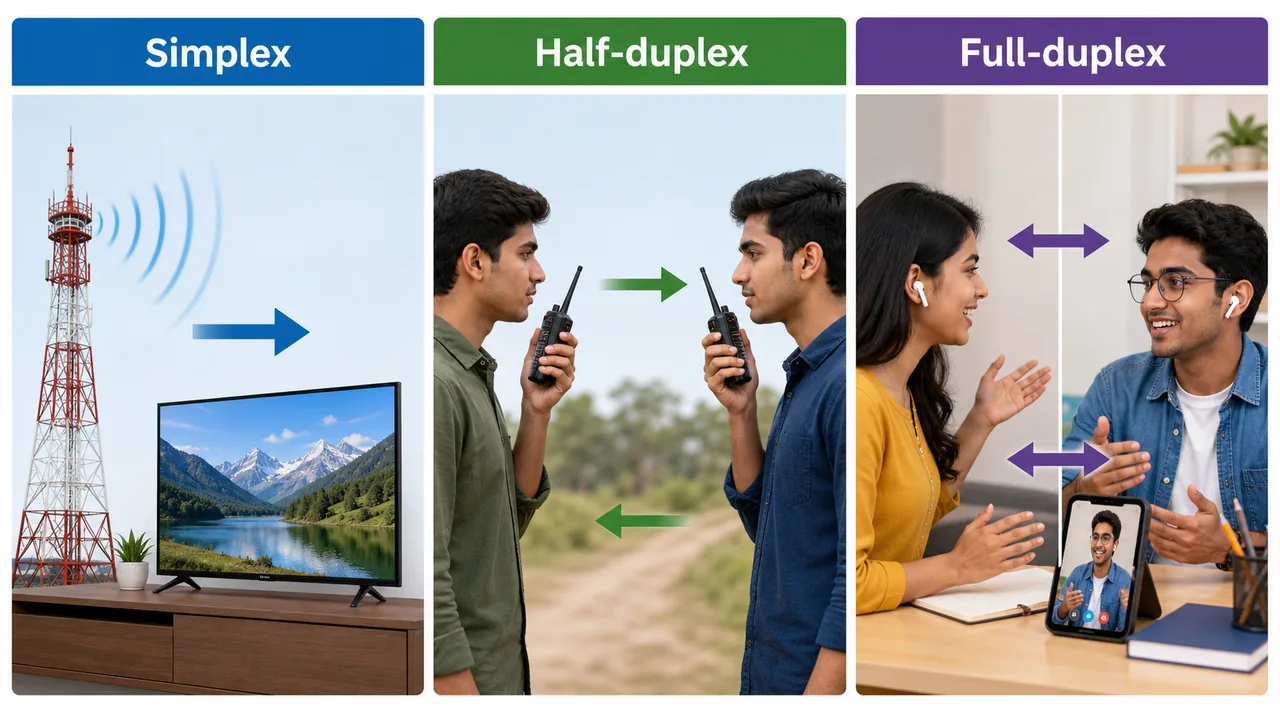
Communication refers to the exchange of data between two devices. Based on the direction of data flow, there are three modes:
| Mode | Direction | Example |
|---|---|---|
| Simplex | One-way only | TV broadcast, radio, keyboard to CPU |
| Half-Duplex | Both ways, but one at a time | Walkie-talkie, push-to-talk |
| Full-Duplex | Both ways simultaneously | Telephone call, video conferencing |
A quick way to remember the three modes is to connect them to familiar devices: TV broadcast is simplex because information moves only one way, a walkie-talkie is half-duplex because only one person speaks at a time, and a phone call is full-duplex because both sides can speak together.
In older computer-awareness books, teleconferencing is a common term for conducting meetings over communication networks when participants are in different locations. Modern video conferencing is one form of teleconferencing.
Digital vs Analog Communication
| Feature | Analog | Digital |
|---|---|---|
| Signal | Continuous wave | Discrete pulses (0s and 1s) |
| Quality | Degrades over distance | Maintains quality |
| Example | Old telephone, AM/FM radio | Internet, digital TV, mobile calls |
| Noise | More susceptible | Less susceptible |
Bandwidth
Bandwidth is the maximum amount of data that can be transmitted over a communication channel in a given time. It is measured in bits per second (bps) — Kbps, Mbps, Gbps.
- Higher bandwidth = faster data transfer
- Broadband: High-speed internet (typically 256 Kbps or more)
Data Transmission Modes
| Mode | Description | Example |
|---|---|---|
| Serial Transmission | Bits sent one after another on a single channel | USB, internet data |
| Parallel Transmission | Multiple bits sent simultaneously on multiple channels | Printer port (old), internal bus |
- Serial is slower but works over longer distances
- Parallel is faster but only for short distances (within a computer)
Mobile Communication
Evolution of Mobile Networks
| Generation | Period | Technology | Speed | Key Features |
|---|---|---|---|---|
| 1G | 1980s | Analog | 2.4 Kbps | Voice calls only, no encryption |
| 2G | 1990s | Digital (GSM) | 64 Kbps | SMS, MMS, digital voice |
| 2.5G | Late 1990s | GPRS | 171 Kbps | Basic internet (WAP) |
| 3G | 2000s | WCDMA/HSPA | 2-42 Mbps | Mobile internet, video calls |
| 4G/LTE | 2010s | LTE/LTE-A | 100-300 Mbps | HD streaming, VoLTE, gaming |
| 5G | 2020s | mmWave/Sub-6 | Up to 10 Gbps | Ultra-fast, IoT, 1ms latency |
5G Key Features
- Speed: Up to 10 Gbps — 100x faster than 4G
- Latency: As low as 1 millisecond (near real-time)
- Massive IoT support: Can connect millions of devices per square kilometer
- Applications: Self-driving cars, remote surgery, smart farming, AR/VR
- India launched 5G in October 2022 (Jio and Airtel)
GSM vs CDMA
| Feature | GSM | CDMA |
|---|---|---|
| Full Form | Global System for Mobile Communication | Code Division Multiple Access |
| SIM Card | Uses SIM card (swappable) | No SIM in older versions |
| Usage | Most of the world (including India) | USA, some Asian countries |
| Standard | Open standard | Proprietary (Qualcomm) |
SIM Card
SIM (Subscriber Identity Module) is a small chip that identifies the user on a mobile network.
- Stores: phone number, contacts, network authentication data
- Types: Standard SIM, Micro SIM, Nano SIM
- eSIM — embedded SIM built into the phone, no physical card needed, can switch carriers digitally
WiFi Standards
| Standard | Name | Max Speed | Frequency |
|---|---|---|---|
| 802.11b | WiFi 1 | 11 Mbps | 2.4 GHz |
| 802.11g | WiFi 3 | 54 Mbps | 2.4 GHz |
| 802.11n | WiFi 4 | 600 Mbps | 2.4/5 GHz |
| 802.11ac | WiFi 5 | 3.5 Gbps | 5 GHz |
| 802.11ax | WiFi 6 | 9.6 Gbps | 2.4/5/6 GHz |
Mobile Sensors
Modern smartphones contain numerous sensors that enable various features. This topic has appeared in AGTA exams.
| Sensor | Function | Use Case |
|---|---|---|
| Accelerometer | Detects motion, tilt, and orientation | Auto-rotate screen, step counter |
| Gyroscope | Measures rotational movement | Gaming, 360-degree video, navigation |
| Proximity Sensor | Detects nearby objects | Turns off screen during calls |
| GPS | Global Positioning System — satellite-based location | Maps, navigation, ride-hailing apps |
| Barometer | Measures atmospheric pressure | Altitude detection, weather apps |
| Fingerprint Sensor | Reads fingerprint patterns | Biometric authentication, unlocking phone |
| NFC | Near Field Communication — short-range wireless | Contactless payments (Google Pay tap), data sharing |
| LiDAR | Light Detection and Ranging — laser-based 3D mapping | 3D scanning, AR, newer iPhones/iPads |
| Ambient Light Sensor | Measures surrounding light | Auto-brightness adjustment |
| Magnetometer | Detects magnetic fields | Digital compass, metal detection |
GPS Details
GPS (Global Positioning System) uses a network of 24+ satellites orbiting Earth to determine precise location.
- Developed by: US Department of Defense
- Accuracy: Within 3-5 meters
- India's own system: NavIC (Navigation with Indian Constellation) — 7 satellites by ISRO
- Uses: Maps, agriculture (precision farming), disaster management, vehicle tracking
NFC Details
NFC works within a range of 4 cm or less. It is used for:
- Contactless payments (tap and pay)
- Metro/bus smart cards
- Sharing files between phones (tap to share)
- Smart tags and access cards
Social Media
Major Platforms
| Platform | Owner | Primary Use |
|---|---|---|
| Meta | Social networking, groups, marketplace | |
| Meta | Photo/video sharing, reels, stories | |
| Twitter (X) | xAI/Elon Musk | Short posts, news, real-time updates |
| Microsoft | Professional networking, job search | |
| YouTube | Video sharing and streaming | |
| Meta | Messaging, voice/video calls, groups |
Social Media Algorithms
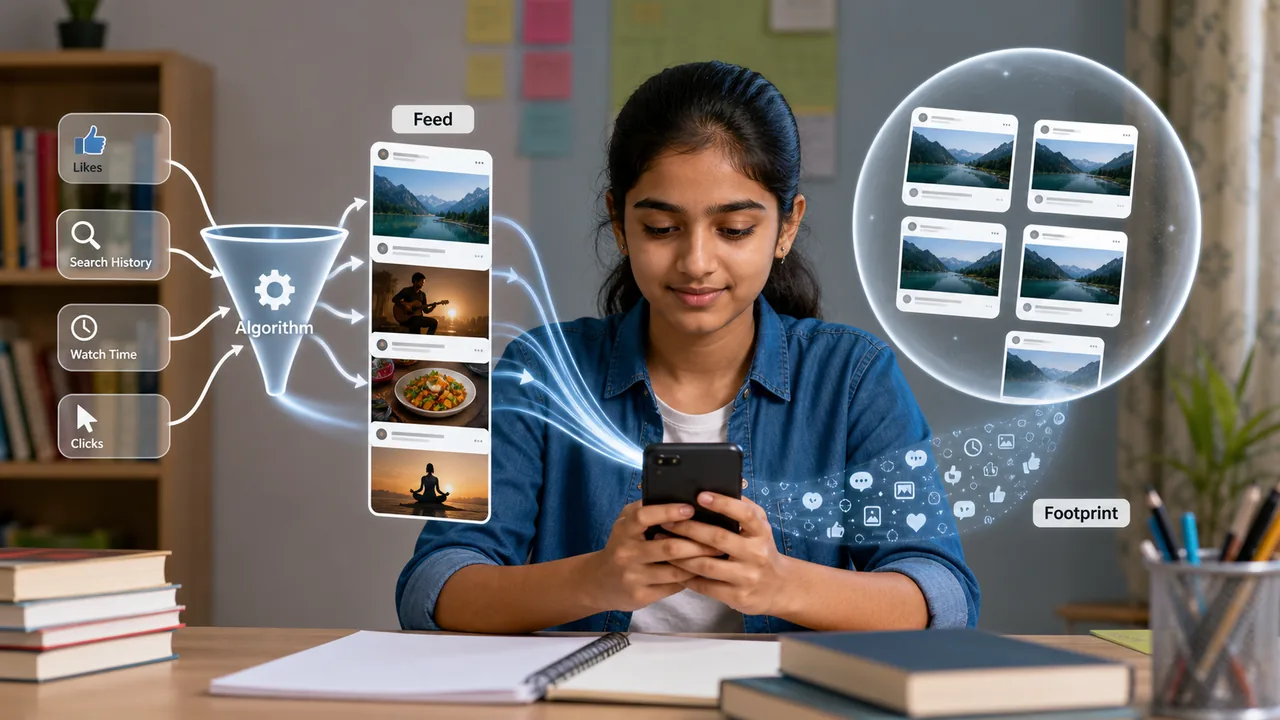
Social media platforms use algorithms to decide what content appears in your feed. They prioritize content based on:
- Engagement — posts with more likes, comments, shares appear higher
- Relevance — content matching your interests and past behavior
- Recency — newer posts get priority
- Relationships — content from close friends/frequent contacts ranks higher
Filter Bubble and Echo Chamber
| Concept | Description |
|---|---|
| Filter Bubble | Algorithms show you only content matching your views, creating an information bubble |
| Echo Chamber | You only hear opinions similar to yours, reinforcing existing beliefs |
Both can lead to a narrow worldview and increased polarization.
Digital Footprint
Your digital footprint is the trail of data you leave behind when using the internet.
| Type | Description | Example |
|---|---|---|
| Active Footprint | Data you intentionally share | Social media posts, emails, form submissions |
| Passive Footprint | Data collected without your direct action | Browsing history, cookies, IP address logs |
Online Safety
| Practice | Description |
|---|---|
| Privacy Settings | Control who can see your posts and personal information |
| Two-Factor Authentication (2FA) | Password + OTP/fingerprint for extra security |
| Strong Passwords | 8+ characters with uppercase, lowercase, numbers, symbols |
| Avoid Public WiFi | Don't access banking or sensitive data on open networks |
| Verify Links | Don't click suspicious links — check URL before clicking |
Online Threats
| Threat | Description |
|---|---|
| Cyberbullying | Harassment or intimidation through digital platforms |
| Trolling | Deliberately posting provocative content to upset others |
| Fake News | False information spread to mislead or manipulate |
| Doxing | Publishing someone's private information without consent |
| Identity Theft | Stealing personal data to impersonate someone |
Social Media in Governance
The Indian government actively uses social media for citizen engagement:
- MyGov.in — citizen participation platform
- Twitter/X — official government announcements, disaster alerts
- YouTube — PM addresses (Mann Ki Baat)
- WhatsApp — government chatbots for information delivery
- Digital India — initiative promoting ICT in governance
Li-Fi — Light-Based Communication
Li-Fi (Light Fidelity) uses LED light for data transmission instead of radio waves (WiFi).
| Feature | Details |
|---|---|
| Speed | Up to 224 Gbps in laboratory conditions |
| Medium | Visible light, infrared, or ultraviolet spectrum |
| Range | Limited to line-of-sight (within a room) |
| Security | More secure than WiFi — light does not pass through walls |
| Coined by | Harald Haas (University of Edinburgh, 2011) |
Exam tip: Li-Fi uses light; WiFi uses radio waves. Li-Fi is faster but works only in line-of-sight.
5G Bands in India
| Band | Frequency | Characteristic |
|---|---|---|
| Sub-6 GHz | Below 6 GHz (3.3–3.67 GHz in India) | Wider coverage, better penetration through buildings, moderate speed |
| mmWave (millimeter wave) | 24–40 GHz (26 GHz in India) | Ultra-fast speeds, but short range and poor building penetration |
- Jio uses both sub-6 GHz and mmWave
- Airtel primarily uses sub-6 GHz band
VoLTE & WiFi Calling
| Technology | Full Form | Description |
|---|---|---|
| VoLTE | Voice over LTE | HD voice calls over 4G network — no need to fall back to 2G/3G for calls |
| WiFi Calling | — | Voice calls made over WiFi when mobile signal is weak — uses internet instead of cellular network |
Exam tip: VoLTE = calls over 4G; WiFi Calling = calls over WiFi. Both provide HD voice quality.
OTT Platforms
OTT (Over-The-Top) platforms deliver media content directly over the internet, bypassing traditional cable/satellite distribution.
| Platform | Type | Owner |
|---|---|---|
| Netflix | Video streaming | Netflix Inc. |
| Disney+ Hotstar | Video streaming | Walt Disney |
| YouTube | Video sharing/streaming | |
| Amazon Prime Video | Video streaming | Amazon |
| Spotify | Music streaming | Spotify AB |
- OTT platforms are regulated under IT Rules 2021 in India
- Must have a grievance officer and content classification system
Digital Wellbeing
| Concept | Description |
|---|---|
| Digital Detox | Intentionally reducing or eliminating digital device usage for a period — to improve mental health and reduce screen addiction |
| Screen Time | Total time spent on digital devices — excessive use linked to eye strain, sleep disruption, anxiety |
| Nomophobia | Fear of being without a mobile phone |
Right to Privacy & IT Rules
Right to Privacy
The Supreme Court of India declared the Right to Privacy as a Fundamental Right under Article 21 in the landmark Justice K.S. Puttaswamy vs Union of India case (2017).
- 9-judge bench — unanimous decision
- Privacy is intrinsic to life and personal liberty
- Led to the formulation of the Digital Personal Data Protection Act, 2023
IT Rules 2021 (Intermediary Guidelines)
IT (Intermediary Guidelines and Digital Media Ethics Code) Rules, 2021 regulate social media and OTT platforms.
| Requirement | Details |
|---|---|
| Grievance Officer | Every platform must appoint one — resolve complaints within 15 days |
| Chief Compliance Officer | Significant social media intermediaries (5M+ users) must appoint one |
| Traceability | Must identify the first originator of a message if ordered by court |
| Content Removal | Remove unlawful content within 36 hours of government order |
| OTT Classification | Content classified as U, U/A 7+, U/A 13+, U/A 16+, A |
Deepfake
Deepfake refers to AI-generated fake videos, audio, or images that appear extremely realistic.
| Aspect | Details |
|---|---|
| Technology | Uses GANs (Generative Adversarial Networks) and deep learning |
| Risks | Misinformation, identity fraud, political manipulation, financial scams |
| Detection | AI-based deepfake detection tools, digital watermarking |
| India | Government issued advisory in November 2023 to social media platforms to identify and remove deepfakes |
Exam tip: Deepfakes are a growing cybersecurity concern — they can be used for identity theft and spreading fake news.
Summary Points
| Concept | Key Details |
|---|---|
| ICT | Information and Communication Technology |
| Simplex | One-way — TV, radio, keyboard |
| Half-Duplex | One at a time — walkie-talkie |
| Full-Duplex | Both ways simultaneously — phone call |
| Bandwidth | Data capacity in bps — Kbps, Mbps, Gbps |
| Serial vs Parallel | One bit at a time vs multiple bits simultaneously |
| 1G | Analog voice only, 1980s |
| 2G | Digital, SMS, GSM, 1990s |
| 3G | Mobile internet, video calls, 2000s |
| 4G/LTE | HD streaming, VoLTE, 100-300 Mbps |
| 5G | 10 Gbps, 1ms latency, IoT, launched India Oct 2022 |
| 5G Sub-6 GHz | Below 6 GHz — wider coverage, better building penetration |
| 5G mmWave | 24-40 GHz — ultra-fast speeds, short range |
| VoLTE | Voice over LTE — HD voice calls over 4G network |
| WiFi Calling | Voice calls over WiFi when mobile signal is weak |
| Li-Fi | Light Fidelity — up to 224 Gbps via LED, Harald Haas 2011, line-of-sight |
| GSM | Global System for Mobile Communication, uses SIM |
| eSIM | Embedded SIM, no physical card, switch carriers digitally |
| WiFi 6 | 802.11ax, 9.6 Gbps, latest standard |
| Accelerometer | Detects motion/tilt — auto-rotate |
| Proximity Sensor | Turns off screen during calls |
| GPS | 24+ satellites, 3-5m accuracy, NavIC (India, ISRO, 7 satellites) |
| NFC | Contactless payments, 4 cm range |
| LiDAR | Laser-based 3D mapping |
| OTT Platforms | Content over internet (Netflix, Hotstar) — regulated under IT Rules 2021 |
| Digital Detox | Reducing digital device usage for mental health |
| Nomophobia | Fear of being without a mobile phone |
| Right to Privacy | Fundamental Right, Article 21, Puttaswamy case 2017, 9-judge bench |
| IT Rules 2021 | Grievance Officer, traceability, content removal in 36 hrs, OTT classification |
| DPDP Act 2023 | Digital Personal Data Protection Act — from Puttaswamy ruling |
| Deepfakes | AI-generated fake media using GANs — misinformation, identity fraud |
| Filter Bubble | Algorithm shows only matching content |
| Echo Chamber | Only hear similar opinions |
| Digital Footprint | Active (posts) + Passive (browsing history) |
| MyGov.in | Citizen participation platform |
| 2FA | Password + OTP/fingerprint for security |
Lesson Doubts
Ask questions, get expert answers