⛏️ Mineral Wealth of UP
Overview of Uttar Pradesh's mineral resources — classification, main mineral belts, key minerals, revenue from mining, and comparison with mineral-rich states for Uttar Pradesh GK.
Mineral Classification of UP
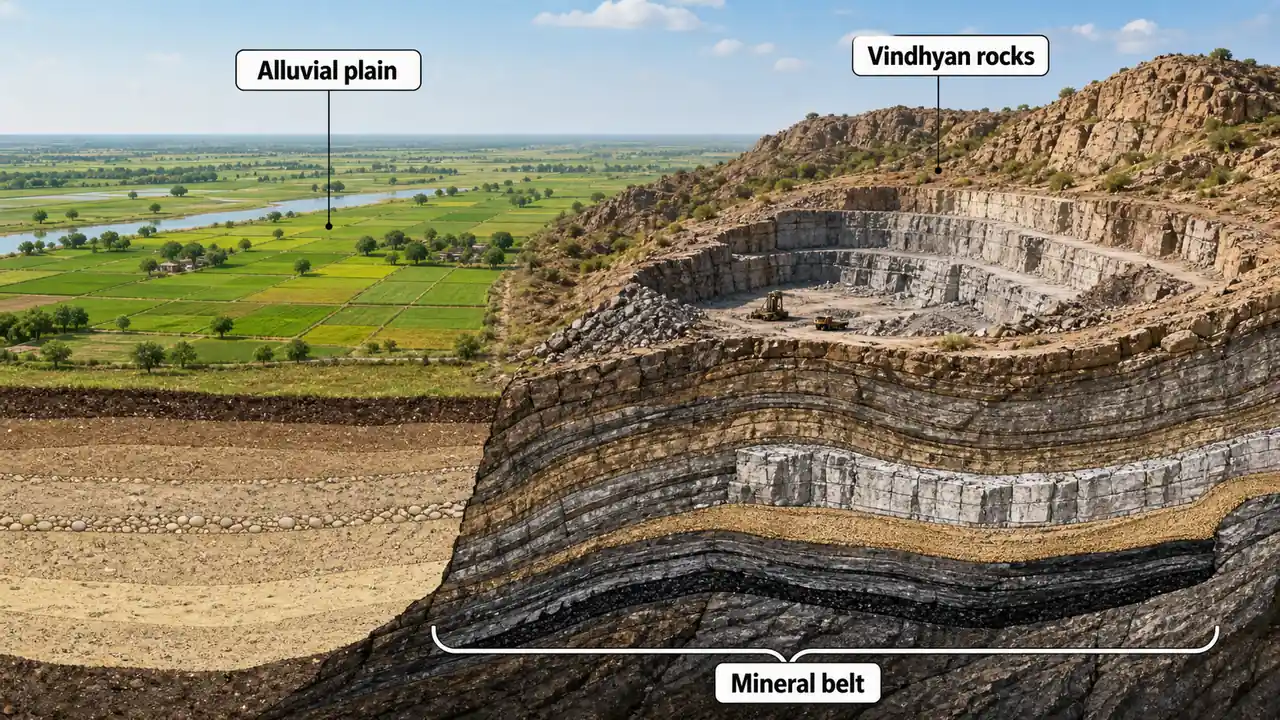
Uttar Pradesh is classified as a low-to-medium mineral state by the Indian Bureau of Mines. Unlike Jharkhand, Odisha, or Chhattisgarh — which sit on ancient Precambrian shields rich in metallic ores — UP's geology is dominated by the Indo-Gangetic alluvial plain, which has virtually no hard-rock mineral deposits.
The mineral wealth that UP does possess is concentrated in its southern fringe, where the Vindhyan and Bundelkhand geological formations emerge. These are primarily non-metallic and industrial minerals.
The easiest way to understand UP's mineral geography is this:
- the alluvial plain is agriculturally rich but mineral-poor
- the southern hard-rock belt is where most mineral occurrences are found
- UP is more important for industrial and construction minerals than for large metallic ore production
| Classification | Details |
|---|---|
| Mineral Status | Low-to-medium mineral state |
| Dominant Type | Non-metallic minerals (limestone, silica sand, dolomite) |
| Geological Formations | Vindhyan Supergroup, Bundelkhand Gneissic Complex |
| Alluvial Plain | Covers ~75% of state — negligible hard-rock minerals |
Exam Tip: When asked about UP's mineral status, remember that it is stronger in non-metallic and industrial minerals than in metallic minerals compared with peninsular states.
The Mineral Belt: Sonbhadra-Mirzapur-Bundelkhand
The principal mineral-bearing zone in UP stretches across Sonbhadra, Mirzapur, and the Bundelkhand region (Lalitpur, Hamirpur, Banda, Chitrakoot). This belt lies along the northern edge of the Vindhyan Plateau and the Bundelkhand Massif.
Sonbhadra district accounts for the largest share of UP's mineral output. It is often called the "energy capital" of UP because mineral extraction there is closely linked with thermal and power infrastructure.
District-wise Mineral Concentration
| District | Key Minerals |
|---|---|
| Sonbhadra | Coal, limestone, dolomite, bauxite, uranium |
| Mirzapur | Limestone, sandstone, silica sand |
| Lalitpur | Copper occurrence (Sonrai area), pyrophyllite |
| Banda | Limestone, building stone |
| Prayagraj | Glass sand, silica sand (Shankargarh) |
| Hamirpur | Pyrophyllite, building stone |
Key Minerals at a Glance
UP's mineral inventory is dominated by construction and industrial-grade minerals. The Geological Survey of India (GSI) has identified over 20 mineral types in the state, though only a handful are commercially extracted at scale.
| Mineral | Primary Use | Key Locations |
|---|---|---|
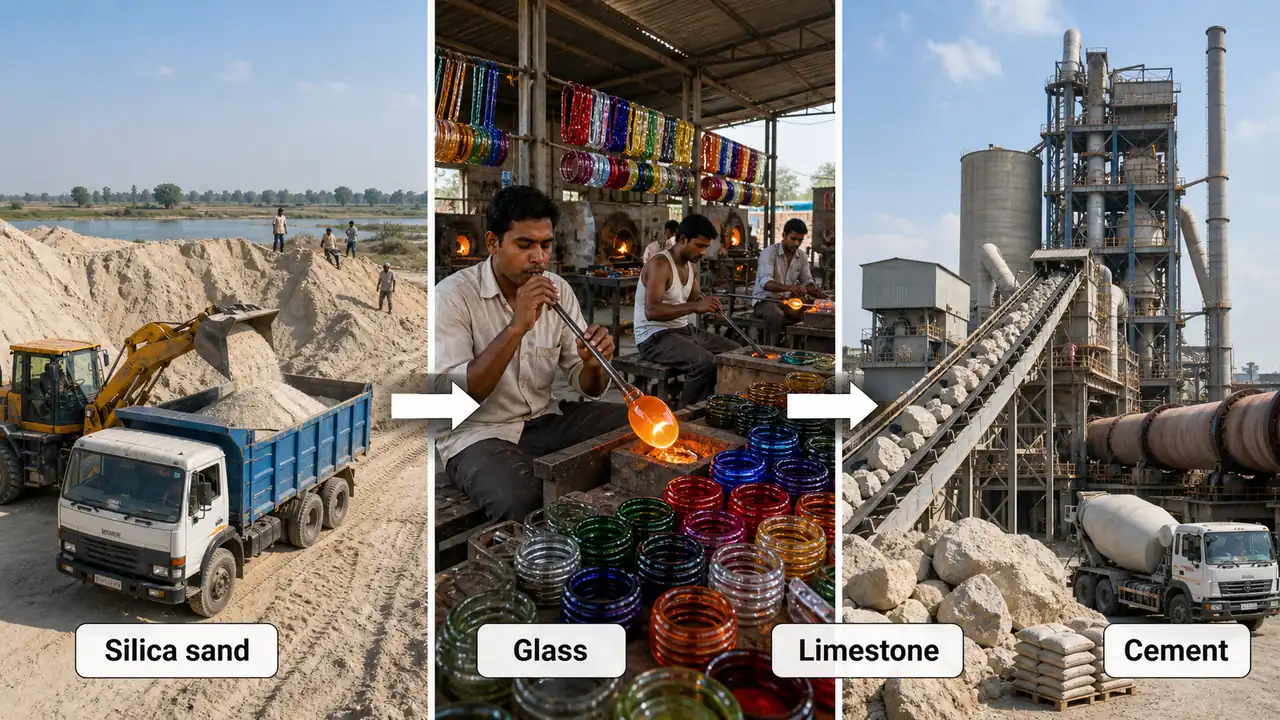
| Limestone | Cement, chemical industry | Mirzapur, Sonbhadra, Banda |
| Coal | Thermal power generation | Sonbhadra (Singrauli coalfield) |
| Silica Sand | Glass manufacturing | Shankargarh (Prayagraj) |
| Dolomite | Steel flux, refractory | Sonbhadra, Mirzapur |
| Gypsum | Plaster, cement additive | Western UP pockets |
| Copper | Electrical, industrial | Lalitpur (Sonrai area) |
| Uranium | Strategic/nuclear use | Sonbhadra occurrence zone |
| Sandstone | Construction, export | Vindhyan region |
Revenue and Economic Contribution
Mining contributes a relatively modest share to UP's economy compared with mineral-rich states like Odisha or Jharkhand. However, the sand and minor mineral segment generates important revenue because of the state's construction demand.
| Parameter | UP | Jharkhand | Odisha |
|---|---|---|---|
| Mining role in economy | Modest | Major | Major |
| Dominant Mineral Type | Non-metallic | Metallic (iron, coal) | Metallic (iron, bauxite) |
| Mineral profile | Industrial / minor minerals | Major ore base | Major ore base |
The Directorate of Geology and Mining (UP) oversees mineral exploration, licensing, and royalty collection.
GSI Findings and Future Potential
The Geological Survey of India has conducted multiple surveys in southern UP and identified:
- Uranium deposits in Sonbhadra — of strategic significance under the Atomic Energy Commission
- Copper occurrence at Sonrai (Lalitpur) — important for exploration-oriented questions
- Rare earth potential in the Bundelkhand Gneissic Complex
- Diaspore deposits in Sonbhadra — a source of alumina
Despite these findings, large-scale extraction remains limited due to environmental clearance hurdles, forest cover restrictions, and the strategic nature of uranium reserves.
Exam Tip: Sonbhadra is the single most important district for UP's mineral wealth — coal, limestone, dolomite, bauxite, and uranium are all found here.
Comparison with Mineral-Rich States
| Factor | UP | Chhattisgarh | Rajasthan |
|---|---|---|---|
| Iron Ore | Negligible | Major producer | Moderate |
| Coal | Sonbhadra only | Korba, Raigarh | Limited |
| Limestone | Strong (Vindhyan belt) | Moderate | Largest producer |
| Copper | Sonrai occurrence | Negligible | Khetri (major) |
| Silica Sand | Important industrial mineral | Limited | Moderate |
UP compensates for its weak metallic mineral base through the importance of non-metallic and industrial minerals — especially limestone, silica sand, sandstone, and related construction minerals.
Summary Cheat Sheet
| Item | Quick Fact |
|---|---|
| Mineral Status | Low-to-medium |
| Dominant Type | Non-metallic |
| Main Belt | Sonbhadra-Mirzapur-Bundelkhand |
| Richest District | Sonbhadra |
| Main contrast | Alluvial plain poor; southern hard-rock belt richer |
| Strategic Minerals | Uranium (Sonbhadra), Copper occurrence (Lalitpur) |
| Regulatory Body | Directorate of Geology and Mining, UP |
Lesson Doubts
Ask questions, get expert answers