🐾 Wildlife Sanctuaries of UP
Complete list of major wildlife sanctuaries in Uttar Pradesh — Chandraprabha, Hastinapur, National Chambal, Katarniaghat, Ranipur Tiger Reserve for Uttar Pradesh GK.
Wildlife Sanctuaries — Overview
Uttar Pradesh has around two dozen wildlife sanctuaries spread across different ecological zones. While UP lacks the dense forests of central and southern India, its sanctuaries protect crucial habitats — from Terai grasslands to riverine ecosystems to dry deciduous forests.
The sanctuaries are managed by the UP Forest Department under the Wildlife Protection Act, 1972. Unlike national parks, wildlife sanctuaries allow limited human activity (grazing, movement) within their boundaries.
The easiest way to study this lesson is by grouping sanctuaries into types:
- Vindhyan / dry forest sanctuaries such as Chandraprabha
- floodplain and river sanctuaries such as Hastinapur and Chambal
- Terai wildlife sanctuaries such as Katarniaghat and Kishanpur
Exam Tip: UP has only ONE national park (Dudhwa) but around two dozen wildlife sanctuaries. The distinction: national parks have stricter protection — no grazing, no human habitation, no resource extraction.
Chandraprabha Wildlife Sanctuary — First in UP
Chandraprabha Wildlife Sanctuary holds the distinction of being the first wildlife sanctuary established in Uttar Pradesh.
| Parameter | Details |
|---|---|
| Location | Chandauli district |
| Established | 1957 |
| Area | ~78 sq km |
| Terrain | Vindhyan hills, deciduous forest |
| Key Species | Leopard, chinkara, sambar, nilgai, wild boar |
| Historical Note | Asiatic lions were reintroduced here in 1957 (failed experiment) |
The lion reintroduction experiment at Chandraprabha (3 lions from Gir) ultimately failed due to poaching and habitat unsuitability. Today, it is primarily known for its leopard population and Vindhyan landscape.
Hastinapur Wildlife Sanctuary — Largest in UP
Hastinapur Wildlife Sanctuary is commonly cited as the largest wildlife sanctuary in Uttar Pradesh, spanning an enormous area across the Ganga-Yamuna Doab.
| Parameter | Details |
|---|---|
| Location | Multi-district sanctuary in western UP |
| Established | 1986 |
| Area | ~2,073 sq km |
| Habitat | Ganga-Yamuna floodplain, grasslands, ravines |
| Key Species | Gharial, Gangetic dolphin, nilgai, wild boar, jackal |
| River Systems | Ganga and its tributaries |
Despite its massive area, Hastinapur is heavily fragmented by human settlements, agriculture, and roads. Conservation efforts focus more on riverine, floodplain, and ravine habitats than on dense forest blocks.
Exam Tip: Hastinapur WLS = Largest in UP (~2,073 sq km). It is NOT a dense forest — it is a floodplain/ravine landscape spanning multiple districts.
National Chambal Sanctuary — Gharial Paradise
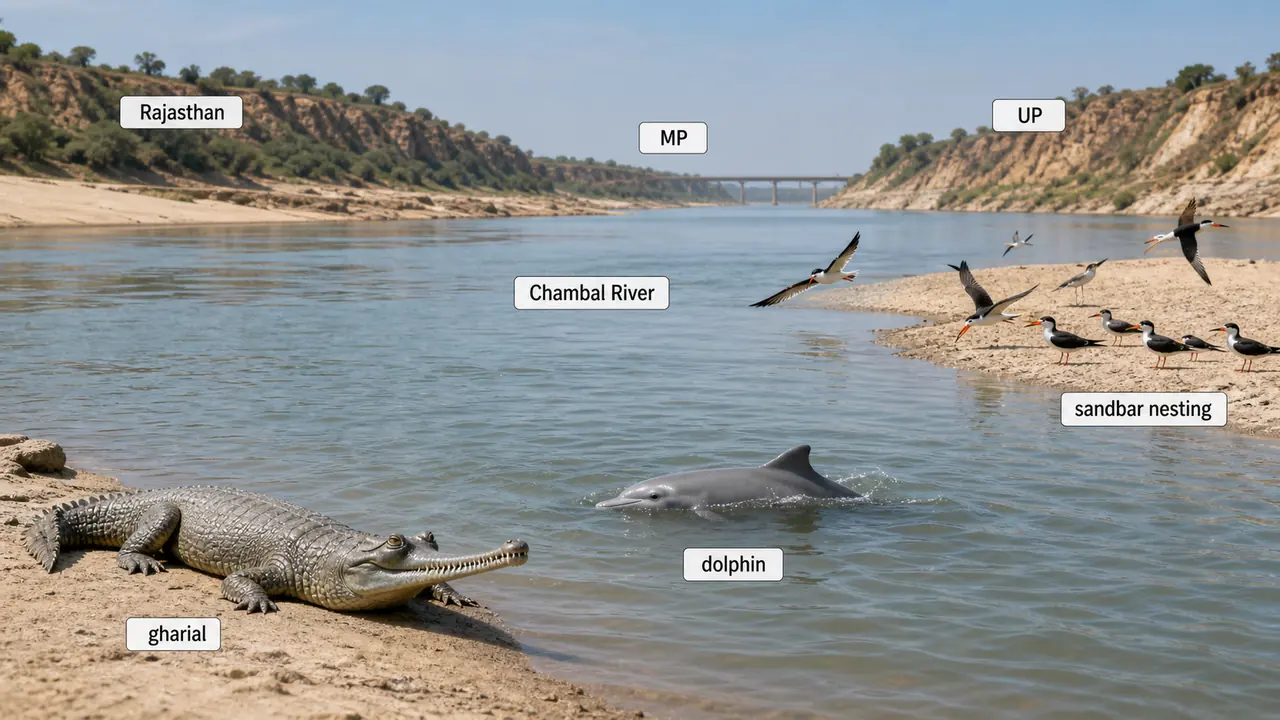
The National Chambal Sanctuary protects one of India's cleanest rivers — the Chambal — and its iconic reptilian inhabitant, the gharial.
| Parameter | Details |
|---|---|
| Location | Shared between UP, Madhya Pradesh, and Rajasthan |
| UP Portion | Agra and Etawah districts |
| Established | 1979 |
| Total Area | ~5,400 sq km (tri-state) |
| Key Species | Gharial, Gangetic dolphin, mugger crocodile, Indian skimmer |
| River | Chambal (tributary of Yamuna) |
| UNESCO Status | Often discussed for its conservation importance, but best remembered as a tri-state river sanctuary |
The Chambal remains relatively pristine because ravine-riddled terrain discouraged human settlement. It hosts the largest surviving gharial population in the world.
Key Species of Chambal
| Species | IUCN Status | Significance |
|---|---|---|
| Gharial | Critically Endangered | Fish-eating crocodilian, long snout |
| Gangetic Dolphin | Endangered | India's National Aquatic Animal |
| Red-crowned Roof Turtle | Critically Endangered | Among world's rarest turtles |
| Indian Skimmer | Endangered | Breeds on Chambal sandbars |
Katarniaghat Wildlife Sanctuary
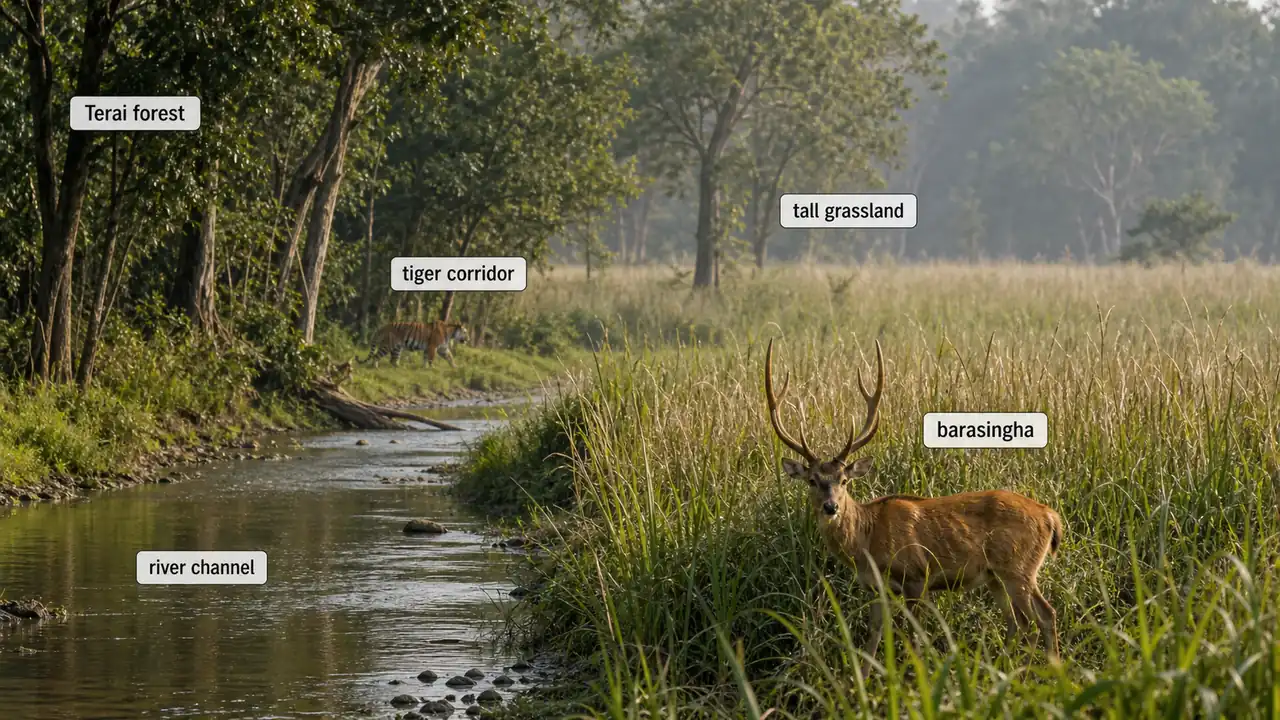
Katarniaghat Wildlife Sanctuary in the Terai belt is one of UP's most biodiverse protected areas.
| Parameter | Details |
|---|---|
| Location | Bahraich district |
| Established | 1975 |
| Area | ~400 sq km |
| Habitat | Terai forests, wetlands, rivers |
| Key Species | Tiger, gharial, Gangetic dolphin, swamp deer, fishing cat |
| River | Girwa (tributary of Ghaghra/Saryu) |
| Relation to Dudhwa | Forms part of the wider Dudhwa Tiger Reserve / Terai landscape |
Katarniaghat is notable for supporting both tigers and gharials — a rare combination. The Girwa River within the sanctuary is a breeding ground for gharials.
Ranipur Wildlife Sanctuary — Now a Tiger Reserve
Ranipur Wildlife Sanctuary in Chitrakoot was recently notified as UP's 4th Tiger Reserve (after Dudhwa, Pilibhit, and Amangarh), marking a significant expansion of tiger conservation in the state.
| Parameter | Details |
|---|---|
| Location | Chitrakoot district (Bundelkhand) |
| Established | 1977 (as WLS) |
| Tiger Reserve Status | 2022 |
| Area | ~230 sq km |
| Habitat | Vindhyan dry deciduous forest |
| Key Species | Tiger, leopard, sloth bear, chinkara, vulture |
| Connectivity | Links to Panna Tiger Reserve (MP) |
Ranipur's elevation to tiger reserve status is significant because it strengthens the conservation corridor between UP's Vindhyan forests and Panna Tiger Reserve in Madhya Pradesh, enabling tiger dispersal.
Other Important Sanctuaries
| Sanctuary | District | Year | Area (sq km) | Key Species |
|---|---|---|---|---|
| Kishanpur | Lakhimpur Kheri | 1972 | 204 | Tiger, rhino, swamp deer |
| Sohagi Barwa | Maharajganj | 1987 | 428 | Tiger, leopard, elephant |
| Kaimoor | Mirzapur/Sonbhadra | 1982 | 501 | Sloth bear, leopard, vulture |
| Chandra Prabha | Chandauli | 1957 | 78 | Leopard, sambar, chinkara |
| Mahavir Swami | Lalitpur | 1977 | 5.4 | Chinkara, nilgai |
| Patna Bird | Etah | 1990 | 1.1 | Migratory birds |
| Saman | Mainpuri | 1990 | 5.3 | Sarus crane, migratory birds |
This section is easier to revise if you remember a few anchors instead of the full list:
- Kishanpur -> Dudhwa-linked Terai sanctuary
- Sohagi Barwa -> north-eastern forested sanctuary
- Kaimoor / Chandraprabha -> Vindhyan landscape sanctuaries
- Patna Bird / Saman -> wetland-bird sanctuaries
UP's Tiger Reserves
UP now has 4 Tiger Reserves:
| Tiger Reserve | District | Year | Area |
|---|---|---|---|
| Dudhwa | Lakhimpur Kheri | Late 1980s | ~884 sq km |
| Pilibhit | Pilibhit | 2014 | ~730 sq km |
| Amangarh | Bijnor | 2012 | ~816 sq km (buffer of Corbett) |
| Ranipur | Chitrakoot | 2022 | ~230 sq km |
Exam Tip: Pilibhit Tiger Reserve won the TX2 Award (2020) from the Global Tiger Initiative for doubling its tiger population. It is a Terai landscape reserve.
Summary Cheat Sheet
| Item | Quick Fact |
|---|---|
| Total WLS | Around two dozen |
| First WLS | Chandraprabha (1957, Chandauli) |
| Largest WLS | Hastinapur (~2,073 sq km, 6 districts) |
| Gharial Sanctuary | National Chambal (UP-MP-Rajasthan) |
| Terai Tiger+Gharial | Katarniaghat (Bahraich) |
| Newest Tiger Reserve | Ranipur (2022, Chitrakoot) |
| TX2 Award Winner | Pilibhit Tiger Reserve (2020) |
| Total Tiger Reserves | 4 (Dudhwa, Pilibhit, Amangarh, Ranipur) |
Lesson Doubts
Ask questions, get expert answers