🦌 State Symbols & Biodiversity Highlights
UP state animal (Barasingha), state bird (Sarus Crane), state tree (Ashoka), state flower (Palash), state fish, endangered species, and biodiversity hotspots for Uttar Pradesh GK.
State Symbols — Complete Reference
Every Indian state designates official symbols representing its natural and cultural identity. UP's state symbols reflect the biodiversity of the Gangetic plain and Terai ecosystems.
The easiest way to revise this lesson is in two layers:
- first, memorize the official state symbols
- then connect them to the real ecosystems of UP such as Dudhwa, wetlands, Chambal, and the Gangetic plain
| Symbol | Species | Scientific Name |
|---|---|---|
| State Animal | Barasingha (Swamp Deer) | Rucervus duvaucelii |
| State Bird | Sarus Crane | Antigone antigone |
| State Tree | Ashoka | Saraca asoca |
| State Flower | Palash (Flame of Forest) | Butea monosperma |
| State Fish | Moh / Chital | Chitala chitala |
| State Dance | Kathak | — |
| State Sport | Field Hockey | — |
Exam Tip: This table is one of the most frequently tested topics in UP GK. Memorize all symbols including the state dance and sport.
State Dance — Kathak
Kathak is UP's official state dance and one of the eight classical dance forms of India. The word "Kathak" derives from katha (story) — it originated as a form of temple storytelling where wandering bards narrated epics through dance and mime.
Two major gharanas (schools) of Kathak flourished in UP:
| Gharana | City | Characteristic |
|---|---|---|
| Lucknow Gharana | Lucknow | Emphasis on expressiveness (abhinaya), grace, and Nawabi elegance |
| Banaras Gharana | Varanasi | Emphasis on footwork (tatkar), rhythm, and pure dance (nritta) |
The Lucknow gharana developed under the patronage of the Nawabs of Awadh, blending Hindu devotional storytelling with Mughal court aesthetics. Legendary exponents include Birju Maharaj (Lucknow gharana).
State Sport — Field Hockey
Field Hockey is the designated state sport of Uttar Pradesh. UP has produced several national and international hockey players and hosts major hockey infrastructure including the Major Dhyan Chand Stadium in Lucknow, named after the legendary hockey wizard from Jhansi, UP.
State Emblem
The official emblem of Uttar Pradesh carries deep historical and cultural symbolism:
| Element | Significance |
|---|---|
| Confluence of Ganga-Yamuna | Represents the sacred Sangam at Prayagraj |
| Pair of Matsya (fish) | Legacy of the Nawabs of Awadh who used the fish emblem |
| Bow and Arrow | Symbolizes Lord Ram and Ayodhya |
The emblem beautifully combines the Hindu and Islamic heritage of the state — the bow and arrow of Lord Ram alongside the Matsya (fish) symbol of the Nawabi era, unified by the sacred rivers.
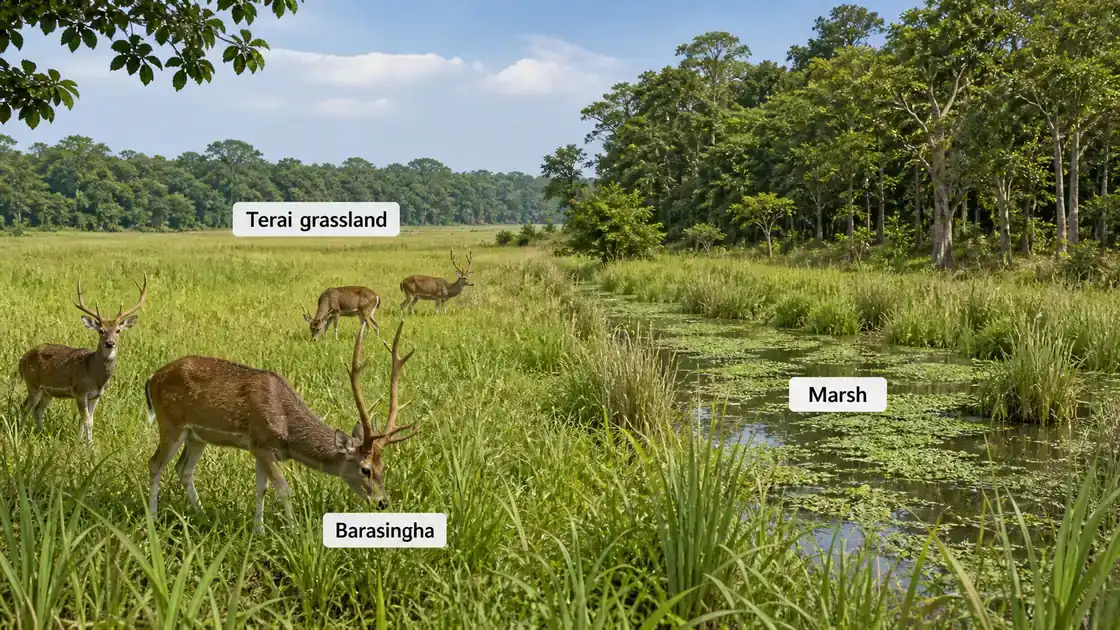
State Animal — Barasingha (Swamp Deer)
The Barasingha (Rucervus duvaucelii) is a large deer endemic to the Indian subcontinent, found in marshy grasslands and floodplain meadows.
| Parameter | Details |
|---|---|
| Common Name | Barasingha / Swamp Deer (दलदल का हिरण) |
| Scientific Name | Rucervus duvaucelii |
| IUCN Status | Vulnerable |
| Schedule | Schedule I of Wildlife Protection Act, 1972 |
| Height | ~120–135 cm at shoulder |
| Weight | Males: 170–280 kg |
| Antlers | 10–14 tines (Bara = 12, Singha = horn) |
| Habitat | Marshy grasslands, swampy meadows |
| Diet | Grasses, aquatic vegetation |
Subspecies in India
| Subspecies | Location | Habitat |
|---|---|---|
| R. d. duvaucelii (Wetland) | Dudhwa (UP) — largest population | Swampy grasslands |
| R. d. branderi (Hard-ground) | Kanha (MP) | Dry grasslands |
| R. d. ranjitsinhi (Eastern) | Kaziranga (Assam) | Alluvial grasslands |
The Dudhwa population is one of the most important surviving populations of the wetland subspecies. Billy Arjan Singh's conservation efforts in the 1960s-70s helped save this subspecies from near-extinction when numbers had fallen drastically.
State Bird — Sarus Crane
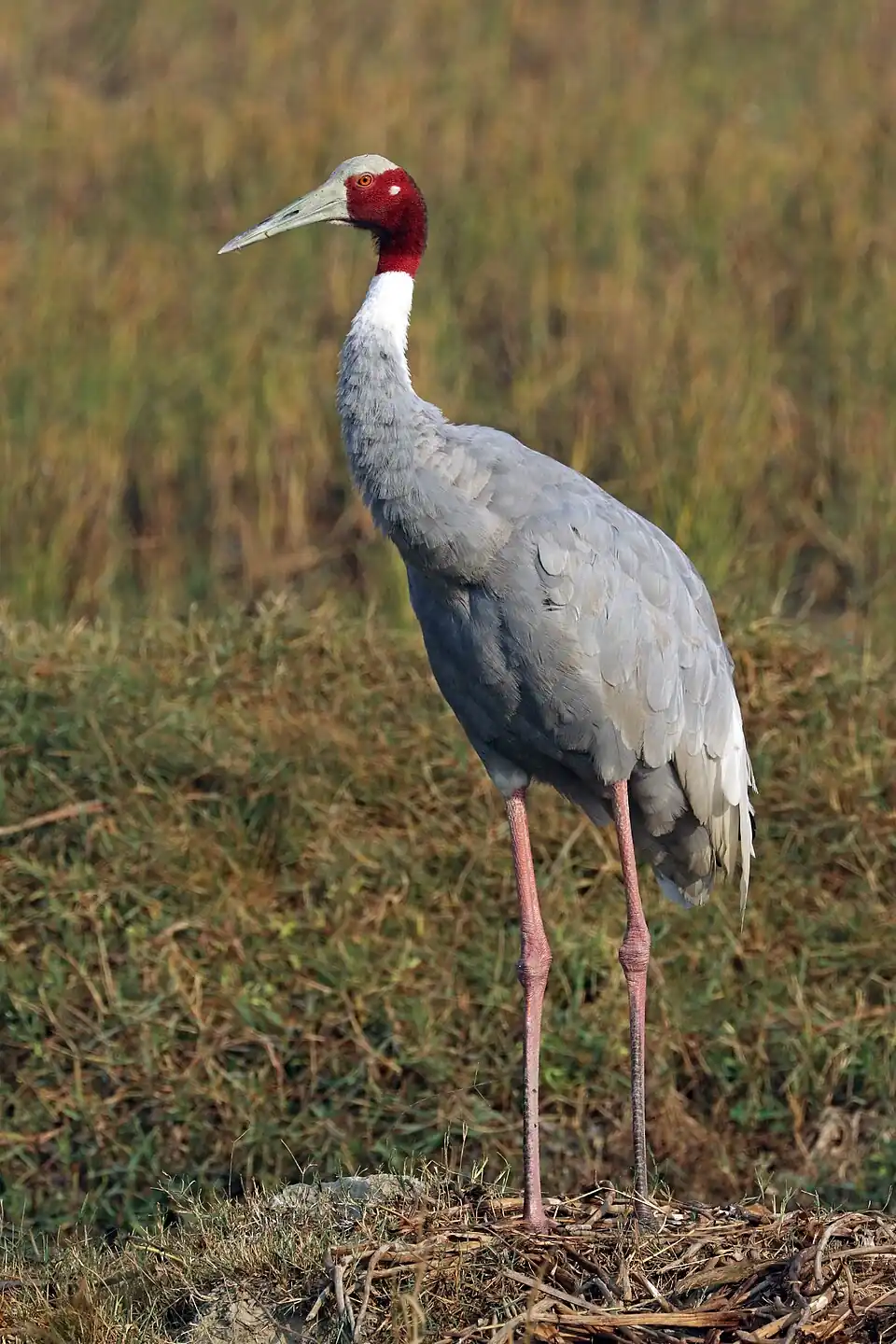
The Sarus Crane (Antigone antigone) holds a special place in Indian culture and is UP's most recognizable bird.
| Parameter | Details |
|---|---|
| Scientific Name | Antigone antigone |
| IUCN Status | Vulnerable |
| Height | Up to 1.8 m (6 feet) |
| Distinction | World's tallest flying bird |
| Wingspan | ~2.5 m |
| Plumage | Grey body, bare red head and upper neck |
| Behaviour | Monogamous — pairs bond for life |
| Call | Loud trumpeting, audible over 2 km |
| Breeding Season | July–October (monsoon) |
| Nest | Ground nest in shallow water/marshes |
Population and Distribution
| Region | General Status |
|---|---|
| Uttar Pradesh | One of the strongest Sarus populations in India |
| Rajasthan | Important population |
| Gujarat | Smaller but notable population |
| MP and others | Scattered populations |
| Global Context | Mostly concentrated in the Indian subcontinent |
UP's Etawah-Mainpuri-Kannauj belt is widely regarded as one of the strongest Sarus-crane landscapes. The bird thrives in paddy fields and marshes where farmers traditionally protect it.
Cultural Significance
The Sarus Crane appears in the opening verse of the Ramayana — sage Valmiki witnessed a hunter killing a Sarus from a pair, and his grief at the separation of the mates inspired the first shloka of the epic. In rural UP, killing a Sarus is considered deeply inauspicious.
State Tree — Ashoka
The Ashoka tree (Saraca asoca) is revered in Indian mythology and has significant medicinal value.
| Parameter | Details |
|---|---|
| Scientific Name | Saraca asoca |
| Family | Fabaceae (Leguminosae) |
| Common Names | Ashoka, Sita Ashoka |
| Height | 7–10 metres |
| Flowers | Orange-red clusters, fragrant |
| Flowering Season | February–April |
| Bark Use | Ayurvedic medicine (Ashokarishtam — gynecological treatment) |
Mythological Connections
- Ramayana — Sita was held captive in the Ashoka Vatika (grove of Ashoka trees) in Lanka
- Buddhism — Queen Maya Devi gave birth to Siddhartha (Buddha) under an Ashoka tree in Lumbini
- Jainism — associated with Tirthankara Neminatha
- The name "Ashoka" means "without sorrow" (a = without, shoka = sorrow)
Exam Tip: Do not confuse Saraca asoca (the true Ashoka) with Polyalthia longifolia (the "false Ashoka" or mast tree commonly planted along roads). The state tree is Saraca asoca.
State Flower — Palash (Flame of Forest)
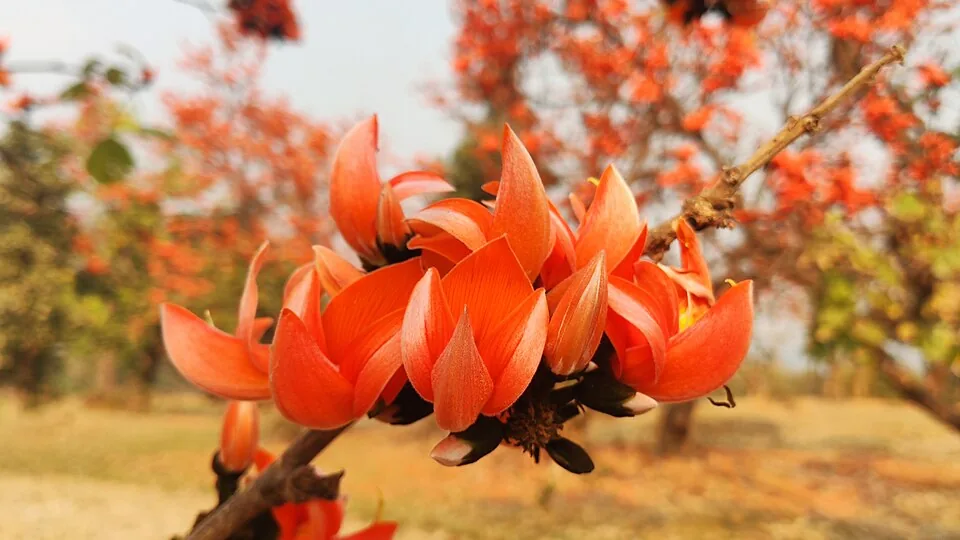
The Palash (Butea monosperma) transforms the dry deciduous forests of UP into a blaze of orange-red every spring.
| Parameter | Details |
|---|---|
| Scientific Name | Butea monosperma |
| Family | Fabaceae |
| Common Names | Palash, Dhak, Flame of Forest, Parrot Tree |
| Height | 8–15 metres |
| Flowers | Bright orange-red, claw-shaped petals |
| Flowering Season | February–March (before new leaves) |
| Traditional Use | Natural Holi colours extracted from flowers |
| Other Uses | Lac cultivation, fodder, Ayurvedic medicine |
The Palash is intimately connected to the festival of Holi — the traditional orange-red colour (tesu/kesudo) for Holi was made by soaking Palash flowers in water. Before synthetic colours, this was the primary Holi dye across northern India.
State Fish — Moh / Chital
The Chital (Chitala chitala), also called Moh, is a large freshwater fish of the knifefish family found in the Gangetic river system.
| Parameter | Details |
|---|---|
| Scientific Name | Chitala chitala |
| Common Names | Moh, Chital, Clown Knifefish |
| Family | Notopteridae |
| Habitat | Rivers, lakes, floodplain wetlands |
| Size | Up to 1 metre, weight up to 5 kg |
| IUCN Status | Near Threatened |
| Distribution | Ganga, Yamuna, Ghaghra river systems |
| Culinary Value | Prized food fish in eastern UP and Bihar |
This symbol is easy to miss because students often focus only on animal, bird, tree, and flower. For UP exams, Chital / Moh = state fish is a direct recall fact worth memorizing separately.
Endangered Species of UP
Beyond the state symbols, UP hosts several critically threatened species that deserve attention:
Gangetic River Dolphin
| Parameter | Details |
|---|---|
| Scientific Name | Platanista gangetica |
| Status | Endangered (IUCN) |
| National Designation | India's National Aquatic Animal (2009) |
| UP Habitat | Chambal, Ganga, Ghaghra rivers |
| Threats | Dam barriers, pollution, fishing nets |
The dolphin is functionally blind and navigates using echolocation. The Chambal and relatively cleaner upper river stretches are especially important for its survival.
Gharial
| Parameter | Details |
|---|---|
| Scientific Name | Gavialis gangeticus |
| Status | Critically Endangered |
| UP Habitat | Chambal River, Girwa River (Katarniaghat) |
| Key Feature | Long, narrow snout with bulbous "ghara" (males) |
| Diet | Exclusively fish |
| Conservation | Gharial breeding centre at Kukrail (Lucknow) |
Bengal Florican
| Parameter | Details |
|---|---|
| Scientific Name | Houbaropsis bengalensis |
| Status | Critically Endangered |
| UP Habitat | Dudhwa and Pilibhit grasslands |
| Significance | One of the rarest bustards in the world |
Biodiversity Hotspots in UP
While UP does not contain any of the four globally recognized biodiversity hotspots of India, it has areas of high conservation value:
| Area | Significance |
|---|---|
| Terai Belt | Highest biodiversity — tigers, rhinos, elephants, florican |
| Chambal Ravines | Gharial, dolphin, red-crowned turtle |
| Vindhyan Forests | Sloth bear, leopard, vulture nesting |
| Gangetic Floodplain Wetlands | Fish diversity, migratory birds |
| Bundelkhand Rocky Outcrops | Chinkara, vulture colonies |
The Terai Arc Landscape is considered a conservation priority area at the global level for tiger and elephant habitat connectivity.
Summary Cheat Sheet
| Symbol | Species | Scientific Name | Key Fact |
|---|---|---|---|
| Animal | Barasingha | Rucervus duvaucelii | 10–14 antler tines, Vulnerable |
| Bird | Sarus Crane | Antigone antigone | 6 ft tall, monogamous |
| Tree | Ashoka | Saraca asoca | Sita's Ashoka Vatika |
| Flower | Palash | Butea monosperma | Natural Holi colour |
| Fish | Chital/Moh | Chitala chitala | Gangetic knifefish |
| Aquatic | Gangetic Dolphin | Platanista gangetica | National Aquatic Animal |
| Dance | Kathak | — | Lucknow & Banaras gharanas |
| Sport | Field Hockey | — | Major Dhyan Chand legacy |
| Emblem | State Emblem | — | Ganga-Yamuna, Matsya, Bow & Arrow |
| Reptile | Gharial | Gavialis gangeticus | Critically Endangered |
Lesson Doubts
Ask questions, get expert answers