♻️ Environmental Challenges of UP
Air pollution, Ganga-Yamuna pollution, groundwater depletion, soil degradation, urban waste crisis, and green initiatives in Uttar Pradesh for Uttar Pradesh GK.
The Environmental Crisis — Scale of the Problem
Uttar Pradesh faces environmental challenges that are amplified by its very large population, rapid urbanization, intensive agriculture, and industrial growth. The state repeatedly appears in national discussions on air pollution, water contamination, groundwater stress, and land degradation.
The easiest way to understand this lesson is through five problem clusters:
- air pollution in NCR and plain cities
- river pollution in the Ganga-Yamuna system
- groundwater stress in agriculture-heavy regions
- soil degradation such as usar and erosion
- urban waste and industrial management gaps
Air Pollution — NCR and Beyond
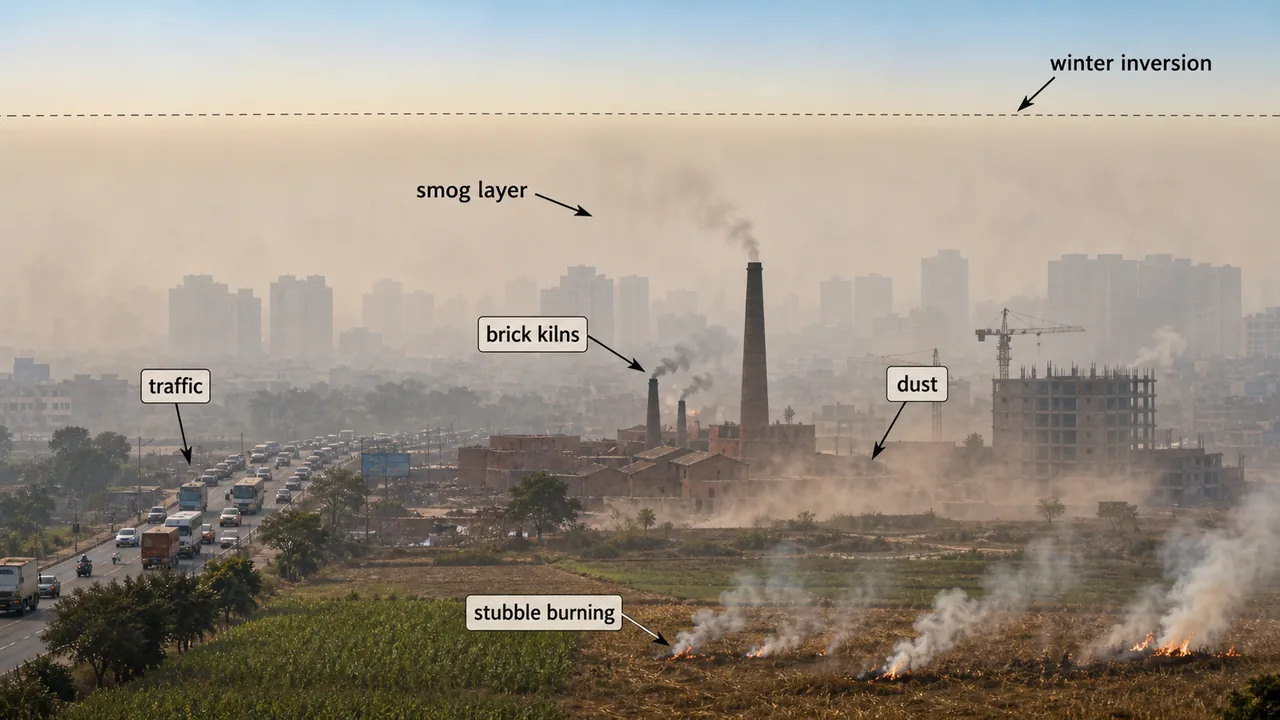
Several UP districts frequently rank among the most polluted urban regions in India by PM2.5 levels. The problem is most acute in the National Capital Region (NCR) districts but extends across the Indo-Gangetic plain.
Most Polluted Districts
| District | Key Pollution Sources |
|---|---|
| Ghaziabad | Vehicular emissions, construction dust, industry |
| Noida / Greater Noida | Traffic, construction, thermal power |
| Bulandshahr | Stubble burning, brick kilns |
| Lucknow | Vehicular pollution, waste burning |
| Kanpur | Industrial emissions (tanneries, chemicals) |
| Agra | Vehicular + Mathura refinery impact |
Sources of Air Pollution
| Source | Contribution | Season |
|---|---|---|
| Stubble Burning (Parali) | Major contributor to winter smog | October–November |
| Vehicular Emissions | Year-round, worst in NCR | All year |
| Brick Kilns | Very large statewide source of particulate matter | October–June |
| Industrial Emissions | Tanneries (Kanpur), refineries (Mathura) | All year |
| Construction Dust | Rapid urbanization across UP | All year |
| Waste Burning | Open garbage burning in cities | All year |
| Crop Residue | Post-harvest burning in western UP | Oct–Nov, Apr–May |
Exam Tip: Ghaziabad and adjoining NCR cities are repeatedly cited in pollution discussions. Brick kilns, traffic, dust, stubble burning, and waste burning together create the winter pollution crisis.
Government Response
- Graded Response Action Plan (GRAP) — emergency measures during severe pollution in NCR
- National Clean Air Programme (NCAP) — long-term city-level air pollution reduction framework
- Brick kiln conversion to zig-zag technology (reduces emissions by 60–70%)
- BS-VI emission norms for vehicles (implemented April 2020)
Ganga Pollution
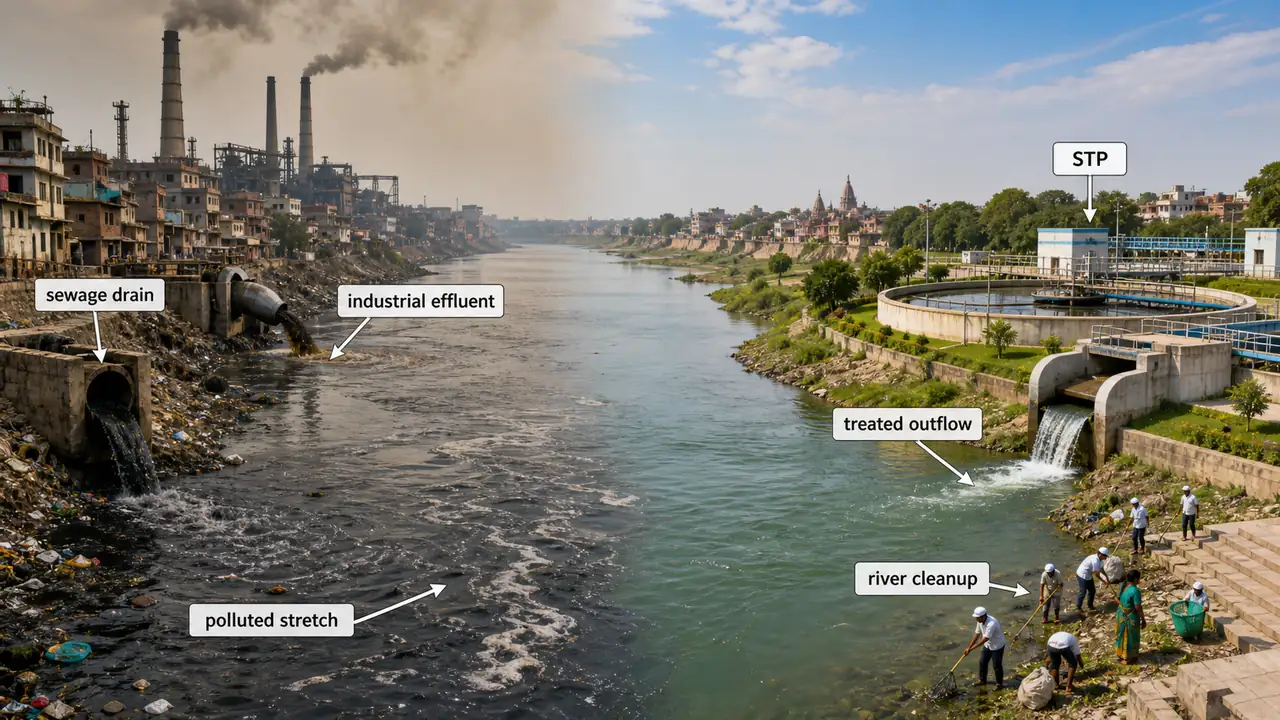
The Ganga flows through UP for approximately 1,140 km — the longest stretch in any state — and accumulates enormous pollution along the way.
Pollution Hotspots
| City | Key Pollutant Source |
|---|---|
| Kanpur | Tanneries and industrial effluents, especially chromium-related waste |
| Varanasi | Sewage, cremation waste, ritual offerings |
| Prayagraj | Sewage from city + Yamuna confluence (dirty Yamuna) |
| Unnao | Industrial effluents |
| Moradabad | Brass industry waste |
Kanpur is widely treated as one of the biggest industrial pollution hotspots on the Ganga in UP. Its tannery cluster is especially associated with heavy-metal contamination, including chromium.
Namami Gange Programme
The Namami Gange Mission (launched 2014) is the central government's flagship programme for Ganga rejuvenation.
| Component | Action |
|---|---|
| Sewage Treatment | New STPs (Sewage Treatment Plants) in all Ganga-bank cities |
| Industrial Effluent | Zero Liquid Discharge (ZLD) mandated for tanneries |
| Ghat Renovation | Cleaning and beautification of bathing ghats |
| Biodiversity | Gangetic dolphin conservation, fish ranching |
| Monitoring | Real-time water quality monitoring stations |
Yamuna Pollution
The Yamuna enters UP from Delhi in a severely polluted condition. It flows through Noida, Mathura, Agra, and Etawah before joining the Ganga at Prayagraj.
| Stretch | Condition |
|---|---|
| Delhi to Noida | Virtually no dissolved oxygen — biologically dead |
| Mathura-Agra | Partial recovery but still polluted |
| Etawah onwards | Some improvement with Chambal inflow |
| Prayagraj confluence | Mixes with Ganga at Sangam |
The irony of Prayagraj's Sangam — where millions bathe during Kumbh — is that the Yamuna arriving there is heavily contaminated, diluted only partially by the cleaner Ganga.
Groundwater Depletion
Groundwater is UP's agricultural lifeline — a very large share of irrigation, often described as roughly 70–80%, depends on tube wells and bore wells. Decades of overdependence have created a crisis.
Regional Groundwater Status
| Region | Status | Cause |
|---|---|---|
| Western UP | Critical/Overexploited | Sugarcane + paddy water demand |
| Central UP | Semi-critical | Increasing tube well density |
| Eastern UP | Relatively safe | Higher rainfall, lower extraction |
| Bundelkhand | Stressed | Rocky terrain, low recharge |
The Central Ground Water Board (CGWB) classifies blocks as Safe, Semi-Critical, Critical, or Overexploited based on the ratio of extraction to recharge.
Scale of the Problem
| Parameter | Value |
|---|---|
| Total Tube Wells in UP | Very high statewide dependence |
| Groundwater Extraction Rate | High in many agricultural belts |
| Western UP Extraction | Overexploited in many blocks |
| Annual Water Table Drop | Noticeable decline in stressed blocks |
Exam Tip: Western UP's groundwater crisis is strongly linked to sugarcane and paddy — both water-intensive crops. Crop diversification is often suggested, but it is economically and politically difficult.
Soil Degradation
UP faces multiple forms of soil degradation that reduce agricultural productivity:
Usar (Alkaline/Sodic) Soils
Usar soils are alkaline, sodium-rich soils that form white crusts and support little vegetation. They are widespread in central and eastern UP.
| Parameter | Details |
|---|---|
| Affected Area | Large tracts in central and eastern UP |
| pH Range | 8.5–10.5+ |
| Key Problem | High sodium, poor drainage |
| Treatment | Gypsum application + drainage improvement |
| Crops Possible (post-treatment) | Rice (tolerant variety), dhaincha (green manure) |
Other Soil Issues
| Problem | Region | Cause |
|---|---|---|
| Waterlogging | Eastern UP | Poor drainage, canal seepage |
| Erosion (ravines) | Chambal, Yamuna banks | River cutting, deforestation |
| Fertility Decline | Pan-UP | Excessive urea, low organic matter |
| Salinization | Western UP canal areas | Poor irrigation management |
Urban Waste Management Crisis
UP's cities generate enormous volumes of municipal solid waste (MSW) but still lag in scientific segregation, processing, and disposal.
| City | Daily Waste (tonnes) | Processing Status |
|---|---|---|
| Lucknow | Very high urban waste load | Partial — landfill dependent |
| Kanpur | High waste load | Limited scientific processing |
| Varanasi | Major pilgrimage-city burden | Improving but uneven |
| Ghaziabad | NCR-driven high waste pressure | Mixed processing systems |
| Prayagraj | Seasonal surges during major events | Infrastructure expanded after Kumbh |
The Swachh Bharat Mission (Urban) and state-level initiatives have improved garbage collection, but scientific waste processing (composting, recycling, waste-to-energy) remains far below requirement.
UP Pollution Control Board (UPPCB)
The UP Pollution Control Board is the state's primary environmental regulatory authority.
| Parameter | Details |
|---|---|
| Established | 1975 (under Water Act, 1974) |
| Headquarters | Lucknow |
| Functions | Industrial consent, air/water monitoring, enforcement |
| Reports To | State Government + CPCB (Central Pollution Control Board) |
| Key Powers | Issue/revoke industrial consent, levy penalties |
Green Initiatives
Despite the challenges, UP has launched several environmental programmes:
| Initiative | Description |
|---|---|
| Solar Energy Policy | Expansion of solar generation, including Bundelkhand-focused projects |
| EV Policy 2022 | Subsidies for EVs, charging infrastructure |
| Tree Plantation Drives | Annual Van Mahotsav (record: 25 crore saplings in one day, 2019) |
| Namami Gange | Central scheme for Ganga rejuvenation |
| GRAP | NCR air pollution emergency response |
| Zig-Zag Brick Kilns | Mandate for cleaner kiln technology |
| Ethanol Blending | Sugarcane-to-ethanol for cleaner fuel |
UP's ethanol blending programme leverages its sugarcane production. Diverting sugarcane juice/molasses to ethanol reduces both pollution (cleaner fuel) and sugar surplus.
Summary Cheat Sheet
| Issue | Key Fact |
|---|---|
| Most Polluted City | Ghaziabad (NCR) |
| Brick Kilns | Major statewide PM source |
| Ganga Pollution Hotspot | Kanpur tannery-industrial belt |
| Ganga Programme | Namami Gange |
| Groundwater Crisis | Western UP — sugarcane + paddy overdraw |
| Tube Wells | Roughly 70–80% irrigation dependence |
| Usar Soils | Sodic/alkaline soils, treated with gypsum |
| Regulatory Body | UPPCB (est. 1975) |
| Solar Push | Bundelkhand and statewide solar expansion |
| EV Policy | 2022 — subsidies + charging infra |
Lesson Doubts
Ask questions, get expert answers