🗿 Prehistoric UP — Stone Age to Iron Age
Palaeolithic, Mesolithic, Neolithic, Chalcolithic and Iron Age sites in Uttar Pradesh — Belan Valley, rock paintings, Koldihwa rice cultivation, Painted Grey Ware culture for Uttar Pradesh GK.
The Palaeolithic Age in UP
The Palaeolithic (Old Stone Age) is the earliest period of human activity, dating roughly from 5,00,000 BCE to 10,000 BCE. Uttar Pradesh's southern highlands — especially the Vindhyan region — preserve some of the state's most important early archaeological evidence.
Belan Valley — The Treasure Trove
The Belan Valley in the Mirzapur-Prayagraj side of the Vindhyan zone is one of the most important prehistoric corridors in UP. Excavations associated with G.R. Sharma and other archaeologists revealed a long cultural sequence from the Lower Palaeolithic up to later farming phases. For exam preparation, the key point is simple: Belan Valley helps connect almost the entire prehistoric story of UP in one broad region.
| Phase | Tool Types | Key Sites |
|---|---|---|
| Lower Palaeolithic | Hand axes, cleavers | Belan Valley |
| Middle Palaeolithic | Flake tools, scrapers | Son-Belan confluence |
| Upper Palaeolithic | Blades, burins | Baghor, Chopani Mando |
Other Palaeolithic Locations
Beyond the Belan Valley, Palaeolithic tools have been found across the Vindhyan plateau and adjoining southern UP belt:
- Singhanpur and Hanumanganj (Sonbhadra) — Lower Palaeolithic hand axes in laterite gravel
- Lohaghat area near the Son river — Middle Palaeolithic flake assemblages
- Baghor-area finds near the Sonbhadra-Madhya Pradesh side — often discussed in the wider Son valley prehistoric context
Exam Tip: Remember Belan Valley not just as one site, but as a continuous prehistoric zone that links stone-tool cultures with later settled life.
Rock Paintings of the Vindhyan Region
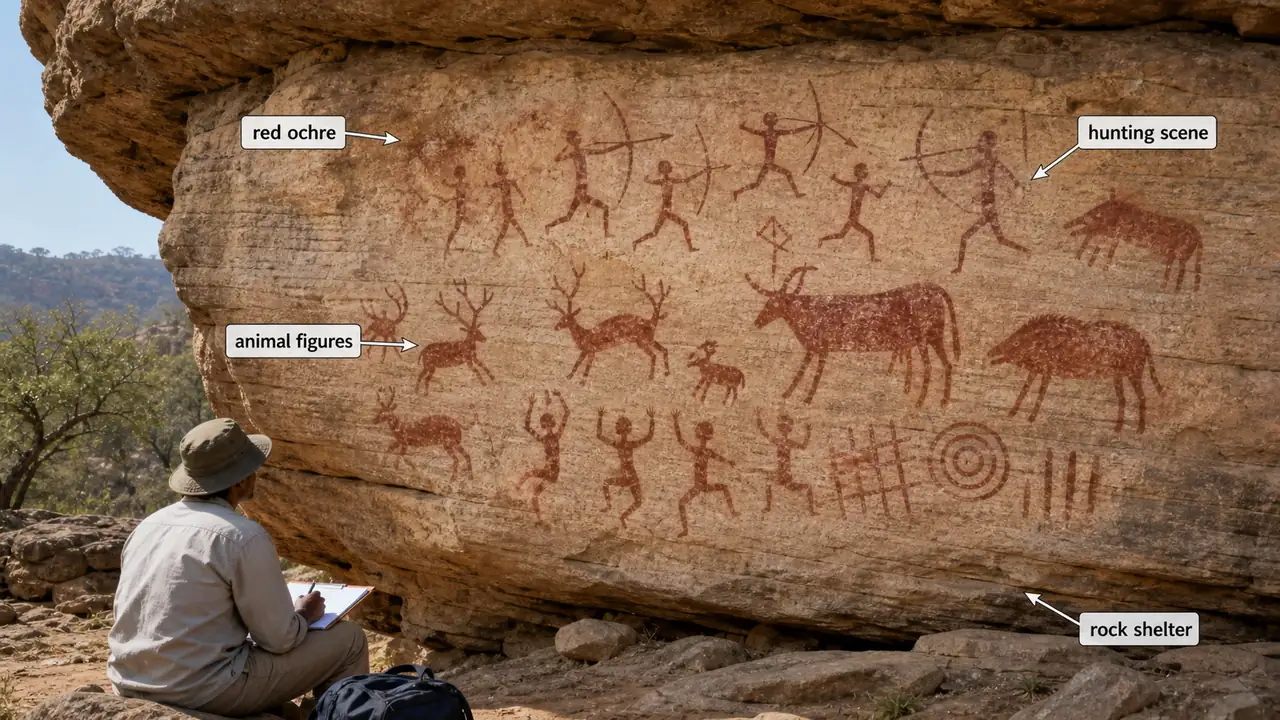
UP's rock art sites rank among the most significant prehistoric art galleries in India, concentrated in the Mirzapur district.
| Rock Art Site | Location | Significance |
|---|---|---|
| Kauva Khoh | Mirzapur | Biggest rock art site in UP — hunting scenes, animal figures |
| Morhana Pahar | Mirzapur | Human and animal figures in red ochre |
| Likhaniya Dari | Mirzapur | "Written cave" — geometric symbols and human stick figures |
| Chuna Dari Cave | Mirzapur | White pigment paintings of animals |
| Wyndham Falls | Mirzapur | Rock shelters with faded red paintings |
These paintings typically depict hunting scenes, dancing figures, wild animals (bison, deer, boar), and geometric patterns. They matter because they show that prehistoric life in UP was not only about tools and food gathering, but also about symbolic expression and community memory.
Mesolithic Period (10,000 — 6,000 BCE)
The Mesolithic (Middle Stone Age) is marked by the use of tiny, finely crafted tools called microliths — small blades and points often set into wooden or bone handles. In UP, this phase is especially important because it gives unusually rich evidence of burials, food habits, and social life.
Key Mesolithic Sites in UP
- Chopani Mando (Belan Valley) — earliest evidence of semi-permanent settlements and possible use of wild rice
- Sarai Nahar Rai (Pratapgarh) — a burial site with human skeletons found alongside microliths and animal bones
- Mahadaha (Pratapgarh) — similar burial evidence, some skeletons showing arrowhead injuries
- Damdama (Pratapgarh) — one of the richest Mesolithic burial sites in India, with around 41 human burials reported in excavation literature
Key Fact: The Pratapgarh district cluster (Sarai Nahar Rai, Mahadaha, Damdama) is among the most important Mesolithic burial zones in India.
What Mesolithic Burials Tell Us
The Pratapgarh burial sites reveal fascinating details about early human society in UP:
- Both male and female skeletons were found buried with grave goods — bone ornaments, shell beads, and microlith tools
- Some burials at Mahadaha show double burials (two individuals in one grave), suggesting family bonds
- Arrowhead injuries on some skeletons indicate possible inter-group conflict
- Animal bones (deer, boar, turtle) found alongside humans suggest belief in an afterlife where food would be needed
Neolithic Period (6,000 — 4,000 BCE)
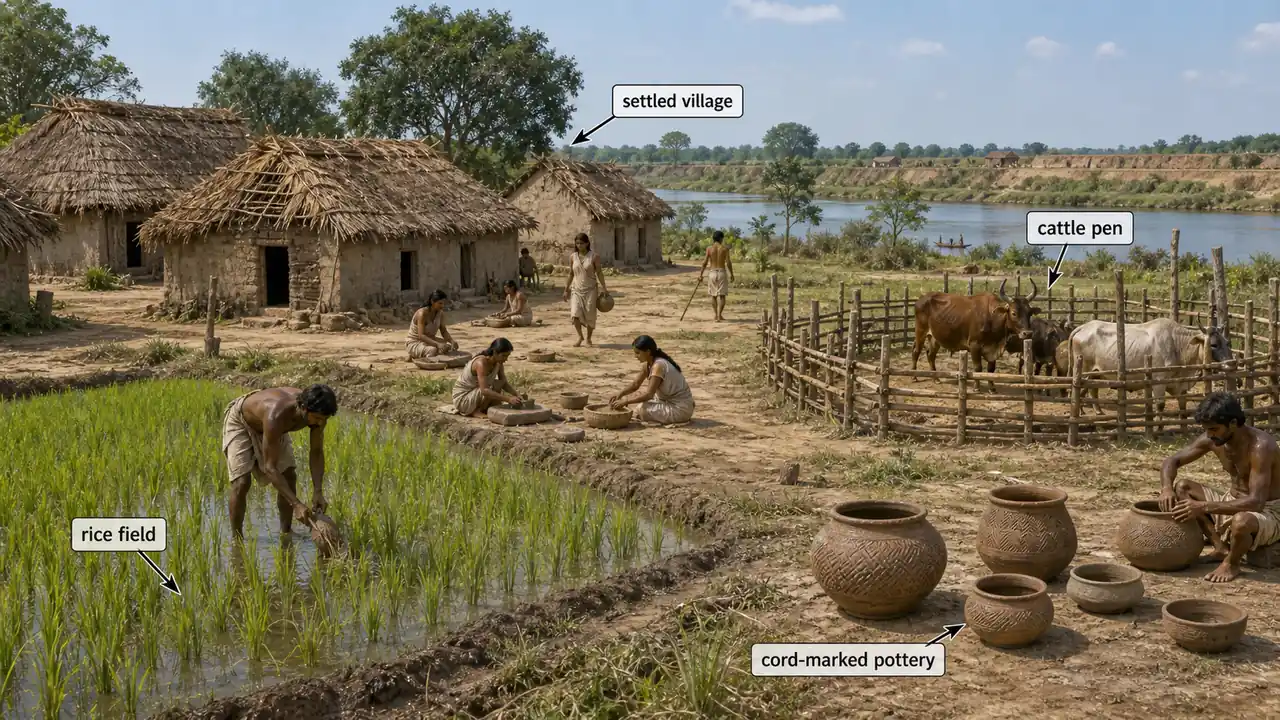
The Neolithic (New Stone Age) brought the revolutionary shift from hunting-gathering to farming and settled village life.
Koldihwa — World-Class Discovery
Koldihwa (near Prayagraj) is globally significant because it yielded evidence often discussed as some of the earliest rice cultivation evidence in South Asia. The exact dating and interpretation are debated in archaeology, but for UP GK the safe takeaway is that Koldihwa is a landmark early farming site. Excavations associated with G.R. Sharma reported:
- Charred rice husks embedded in pottery
- Cord-marked pottery typical of early farming communities
- Evidence of cattle domestication
| Neolithic Site | District | Key Finding |
|---|---|---|
| Koldihwa | Prayagraj | Early rice cultivation evidence |
| Mahagara | Prayagraj | Cattle pens, rice husk impressions |
| Chopani Mando | Mirzapur | Transitional Mesolithic-Neolithic |
Chalcolithic / Copper Age
The Chalcolithic phase (copper + stone tools together) in UP is remembered mainly through the Ochre Coloured Pottery (OCP) horizon and the related Copper Hoard culture of the Ganga-Yamuna Doab. Some major sites, such as Ahichchhatra, later became important in early historic times as well.
- Copper tools found alongside stone implements at related sites
- Black-and-Red Ware and Ochre Coloured Pottery (OCP) are important ceramic markers of this transition
- Ochre Coloured Pottery (OCP) culture is concentrated in the Ganga-Yamuna Doab of western UP — sites commonly cited include Hastinapur and Atranjikhera
Exam Note: OCP culture is considered a late Harappan or post-Harappan phase and is unique to the Upper Ganga plains.
Copper Hoard Culture
A distinctive feature of UP's Chalcolithic era is the Copper Hoard culture — large caches of copper objects found buried across the Ganga-Yamuna Doab:
- Copper harpoons, antenna swords, rings, and anthropomorphic figures
- Major find-spots: Bisauli (Budaun), Rajpur Parsu (Bijnor), Baheria (Shahjahanpur)
- A very large number of copper hoard sites have been reported from UP, making the state central to this culture
- These hoards are generally associated with OCP culture, though the exact makers remain debated
Iron Age and Painted Grey Ware Culture
The Iron Age in UP (approximately 1200 — 600 BCE) is closely associated with the Painted Grey Ware (PGW) culture, which spread across western UP and Haryana.
Key PGW Sites in UP
| Site | District | Notable Feature |
|---|---|---|
| Hastinapur | Meerut | Excavated by B.B. Lal, linked to Mahabharata |
| Atranjikhera | Etah | Earliest iron objects in UP, rice and wheat remains |
| Ahichchhatra | Bareilly | Fortified settlement, Panchala capital |
| Mathura | Mathura | PGW layers beneath later NBPW layers |
PGW Characteristics
- Fine grey pottery with painted geometric designs in black
- Associated with the late Vedic period (Mahabharata era)
- Succeeded by Northern Black Polished Ware (NBPW) from ~600 BCE, marking the beginning of the Mahajanapada period
Summary Cheat Sheet
| Period | Key Site(s) | Key Fact |
|---|---|---|
| Lower Palaeolithic | Belan Valley | Continuous prehistoric sequence in the wider region |
| Rock Art | Kauva Khoh, Mirzapur | Biggest rock art site in UP |
| Mesolithic | Sarai Nahar Rai, Mahadaha, Damdama | Best-known burial cluster in UP prehistory |
| Neolithic | Koldihwa, Mahagara | Early rice cultivation and cattle domestication evidence |
| Chalcolithic | OCP and Copper Hoards | Concentrated in the Ganga-Yamuna Doab |
| Iron Age (PGW) | Hastinapur, Atranjikhera | Mahabharata-era, excavated by B.B. Lal |
Lesson Doubts
Ask questions, get expert answers