👑 The 16 Mahajanapadas in UP
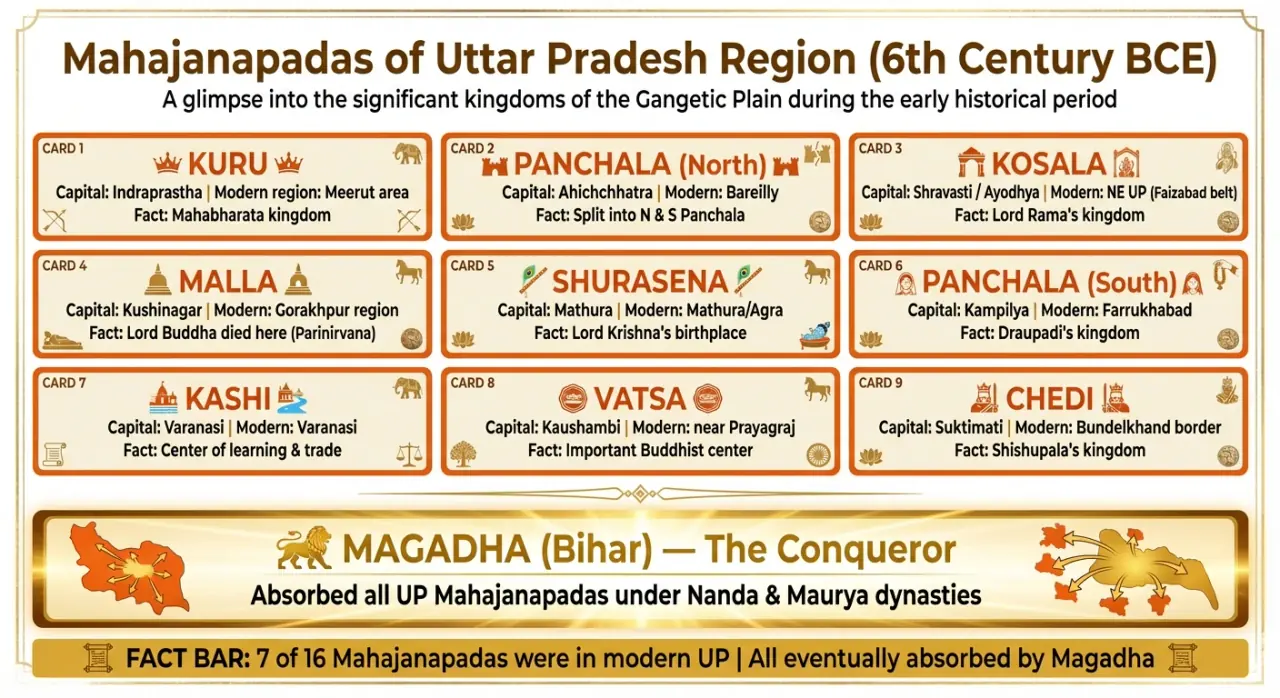
Mahajanapadas located in modern Uttar Pradesh — Kashi, Kosala, Vatsa, Panchala, Kuru, Shurasena, Malla with capitals, Buddhist connections for Uttar Pradesh GK.
What Were Mahajanapadas?
By the 6th century BCE, the later Vedic tribal settlements had evolved into large territorial states called Mahajanapadas (literally "great foothold of a people"). The Buddhist text Anguttara Nikaya lists 16 such states that dominated the political landscape of ancient India.
Uttar Pradesh was one of the main heartlands of this transformation — about 6-7 Mahajanapadas were located entirely or partially within modern UP. That is why ancient UP appears so frequently in Buddhist, Jain, and early historical traditions.
Exam Tip: Questions often ask "How many Mahajanapadas were in UP?" In exam practice, the answer is usually given as 7: Kashi, Kosala, Vatsa, Panchala, Kuru, Shurasena, and Malla.
Mahajanapadas Located in UP
1. Kashi
| Feature | Detail |
|---|---|
| Capital | Varanasi |
| Location | Eastern UP, along the Ganga |
| Significance | One of the oldest cities in the world; powerful before being absorbed by Kosala |
Kashi was initially one of the most important Mahajanapadas in the eastern Ganga valley. Its capital Varanasi was a major centre of trade, learning, and religion. In later traditions, Kashi is shown as having been absorbed by Kosala, which is the main exam point students should remember.
2. Kosala (Kaushal)
| Feature | Detail |
|---|---|
| Capital | Shravasti (earlier), Ayodhya (later Saketa) |
| Location | Northeastern UP (Gonda, Bahraich, Ayodhya region) |
| Famous Rulers | Prasenajit (contemporary of Buddha), Vidudabha |
Kosala was one of the most powerful Mahajanapadas of northern India. Key facts:
- Shravasti hosted the Jetavana Monastery, one of the most important centres of Buddha's teaching career
- Ayodhya is associated with the Ramayana tradition and Rishabhanath (1st Tirthankara)
- Prasenajit was a follower of Buddha and married a Shakya woman
3. Vatsa
| Feature | Detail |
|---|---|
| Capital | Kaushambi (near Prayagraj) |
| Location | Central-southern UP, along the Yamuna |
| Famous Ruler | Udayana (romantic hero of Sanskrit literature) |
Kaushambi was a major Buddhist centre and also a thriving trade hub on the Yamuna. It is strongly associated with King Udayana in literary and Buddhist traditions. For exam purposes, remember Kaushambi as the capital of Vatsa and one of the major ancient urban centres of UP.
4. Panchala
| Feature | Detail |
|---|---|
| Capital (North) | Ahichchhatra (Bareilly) |
| Capital (South) | Kampilya (Farrukhabad) |
| Location | Central-western UP (Rohilkhand and Doab) |
Panchala was divided into two parts by the Ganga:
- Uttara Panchala (north) with capital Ahichchhatra — massive fortification ruins survive
- Dakshina Panchala (south) with capital Kampilya — associated with Draupadi (Panchali) in the Mahabharata
5. Kuru
| Feature | Detail |
|---|---|
| Capital | Indraprastha (near modern Delhi) |
| Location | Partly in western UP (Meerut region) |
| Significance | Mahabharata heartland |
The Kuru territory extended into western UP. Hastinapur (Meerut region) was the older Kuru centre in epic and archaeological tradition, while Indraprastha is the better-known later capital reference. By the 6th century BCE, Kuru is often described in Buddhist sources as having republican features rather than being a strong monarchy.
6. Shurasena
| Feature | Detail |
|---|---|
| Capital | Mathura |
| Location | Western UP, along the Yamuna |
| Famous Ruler | Avantiputra (follower of Buddha) |
Mathura was already a major city and later became the centre of Krishna tradition. During the Mahajanapada era, Shurasena's king Avantiputra is associated in Buddhist tradition with the spread of Buddhism, making Mathura important in multiple religious histories.
7. Malla
| Feature | Detail |
|---|---|
| Capitals | Kushinagar and Pava |
| Location | Eastern UP (Deoria-Kushinagar region) |
| Government | Republic (Gana-Sangha) |
Malla holds supreme importance in Buddhist history because Buddha attained Mahaparinirvana at Kushinagar. The Mallas were a republican clan, not a monarchy. After Buddha's death, the Mallas are described as receiving a share of his relics.
Other Nearby Mahajanapadas
| Mahajanapada | Capital | Modern Region | UP Connection |
|---|---|---|---|
| Chedi | Suktimati | Bundelkhand (MP border) | Southern UP border areas |
| Magadha | Rajagriha | Bihar | Rival and eventual conqueror of UP states |
| Vrijji | Vaishali | Bihar | Republic, bordered eastern UP |
Magadha ultimately absorbed most UP Mahajanapadas under the Nanda and Maurya dynasties.
Monarchy vs Republic (Gana-Sangha)
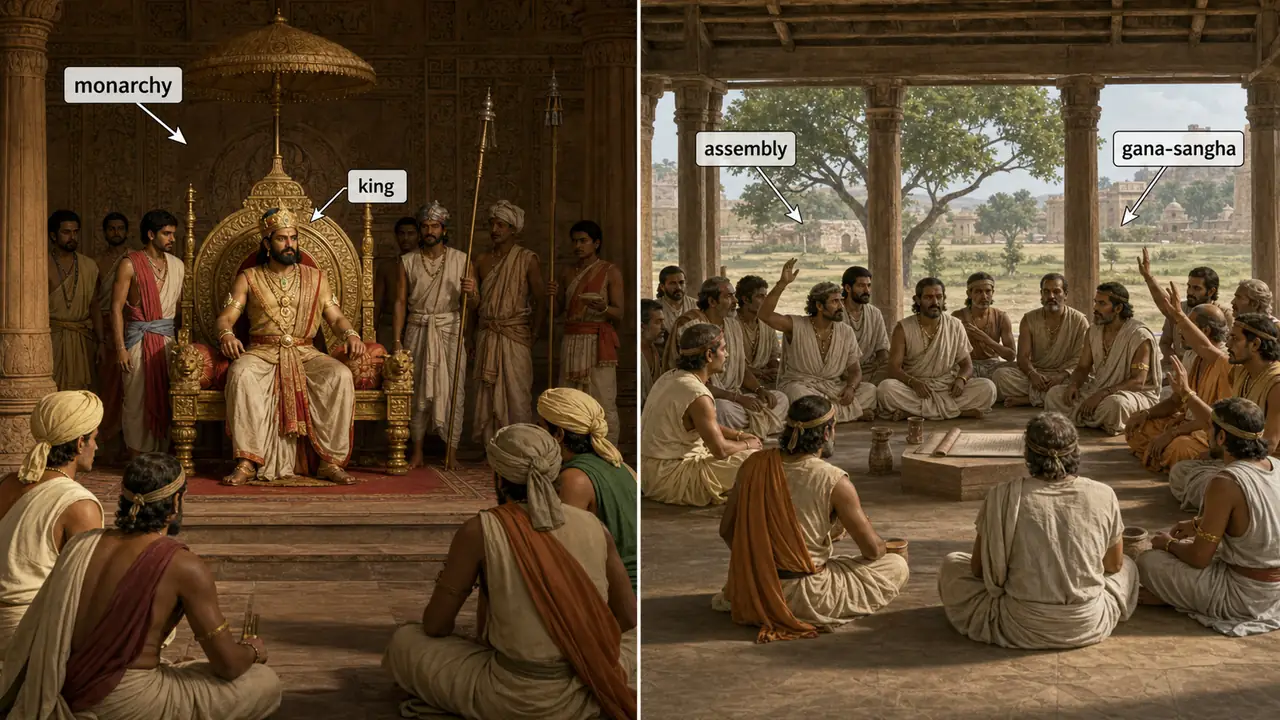
The 16 Mahajanapadas had two types of governance:
| Type | Meaning | UP Examples |
|---|---|---|
| Monarchy | Rule by a hereditary king | Kashi, Kosala, Vatsa, Panchala |
| Republic (Gana-Sangha) | Rule by an assembly of nobles/chiefs | Kuru (later), Malla |
The republican Mahajanapadas were governed through assemblies of chiefs or nobles rather than a single hereditary king. Buddha himself came from the Shakya republic of the Kapilavastu region, which is associated with the Indo-Nepal border zone rather than being treated as a core UP Mahajanapada.
Summary Cheat Sheet
| Mahajanapada | Capital | Modern District | Government |
|---|---|---|---|
| Kashi | Varanasi | Varanasi | Monarchy |
| Kosala | Shravasti / Saketa-Ayodhya | Shravasti / Ayodhya region | Monarchy |
| Vatsa | Kaushambi | Kaushambi-Prayagraj region | Monarchy |
| Panchala (N) | Ahichchhatra | Bareilly | Monarchy |
| Panchala (S) | Kampilya | Farrukhabad | Monarchy |
| Kuru | Indraprastha / Hastinapur tradition | Meerut region (partial) | Republican tendency in later phase |
| Shurasena | Mathura | Mathura | Monarchy |
| Malla | Kushinagar / Pava | Kushinagar | Republic |
Lesson Doubts
Ask questions, get expert answers