🧱 Archaeological Treasures of UP
Major archaeological sites in UP — Hastinapur, Ahichchhatra, Kaushambi, Sringaverapura, Bhitargaon, Deogarh, Rajghat, Piprahwa, Jhusi and ASI-protected monuments for Uttar Pradesh GK.
UP — India's Archaeological Capital
Uttar Pradesh is one of the richest states in India for archaeology and protected monuments. From prehistoric settlements to early historic cities, Gupta temples, Buddhist sites, and medieval forts, the state's archaeological wealth spans a very long civilizational timeline.
Exam Fact: UP consistently ranks among the top states in India for ASI-protected monuments. For exam purposes, the important point is the exceptional range of sites found here.
Hastinapur (Meerut District)
Hastinapur is the legendary capital of the Kuru dynasty and the central city of the Mahabharata epic.
| Feature | Detail |
|---|---|
| Location | Near Meerut, on the banks of an old Ganga channel |
| Excavated By | B.B. Lal (1950-52, ASI) |
| Key Finding | Painted Grey Ware (PGW) culture — linked to Mahabharata era |
Archaeological Layers at Hastinapur
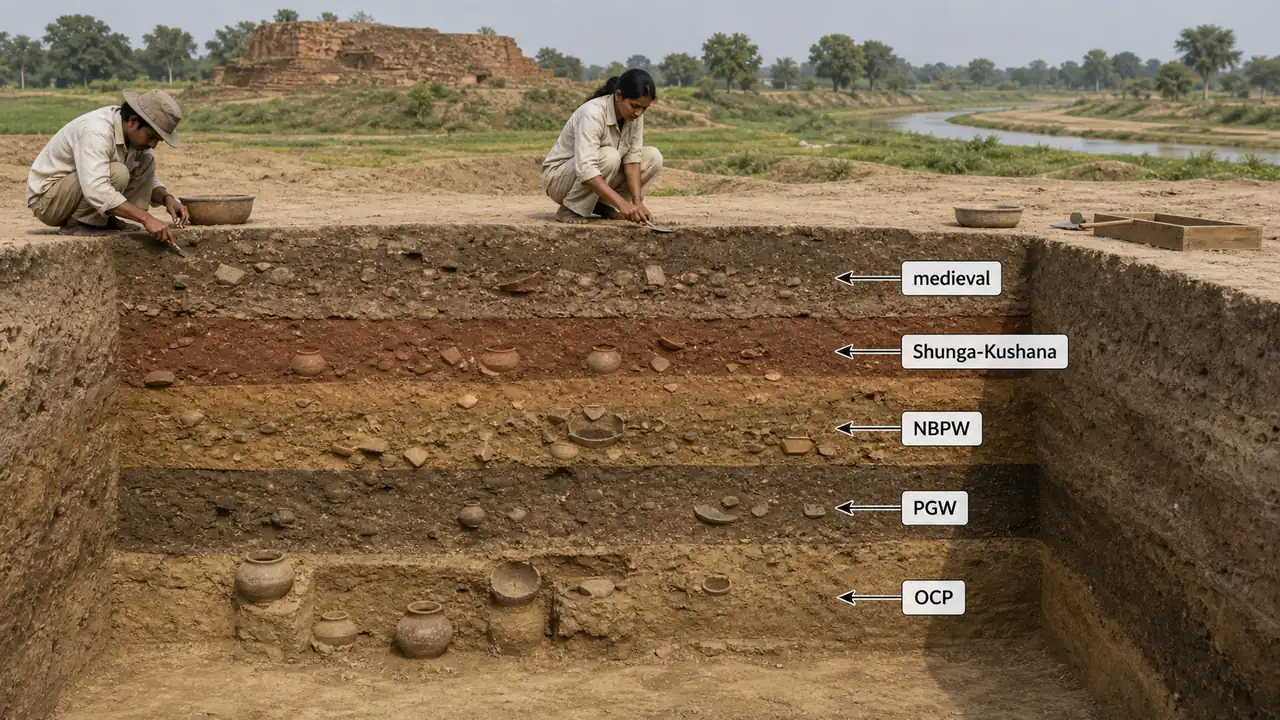
B.B. Lal identified five cultural periods at Hastinapur:
| Period | Culture | Approximate Date |
|---|---|---|
| I | Ochre Coloured Pottery (OCP) | ~1200-1000 BCE |
| II | Painted Grey Ware (PGW) | ~1000-600 BCE |
| III | Northern Black Polished Ware (NBPW) | ~600-200 BCE |
| IV | Shunga-Kushana | 200 BCE-300 CE |
| V | Medieval | Post-600 CE |
The PGW layer (Period II) is often linked by archaeologists and historians with the later Vedic / Mahabharata tradition. Lal also found evidence of flooding, which is often compared with epic tradition, though archaeology cannot directly prove the epic narrative.
Ahichchhatra (Bareilly District)
Ahichchhatra was the capital of North Panchala, one of the 16 Mahajanapadas.
| Feature | Detail |
|---|---|
| Location | Ramnagar village, Bareilly |
| Excavated By | A. Ghosh (ASI) |
| Key Finding | Massive triangular fortification — largest ancient fort plan in UP |
- Habitation layers from the Chalcolithic period to the medieval era
- A large Shiva temple with a 3-metre tall linga was discovered
- Painted Grey Ware, Northern Black Polished Ware, and Kushana-period coins found
- Terracotta figurines depicting folk deities and daily life scenes
Kaushambi (Prayagraj District)
Kaushambi was the capital of the Vatsa Mahajanapada and one of the most important cities of ancient India.
| Feature | Detail |
|---|---|
| Location | Kaushambi region, southwest of Prayagraj, on the Yamuna |
| Excavated By | G.R. Sharma (Allahabad University) |
| Period | 1200 BCE to 600 CE |
Major Discoveries
- Ashokan pillar association and the famous Queen's Edict tradition linked with Queen Karuvaki
- Ghositarama Monastery — one of the earliest Buddhist monastery ruins
- Massive mud-brick rampart (defence wall) spanning several kilometres
- Palace complex remains from the Vatsa period
- A large collection of Kushana-period sculptures
Sringaverapura (Prayagraj District)
Sringaverapura is famous for revealing one of the most sophisticated ancient water management systems in India.
| Feature | Detail |
|---|---|
| Location | 15 km from Prayagraj, on the Ganga |
| Excavated By | B.B. Lal (1977-86) |
| Period | 3rd century BCE to 1st century CE |
The Water Harvesting System
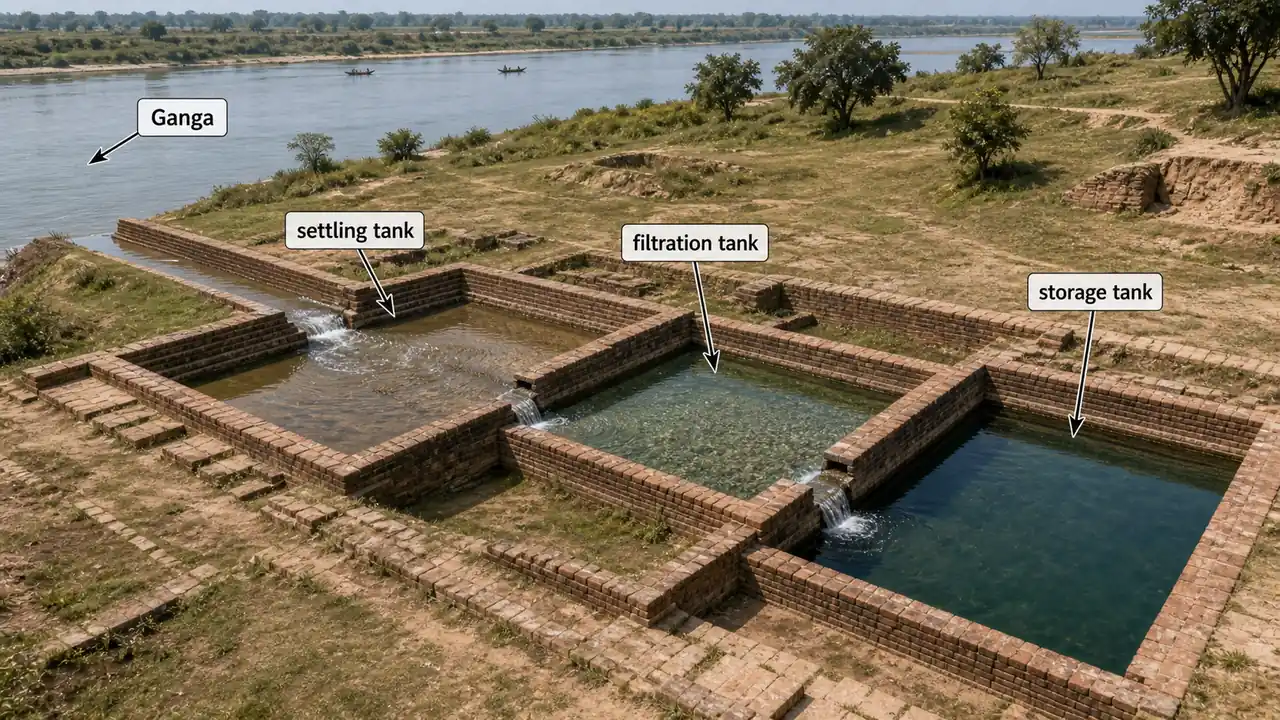
The site contained a three-stage water filtration and storage system:
- Stage 1: Water from the Ganga diverted into a settling tank through a channel
- Stage 2: Partially filtered water flowed into a second tank with finer sediment removal
- Stage 3: Clean water collected in a final brick-lined storage tank
This is considered one of the most impressive early water-management systems found in ancient north India.
The site is also identified with the Ramayana legend where Lord Rama crossed the Ganga with the help of boatman Nishad Raj Guha.
Bhitargaon (Kanpur Dehat District)
The Bhitargaon temple is the oldest surviving brick Hindu temple in India.
| Feature | Detail |
|---|---|
| Period | 5th century CE (Gupta era) |
| Dedication | Vishnu |
| Style | North Indian Nagara |
| Material | Moulded brick with terracotta panels |
- Terracotta panels depict scenes from Hindu mythology — Vishnu, Shiva, Ganga, Yamuna
- The shikhara (tower) is partially damaged but the sanctum survives
- Demonstrates that Gupta architects had mastered advanced brick vaulting techniques without using mortar arches
Deogarh (Lalitpur District)
Deogarh houses the Dashavatara Temple, one of the finest examples of Gupta-period art and architecture.
| Feature | Detail |
|---|---|
| Period | 6th century CE |
| Dedication | Vishnu (ten avatars) |
| Famous Panels | Sheshashayi Vishnu (reclining on cosmic serpent), Nara-Narayana, Gajendramoksha |
- The Sheshashayi Vishnu panel is considered one of the greatest relief sculptures in Indian art
- Also has 31 Jain temples from the 8th-17th century (covered in the Buddhism-Jainism lesson)
- ASI maintains both the Hindu and Jain temple complexes
Rajghat (Varanasi)
Rajghat is an archaeological site at the confluence of the Ganga and Varuna rivers in Varanasi, showing a long sequence of habitation from early historic times onward.
| Feature | Detail |
|---|---|
| Excavated By | A.K. Narain and T.N. Roy (BHU) |
| Layers | Over 3,000 years of habitation |
| Earliest Phase | NBPW period (~800-600 BCE) |
- One of the important sites for tracing the urban evolution of Varanasi over a long period
- Found: NBPW pottery, Maurya-era terracottas, Gupta coins, medieval artefacts
- Evidence of iron smelting, bead-making, and textile production from the earliest phases
Piprahwa (Siddharthnagar District)
Piprahwa is one of the key archaeological sites linked with the wider Kapilavastu debate and the Shakya-Buddhist tradition.
| Feature | Detail |
|---|---|
| Discovered By | W.C. Peppe (1898) |
| Key Finding | Stone casket with Brahmi inscription reading "relics of the Buddha" |
- The relic casket discovery became one of the most discussed Buddhist archaeological finds in the region
- Later excavations by K.M. Srivastava (ASI, 1970s) revealed monastery complexes from 3rd century BCE to 5th century CE
- Two large stupas and multiple viharas (monasteries) uncovered
Jhusi (Prayagraj District)
Jhusi (Pratishthana) on the northern bank of the Ganga-Yamuna confluence is one of the oldest continuously inhabited sites in UP.
| Feature | Detail |
|---|---|
| Location | Opposite the Triveni Sangam, Prayagraj |
| Period | Neolithic to medieval |
| Excavated By | G.R. Sharma, Allahabad University |
- Evidence of Neolithic settlement with cord-marked pottery
- Identified with ancient Pratishthana, capital of the Lunar dynasty in Puranic literature
- Layers spanning NBPW, Maurya, Shunga, Kushana, and Gupta periods
Other Notable Sites
| Site | District | Key Feature |
|---|---|---|
| Atranjikhera | Etah | PGW site; important early iron-age evidence |
| Mathura | Mathura | Kushana art capital; continuous habitation from 600 BCE |
| Sravasti (Saheth-Maheth) | Gonda | Twin mounds with Jetavana monastery ruins |
| Sarnath | Varanasi | Ashoka pillar, Dhamekh Stupa, museum |
| Kalinjar Fort | Banda | Ancient fortress; Chandela stronghold |
| Chunar Fort | Mirzapur | Strategic Vindhyan fort from Gupta era onwards |
Summary Cheat Sheet
| Site | District | Excavator | Key Discovery |
|---|---|---|---|
| Hastinapur | Meerut | B.B. Lal | PGW culture, 5 habitation layers |
| Ahichchhatra | Bareilly | A. Ghosh | Triangular fort, Panchala capital |
| Kaushambi | Kaushambi region | G.R. Sharma | Rampart, monastery, Ashokan association |
| Sringaverapura | Prayagraj | B.B. Lal | 3-stage water-management system |
| Bhitargaon | Kanpur Dehat | — | Oldest brick Hindu temple in India |
| Deogarh | Lalitpur | — | Dashavatara Temple, Sheshashayi Vishnu |
| Rajghat | Varanasi | A.K. Narain | Long urban-habitation sequence |
| Piprahwa | Siddharthnagar | W.C. Peppe | Buddhist relic casket, Kapilavastu debate |
| Jhusi | Prayagraj | G.R. Sharma | Neolithic to medieval layers |
Lesson Doubts
Ask questions, get expert answers