🕌 Delhi Sultanate & Its Impact on UP
Turkish invasions, Slave Dynasty to Lodi Dynasty, Jaunpur Sultanate (Sharqi dynasty), architectural legacy, and provincial administration in Uttar Pradesh during the Delhi Sultanate period for Uttar Pradesh GK.
Turkish Invasions & the Fall of Kannauj
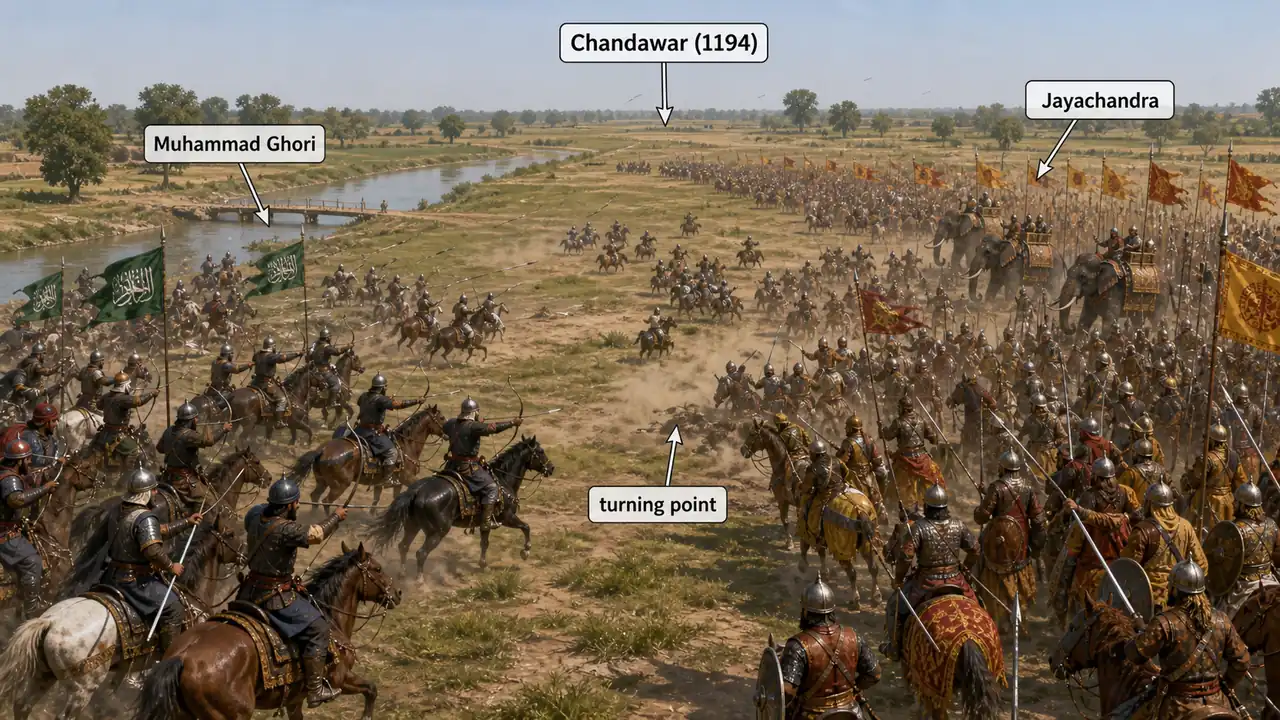
The medieval history of Uttar Pradesh is closely tied to the Turkish invasions that reshaped the political landscape of northern India. Muhammad Ghori defeated Jayachandra (Gahadavala dynasty) at the Battle of Chandawar near Firozabad in 1194. This battle marked a major turning point in the control of the Gangetic plains and opened the way for Turkish rule in much of north India.
Exam Tip: Do not confuse the Battle of Chandawar (1194) with the Battle of Tarain (1191 & 1192). Chandawar specifically involved UP — fought near modern-day Firozabad district.
Kannauj, which had been one of the great imperial cities of north India, declined politically after these invasions. After Ghori's assassination in 1206, his general Qutbuddin Aibak established the Slave (Mamluk) Dynasty, beginning the Delhi Sultanate era.
| Event | Year | Significance |
|---|---|---|
| Battle of Chandawar | 1194 | Jayachandra defeated; Turkish control over UP begins |
| Slave Dynasty founded | 1206 | Qutbuddin Aibak becomes first Sultan |
| Iltutmish consolidates | 1211-1236 | UP firmly integrated into Sultanate |
Delhi Sultanate Dynasties & UP
Five dynasties ruled the Delhi Sultanate between 1206 and 1526. Each left a distinct mark on Uttar Pradesh.
Slave (Mamluk) Dynasty (1206-1290)
Iltutmish organized the iqta system, dividing major territories into provincial administrative assignments. Balban (1266-1287) strengthened central control and military discipline across the Gangetic plains. He stationed garrisons in important centres such as Awadh, Kara, and Badaun.
Khalji Dynasty (1290-1320)
Alauddin Khalji introduced market reforms that influenced the grain-rich Ganga-Yamuna Doab. His price control mechanism (diwan-i-riyasat) mattered especially for regions supplying food and horses to the Sultanate army. Kara-Manikpur also remained strategically important in this period.
Tughlaq Dynasty (1320-1414)
Muhammad bin Tughlaq's experiments, including token currency and the shifting of capital to Daulatabad, affected provincial governance across north India. Firoz Shah Tughlaq invested in canals and infrastructure, and his reign is often associated with irrigation improvements in the Doab belt.
Sayyid & Lodi Dynasties (1414-1526)
The weakening of central authority under the Sayyids allowed provincial governors to assert independence. Sikandar Lodi moved the capital from Delhi to Agra in 1504, recognizing UP's strategic importance. He founded the city of Agra as an administrative centre, which would later become the Mughal imperial capital.
| Dynasty | Period | Key Impact on UP |
|---|---|---|
| Slave (Mamluk) | 1206-1290 | Iqta system; garrisons at Awadh, Badaun |
| Khalji | 1290-1320 | Market reforms; Doab economy regulated |
| Tughlaq | 1320-1414 | Canal irrigation in Upper Doab |
| Sayyid | 1414-1451 | Provincial autonomy increases |
| Lodi | 1451-1526 | Capital shifted to Agra (1504) |
Jaunpur Sultanate — Shiraz-i-Hind
The most remarkable medieval development within UP was the rise of the Jaunpur Sultanate under the Sharqi dynasty (1394-1479). When Timur's invasion weakened Delhi in 1398, the governor of Jaunpur, Khwaja Jahan, declared independence.
His successors — the Sharqi sultans — transformed Jaunpur into a centre of learning, art, and architecture. Because of its cultural reputation, it earned the title "Shiraz-i-Hind" (Shiraz of India).
Key Sharqi Rulers
| Ruler | Reign | Contribution |
|---|---|---|
| Malik Sarwar (founder) | 1394-1399 | Established independence from Delhi |
| Mubarak Shah | 1399-1402 | Consolidated Sharqi authority |
| Ibrahim Shah | 1402-1440 | Golden age of Jaunpur; patron of scholars |
| Hussain Shah | 1458-1479 | Defeated by Bahlol Lodi; Sultanate ends |
Exam Tip: Ibrahim Shah Sharqi is considered the greatest Sharqi ruler. His court attracted scholars from across the Islamic world.
Architectural Legacy of Jaunpur
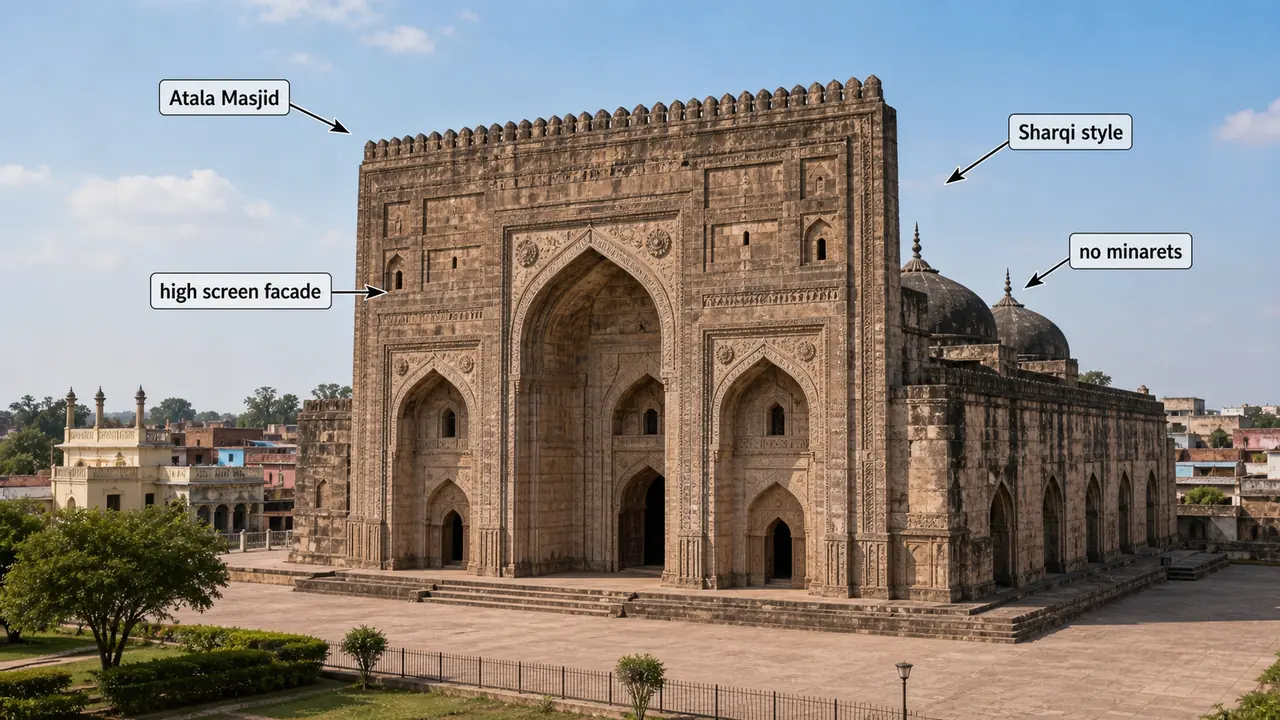
The Sharqi rulers developed a distinctive architectural style that blended Hindu and Islamic elements — characterized by massive propylon (screen facade) entrances and the absence of minarets.
Major Monuments
- Atala Masjid (1408) — Built by Ibrahim Shah on the site of an Atala Devi temple. Features a massive arched screen 23 metres high. Considered the finest example of Sharqi architecture.
- Jama Masjid (1470) — Built by Hussain Shah Sharqi. Largest mosque in Jaunpur, raised on a high platform.
- Lal Darwaza Masjid (1450) — Named after its red gateway. Smallest of the three great Jaunpur mosques but architecturally elegant.
- Jhanjhari Masjid — Known for its lattice screen work (jali).
| Monument | Builder | Year | Special Feature |
|---|---|---|---|
| Atala Masjid | Ibrahim Shah | 1408 | 23m arched screen; finest Sharqi specimen |
| Jama Masjid | Hussain Shah | 1470 | Largest Jaunpur mosque; high platform |
| Lal Darwaza | Hussain Shah | ~1450 | Red gateway; compact design |
| Jhanjhari Masjid | Sharqi period | 15th c. | Lattice screen (jali) work |
Provincial Administration & Cultural Impact
Under the Delhi Sultanate, UP was divided into several provinces (iqtas or shiqs). Key administrative centres included Awadh (Ayodhya region), Kara-Manikpur (near Allahabad), Badaun, Kannauj, and Jaunpur.
Administrative Structure
The provincial governor (muqti or wali) collected revenue, maintained armies, and dispensed justice. The Doab region (land between Ganga and Yamuna) was the most productive agricultural belt and thus the most heavily taxed.
Cultural Transformations
The Sultanate period brought lasting changes to UP:
- Language: Persian became the court language; its long interaction with local speech traditions contributed to the later development of Urdu/Hindustani.
- Architecture: The pointed arch, dome, and geometric ornamentation became permanent features of UP's built landscape.
- Textiles: Weaving centres emerged at Varanasi and Jaunpur, producing silk and muslin.
- Sufism: Sufi networks and khanqahs spread across north India, including UP, fostering cultural exchange and devotional traditions.
Summary Cheat Sheet
| Fact | Answer |
|---|---|
| Battle that brought Turkish rule to UP | Chandawar (1194) |
| Defeated king at Chandawar | Jayachandra (Gahadavala) |
| Jaunpur Sultanate dynasty | Sharqi (1394-1479) |
| Title of Jaunpur | Shiraz-i-Hind |
| Greatest Sharqi ruler | Ibrahim Shah |
| Finest Sharqi monument | Atala Masjid (1408) |
| Who shifted capital to Agra? | Sikandar Lodi (1504) |
| Language development linked to this era | Persian + local dialect interaction -> later Urdu/Hindustani |
Lesson Doubts
Ask questions, get expert answers