🏯 The Mughal Era — Agra as Imperial Capital
Babur to Aurangzeb — Mughal rule in UP, Agra as capital, Fatehpur Sikri, Taj Mahal, administrative system (Subahs), Todar Mal's revenue reforms, and cultural fusion for Uttar Pradesh GK.
Establishment of Mughal Rule
The Mughal Empire's connection with Uttar Pradesh is extremely close — major centres such as Agra, Fatehpur Sikri, Allahabad, and later Awadh played central roles in imperial politics. Babur defeated Ibrahim Lodi at the First Battle of Panipat on 21 April 1526, ending the Delhi Sultanate and establishing Mughal rule. He then defeated Rana Sanga of Mewar at the Battle of Khanwa (1527) to consolidate power.
Babur made Agra his capital, a city that Sikandar Lodi had already developed. He laid out the famous Aram Bagh (Garden of Rest) in Agra — the first Mughal garden in India, introducing the Persian char-bagh (four-fold garden) design to the subcontinent.
Exam Tip: Aram Bagh in Agra is considered India's first Mughal garden. Babur's memoirs (Baburnama) describe his fondness for Agra despite complaining about Indian heat and dust.
After Babur's death (1530), his son Humayun lost the empire to Sher Shah Suri, an Afghan noble based in Bihar. Sher Shah built the famous Grand Trunk Road, which passed through UP connecting Kolkata to Peshawar.
Akbar's Golden Age in UP
Akbar (r. 1556-1605) is the Mughal emperor most closely associated with Uttar Pradesh. He made Agra his primary capital and later built an entirely new city nearby.
Fatehpur Sikri (1571-1585)
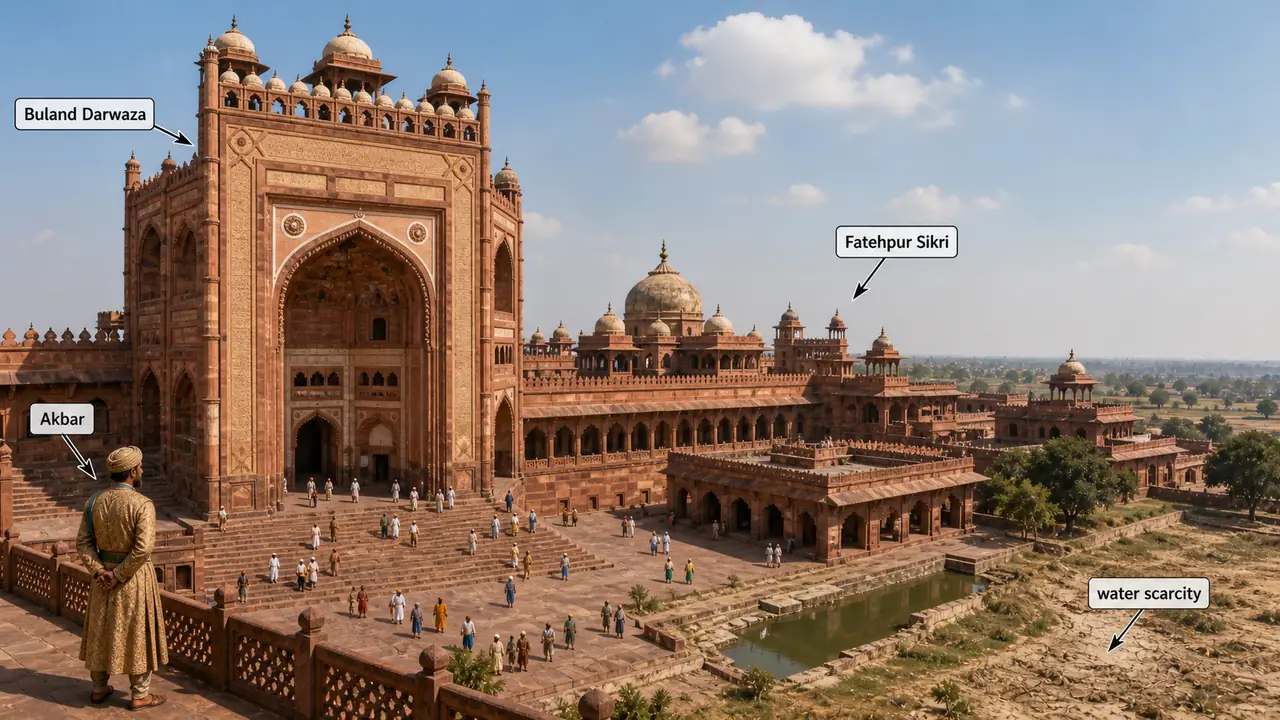
Akbar constructed Fatehpur Sikri about 37 km from Agra as his imperial capital. The city was built to honour Sufi saint Sheikh Salim Chishti, who had predicted the birth of Akbar's son (Prince Salim, later Jahangir).
| Feature | Detail |
|---|---|
| Built by | Akbar |
| Period | 1571-1585 (occupied ~14 years) |
| Abandoned reason | Water scarcity |
| Key structures | Buland Darwaza, Panch Mahal, Diwan-i-Khas, Jodha Bai Palace |
| UNESCO Status | World Heritage Site (1986) |
The Buland Darwaza (Gate of Magnificence) stands about 54 metres high and is widely regarded as one of the largest monumental gateways in the world. Akbar built it to commemorate his victory over Gujarat in 1573.
Administrative Reforms
Akbar divided his empire into major Subahs (provinces). The territory of modern UP was divided primarily between two major subahs:
- Subah of Agra — covering western and central UP
- Subah of Awadh — covering eastern UP
Each Subah was governed by a Subedar (governor), supported by a Diwan (finance officer), Bakshi (military commander), and Sadr (religious/judicial officer).
Todar Mal's Revenue System
One of the most significant Mughal contributions to UP was the land revenue system designed by Raja Todar Mal, Akbar's finance minister and one of the Navaratnas (nine jewels) of Akbar's court.
The Dahsala / Zabti System
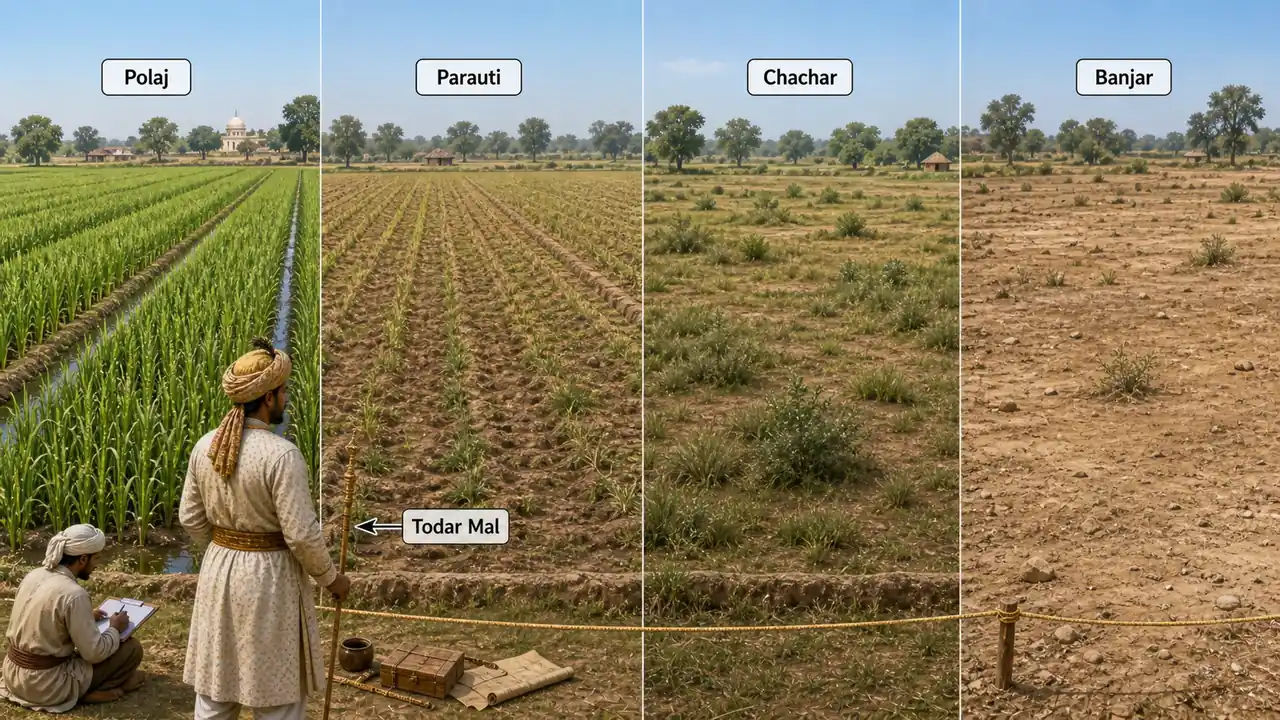
Todar Mal was himself from Laharpur, Sitapur district, UP. He introduced the Dahsala system (1580-1590), which standardized land revenue collection across the empire.
| Feature | Detail |
|---|---|
| Survey method | Actual measurement of land (zabti) using standard jarib |
| Revenue rate | Based on 10-year average (dahsala) of crop yields |
| Payment | One-third of produce, payable in cash |
| Land classification | Polaj (annual), Parauti (fallow 1-2 years), Chachar (3-4 years fallow), Banjar (5+ years fallow) |
Exam Tip: Todar Mal was born in UP (Sitapur). The land classification system (Polaj, Parauti, Chachar, Banjar) is frequently asked in exams.
This system strongly influenced later land-revenue administration in north India, including the systems that later powers adapted and modified.
Shah Jahan & Monumental Agra
Shah Jahan (r. 1628-1658) transformed Agra into one of the grandest cities of Mughal India. His reign is often treated as the zenith of Mughal architecture.
Taj Mahal
The Taj Mahal was built between 1632 and 1653 as a mausoleum for Shah Jahan's wife Mumtaz Mahal, who died during childbirth in Burhanpur.
| Fact | Detail |
|---|---|
| Location | South bank of Yamuna, Agra |
| Material | White Makrana marble (from Rajasthan) |
| Architect | Ustad Ahmad Lahori (chief architect) |
| Workers | ~20,000 artisans |
| Cost (estimated) | ~32 million rupees (17th century) |
| UNESCO Status | World Heritage Site (1983) |
| New7Wonders | Selected in 2007 |
The Taj Mahal is built on principles of perfect bilateral symmetry, with the mosque and guest house (mehman khana) mirroring each other on either side. The only asymmetric element is Shah Jahan's own cenotaph, placed beside Mumtaz's — he was not originally meant to be buried there.
Agra Fort Additions
While Akbar began Agra Fort in 1565 using red sandstone, Shah Jahan replaced many structures with white marble. He added the Moti Masjid (Pearl Mosque), Diwan-i-Khas, and the Musamman Burj — the octagonal tower where he was later imprisoned by Aurangzeb, gazing at the Taj Mahal until his death in 1666.
Aurangzeb & Religious Tensions
Aurangzeb (r. 1658-1707) moved the effective capital southward to the Deccan, but his policies deeply affected UP.
Kashi Vishwanath Controversy
In 1669, Aurangzeb ordered the demolition of several Hindu temples, including the original Kashi Vishwanath Temple in Varanasi. The Gyanvapi Mosque was constructed partially on its foundations. This remains one of the most historically and legally sensitive sites in UP.
Other Impacts
- Reimposition of jizya tax (1679) on non-Muslims alienated Hindu subjects
- Destruction of the Keshav Dev temple at Mathura (replaced by Shahi Idgah mosque)
- Increased Jat and Bundela revolts in UP's Braj and Bundelkhand regions
- Economic strain from prolonged Deccan wars weakened provincial governance
Cultural Fusion Under the Mughals
Despite political conflicts, the Mughal period produced an extraordinary cultural synthesis in UP.
- Language: The Mughal period strengthened the growth of Urdu/Hindustani through sustained interaction between Persianate court culture and local speech traditions.
- Art: Mughal miniature painting flourished, with workshops (karkhanas) operating in Agra.
- Music: Tansen, one of Akbar's Navaratnas, elevated Hindustani classical music. The Agra gharana of music traces its roots to this period.
- Cuisine: Courtly and regional food traditions interacted strongly in this period, shaping later culinary identities associated with cities such as Agra and, later, Lucknow.
- Gardens: Char-bagh layouts (Aram Bagh, Mehtab Bagh, Ram Bagh) defined Agra's landscape.
Decline After Aurangzeb
Aurangzeb's death in 1707 triggered rapid Mughal decline. The empire fragmented, and UP saw the rise of autonomous states:
- Awadh became semi-independent under Sa'adat Khan (1722)
- Rohilkhand fell to Ruhela Afghans
- Jat kingdom consolidated around Bharatpur (bordering UP)
- Maratha raids reached Agra and beyond
The Battle of Karnal (1739) and Nadir Shah's sack of Delhi confirmed that Mughal authority over UP was nominal. Real power shifted to regional Nawabs and chiefs.
Summary Cheat Sheet
| Fact | Answer |
|---|---|
| First Battle of Panipat | 1526 (Babur vs Ibrahim Lodi) |
| First Mughal garden in India | Aram Bagh, Agra |
| Fatehpur Sikri built by | Akbar (1571-1585) |
| Why Fatehpur Sikri abandoned | Water scarcity |
| Buland Darwaza height | About 54 metres |
| UP's Mughal Subahs | Agra & Awadh |
| Todar Mal's birthplace | Laharpur, Sitapur, UP |
| Revenue system | Dahsala / Zabti (1580-1590) |
| Taj Mahal period | 1632-1653 |
| Taj Mahal architect | Ustad Ahmad Lahori |
| Kashi Vishwanath demolished | 1669 by Aurangzeb |
Lesson Doubts
Ask questions, get expert answers