🇮🇳 Post-Independence UP
Renaming to Uttar Pradesh, first CM GB Pant, Zamindari Abolition, Green Revolution, Uttarakhand formation, and key milestones for Uttar Pradesh GK.
From United Provinces to Uttar Pradesh
After independence on 15 August 1947, the province continued briefly as the United Provinces. The renaming to Uttar Pradesh happened just before the Constitution came into force.
| Detail | Fact |
|---|---|
| Old Name | United Provinces |
| New Name | Uttar Pradesh |
| Date of Renaming | 24 January 1950 (when the Constitution came into effect on 26 January 1950, the name was already changed) |
| Meaning | "Northern Province" |
| Capital | Lucknow |
UP was the most populous state at independence and remains so today. Its political weight has made it one of the most influential states in Indian general elections.
First Chief Minister — Govind Ballabh Pant
| Detail | Fact |
|---|---|
| Name | Govind Ballabh Pant |
| Tenure as CM | 1950-1954 (served as Premier of United Provinces from 1946 before becoming the first CM of Uttar Pradesh) |
| Born | Almora (now in Uttarakhand) |
| Later Role | Union Home Minister (1955-1961) |
| Award | Bharat Ratna (1957) |
Key Achievements as CM
- Oversaw the Zamindari Abolition Act (see below)
- Integrated princely states like Rampur, Benares, and Tehri-Garhwal into UP
- Established the administrative framework for the new state
- Promoted Hindi as the official language
Integration of Princely States
Several princely states were merged into UP after independence:
| State | Year of Merger | Notable Fact |
|---|---|---|
| Rampur | 1949 | Was a Muslim-ruled princely state |
| Benares | 1949 | Merged into Varanasi district |
| Tehri-Garhwal | 1949 | Later became part of Uttarakhand |
| Bundelkhand states | 1949-50 | Several small states merged |
The merger of these states was managed through the efforts of Sardar Vallabhbhai Patel and VP Menon at the national level, with GB Pant facilitating at the state level.
Zamindari Abolition Act
This was the most important land reform in UP's history and a landmark in independent India.
| Detail | Fact |
|---|---|
| Full Name | UP Zamindari Abolition and Land Reforms Act, 1950 |
| Enacted / Effective | 1950 / 1 July 1952 |
| Significance | Among the earliest and most important zamindari abolition laws in India |
| Impact | Removed the intermediary role of zamindars between the state and cultivators |
What It Did
- Abolished the zamindari system — landlords could no longer collect rent as intermediaries
- Land ownership transferred to actual cultivators (tillers of the soil)
- Zamindars received compensation but lost their estates
- Created new tenure categories: Bhumidhar, Sirdhar, Asami
Land Tenure After Abolition
| Category | Rights |
|---|---|
| Bhumidhar | Full ownership rights, can sell and transfer land |
| Sirdhar | Hereditary rights, limited transfer ability |
| Asami | Tenant with limited duration rights |
Limitations
- Many zamindars evaded the law by transferring land to relatives before the act took effect
- Large landholdings persisted despite ceiling laws
- Actual implementation was uneven across districts
- Landless labourers gained little direct benefit
Green Revolution in UP (1960s-1970s)
The Green Revolution transformed agriculture across India, and western UP was one of its biggest beneficiaries.
| Detail | Fact |
|---|---|
| Period | Mid-1960s to 1970s |
| Key Architect | M.S. Swaminathan (nationally), with Norman Borlaug's HYV seeds |
| Focus Area in UP | Western UP (Meerut, Muzaffarnagar, Saharanpur, Bulandshahr) |
| Crops | Primarily wheat and rice |
Impact on UP
- Western UP became one of India's most productive agricultural zones
- Wheat production in UP increased dramatically — the state became a surplus producer
- Use of High Yielding Variety (HYV) seeds, chemical fertilizers, pesticides, and tube-well irrigation expanded
- Mechanization: tractors replaced bullocks in western UP
Regional Disparity
- The Green Revolution was largely confined to irrigated western UP
- Eastern UP (Purvanchal) lagged behind due to poor irrigation infrastructure, smaller landholdings, and lower investment
- This created a lasting east-west divide in UP's agricultural development
- Bundelkhand remained drought-prone and largely unaffected
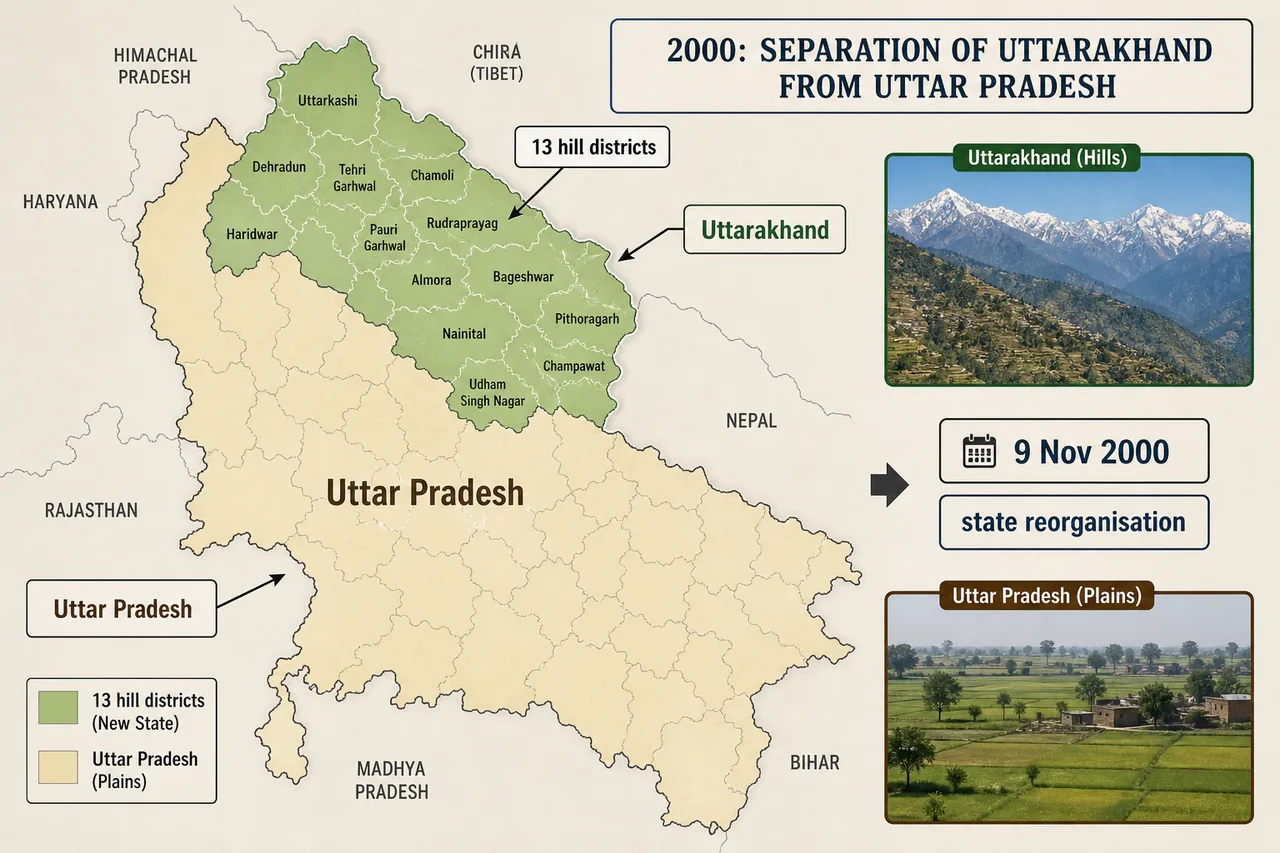
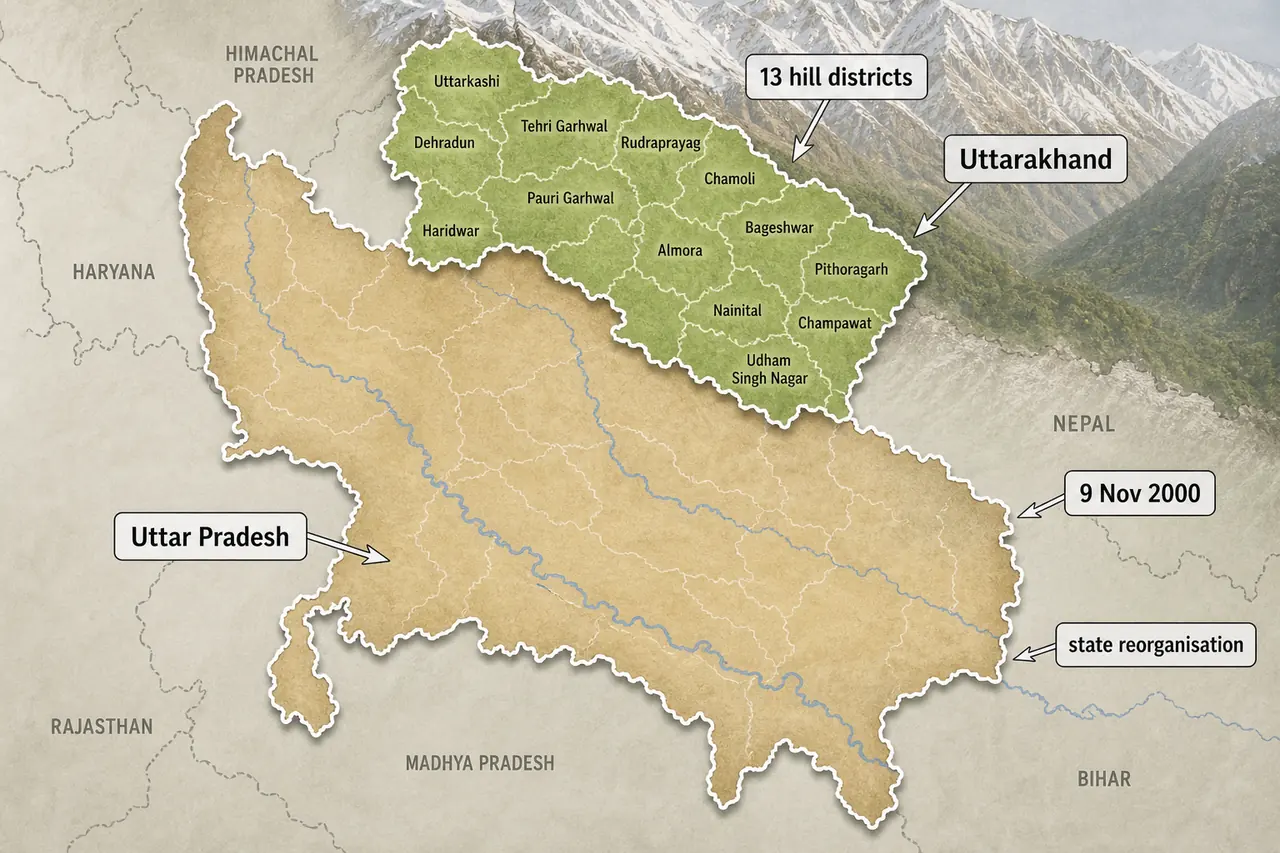
Creation of Uttarakhand (2000)
| Detail | Fact |
|---|---|
| Date | 9 November 2000 |
| Districts Carved Out | 13 hill districts of northwestern UP |
| New State | Initially named Uttaranchal, renamed Uttarakhand in 2007 |
| Capital | Dehradun (interim); Gairsain (summer capital) |
| UP's 28th state status | Uttarakhand became India's 27th state |
Background
- Hill districts had long demanded a separate state due to geographical neglect and development deficit
- The Uttarakhand movement gained momentum in the 1990s
- Muzaffarnagar incident (October 1994) — police fired on Uttarakhand movement protesters; several killed
- This incident galvanized public support for the separate state demand
- The BJP-led NDA government created the state through the UP Reorganisation Act, 2000
Districts Transferred
Chamoli, Champawat, Dehradun, Haridwar, Almora, Bageshwar, Nainital, Pauri Garhwal, Pithoragarh, Rudraprayag, Tehri Garhwal, Udham Singh Nagar, Uttarkashi.
Political Landscape After Independence
UP has been central to national politics. Key milestones:
| Period | Key Development |
|---|---|
| 1947-1967 | Congress dominance; GB Pant, Sampurnanand, CB Gupta as CMs |
| 1967 | First non-Congress government (Charan Singh as CM under SVD coalition) |
| 1970s-80s | Rise of backward caste politics; Charan Singh became PM briefly (1979) |
| 1990s | Mandal-Mandir politics: rise of SP (Mulayam Singh) and BSP (Kanshi Ram, Mayawati) |
| 1992 | Babri Masjid demolition (6 December 1992) in Ayodhya — major national impact |
| 2000 | Uttarakhand carved out |
| 2017 onwards | BJP dominance under Yogi Adityanath |
Many Prime Ministers have either come from UP or represented UP constituencies. This is one reason the state is often called the centre of Indian electoral politics.
Key Development Milestones
| Year | Milestone |
|---|---|
| 1950 | Uttar Pradesh became the official name of the state |
| 1952 | Implementation of zamindari abolition began under the new land-reform framework |
| 1952 | First general elections — UP sent most MPs to Lok Sabha |
| 1963 | IIT Kanpur established |
| 1975 | Emergency declared — massive political impact in UP |
| 1976 | NOIDA established, marking a major phase of planned urban-industrial growth in western UP |
| 1991 | Economic liberalization changed UP's industrial landscape |
| 2000 | Uttarakhand separation |
| 2018 | Allahabad officially renamed Prayagraj |
Population and Demographic Challenges
- UP is India's most populous state. The official Census 2011 population was 19.98 crore, and more recent estimates place it above 24 crore
- Challenges: high population density, lower per capita income than many richer Indian states, a large rural population, and literacy gaps in some regions, especially in female literacy
- UP sends 80 members to the Lok Sabha — the highest from any state
Summary Cheat Sheet
| Item | Key Fact |
|---|---|
| Renamed | 24 January 1950, United Provinces to Uttar Pradesh |
| First CM | GB Pant (first CM 1950-1954; Premier before that), Bharat Ratna 1957 |
| Zamindari Abolition | Act of 1950, effective from 1 July 1952 |
| Land Categories | Bhumidhar, Sirdhar, Asami |
| Green Revolution | 1960s-70s, western UP, wheat and rice |
| Uttarakhand Created | 9 November 2000, 13 districts, 27th state |
| Original Name | Uttaranchal, renamed Uttarakhand in 2007 |
| Lok Sabha Seats | 80 (highest in India) |
| Population | Census 2011: 19.98 crore; recent estimates: 24+ crore |
Lesson Doubts
Ask questions, get expert answers