🚩 National Movements in UP
Non-Cooperation, Chauri Chaura, Civil Disobedience, Quit India Movement, and UP's major role in India's freedom struggle for Uttar Pradesh GK.
UP's Role in Mass Movements
Uttar Pradesh was not just a participant but a major force in the mass movements of the Indian freedom struggle. Its large population, strong Congress organization, and deep-rooted grievances against British rule made it one of the most active provinces in multiple phases of the national movement.
Non-Cooperation Movement (1920-1922)
Launched by Mahatma Gandhi in August 1920, the Non-Cooperation Movement was the first truly mass movement against British rule.
Background
- The Jallianwala Bagh Massacre (13 April 1919) shattered faith in British justice
- The Khilafat issue (Turkey's Ottoman Caliphate dismantled) angered Indian Muslims
- Gandhi combined Khilafat and Swaraj demands to build Hindu-Muslim unity
Programme in UP
- Boycott of schools and colleges: Students left government institutions in large numbers across Lucknow, Allahabad, and Varanasi
- Boycott of courts: Many lawyers including Motilal Nehru gave up their lucrative practices
- Boycott of legislative councils: UP leaders refused to participate in elections
- Boycott of foreign cloth: Bonfires of imported textiles held in cities across UP
- Promotion of khadi: Spinning wheels distributed in villages
- Surrender of titles: Several UP taluqdars returned their British-given titles
UP's Participation
- UP witnessed very large numbers of arrests during the Non-Cooperation Movement
- Jawaharlal Nehru was first arrested in December 1921 in Allahabad
- Motilal Nehru donated his mansion Anand Bhawan for Congress use
- The Awadh peasant movement (Baba Ramchandra) merged with Non-Cooperation energy
- Women came out in large numbers for the first time in UP, picketing liquor shops
Chauri Chaura Incident (1922)
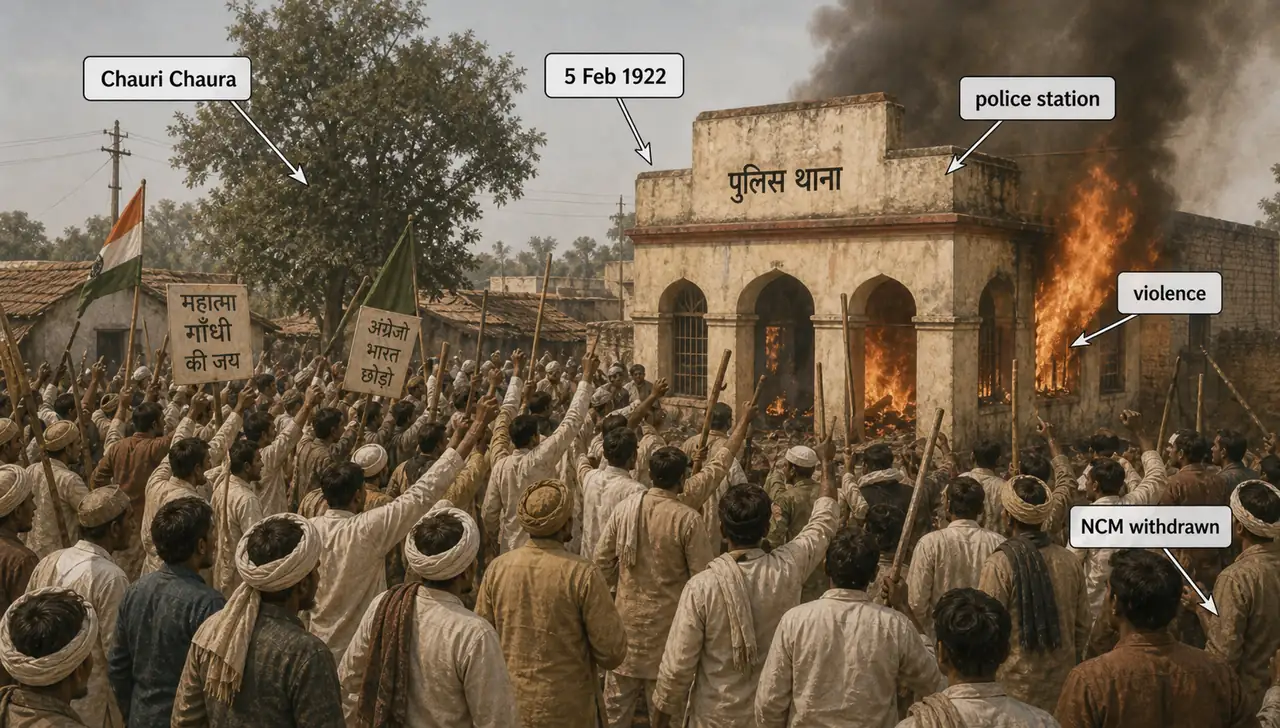
This single event in UP changed the course of the national movement.
| Detail | Fact |
|---|---|
| Date | 5 February 1922 |
| Place | Chauri Chaura, Gorakhpur district, UP |
| What Happened | A mob of around 3,000 protesters set fire to a police station |
| Casualties | 22 policemen burned to death inside the station |
| Trigger | Police had fired on a peaceful procession, killing some protesters |
Gandhi's Response
- Gandhi was deeply disturbed by the violence
- He called off the entire Non-Cooperation Movement on 12 February 1922
- This shocked Congress leaders like Motilal Nehru, C.R. Das, and Subhas Chandra Bose
- Many argued that the movement was at its peak and should not have been withdrawn
Aftermath
- 228 people were put on trial; 172 sentenced to death (later commuted for most)
- The withdrawal led to formation of the Swaraj Party (1923) by C.R. Das and Motilal Nehru
- It established Gandhi's principle: non-violence was non-negotiable
Chauri Chaura remains one of the most debated events in Indian history — a single violent episode in a UP locality led Gandhi to halt a nationwide movement.
Civil Disobedience Movement (1930-1934)
Launched after the Purna Swaraj (Complete Independence) resolution at the Lahore Congress (31 December 1929), this movement was more organized and radical than Non-Cooperation.
Salt March and UP
- While Gandhi's famous Dandi March (12 March - 6 April 1930) was in Gujarat, UP conducted its own salt law violations
- Peasants in eastern UP made salt from local sources in defiance of the salt tax
- No-tax campaigns were launched in several UP districts, refusing to pay land revenue
Key Activities in UP
| Activity | Details |
|---|---|
| Salt law violation | Peasants manufactured salt across eastern UP |
| No-revenue campaigns | Farmers refused land revenue payment in Rae Bareli, Allahabad |
| Picketing | Liquor shops and foreign cloth shops picketed across UP |
| Forest satyagraha | Tribals and peasants gathered forest produce in defiance of forest laws |
| Women's participation | Massive — women led processions, went to jail in large numbers |
Notable UP Leaders in CDM
- Jawaharlal Nehru arrested multiple times (spent 1930-1931 largely in jail)
- Kamala Nehru (Jawaharlal's wife) led processions in Allahabad despite poor health
- Vijaya Lakshmi Pandit (Nehru's sister) actively organized women's protests
- Purushottam Das Tandon led the movement in Allahabad
Gandhi-Irwin Pact (1931)
- Movement temporarily suspended after the Gandhi-Irwin Pact (5 March 1931)
- Resumed in 1932 after the failure of the Second Round Table Conference
- Finally called off in 1934
Individual Satyagraha (1940-1941)
After the failure of negotiations following the outbreak of World War II, Gandhi launched a limited Individual Satyagraha movement.
| Detail | Fact |
|---|---|
| Started | October 1940 |
| First Satyagrahi | Vinoba Bhave (selected by Gandhi) |
| Second | Jawaharlal Nehru |
| Method | Selected individuals made anti-war speeches and courted arrest |
- In UP, Congress workers were individually chosen to make anti-war statements
- The movement was deliberately restrained — it was a moral protest, not a mass agitation
- Hundreds of UP Congress workers were arrested over the following months
Quit India Movement (1942)
The most intense and violent mass movement of the freedom struggle.
| Detail | Fact |
|---|---|
| Resolution | 8 August 1942, Bombay (AICC session) |
| Gandhi's Call | "Do or Die" (Karo ya maro) |
| British Response | Arrested all top Congress leaders on 9 August |
UP — A Major Theatre
With all major leaders in prison, the movement was carried forward by local leaders and common people. UP witnessed some of the most intense resistance.
Ballia — The "Liberated" District
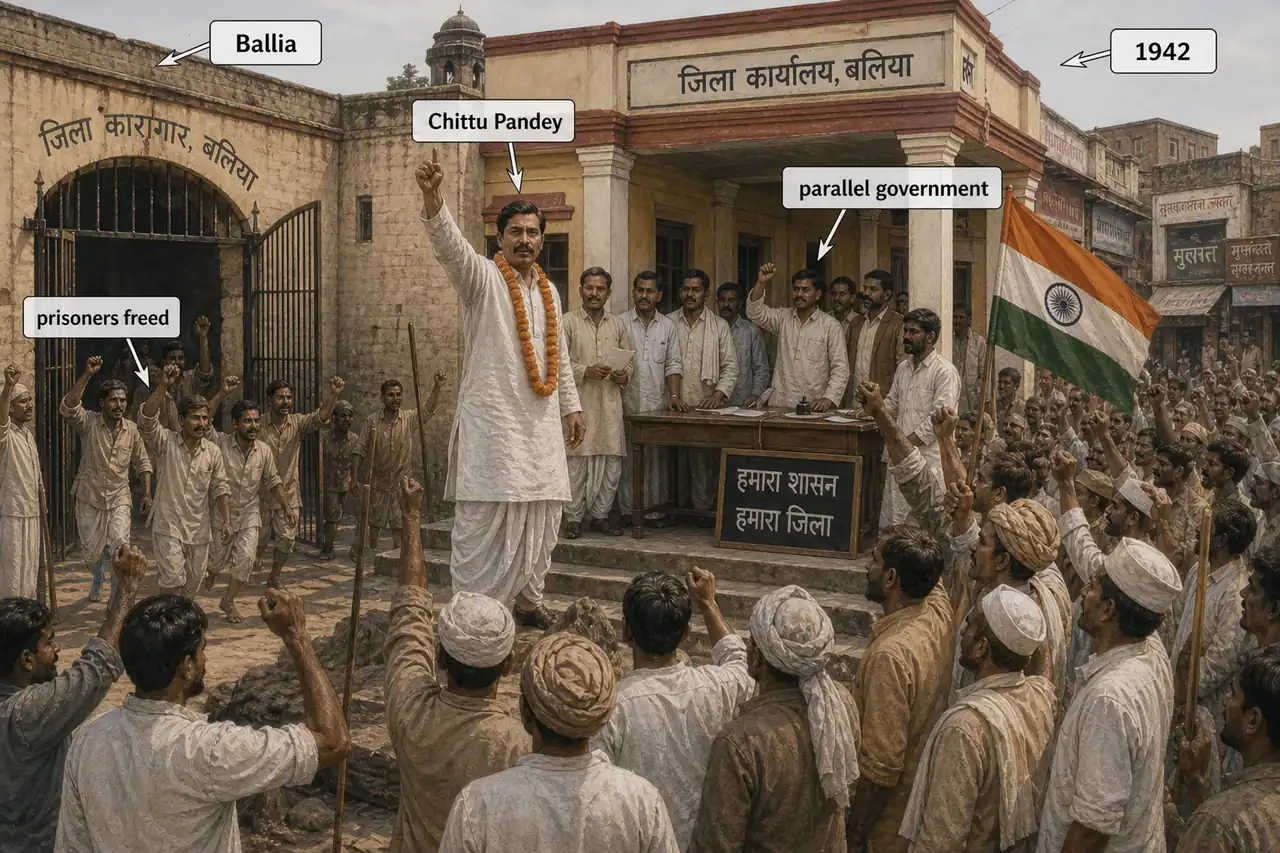
- Chittu Pandey, a local Congress leader, led a mass uprising in Ballia district
- Protesters captured the district jail and freed all political prisoners
- For a brief period, Ballia functioned as a parallel government with Indian administration
- The British had to send military reinforcements to recapture Ballia
- This was one of the few instances where British authority was completely overthrown in a district
Underground Activities
- Underground communication networks operated in and through UP during the movement
- Usha Mehta ran the famous Congress Radio from Bombay; UP activists were linked to wider underground networks
- Students organized secret networks to distribute leaflets and coordinate strikes
- Railway lines and telegraph wires were cut in several UP districts
- Post offices and government buildings were attacked
Repression
- The British response was extremely harsh:
- Mass arrests (thousands imprisoned in UP alone)
- Aerial strafing of protesters reported in some areas
- Villages collectively fined for harboring rebels
- Press censorship imposed; newspapers shut down
- Martial law effectively imposed in several districts
Other UP Centres of Resistance
| Place | Activity |
|---|---|
| Allahabad | Student strikes, underground printing |
| Varanasi | Mass protests, police stations attacked |
| Lucknow | Government offices paralyzed |
| Gorakhpur | Railway disruptions, parallel authority |
| Azamgarh | Telegraph lines cut, government offices seized |
Impact of the Movements on UP
The three major movements progressively radicalized UP's population:
| Movement | Key Impact on UP |
|---|---|
| Non-Cooperation (1920-22) | Politicized the masses; peasants joined the freedom movement for the first time |
| Civil Disobedience (1930-34) | Women entered politics; no-tax campaigns hit British revenue |
| Quit India (1942) | Severe disruption of British authority in some districts; parallel authority briefly emerged |
Each movement left behind a stronger organizational network and a more politically aware populace, making UP one of the major pillars of the national movement.
Summary Cheat Sheet
| Item | Key Fact |
|---|---|
| Non-Cooperation | 1920-22, boycott of courts, schools, titles |
| Chauri Chaura | 5 Feb 1922, Gorakhpur, 22 policemen killed, movement called off |
| Swaraj Party | 1923, C.R. Das + Motilal Nehru (response to NCM withdrawal) |
| Civil Disobedience | 1930-34, salt law violation, no-tax campaigns in UP |
| Gandhi-Irwin Pact | 5 March 1931, CDM suspended |
| Individual Satyagraha | Oct 1940, Vinoba Bhave first, Nehru second |
| Quit India | 8 August 1942, "Do or Die" |
| Ballia Liberation | Chittu Pandey, parallel government, prisoners freed |
| Quit India Repression | Mass arrests, aerial strafing, press censorship |
Lesson Doubts
Ask questions, get expert answers