🤝 INC Sessions & Revolutionary Movement
Important Indian National Congress sessions held in UP, Kakori Conspiracy, Mainpuri Conspiracy, HRA, and revolutionary underground networks for Uttar Pradesh GK.
Congress Sessions in UP — Why They Matter
The Indian National Congress (INC), founded in 1885, held several landmark sessions in Uttar Pradesh. These sessions shaped the direction of the national movement, forged alliances, and launched major campaigns. For the UPSSSC AGTA exam, knowing which sessions were held in UP and what they decided is essential.
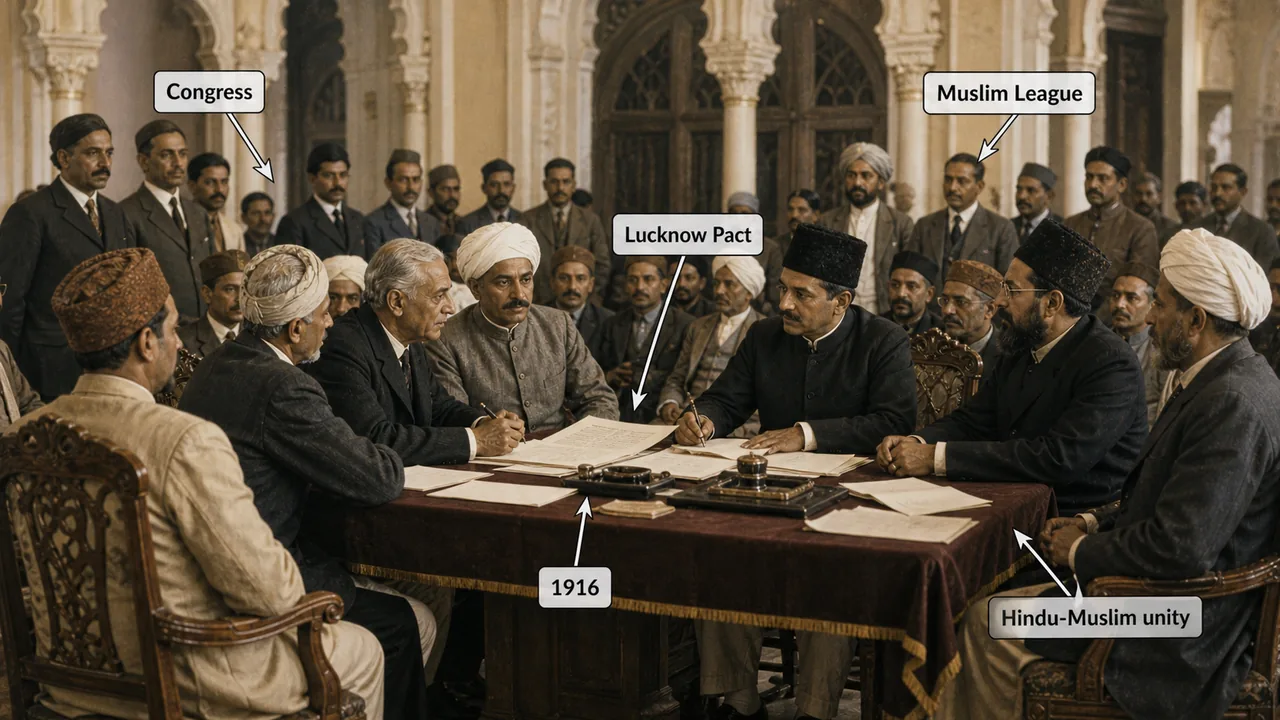
Lucknow Session — 1916
| Detail | Fact |
|---|---|
| Year | 1916 |
| President | Ambika Charan Mazumdar |
| Key Outcome | Lucknow Pact (Congress-Muslim League agreement) |
The Lucknow Pact
- The INC and the All India Muslim League held simultaneous sessions in Lucknow
- They signed a joint scheme of political reforms demanding self-governance
- Muhammad Ali Jinnah played a key role as mediator (he was then called the "Ambassador of Hindu-Muslim Unity")
- The pact accepted separate electorates for Muslims as a compromise
- Congress was represented by moderates and extremists united after the Surat Split (1907) healed
This was the first formal political agreement between Congress and the Muslim League, marking a high point of Hindu-Muslim cooperation.
- Annie Besant's Home Rule League movement was at its peak during this session
- Bal Gangadhar Tilak re-entered the Congress mainstream at Lucknow
Kanpur Session — 1925
| Detail | Fact |
|---|---|
| Year | 1925 |
| President | Sarojini Naidu |
| Significance | First Indian woman president of the INC |
- Sarojini Naidu was known as the "Nightingale of India"
- Her election as president was a landmark moment for women's participation in Indian politics
- The session focused on communal harmony and constructive programme
- It came in the backdrop of growing communal tensions across North India
Lucknow Session — 1936
| Detail | Fact |
|---|---|
| Year | 1936 |
| President | Jawaharlal Nehru |
| Key Outcome | Socialist agenda adopted, AIKS founded alongside |
- Nehru used his presidential address to push a left-leaning, socialist programme
- He called for land reforms, nationalization of key industries, and workers' rights
- The All India Kisan Sabha (AIKS) was founded in Lucknow alongside this broader political moment (11 April 1936)
- Congress Socialist Party members gained significant influence
- This session set the ideological tone for the Congress leading up to independence
Other INC Sessions Connected to UP
| Session | Year | President | Key Fact |
|---|---|---|---|
| Allahabad | 1888 | George Yule | First non-Indian president of INC |
| Lucknow | 1899 | Romesh Chunder Dutt | Emphasized drain of wealth theory |
| Allahabad | 1910 | William Wedderburn | Moderate phase |
| Kanpur | 1905 | Gopal Krishna Gokhale | Swadeshi sentiment rising |
| Agra (AICC meeting) | 1936 | — | Planning for provincial elections |
Revolutionary Movement in UP
While the Congress worked through constitutional means, a parallel revolutionary movement operated underground. UP was an important centre of revolutionary activity.
Mainpuri Conspiracy (1918)
| Detail | Fact |
|---|---|
| Year | 1918 |
| Leader | Ram Prasad Bismil and Genda Lal Dixit |
| Location | Mainpuri district, UP |
| Action | Distribution of revolutionary literature and pamphlets to soldiers |
| Outcome | Bismil went underground; Genda Lal Dixit arrested |
- Also known as the Mainpuri Dacoity Case
- Revolutionaries collected funds through dacoities (robberies) targeting British treasury
- Bismil distributed his poem "Mainpuri Ki Pratigya" (The Vow of Mainpuri) to inspire revolt
- This was Bismil's first major revolutionary action, five years before Kakori
Hindustan Republican Association (HRA) — 1924
| Detail | Fact |
|---|---|
| Founded | October 1924 |
| Place | Kanpur, UP |
| Founders | Ram Prasad Bismil, Sachindra Nath Sanyal, Jogesh Chandra Chatterjee |
| Aim | Armed revolution to overthrow British rule and establish a federal republic |
- The HRA was inspired by the Irish Republican Army (IRA) model
- Its manifesto, "The Revolutionary," was written by Sachindra Nath Sanyal
- After the Kakori case, the organization was reorganized as the Hindustan Socialist Republican Association (HSRA) in 1928 by Chandrashekhar Azad and Bhagat Singh
- The name change reflected a shift toward socialist ideology
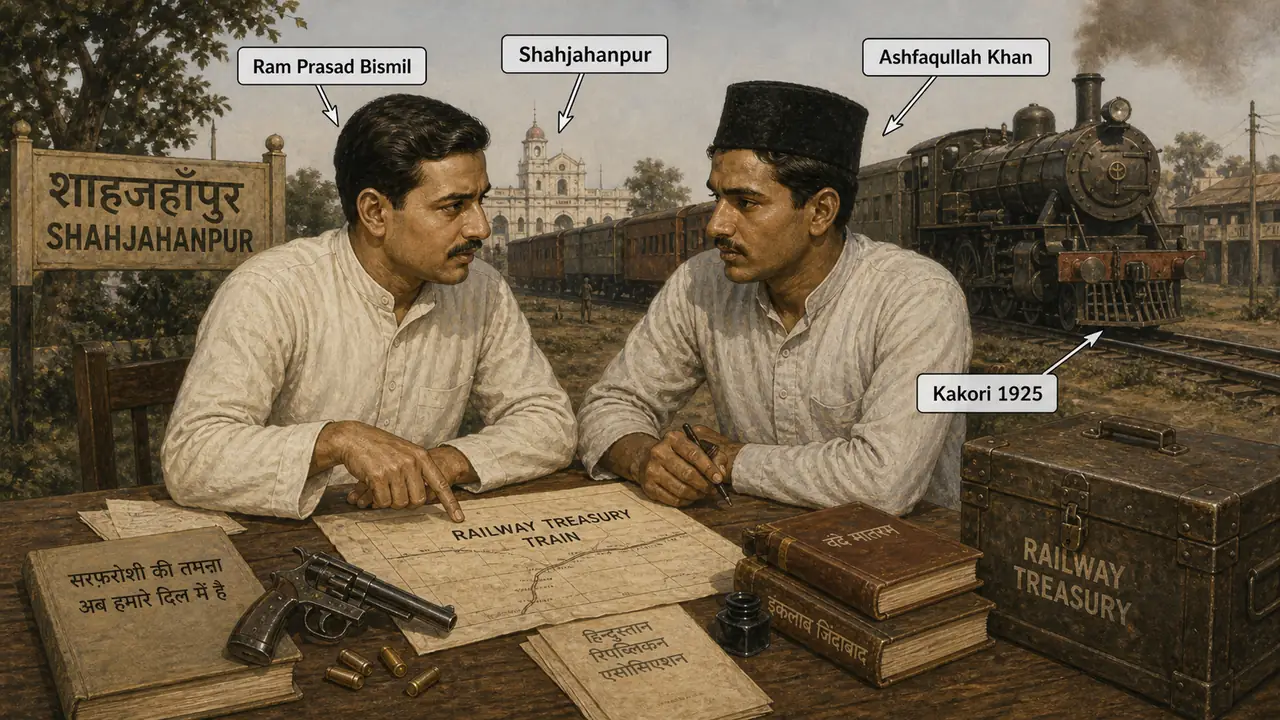
Kakori Conspiracy (1925)
This was the most famous revolutionary action in UP and one of the most celebrated events in Indian revolutionary history.
| Detail | Fact |
|---|---|
| Date | 9 August 1925 |
| Location | Near Kakori, between Shahjahanpur and Lucknow (on the 8-Down train) |
| Target | British government treasury being transported by train |
| Amount Looted | Approximately Rs 4,601 in cash and bags of silver |
Key Participants
| Name | Fate |
|---|---|
| Ram Prasad Bismil | Hanged, 19 Dec 1927, Gorakhpur |
| Ashfaqullah Khan | Hanged, 19 Dec 1927, Faizabad |
| Rajendra Lahiri | Hanged, 17 Dec 1927, Gonda |
| Roshan Singh | Hanged, 19 Dec 1927, Prayagraj |
| Sachindra Nath Bakshi | Life imprisonment |
| Chandrashekhar Azad | Escaped; never caught |
The Trial
- The Kakori Conspiracy Case trial lasted 18 months
- British used it to crush the revolutionary movement by sentencing key leaders to death
- The trial generated enormous public sympathy for the revolutionaries
- Ram Prasad Bismil recited his verse "Sarfaroshi ki tamanna" before execution
Anushilan Samiti Connections
The Anushilan Samiti, originally a Bengal-based revolutionary group (founded 1902), had networks extending into UP:
- Members operated in Varanasi, Allahabad, and Lucknow
- They helped establish arms supply chains for UP revolutionaries
- Sachindra Nath Sanyal (HRA founder) had Anushilan Samiti links
- The organization combined physical training (gymnastics, wrestling) with revolutionary ideology
- British intelligence classified UP-based Anushilan operatives as "most dangerous"
Revolutionary Underground Network in UP
UP served as a logistics and safe-house corridor for revolutionaries from across India:
- Prayagraj (Allahabad): Base for Chandrashekhar Azad, printing presses for revolutionary literature
- Kanpur: HRA headquarters, industrial workers sympathized with revolutionaries
- Shahjahanpur: Home base of Bismil and Ashfaqullah Khan
- Varanasi: Student recruitment ground, Anushilan Samiti presence
- Lucknow: Congress-revolutionary coordination, safe houses
UP's dense railway network made it especially useful for revolutionary communication, travel, and underground coordination.
Summary Cheat Sheet
| Item | Key Fact |
|---|---|
| Lucknow 1916 | Lucknow Pact, Congress-League agreement |
| Kanpur 1925 | Sarojini Naidu, first Indian woman INC president |
| Lucknow 1936 | Nehru president, socialist agenda, AIKS founded |
| Mainpuri Conspiracy | 1918, Bismil + Genda Lal Dixit |
| HRA Founded | October 1924, Kanpur |
| Kakori Conspiracy | 9 August 1925, Bismil, Ashfaqullah, Lahiri, Roshan Singh hanged |
| HSRA | 1928 reorganization by Azad + Bhagat Singh |
| Azad's Death | 27 February 1931, Alfred Park, Prayagraj |
Lesson Doubts
Ask questions, get expert answers