🪔 Holi, Diwali & Janmashtami — UP's Grand Festivals
Lathmar Holi of Barsana, Ayodhya Deepotsav, Janmashtami at Mathura, Dev Deepawali in Varanasi, and other grand festivals of UP for Uttar Pradesh GK.
UP — The Festival Capital of India
Uttar Pradesh celebrates India's major festivals with exceptional scale and cultural depth. Several UP cities are strongly linked in tradition and mythology with these festivals — Mathura for Janmashtami, Ayodhya for Diwali, and Barsana-Nandgaon for Holi. This makes UP's celebrations not just cultural events but living connections to long-standing narratives.
Holi in UP — Beyond Colors
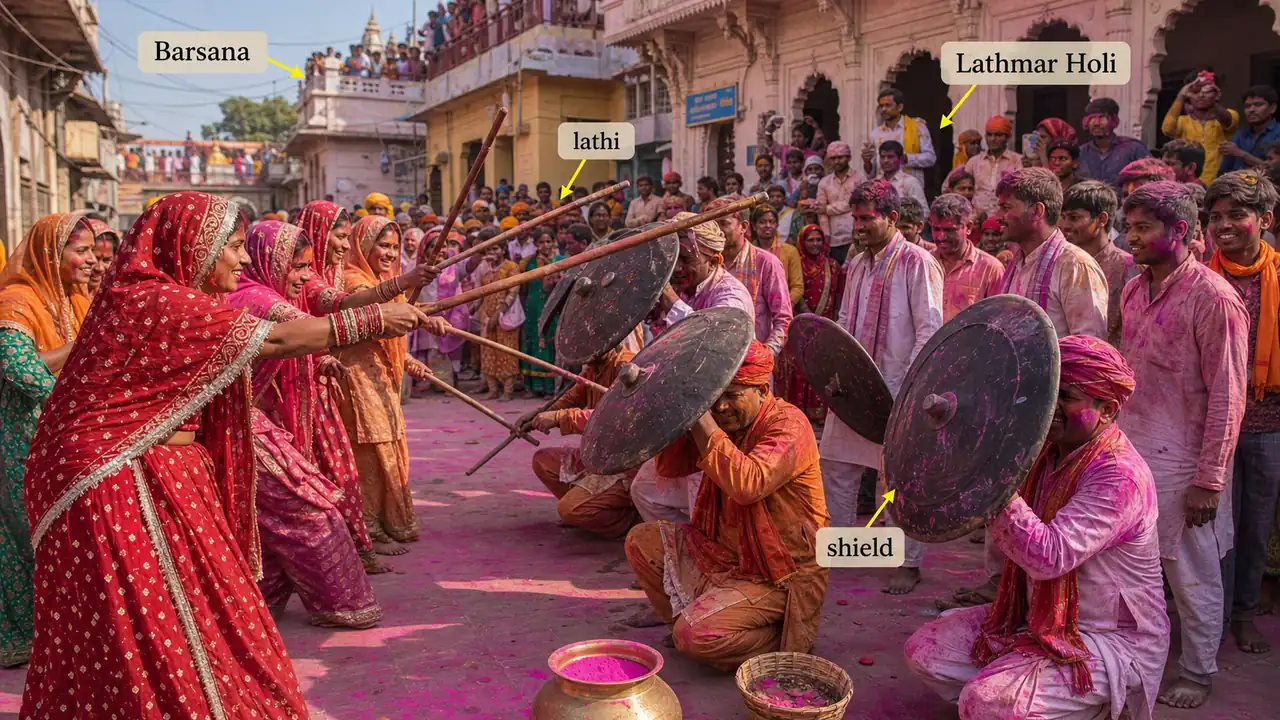
Lathmar Holi of Barsana and Nandgaon
Lathmar Holi is a distinctive Holi tradition celebrated in Barsana and Nandgaon (Mathura district). It is one of the best-known Holi celebrations associated with UP.
| Aspect | Detail |
|---|---|
| Location | Barsana (Radha's village) and Nandgaon (Krishna's village) |
| Tradition | Women beat men with sticks (lathis); men protect themselves with shields |
| Mythology | Krishna visited Radha's village to tease the gopis; women chased him away |
| Timing | A few days before main Holi |
| Unique element | Role reversal — women are the aggressors, men the targets |
The sequence plays out over two days:
- Day 1 — Men of Nandgaon go to Barsana; Barsana's women beat them with lathis
- Day 2 — Women of Barsana go to Nandgaon; the roles continue in friendly combat
The men sing provocative Rasiya songs to tease the women, who respond with stick blows — all in the spirit of Krishna and Radha's playful love. The celebration draws very large numbers of pilgrims and tourists annually.
Exam Tip: Lathmar Holi = Barsana + Nandgaon + Women beat men with sticks + Mathura district.
Widows' Holi at Vrindavan
In a tradition-breaking development, widows at Vrindavan's Meera Sahabhagini Ashram began celebrating Holi publicly, challenging the centuries-old taboo that barred widows from festivals and colors.
| Aspect | Detail |
|---|---|
| Location | Vrindavan (Meera Sahabhagini Ashram) |
| Significance | Broke social taboo against widows participating in festivals |
| Started | Early 2010s, supported by Sulabh International |
| Impact | Became a symbol of social reform and women's dignity |
Phoolon Ki Holi
Phoolon Ki Holi (Holi of Flowers) is celebrated at the Banke Bihari Temple in Vrindavan, where instead of colored powder, flower petals are showered on devotees.
Diwali in UP
Ayodhya Deepotsav
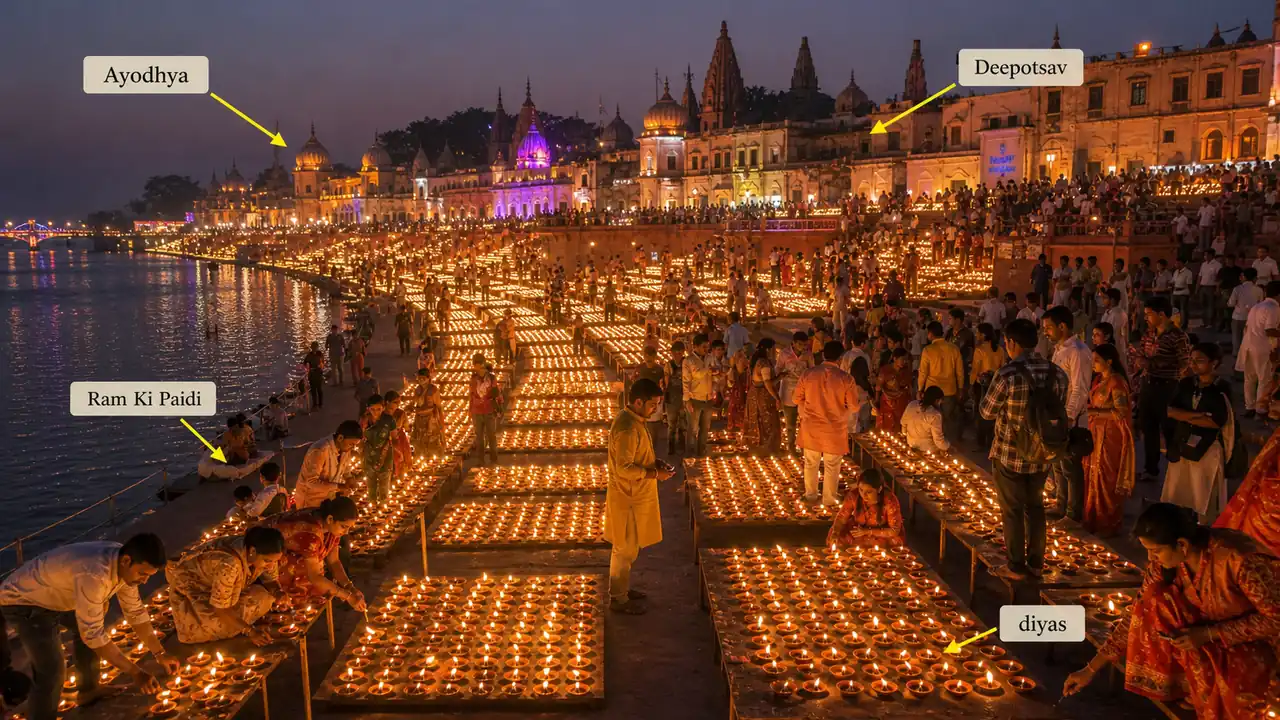
Ayodhya Deepotsav has become one of India's most prominent public Diwali celebrations. It commemorates Lord Ram's return to Ayodhya after 14 years of exile.
| Aspect | Detail |
|---|---|
| Location | Ram Ki Paidi Ghats, Saryu River, Ayodhya |
| Scale | Very large diya-lighting event, often reported in lakhs |
| Record | Guinness World Record for most oil lamps lit at one venue |
| Government support | UP government organizes as flagship cultural event |
| Duration | Multi-day celebrations with cultural programs, laser shows |
The Deepotsav was elevated to a major national event starting from 2017, with the UP government investing heavily in infrastructure and promotion. The sight of millions of diyas along the Saryu ghats has become an iconic image.
Exam Tip: Ayodhya Deepotsav = Ram Ki Paidi + Saryu river + massive diya-lighting + Guinness-style record recognition.
Diwali Across UP
| City | Special Diwali Tradition |
|---|---|
| Ayodhya | Deepotsav — grandest illumination |
| Varanasi | Ganga aarti and ghat illumination |
| Lucknow | Nawabi-era tradition of illuminating Bara Imambara |
| Mathura | Krishna temples decorated, community celebrations |
Janmashtami — Krishna's Birthday
Janmashtami celebrates the birth of Lord Krishna on Ashtami of Krishna Paksha in Bhadrapada month (August-September). While celebrated across India, Mathura-Vrindavan is the most important associated region in UP GK.
Janmashtami at Mathura
| Aspect | Detail |
|---|---|
| Location | Krishna Janmabhoomi Temple, Mathura |
| Timing | Midnight celebration — Krishna was born at midnight in a prison |
| Rituals | Midnight aarti, abhishek of Krishna idol, jhankis (tableaux) |
| Duration | Week-long festivities across Mathura-Vrindavan |
| Attendance | Lakhs of pilgrims |
The midnight celebration at the Krishna Janmabhoomi (birthplace) temple in Mathura is the central event — at the stroke of midnight, conch shells blow, bells ring, and the idol of baby Krishna is bathed in milk, curd, and honey (panchamrit abhishek).
Dahi Handi
Dahi Handi is a popular Janmashtami tradition where young men form human pyramids to reach and break a pot of curd suspended high above the ground, recreating Krishna's childhood habit of stealing butter (makhan chori).
Dev Deepawali — Varanasi's Divine Diwali
Dev Deepawali is celebrated in Varanasi on Kartik Purnima (full moon, 15 days after Diwali). It is believed that on this day, the gods descend to bathe in the Ganga and celebrate their own Diwali.
| Aspect | Detail |
|---|---|
| Location | Varanasi ghats (especially Dashashwamedh Ghat) |
| Date | Kartik Purnima (November, 15 days after Diwali) |
| Tradition | All 84 ghats illuminated with diyas and candles |
| Special feature | Grand Ganga Aarti, cultural performances, boat rides |
| Significance | Gods celebrate Diwali — "Diwali of the Devas" |
| Tourism | Major draw for domestic and international tourists |
The sight of Varanasi's 84 ghats glowing with rows of earthen lamps reflected in the Ganga is considered one of the most spectacular festival visuals in India.
Other Major Festivals in UP
Buddha Purnima at Sarnath
Buddha Purnima (Vesak) is celebrated at Sarnath (near Varanasi) — the site where Buddha delivered his first sermon (Dhammacakkappavattana Sutta).
| Aspect | Detail |
|---|---|
| Location | Sarnath, Varanasi |
| Date | Full moon of Vaishakh (May) |
| Significance | Buddha's birth, enlightenment, and Mahaparinirvana |
| Activities | Prayer assemblies, meditation, processions, cultural events |
| Visitors | Buddhist pilgrims from across the world |
Eid Celebrations in Lucknow
Lucknow is renowned for its grand Eid celebrations, reflecting the city's Nawabi heritage and syncretic culture.
| Aspect | Detail |
|---|---|
| Eid-ul-Fitr | Grand namaz at Aishbagh Eidgah, feasting, seviyan (vermicelli) |
| Eid-ul-Adha | Community prayers, charity, traditional Awadhi cuisine |
| Shab-e-Barat | Night of forgiveness, illumination of mosques |
| Muharram | Taziya processions, marsiya (elegiac poetry) |
| Unique to Lucknow | Ganga-Jamuni tehzeeb — Hindu-Muslim cultural harmony |
Festival Calendar of UP
| Festival | Month | Key Location | Highlight |
|---|---|---|---|
| Makar Sankranti | January | Prayagraj | Kumbh/Magh Mela bathing |
| Lathmar Holi | Feb-March | Barsana | Women beat men with sticks |
| Buddha Purnima | May | Sarnath | Buddhist pilgrimage |
| Janmashtami | Aug-Sept | Mathura | Midnight Krishna birth celebration |
| Ayodhya Deepotsav | Oct-Nov | Ayodhya | Massive diya-lighting, record-setting celebration |
| Dev Deepawali | Nov | Varanasi | 84 ghats illuminated |
| Eid-ul-Fitr | Variable | Lucknow | Grand Nawabi celebrations |
Summary Cheat Sheet
| Fact | Answer |
|---|---|
| Lathmar Holi location | Barsana and Nandgaon (Mathura) |
| Lathmar Holi tradition | Women beat men with sticks |
| Widows' Holi | Vrindavan, Meera Sahabhagini Ashram |
| Ayodhya Deepotsav scale | Massive diya-lighting event at Ram Ki Paidi |
| Deepotsav ghats | Ram Ki Paidi, Saryu River |
| Janmashtami epicenter | Mathura-Vrindavan |
| Dev Deepawali date | Kartik Purnima |
| Dev Deepawali location | Varanasi (84 ghats) |
| Buddha Purnima site | Sarnath |
| Lucknow Eid venue | Aishbagh Eidgah |
Lesson Doubts
Ask questions, get expert answers