🍲 Social Customs & Regional Cuisines
Marriage customs by region, social reform movements, Lucknowi Awadhi cuisine, Banarasi food, Braj specialties, and culinary traditions of UP for Uttar Pradesh GK.
Social Customs Across Regions
Uttar Pradesh's vast geography and diverse communities have produced distinct social customs in each cultural zone. Marriage traditions, in particular, show noticeable regional variation across Awadh, Braj, and Bundelkhand, though many practices overlap in real life.
Marriage Customs by Region
Awadhi Traditions
The Awadh region (Lucknow, Ayodhya-Faizabad belt, Sultanpur and nearby areas) reflects a blend of Hindu and Muslim customs shaped by long interaction and Nawabi-era cultural influence.
| Custom | Detail |
|---|---|
| Nikah (Muslim) | Marriage contract read by Qazi, bride's consent (ijab-o-qubool), Mehr (dower) fixed |
| Walima | Post-wedding feast hosted by groom's family |
| Mangni | Engagement ceremony with exchange of rings and gifts |
| Tilak | Groom's family visits bride's home with gifts and applies tilak |
| Ganga-Jamuni culture | Hindu and Muslim families share celebration customs, attend each other's ceremonies |
Braj Traditions
The Braj region (Mathura, Agra, Hathras) has customs deeply colored by Krishna devotion.
| Custom | Detail |
|---|---|
| Lagan | The wedding invitation ceremony — fixing the auspicious date |
| Dvaar Puja | Groom welcomed at bride's door with aarti and rituals |
| Kanyadaan | Father gives away the bride — central ritual |
| Phere | Seven rounds around the sacred fire |
| Rasiya singing | Wedding songs in Braj Bhasha celebrating love |
| Mooh Dikhai | Bride's face revealed to groom's family after wedding |
Bundelkhand Traditions
Bundelkhand (Jhansi, Banda, Hamirpur, Chitrakoot) has its own robust customs.
| Custom | Detail |
|---|---|
| Hardi | Turmeric ceremony — haldi applied to bride and groom before wedding |
| Bhaat | Maternal uncle's gift ceremony — uncle brings clothes, sweets, cash for the bride |
| Baarat | Groom's procession with drums, dancing, and horses |
| Gaari | Humorous, teasing songs sung by women to the groom's party |
| Bundeli songs | Wedding songs in the Bundeli dialect |
Exam Tip: Bhaat = maternal uncle's ceremony (Bundelkhand). Dvaar Puja = Braj. Nikah-related customs = Muslim marriage tradition often highlighted in the Awadh context.
Social Reform Movements in UP
Uttar Pradesh was a crucible of social reform in the 19th and 20th centuries. Several movements challenged caste discrimination, gender inequality, and orthodox practices.
Arya Samaj's Impact
Arya Samaj, founded by Swami Dayanand Saraswati (1875), had a transformative impact on UP society.
| Reform Area | Achievement |
|---|---|
| Widow remarriage | Actively promoted and performed widow marriages |
| Caste reform | Opposed untouchability, promoted inter-caste marriages |
| Women's education | Established Kanya Pathshalas (girls' schools) across UP |
| Shuddhi movement | Reconversion campaigns |
| DAV schools | Dayanand Anglo-Vedic schools spread modern education |
Other Reform Movements
| Movement/Leader | Contribution |
|---|---|
| Jyotirao Phule's influence | Anti-caste thought influenced later social justice currents beyond Maharashtra, including North India |
| Dr. B.R. Ambedkar | Scheduled Caste empowerment, constitutional rights |
| Swami Vivekananda | Ramakrishna Mission centers in UP — social service, education |
| Sir Syed Ahmad Khan | Aligarh Movement — modern education for Muslims, founded MAO College (1875) → AMU |
| Pandit Madan Mohan Malaviya | Founded BHU (1916) — Hindu renaissance through modern education |
| Ram Manohar Lohia | Socialist movement, anti-caste activism in post-independence UP |
Regional Cuisines of UP
UP's culinary traditions are as diverse as its culture. Each region has a distinctive food identity shaped by geography, religion, history, and local produce.
Lucknowi / Awadhi Cuisine
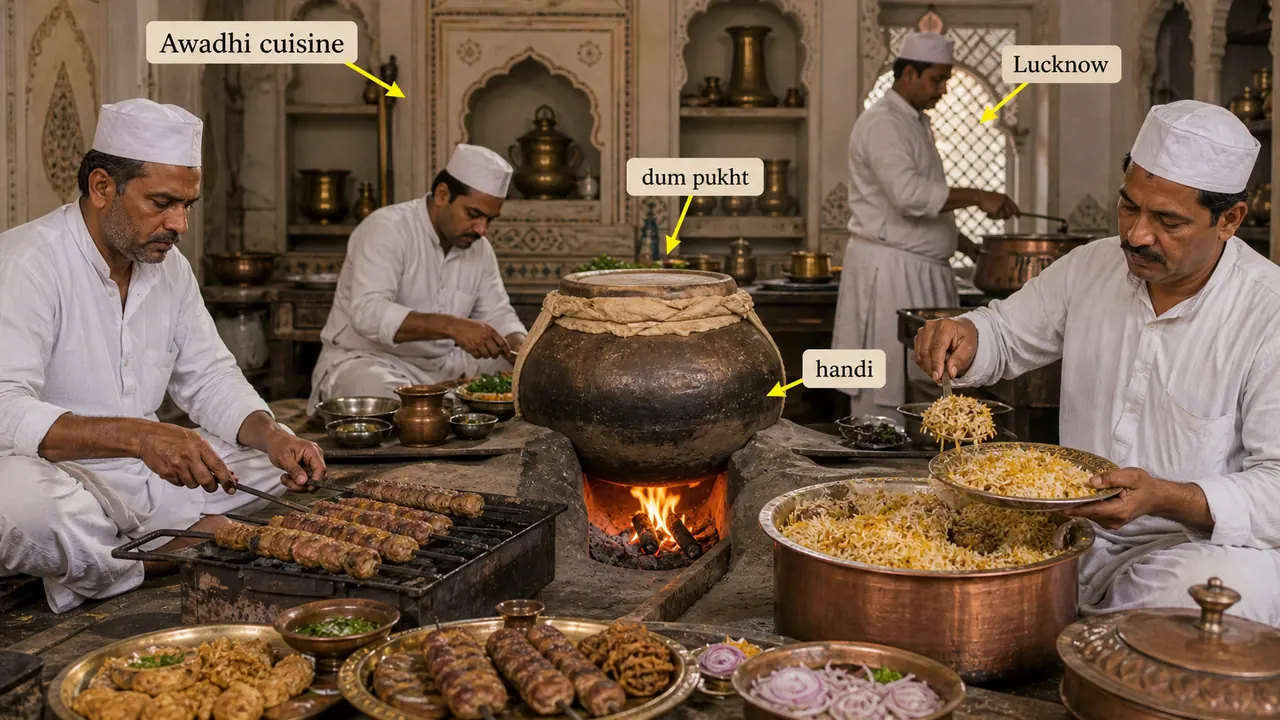
Awadhi cuisine is one of India's most refined culinary traditions, developed in the royal kitchens (bawarchikhanas) of the Nawabs of Awadh.
Signature Technique: Dum Cooking
The hallmark of Awadhi cuisine is dum pukht (slow cooking) — food is sealed in heavy-lidded vessels (handi) and cooked on a low flame for hours, allowing flavors to develop intensely within the sealed pot. A popular tradition links the refinement of this style with Nawab Asaf-ud-Daula's reign and large-scale cooking practices of that era.
Famous Dishes
| Dish | Description |
|---|---|
| Tunday Kabab | Minced meat kebab associated with a secret multi-spice blend, created by one-armed cook Haji Murad Ali (Tunday = one-armed) |
| Galouti Kabab | Ultra-soft kebab that "melts in the mouth" — made for a toothless Nawab |
| Lucknowi Biryani | Dum biryani — rice and meat cooked separately, then layered and sealed |
| Sheermal | Saffron-flavored flatbread baked in tandoor |
| Warqi Paratha | Flaky, layered paratha — hundreds of thin layers |
| Nihari | Slow-cooked meat stew, traditionally a breakfast dish |
| Pasanda | Flattened meat slices in rich gravy |
| Roomali Roti | Paper-thin bread, soft as a handkerchief (roomal) |
Exam Tip: Tunday Kabab = one-armed cook + secret spice blend. Galouti = made for a toothless Nawab. Both are Lucknow icons.
Varanasi (Banarasi) Cuisine
Varanasi's food culture is strongly associated with vegetarian street and temple-linked food traditions, reflecting the city's deep religious character, though non-vegetarian food is also present in parts of the city.
| Dish | Description |
|---|---|
| Banarasi Paan | India's most famous betel leaf preparation — with gulkand, supari, mukhwas |
| Kachori-Sabzi | Crisp fried bread with spicy potato/lentil curry — the Banarasi breakfast |
| Thandai | Cold milk drink with almonds, saffron, cardamom, bhang (optional, during Holi) |
| Malaiyyo | Winter-only dessert — creamy milk froth collected at dawn, flavored with saffron |
| Tamatar Chaat | Tangy tomato-based street food |
| Litti-Chokha | Roasted wheat ball with sattu filling, served with mashed vegetables — especially important in the Purvanchal-Bihar cultural belt |
| Jalebi | Crisp, syrup-soaked spirals — Banarasi jalebis are thicker than most |
| Lassi | Thick yogurt drink, sweet or salted |
Malaiyyo is unique to Varanasi — it is prepared only during winter months (November-February) by collecting the creamy layer that forms on boiled milk left overnight in earthen pots in the cold. It is topped with saffron strands and pistachios.
Braj Cuisine
The Braj region (Mathura, Agra) has a cuisine centered on dairy, sweets, and the Mughal legacy.
| Dish | Description |
|---|---|
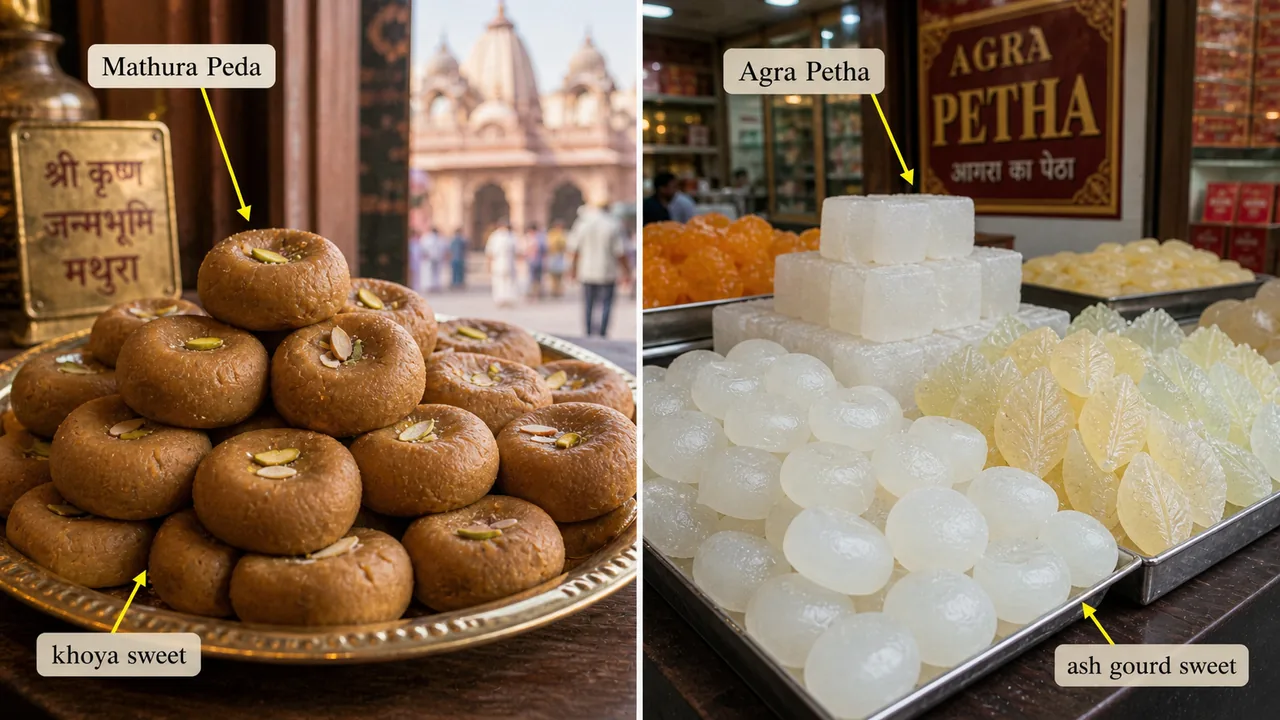
| Mathura ka Peda | Iconic milk sweet — dense, caramelized, made from khoya |
| Agra ka Petha | Translucent ash gourd sweet — available in dozens of flavors |
| Dalmoth | Spicy lentil-based snack mix (Agra specialty) |
| Bedai-Aloo | Deep-fried bread with spicy potato — Agra's breakfast |
| Makhan Mishri | Butter with sugar crystals — Krishna's favorite, offered at temples |
Exam Tip: Peda = Mathura. Petha = Agra. Both are iconic sweets strongly associated with their cities.
Other Regional Specialties
| Region | Famous Food |
|---|---|
| Kanpur | Thaggu ke Laddu (legendary sweet shop) |
| Prayagraj | Kachori-sabzi, chaat culture |
| Bundelkhand | Maheri (wheat dessert), Lapsi, coarse grain preparations |
| Purvanchal | Litti-Chokha, Sattu drinks, Thekua (sweet snack) |
| Terai | Fish curry (river fish), Tharu tribal food |
Street Food Culture
UP has one of India's most vibrant street food cultures. Key centers include:
| City | Street Food Fame |
|---|---|
| Lucknow | Chowk and Aminabad — kebabs, biryani, nihari |
| Varanasi | Kachori Gali, Godowlia — chaat, kachori, thandai |
| Agra | Petha shops, bedai-aloo stalls near Taj |
| Kanpur | Street food markets in Naughara |
| Prayagraj | Civil Lines chaat and kachori |
Cuisine as Cultural Identity
Food in UP is not merely sustenance — it is identity. The dum pukht tradition of Lucknow reflects Nawabi refinement. Varanasi's vegetarian dominance reflects its status as a holy city. Braj's dairy-rich sweets connect to Krishna worship. Bundelkhand's coarse grain diet reflects its arid, hardy landscape.
The UP government promotes culinary tourism through food festivals, heritage food walks, and GI-tag recognition for regional specialties.
Summary Cheat Sheet
| Fact | Answer |
|---|---|
| Awadhi cooking technique | Dum Pukht (slow sealed cooking) |
| Tunday Kabab note | Secret multi-spice blend |
| Tunday meaning | One-armed (cook had one arm) |
| Galouti Kabab made for | Toothless Nawab |
| Malaiyyo season | Winter only (Nov-Feb) |
| Malaiyyo city | Varanasi |
| Peda city | Mathura |
| Petha city | Agra |
| Bhaat ceremony region | Bundelkhand |
| Arya Samaj founder | Swami Dayanand Saraswati (1875) |
Lesson Doubts
Ask questions, get expert answers