🗂️ District Administration System
Administrative hierarchy of UP — Divisions, Districts, Tehsils, Blocks — roles of DM, Divisional Commissioner, SDM, BDO, and urban governance for Uttar Pradesh GK.
Administrative Hierarchy of UP
Uttar Pradesh's administrative machinery is a layered system that connects the state capital in Lucknow to the remotest village. Understanding this hierarchy is essential for UPSSSC AGTA and all UP government examinations.
The most useful way to study this lesson is to remember the chain of command from coordination to implementation:
- Division supervises a group of districts
- District is the core field-administration unit
- Tehsil handles revenue and land administration below the district
- Block is the key rural-development unit
- Village / Gram Panchayat is the grassroots level
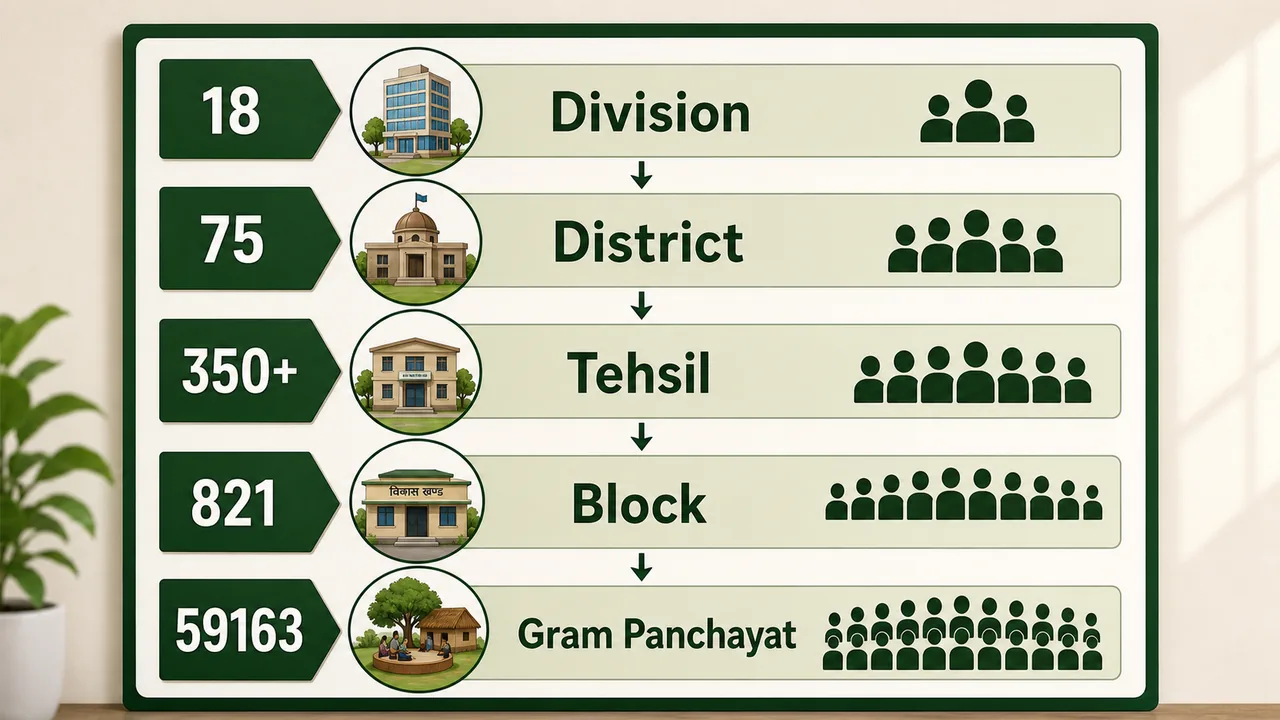
| Level | Unit | Head | Number in UP |
|---|---|---|---|
| 1 | State | Chief Secretary / CM | 1 |
| 2 | Division (Mandal) | Divisional Commissioner | 18 |
| 3 | District (Zila) | District Magistrate (DM) | 75 |
| 4 | Tehsil / Sub-Division | Sub-Divisional Magistrate (SDM) | 350+ |
| 5 | Block (Vikas Khand) | Block Development Officer (BDO) | 821 |
| 6 | Village (Gram) | Gram Pradhan (elected) | ~1,00,000+ |
Divisions (Mandals)
UP is divided into 18 administrative divisions, each headed by a Divisional Commissioner (an IAS officer).
| # | Division | Headquarters | Key Districts |
|---|---|---|---|
| 1 | Lucknow | Lucknow | Lucknow, Unnao, Rae Bareli, Hardoi, Sitapur, Lakhimpur Kheri |
| 2 | Varanasi | Varanasi | Varanasi, Jaunpur, Ghazipur, Chandauli |
| 3 | Prayagraj | Prayagraj | Prayagraj, Kaushambi, Pratapgarh, Fatehpur |
| 4 | Agra | Agra | Agra, Mathura, Firozabad, Mainpuri, Etah |
| 5 | Kanpur | Kanpur | Kanpur Nagar, Kanpur Dehat, Auraiya, Etawah, Farrukhabad, Kannauj |
| 6 | Meerut | Meerut | Meerut, Hapur, Baghpat, Ghaziabad, Bulandshahr |
| 7 | Gorakhpur | Gorakhpur | Gorakhpur, Deoria, Kushinagar, Maharajganj |
| 8 | Bareilly | Bareilly | Bareilly, Badaun, Pilibhit, Shahjahanpur |
| 9 | Moradabad | Moradabad | Moradabad, Rampur, Bijnor, Amroha, Sambhal |
| 10 | Aligarh | Aligarh | Aligarh, Hathras, Kasganj |
| 11 | Jhansi | Jhansi | Jhansi, Lalitpur, Jalaun |
| 12 | Chitrakoot | Chitrakoot | Banda, Hamirpur, Mahoba, Chitrakoot |
| 13 | Faizabad (Ayodhya) | Ayodhya | Ayodhya, Sultanpur, Barabanki, Amethi, Ambedkar Nagar |
| 14 | Azamgarh | Azamgarh | Azamgarh, Mau, Ballia |
| 15 | Basti | Basti | Basti, Sant Kabir Nagar, Siddharthnagar |
| 16 | Devipatan | Gonda | Gonda, Balrampur, Shravasti, Bahraich |
| 17 | Mirzapur | Mirzapur | Mirzapur, Sonbhadra, Bhadohi |
| 18 | Saharanpur | Saharanpur | Saharanpur, Muzaffarnagar, Shamli |
Role of the Divisional Commissioner
- Coordinates between the state government and district-level officers.
- Supervises revenue administration and development work.
- Hears appeals in revenue cases.
- Oversees disaster management at the divisional level.
The District — Core Administrative Unit
The District is the most important unit of administration. It is where policy meets implementation. UP has 75 districts — the highest of any Indian state.
The District Magistrate (DM) / Collector
The District Magistrate is the single most powerful administrative officer at the district level — an IAS officer who wears multiple hats.
| Role | Responsibilities |
|---|---|
| District Magistrate | Law and order, criminal administration |
| District Collector | Revenue collection, land records |
| District Election Officer | Conducting parliamentary and assembly elections |
| District Census Officer | Census operations |
| Disaster Management head | Coordinating relief during floods, droughts |
- The DM chairs the District Development Committee.
- Handles CrPC Section 144 orders (prohibitory orders) for maintaining peace.
- Supervises all government schemes at the district level — MGNREGA, PM-Kisan, ration distribution.
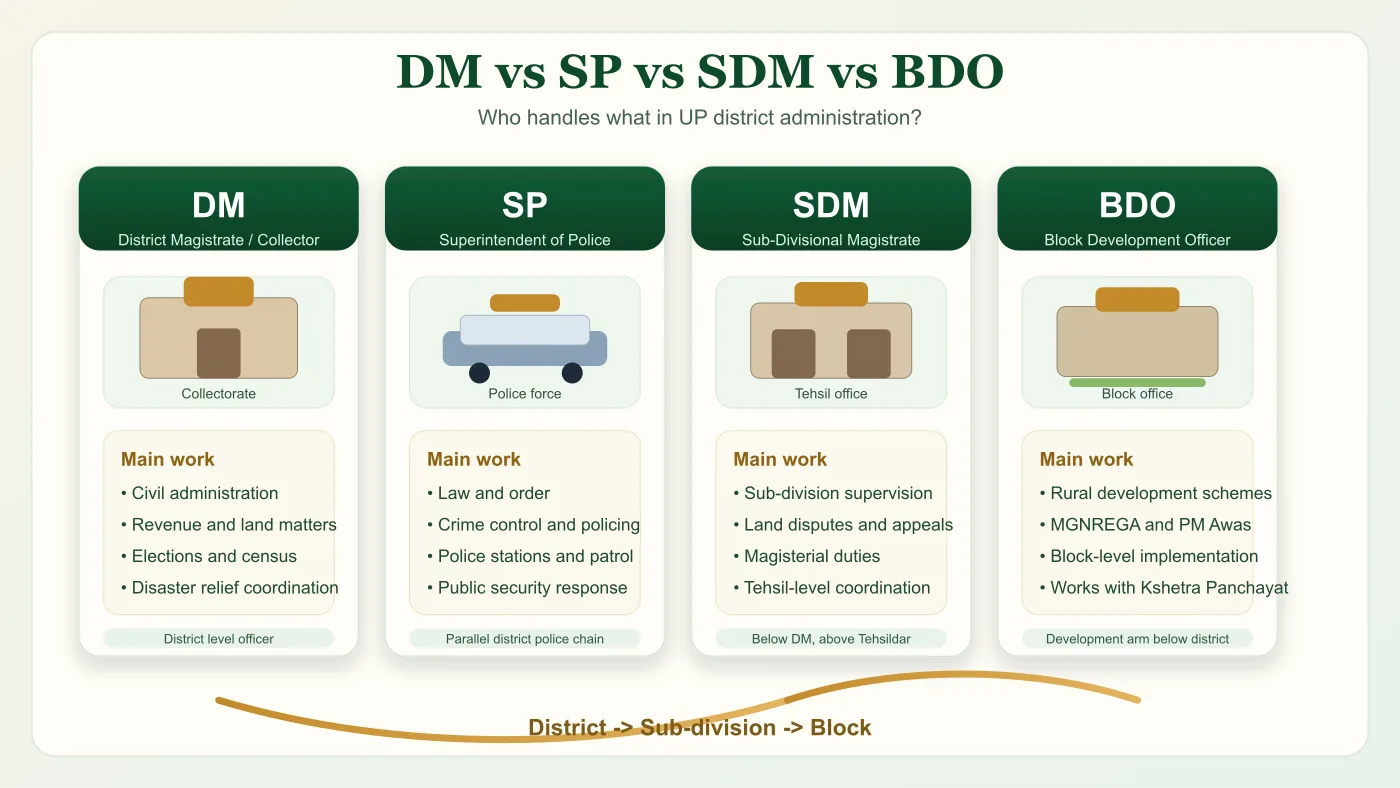
Students often get confused between the DM and SP. A simple rule helps:
- DM = civil administration, revenue, elections, coordination
- SP / Commissioner system = policing and crime control
Tehsil / Sub-Division
Each district is divided into tehsils (often aligned with sub-divisional administration), headed at the sub-divisional level by a Sub-Divisional Magistrate (SDM) — typically a PCS officer.
- The SDM handles revenue matters, land disputes, and is the first appellate authority for revenue cases.
- The Tehsildar manages land records, mutation, and revenue collection at the tehsil level.
- UP has 350+ tehsils across its 75 districts.
The key distinction is:
- SDM = magisterial and supervisory role at sub-divisional level
- Tehsildar = operational revenue officer at tehsil level
Block (Vikas Khand)
The Block is the main unit of rural development administration, headed by the Block Development Officer (BDO).
| Feature | Detail |
|---|---|
| Total blocks in UP | 821 |
| Head | BDO (Block Development Officer) |
| Function | Rural development, implementing central/state schemes |
| Link to Panchayati Raj | Each block corresponds to a Kshetra Panchayat |
- The BDO coordinates implementation of schemes like MGNREGA, Swachh Bharat, PM Awas Yojana at the grassroots level.
- Works closely with the elected Block Pramukh (head of Kshetra Panchayat).
This is another high-yield distinction:
- BDO = administrative/development officer
- Block Pramukh = elected local body head
District Police Administration
| Officer | Jurisdiction |
|---|---|
| Superintendent of Police (SP) | District level — overall law and order (IPS officer) |
| Additional SP | Assists SP in larger districts |
| Circle Officer (CO) | Sub-division level |
| Station House Officer (SHO) | Police station level |
- In metropolitan cities (Lucknow, Kanpur, Varanasi, Prayagraj, Agra, Ghaziabad), the police is headed by a Commissioner of Police instead of an SP.
Urban Governance
| Body | Head | Areas |
|---|---|---|
| Nagar Nigam (Municipal Corporation) | Mayor | Large cities (Lucknow, Kanpur, Varanasi, Agra, etc.) |
| Nagar Palika Parishad (Municipality) | Chairman | Medium towns |
| Nagar Panchayat | Chairman | Small towns transitioning from rural |
UP has 17 Municipal Corporations (Nagar Nigams). The total number of urban local bodies can change over time, so it is better to remember the institutional categories more strongly than one fluctuating aggregate figure.
Summary Cheat Sheet
| Exam Fact | Answer |
|---|---|
| Number of divisions | 18 |
| Number of districts | 75 |
| Number of blocks | 821 |
| Division head | Divisional Commissioner |
| District head | District Magistrate (IAS) |
| Sub-division head | SDM |
| Tehsil revenue officer | Tehsildar |
| Block head | BDO |
| District police head | SP (IPS) |
| Municipal Corporation head | Mayor |
| Total Nagar Nigams | 17 |
Lesson Doubts
Ask questions, get expert answers