🏘️ Panchayati Raj in UP
Three-tier Panchayati Raj system in UP — Gram Panchayat, Kshetra Panchayat, Zila Panchayat, 73rd Amendment, reservations, Gram Sabha powers for Uttar Pradesh GK.
Panchayati Raj — Local Self-Governance
Panchayati Raj is the system of rural local self-government in India. The concept traces back to ancient village councils, but the modern constitutional framework was established by the 73rd Constitutional Amendment Act, 1992 (effective 24 April 1993).
Uttar Pradesh was a pioneer in Panchayati Raj — the UP Panchayati Raj Act was passed in 1947, making it one of the earliest states to legislate on local governance, even before the Constitution came into effect.
Three-Tier Structure
The Panchayati Raj system in UP has three tiers, as mandated by the 73rd Amendment. The easiest way to remember them is:
- Gram Panchayat = village level
- Kshetra Panchayat = block level
- Zila Panchayat = district level
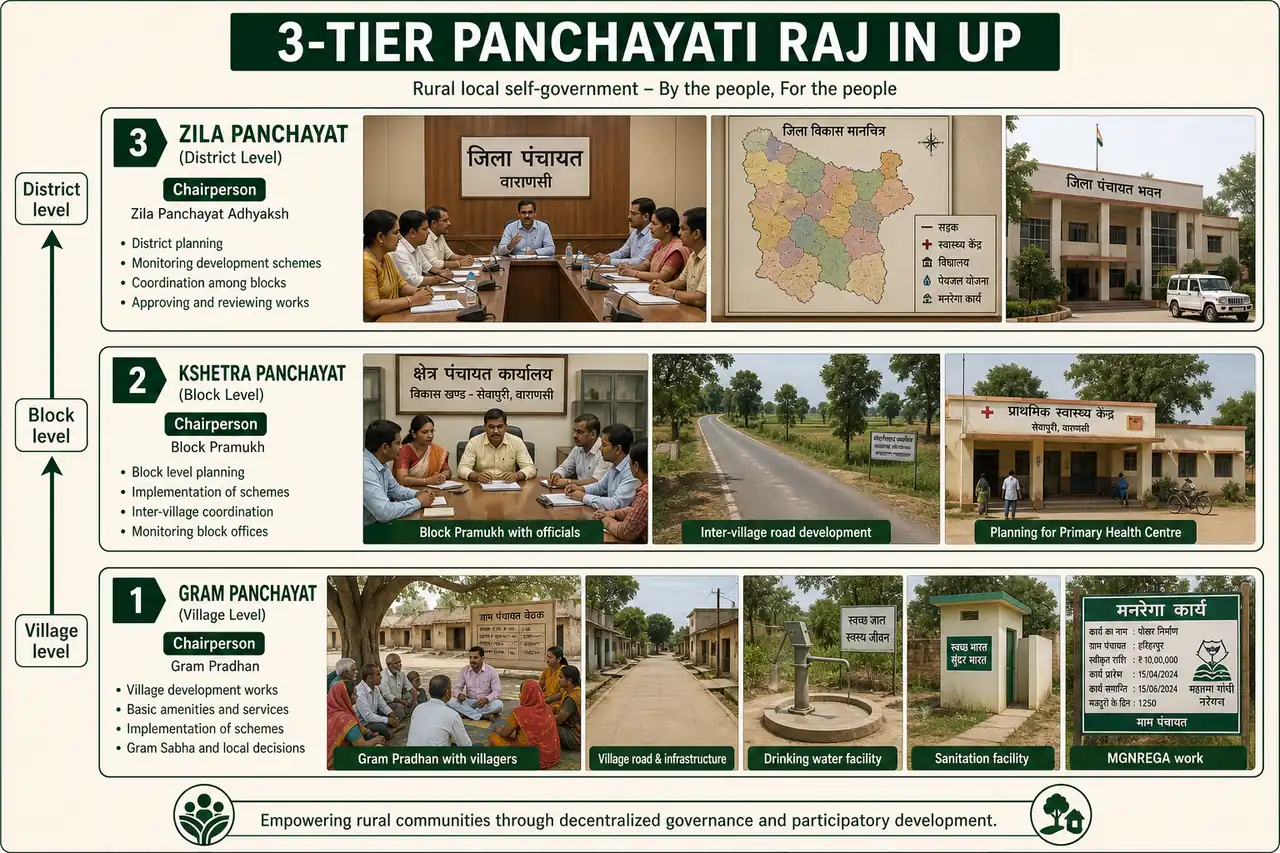
| Tier | Body | Head | Number in UP |
|---|---|---|---|
| Village level | Gram Panchayat | Gram Pradhan | about 59,000+ |
| Block level | Kshetra Panchayat (Block Panchayat) | Block Pramukh | 821 |
| District level | Zila Panchayat | Zila Panchayat Adhyaksha | 75 |
Gram Panchayat — The Foundation
The Gram Panchayat is the lowest and most direct tier of rural self-government. It is where villagers see local governance most visibly.
Composition
- Headed by the Gram Pradhan (also called Sarpanch in other states), who is directly elected by the voters of the Gram Panchayat area.
- Members (Panch) are elected from wards within the panchayat area.
- Term: 5 years.
Functions
The Gram Panchayat is responsible for:
- Construction and maintenance of village roads, drains, and ponds.
- Drinking water supply and sanitation (Swachh Bharat implementation).
- Street lighting and village cleanliness.
- Implementation of MGNREGA (employment guarantee scheme) at the village level.
- Birth and death registration.
- Managing village common lands (Gram Sabha land).
Revenue Sources
- Local taxes (house tax, fair tax).
- Grants from state and central governments.
- Finance Commission grants (Central and State).
- MGNREGA and other scheme funds.
Gram Sabha — The People's Assembly
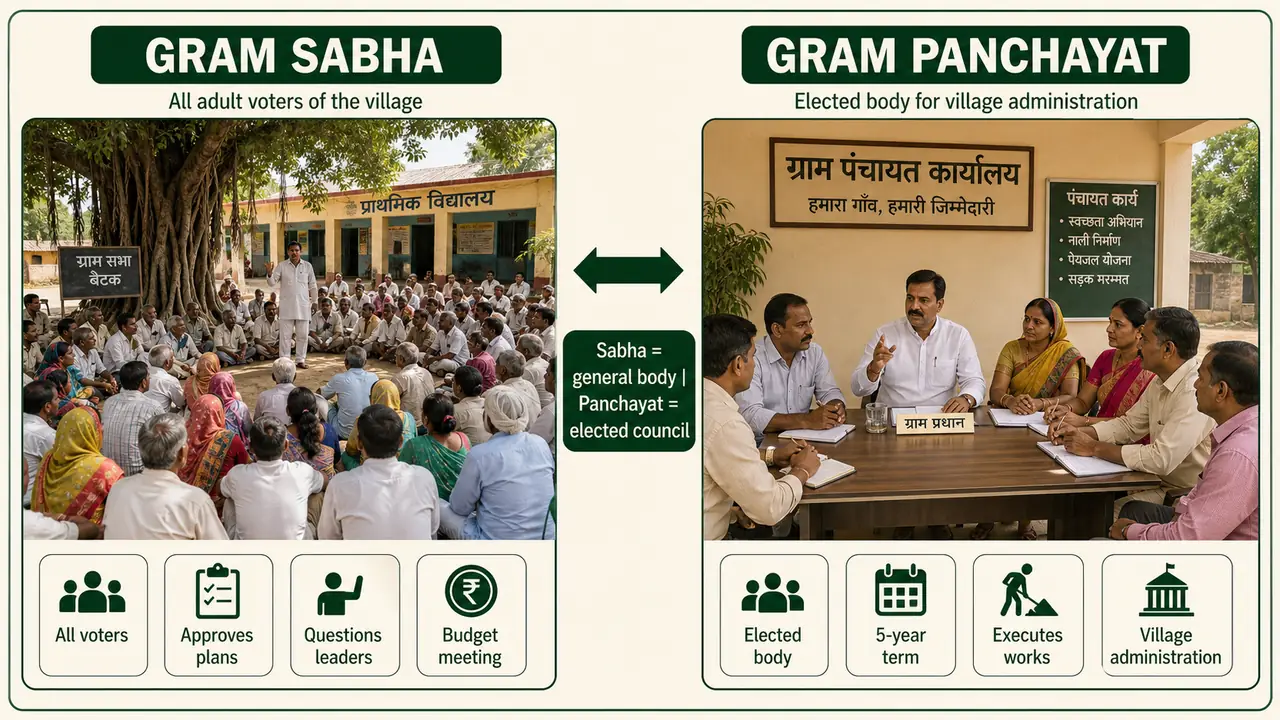
The Gram Sabha consists of all registered voters of the Gram Panchayat area. It is the foundation of grassroots democracy because it is broader than the elected Panchayat itself.
| Feature | Detail |
|---|---|
| Membership | All adult voters in the panchayat area |
| Meetings | Minimum 2 meetings per year (UP rules mandate at least 2) |
| Quorum | 1/5th (20%) of total members |
Powers of the Gram Sabha
- Approves the annual budget and development plans of the Gram Panchayat.
- Audits accounts and reviews expenditure.
- Identifies beneficiaries for government schemes (BPL lists, housing, pensions).
- Can question the Gram Pradhan and demand accountability.
Exam Tip: The Gram Sabha is NOT the same as the Gram Panchayat. The Sabha is the general body of all voters; the Panchayat is the elected governing council.
Kshetra Panchayat (Block Panchayat)
The Kshetra Panchayat operates at the block level as the intermediate tier, linking village panchayats with the district-level body.
| Feature | Detail |
|---|---|
| Head | Block Pramukh (indirectly elected under the block-level panchayat structure) |
| Members | Elected territorial members along with other members provided under state law |
| Number in UP | 821 |
| Role | Coordination between Gram Panchayats and Zila Panchayat |
- The Kshetra Panchayat focuses on block-level development: roads connecting villages, primary health centres, block-level education planning.
- Works closely with the Block Development Officer (BDO).
This level is easiest to remember as the coordination tier:
- village issues too large for one Gram Panchayat often rise to the block level
- district-wide planning is too large for it, so that goes upward to Zila Panchayat
Zila Panchayat (District Panchayat)
The Zila Panchayat is the apex tier of the Panchayati Raj system at the district level.
| Feature | Detail |
|---|---|
| Head | Zila Panchayat Adhyaksha (Chairperson) |
| Members | Elected territorial members along with ex officio members as provided under law |
| Number in UP | 75 |
| Role | District-level rural development planning |
- Prepares the District Development Plan.
- Coordinates with the DM and district administration.
- Oversees education, health, agriculture extension, and rural infrastructure at the district level.
Students should not confuse the Zila Panchayat with the district administration:
- Zila Panchayat = elected rural local body
- DM / district administration = executive administrative machinery
Reservations in Panchayati Raj
The 73rd Amendment and UP Panchayati Raj Act mandate extensive reservations:
| Category | Reservation |
|---|---|
| Scheduled Castes (SC) | Proportional to population |
| Scheduled Tribes (ST) | Proportional to population |
| Other Backward Classes (OBC) | Reservation provided under UP's state framework |
| Women | 50% of all seats (UP increased from 33% to 50%) |
- The 50% reservation for women applies at all three tiers — Gram Pradhan, Block Pramukh, and Zila Panchayat Adhyaksha positions.
- Reservation rotates every election cycle to ensure different categories get representation across different panchayats.
Exam Tip: UP provides 50% reservation for women in Panchayati Raj institutions — higher than the constitutionally mandated minimum of 33%.
Panchayat Elections
| Feature | Detail |
|---|---|
| Conducted by | UP State Election Commission |
| Frequency | Every 5 years |
| Voting method | Direct (for Gram Pradhan and ward members) |
| Latest statewide elections mentioned here | 2021 |
- The State Election Commission (established under Article 243K) is independent of the general Election Commission of India.
- Panchayat elections in UP involve a very large number of elected representatives across all three tiers, making them one of the biggest local democratic exercises in India.
Challenges and Reforms
| Challenge | Reality |
|---|---|
| Financial dependence | Most Gram Panchayats depend heavily on government grants; own revenue is minimal |
| Caste dynamics | Caste affiliations often influence electoral outcomes |
| Capacity gaps | Many elected representatives lack training in governance and accounting |
| Proxy representation | Women or SC/ST candidates sometimes serve as proxies for dominant groups |
Reforms
- E-Gram Swaraj portal digitises panchayat planning, budgeting, and accounting.
- SVAMITVA scheme provides property cards to village households using drone mapping — strengthening land governance.
- Regular training through State Institute of Rural Development (SIRD).
Summary Cheat Sheet
| Exam Fact | Answer |
|---|---|
| Constitutional basis | 73rd Amendment (1992) |
| UP Panchayati Raj Act | 1947 |
| Gram Panchayats in UP | about 59,000+ |
| Kshetra Panchayats | 821 |
| Zila Panchayats | 75 |
| Gram Panchayat head | Gram Pradhan |
| Block Panchayat head | Block Pramukh |
| District Panchayat head | Zila Panchayat Adhyaksha |
| Women reservation | 50% |
| Gram Sabha quorum | 1/5th (20%) |
| Gram Sabha vs Panchayat | All voters vs elected council |
| Elections conducted by | UP State Election Commission |
Lesson Doubts
Ask questions, get expert answers