🍞 Wheat (Triticum spp.)
Origin, importance, species groups, growth stages, and practical cultivation points of wheat under Indian conditions.
Wheat is the dominant Rabi cereal of India and one of the most important field crops in the world. To understand wheat agronomy properly, it is useful to connect its origin, species groups, growth stages, and practical field management.
Wheat at a Glance
Wheat belongs to the genus Triticum. It is mainly grown as a cool-season cereal and forms the backbone of Rabi food-grain production in India.
Why wheat matters:
- it is one of the world’s leading cereals by area and production,
- it provides staple food in the form of chapati, bread, bakery products, and processed foods,
- it fits a wide range of irrigated and semi-irrigated systems,
- it plays a central role in national food security and grain procurement.
Origin of Wheat
Two classical views are often cited in crop-origin discussions:
- De Candolle associated wheat origin with the Euphrates-Tigris region.
- Vavilov linked different wheat groups to centers such as Abyssinia and regions around Western Pakistan, south-west Afghanistan, and adjoining mountainous zones.
For exam purposes, the main point is that wheat has an ancient origin in the broader Near Eastern region and has been cultivated since early civilization.
Classification of Wheat
Wheat species are often grouped by chromosome number:
- Diploids: 7 pairs of chromosomes
- Tetraploids: 14 pairs of chromosomes
- Hexaploids: 21 pairs of chromosomes
This classification helps explain why different wheat species vary in grain quality, adaptation, and end use.
Important Wheat Species in India
1. Common Wheat (Triticum aestivum)
This is the most widely grown wheat in India.
Main features:
- also called bread wheat,
- suited for chapati and bakery use,
- cultivated in most wheat-growing regions,
- forms the bulk of irrigated wheat cultivation.
2. Durum Wheat (Triticum durum)
Main features:
- often called macaroni wheat,
- used for pasta, noodles, and vermicelli,
- better known in central and southern regions,
- generally belongs to the tetraploid group.
3. Emmer Wheat (Triticum dicoccum)
Main features:
- found in limited areas,
- traditionally valued for special food preparations,
- grown in parts of peninsular India.
4. Indian Dwarf or Shot Wheat (Triticum sphaerococcum)
Main features:
- historically important,
- now cultivated only on a very limited scale,
- low productivity is one reason it declined.
Growth Stages of Wheat
Wheat passes through a predictable sequence of development. Understanding these stages is essential because irrigation, fertilizer use, and stress effects are stage-specific.
Common stages:
- germination and emergence,
- crown root initiation,
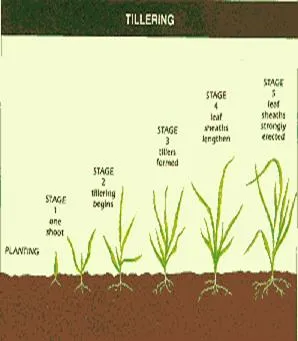
- tillering,
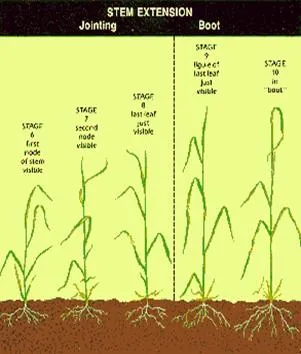
- jointing,
- booting,
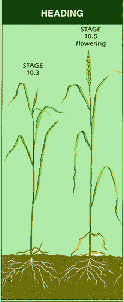
- heading and flowering,
- grain filling,
- physiological maturity.
Why growth stages matter
- early stages determine plant stand and tiller number,
- vegetative stages determine canopy growth,
- reproductive stages decide grain number and grain weight,
- late heat or moisture stress during grain filling sharply reduces yield.
Practical Wheat Cultivation Points
Climate and Soil
Wheat is a cool-season crop.
Broad agronomic preference:
- cool weather during vegetative growth,
- bright weather during grain filling,
- well-drained fertile loam to clay-loam soils,
- avoidance of waterlogging.
Sowing
Timely sowing is one of the most critical decisions in wheat.
Practical importance:
- timely sowing improves tillering and yield potential,
- delayed sowing exposes the crop to terminal heat,
- sowing method and spacing affect plant population.
Nutrient Management
Wheat responds strongly to balanced fertilization.
Key points:
- nitrogen is usually given in split doses,
- phosphorus is important for root development and early vigor,
- potassium supports overall plant health where soils are responsive.
Irrigation
Stage-specific irrigation is essential. The most critical stage is usually crown root initiation (CRI).
Other important stages may include:
- tillering,
- jointing or booting,
- flowering,
- grain filling.
Weed and Crop Care
Wheat needs early weed control because weeds compete strongly during the initial growth period. Proper seedbed preparation, timely sowing, and integrated weed management improve stand and yield.
Summary Cheat Sheet
| Topic | Key Point |
|---|---|
| Crop identity | Wheat is the major Rabi cereal of India |
| Important species | T. aestivum, T. durum, T. dicoccum, T. sphaerococcum |
| Classification basis | Diploid, tetraploid, and hexaploid groups |
| Most critical irrigation stage | CRI in most practical wheat systems |
| Main agronomic principle | Timely sowing and stage-specific management decide yield |
* 47ºS to 57ºN latitude
* Cultivated in wide range of soils but
* Well suited to fertile well drained silt and clay loam soils
* Poorly suited to sandy or poorly drained soils
- Climate
- Wheat has hardening ability after germination
- It can germinate at temp just above 4ºC
- After germination it can withstand freezing temperatures by-
- Spring wheat - as low as (-9.4ºC)
- Winter wheat – as low as (-31.6ºC)
- Normal process starts above 5ºC under the presence of adequate sunlight
- During the process of hardening there is gradual increase in the dry matter, sugars, amide nitrogen, and amino nitrogen in the tissues
- As a result there is greater tolerance to freezing of proteins
- Hardened plants have lower moisture in the leaves and
- Water is held more tightly within the cells
- Response to photo period and growth
- It is long day plant
- Long day hastens the flowering
- Short day increase the vegetative period
- But no more varieties after the release of photo-insensitive
- Temperature and growth
- Wheat can be exposed to low temp during vegetative and high temp and long days during reproductive phases
- Optimum is 20-22ºC
- Optimum for vegetative – 16-22 º C
- Leaves are largest at 22 º C
- Temp above 22 ºC decreases the plant height, root length and tiller number
- Heading is accelerated as temp rose from 22 to 34 ºC but retarded above 34 ºC
- At grain development 25 ºC for 4- 5 weeks is optimum
- Temp above 25 ºC reduce the grain weight
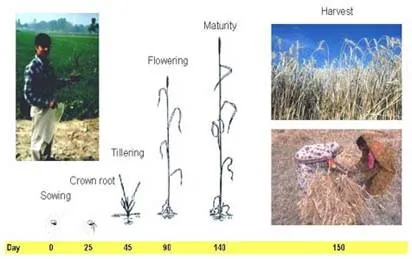
Growth stages in wheat in North India
- Vegetative
- Germination : 5-7 days
- CRI : 20-25 DAS
- Tillering: from 15 days at 4-5 days until 45 DAS
- Jointing: Peak plant growth 45-60 DAS
- Internode elongation period
- Reproductive
- Boot leaf 70-75 DAS
- Flowering : 85-90 DAS
- Milking: 100-105DAS
- Dough: 105-110
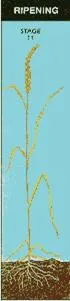
- Maturity: 115 – 120
- Coordinating Research Zones
- There are 6 zones in India for wheat improvement and coordination
- Northern Hills Zone
- North Western Plans Zone
- North Eastern Plains Zone
- Central Zone
- Peninsular Zone
- Southern Hills Zone
Different growth stages of wheat
Wheat cultivation practices
- Season
- Time of sowing decides yield potential in wheat
- Irrigated long duration varieties (135-140d)
- Nov 10-30th
- Short duration varieties (120-125)may be sown up to Dec 15
- Later than Dec 15th there is drastic reduction in yield
- Zone wise there is slight variation
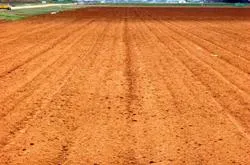
- Field preparation
- Usually after harvest of Kharif crops
- Field is prepared by disking once and harrowing
- Moderate to fine tilth is suitable
- Zero tillage also possible
- After rice dibbling in lines may be an option
- Methods of sowing
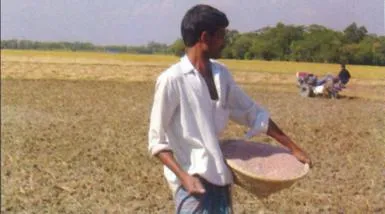
- Broad casting
- Zero / No-tillage sowing
- Behind the plough
- Drilling
- Dibbling
- FIRB – Furrow irrigated raised bed system
-
Seed rate
- Normal recommendation 100-125 kg /ha
- Increase seed rate by 25% when
- Under late sown
- When the soil moisture is less
- Broadcast requires higher seed rate – 150 kg
- For dibbling 25-30kg is sufficient
-
Spacing
- Varies with varieties
- Tillering variety requires wider spacing
- Irrigated wheat spaced 22.5 cm and 8-18 cm between plants
- Rainfed wheat – 25-30 cm x 5-6cm
- When late sown closer spacing 15-16cm
-
Mineral Nutrition
-
Nitrogen
- Critical leaf N conc is 2.5%
- Poor tillering and small ear heads are deficiency
- Indian soils lack N
- General recommendation
- For irrigated crop -s 120-150 kg
- Rainfed - 40-60kg
- Irrigated 2-3 equal splits
- Heavy soils 2 splits
- Light soils three
- Basal, 1st irrigation and 2nd irrigation are time
- In rainfed crop if moisture availability is sufficient
- Additional dose may be – 40kg/ha
- All the nitrogenous may be used
- For calcarious and strongly alkaline soils
- Ammonium sulphate is better than Urea
-
Phosphorous
- It is also critical nutrient particularly for dwarf
- If adequate P fertilization is done for
- Maize-wheat
- Sorghum – wheat
- Rice-wheat
- P may be reduced or avoided
- But most of soils are responding
- May be 0.1% dry leaf P conc be maintained
- 60kg P2O5 at planting is good
- Source wise water soluble is preferred
- Rock phosphate efficiency much lower
- For acid soils
- Use of rock phosphate with pyrites may be useful
- When the water soluble (SSP / DAP) when placed near the root zone is more efficient than broadcasting
- All P as basal
-
Potassium
- There is response to applied K
- In general Indo-Gangetic alluvium is rich in K and not recommended with K
- General recommendation is 40-60kg /ha
- May be basal or split along with 1st irrigation
-
Micro-nutrients
- Zn, Fe, Cu, Mn and B are reported as deficient in certain soils and conditions
- Zn is widely reported
- <10ppm in leaves is acute deficiency
- Higher P is interfering with Zn
- Generally 25 kg Zn SO4 /ha
- Foliar spray with 0.5%
- 5kg ZnSO4 along with 2.5kg slaked lime is dissolved in 1000 lit to spray 1 ha
-
INM
- Green manure / FYM applied to Kharif crop
- A pulse crop before wheat
- Biofertlizers along the seeds and soil
-

-
Irrigation
- Highly responds to irrigation
- 4-6 irrigations are essential
- 40-50% depletion of ASM
- Appropriate IW :CPE ratio for wheat 0.7-0.9
- On clay loam up to 80% depletion
- Critical phases for irrigation are
- CRI – 20-25 DAS)
- Second most critical stage – Flowering
- Third important stage – jointing and milk stages
-
For varying number irrigations
| No of irrigations | Stages |
|---|---|
| 1 | CRI |
| 2 | CRI + LJ |
| 3 | CRI + B + M |
| 4 | CRI + LT + F + M |
| 5 | CRI + LT + LJ + F + M |
| 6 | CRI + LT + LJ + F + M + D |
CRI – Crown root initiation; LT – Late tillering; LJ – late jointing; F- Flowering; M- milking; D – Dough stages
-
Weed control
- Deadly competitor
- Should be controlled at the early
- Better filed maintenance to previous crop
- Problematic mono-cot weeds are
- Phalaris minor – (Canary grass)
- Avena fatua (Wild oat)
- Polypogan monspliensis
- Hand weeding is recommended
- Before 20-25DAS
- Second weeding 2 weeks later
- Use of herbicides becomes handy
- Dicots can be controlled by 2,4 D (EE) 0.3-0.4 kg /ha at 35DAS
- Monocots can be controlled by
- Isoproturon 1-1.5kg /ha or
- Methabenzthiazuron 1.5 kg or
- Metoxuron 1.5 kg /ha on 30-35 DAS
- Pre-emergence application of Pendimethalin or Isoproturon is broad spectrum control
-
Harvesting and threshing
- Yellow and dry straw is visual indicator
- Shredding, breaking of spikes are over ripe
- Most suitable stage is grain moisture of 20-25%
- Combine harvester is ideal
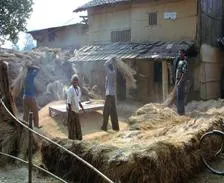
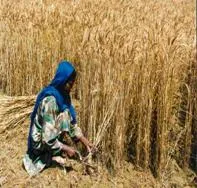
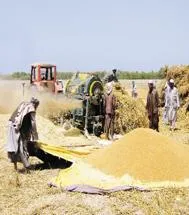
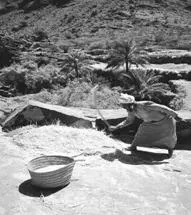
- Usually manually harvested or by reapers is dried for 3-4 days on threshing floor and threshed
- Wheat based cropping systems
- Normally wheat is cultivated after Kharif crops under double crop sequence
- Kharif crops may be
- Rice, maize, sorghum, millet, mungbean, urdbean, cowpea, pigeonpea, cotton etc.,
- A third crop of any catch crop is raised in certain pockets
- In UP wheat is alternated with sugarcane
Multiple choice questions
- Bread wheat is ____________ a. Secale cereale b. Hordeum vulgarec. Triticum aestivum_
- According to Vavilov the origin of Durum wheat is ________ a. Abyssinia b. Asia c. Africa
- Permanent adventitious roots of wheat is called __________ a. Primary roots b. Secondary roots c. Clonal roots
- Common wheat is _________ a. Triticum durum b. Triticum dicoccum c._Triticum aestivum
- Duram wheat is ________ a. Triticum durum _b. Triticum dicoccum c._Triticum aestivum
- Emmer wheat is _________ a. Triticum durumb. Triticum dicoccum c. _Triticum aestivum
- Wheat is a _________ plant a. Short day b. long day c. day neutral
- Duration of CRI stage in wheat is ________ DAS a. 45-60 b. 20-25 c. 30-45
- Duration of boot leaf stage in wheat is ________ DAS a. 45-60 b. 70-75 c. 30-45
- Duration of flowering stage in wheat is ________ DAS a. 85-90 b. 70-75 c. 100-105
- Duration of milking stage in wheat is ________ DAS a. 85-90 b. 70-75 c. 100-105
- Duration of dough stage in wheat is ________ DAS a. 105-110 b. 115-120 c. 100-105
- Duration of maturity stage in wheat is ________ DAS a. 105-110 b. 115-120 c. 100-105
- Normal recommendation of seed rate for wheat is ________ kg/ha a. 75-90 b. 90-100 c. 100-125
- The recommended seed rate for wheat under dibbling method is ________ kg/ha a. 25-30 b. 30-45 c. 45-60
- General recommendation of inorganic fertilizers for wheat is ________ kg/ha
- 120-150 : 60 : 40-60 b. 130-145 : 65 : 60 c. 145-160 : 65 : 65
- Spacing for irrigated wheat is ____________
- 22.5 x 8-18 cm b. 25-30 x 5-6cm c. 25 x 15 cm
- Spacing for rainfed wheat is ____________
- 22.5 x 8-18 cm b. 25-30 x 5-6cm c. 25 x 15 cm
Lesson Doubts
Ask questions, get expert answers