📈 Weed Classification and Identification
Weed Classification and Identification — grasses, broadleaves, sedges, and parasitic weeds with key identification features.
This lesson builds core elective concepts in BSc Agriculture with practical applications and exam-oriented clarity.
Weed Classification and Identification
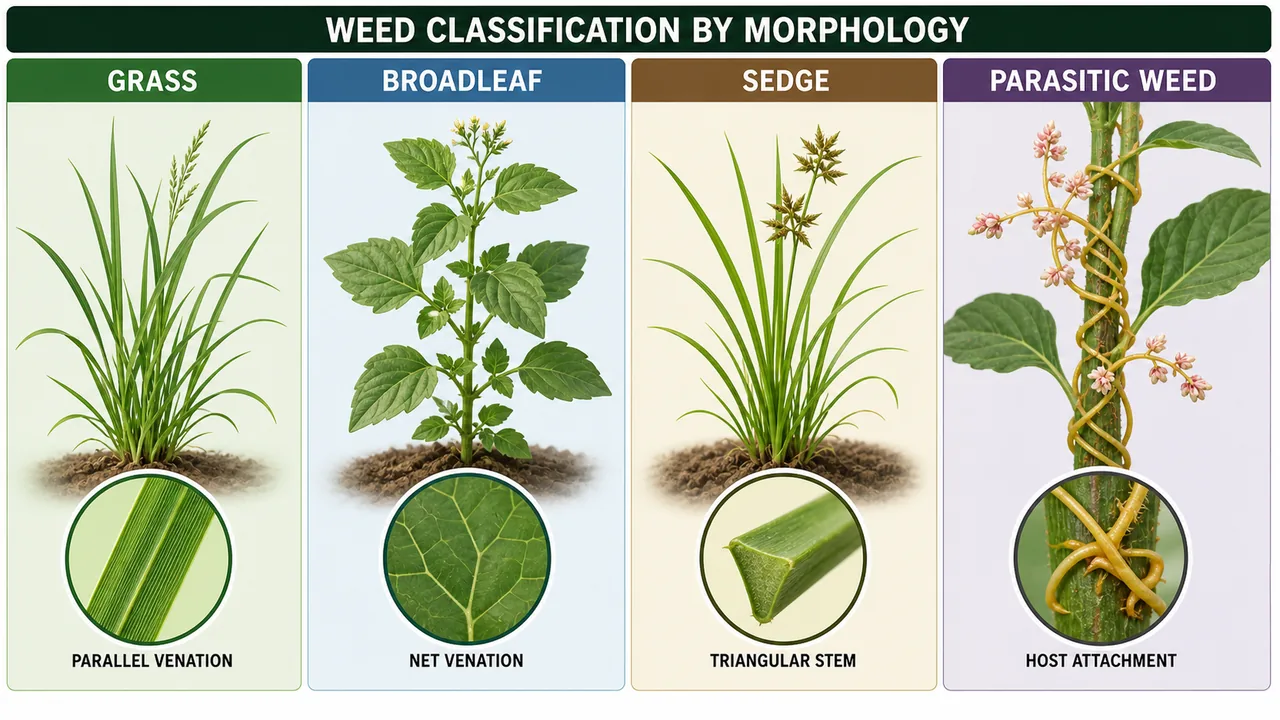
Accurate identification and classification of weeds is the first step in developing effective weed management programmes. Weeds are broadly categorised by their morphological features into grasses, broadleaves, sedges, and parasitic weeds.
Quick Field ID Rules
| If you observe... | Most likely group |
|---|---|
| Narrow leaves + parallel venation + hollow culm | Grass |
| Broad leaves + reticulate venation + tap root | Broadleaf |
| Triangular solid stem + three-ranked leaves | Sedge |
| Direct attachment on host stem/root | Parasitic weed |
Grasses (Family Poaceae)
Grasses are monocotyledonous weeds characterised by:
- Narrow, linear leaves with parallel venation
- Hollow, cylindrical stems (culms) with distinct nodes
- Fibrous root system
- Flowers arranged in spikelets
Important Grass Weeds in India
| Weed | Common Name | Crops Affected |
|---|---|---|
| Phalaris minor | Little seed canary grass | Wheat |
| Echinochloa crusgalli | Barnyard grass | Rice |
| Cynodon dactylon | Bermuda grass | All crops (perennial) |
| Avena fatua | Wild oat | Wheat, barley |
| Digitaria sanguinalis | Crab grass | Maize, vegetables |
Broadleaf Weeds (Dicots)
Broadleaf weeds have net-veined leaves, tap root systems, and flowers with distinct petals:
- Chenopodium album (bathua) — major rabi season weed
- Parthenium hysterophorus (congress grass) — invasive weed in wastelands and crops
- Convolvulus arvensis (field bindweed) — perennial twining weed
- Amaranthus viridis (pigweed) — common in kharif crops
- Trianthema portulacastrum (horse purslane) — problematic in cotton, groundnut
Sedges (Family Cyperaceae)
Sedges are often confused with grasses but differ in key features:
- Triangular stems (the mnemonic: "sedges have edges")
- Leaves arranged in three ranks
- Solid stems (unlike hollow grass culms)
- Cyperus rotundus (purple nutsedge) is ranked the world's worst weed
- Cyperus iria and Fimbristylis miliacea are common in rice paddies
Parasitic Weeds
Parasitic weeds derive nutrition partially or fully from host plants:
- Holoparasites (total parasites) — Cuscuta (dodder) on lucerne, linseed; lacks chlorophyll entirely
- Hemiparasites (partial parasites) — Striga (witchweed) on sorghum, maize; has some photosynthetic ability
- Root parasites — Orobanche (broomrape) on mustard, tobacco; attaches to host roots underground
- Parasitic weeds cause severe yield losses (up to 100% in Striga-infested sorghum fields)
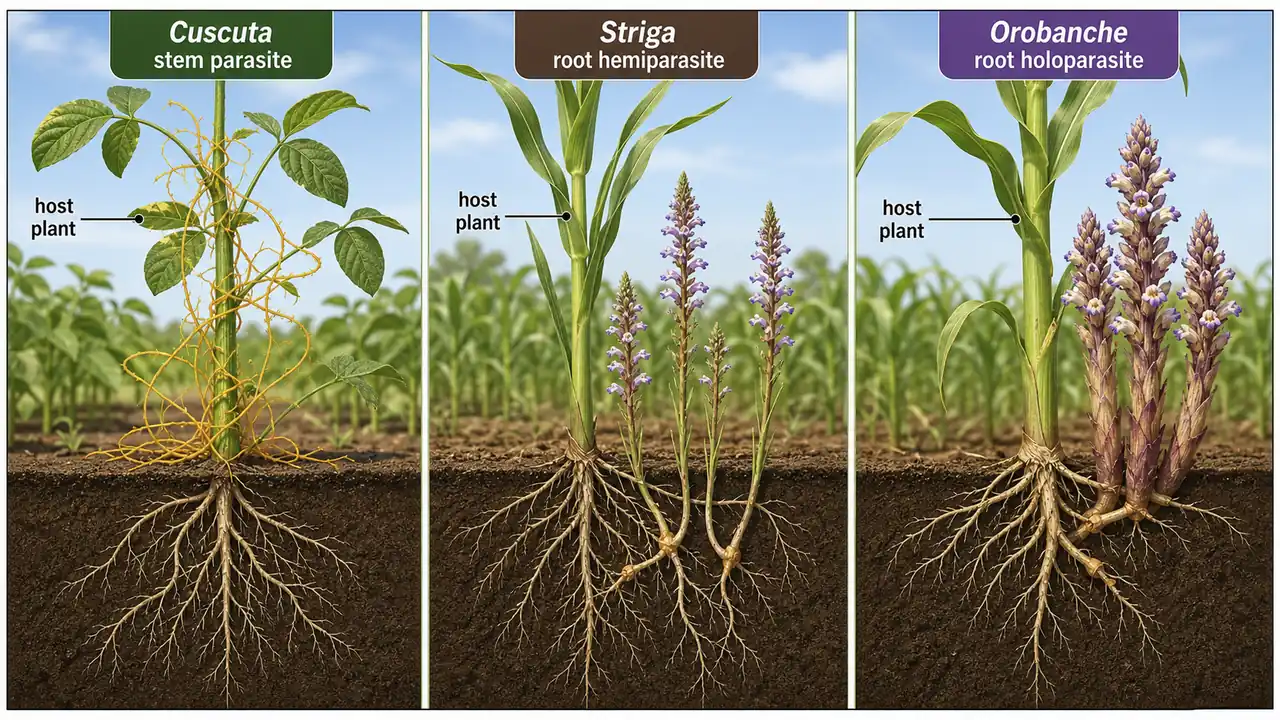
Correct identification — whether grass, broadleaf, sedge, or parasite — directly determines the choice of herbicide and management approach.
Summary Cheat Sheet
| Topic | Key takeaway |
|---|---|
| Main focus | Weed Classification and Identification — grasses, broadleaves, sedges, and parasitic weeds with key identification features. |
| Section context | Revise this lesson with the rest of Weed Management for stronger conceptual continuity. |
Lesson Doubts
Ask questions, get expert answers