Elective Courses 🎯
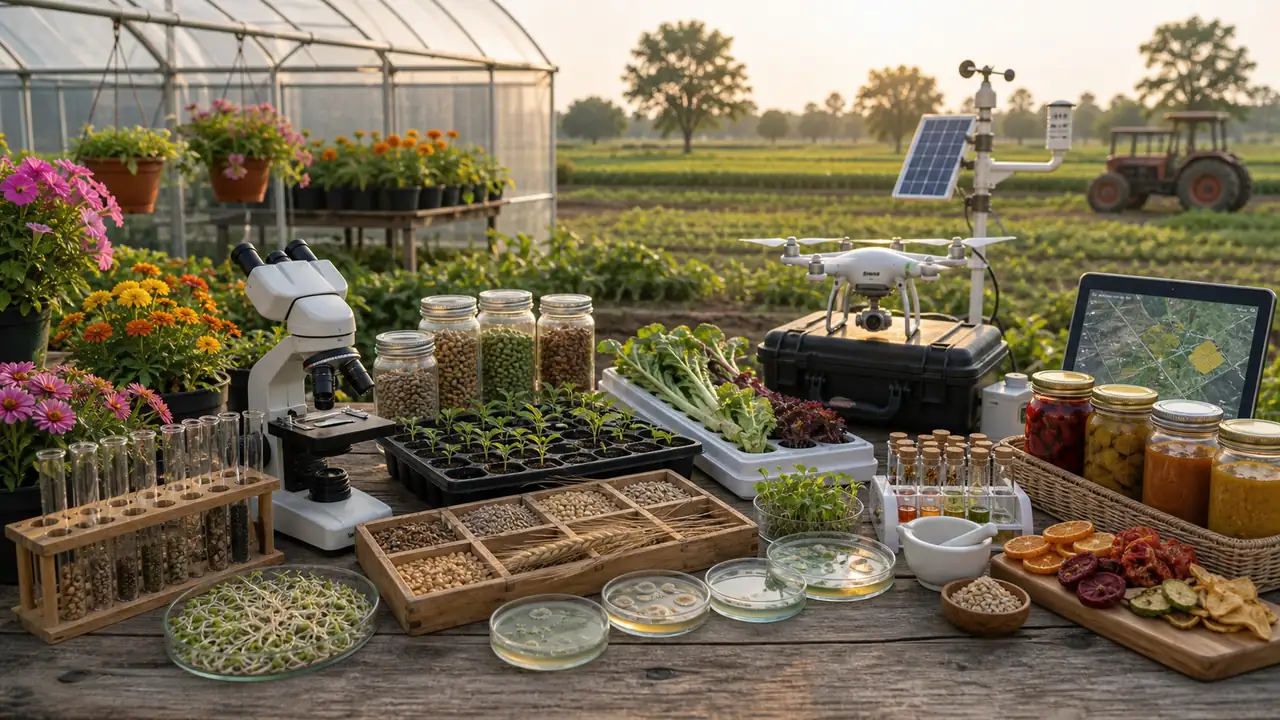
Elective course study material for BSc Agriculture students, covering specialization areas such as agribusiness, biotechnology, horticulture, sustainability, food science, and precision farming.
Course Structure
What's Inside

Post Harvest Technology and Value Addition
Lecture notes covering post-harvest losses, handling, storage, processing, packaging, value addition, and enterprise policy as per ICAR 6th Deans' Committee 2024. Course Code: ELEC 21 | Credits: 4(3+1).
Geoinformatics, Remote Sensing and Precision Farming
Lecture notes covering GIS, GPS, remote sensing, image analysis, crop monitoring, and precision-farming technologies as per ICAR 6th Deans' Committee 2024. Course Code: ELEC 18 | Credits: 4(3+1).
Food Science and Nutrition
Lecture notes covering food composition, nutritional needs, digestion, processing, spoilage, quality standards, and food safety as per ICAR 6th Deans' Committee 2024. Course Code: ELEC 20 | Credits: 4(3+1).
Biotechnology of Crop Improvement
Lecture notes covering tissue culture, molecular breeding, genomics, transformation, genome editing, and biotech regulation as per ICAR 6th Deans' Committee 2024. Course Code: ELEC 17 | Credits: 4(3+1).
Commercial Seed Production
Lecture notes covering seed industry structure, seed production systems, quality assurance, storage, and seed business management as per ICAR 6th Deans' Committee 2024. Course Code: ELEC 16 | Credits: 4(3+1).
Climate Resilient Agriculture
Lecture notes covering climate change evidence, agricultural vulnerability, climate-smart adaptation, and mitigation strategies as per ICAR 6th Deans' Committee 2024. Course Code: ELEC 15 | Credits: 4(3+1).
Bioformulation and Nanoformulation
Lecture notes covering biological and nano-enabled agricultural formulations, their production, quality control, and regulation as per ICAR 6th Deans' Committee 2024. Course Code: ELEC 14 | Credits: 4(3+1).
Principles and Practices of Organic Farming and Conservation Agriculture
Lecture notes covering organic farming principles, certification, nutrient and pest management, conservation agriculture, natural farming, and market-policy aspects as per ICAR 6th Deans' Committee 2024. Course Code: ELEC 19 | Credits: 4(3+1).
Agri-business Management
Course overview and lesson index for ELEC 01, focused on the business, marketing, processing, and trade dimensions of agriculture.
Agrochemicals and Pest Management
Course overview and lesson index for ELEC 02, focused on agrochemicals, their safe use, and their role in integrated pest management.
Commercial Plant Breeding
Course overview and lesson index for ELEC 03, focused on commercial breeding, seed systems, variety protection, and the business side of crop improvement.
Landscaping and Ornamental Gardening
Course overview and lesson index for ELEC 04, focused on landscape planning, ornamental gardening, and the practical business side of landscaping.
Food Safety and Standards
Course overview and lesson index for ELEC 05, focused on food hazards, preventive systems, legal standards, and food-safety management.
Biopesticides and Biofertilizers
Course overview and lesson index for ELEC 06, focused on biological crop-protection inputs, biological nutrient inputs, and their production and marketing.
Protected Cultivation
Course overview and lesson index for ELEC 07, focused on controlled-environment production, structure management, crop performance, and enterprise economics.
Micropropagation Technologies
Course overview and lesson index for ELEC 08, focused on plant tissue culture, micropropagation methods, acclimatization, and industry applications.
Hi-Tech Horticulture
Course overview and lesson index for ELEC 09, focused on technology-intensive horticulture from nursery to market.
Weed Management
Course overview and lesson index for ELEC 10, focused on weed science, herbicide use, and integrated weed-management strategies.
System Simulation and Agro-Advisory
Course overview and lesson index for ELEC 11, focused on crop-system modeling, simulation-based decision support, and weather-linked agro-advisory services.
Agricultural Journalism
Course overview and lesson index for ELEC 12, focused on communicating agricultural knowledge through print, broadcast, digital media, and extension materials.
Management of Natural Resources
Course overview and lesson index for ELEC 13, focused on natural-resource classification, conservation, governance, and sustainable development.
Elective Courses
The elective block in B.Sc. Agriculture allows students to move beyond the common core and begin building a specialization pathway. These courses are important because they let students align their study with future goals such as agribusiness, crop improvement, food processing, sustainability, digital agriculture, or protected cultivation.
Courses included in this section
This section currently includes the following elective areas:
- Agribusiness Management
- Agrochemicals and Pest Management
- Commercial Plant Breeding
- Landscaping and Ornamental Gardening
- Food Safety and Standards
- Biopesticides and Biofertilizers
- Protected Cultivation
- Micropropagation Technologies
- Hi-tech Horticulture
- Weed Management
- System Simulation and Agro-Advisory
- Agricultural Journalism
- Management of Natural Resources
- Bioformulation and Nanoformulation
- Climate Resilient Agriculture
- Commercial Seed Production
- Biotechnology of Crop Improvement
- Geoinformatics, Remote Sensing and Precision Farming
- Organic Farming and Conservation Agriculture
- Food Science and Nutrition
- Post-Harvest Technology and Value Addition
Why the elective block matters
The core B.Sc. Agriculture curriculum gives students a broad agricultural foundation. The elective block is where students begin shaping a stronger identity.
- Students interested in business can lean toward agribusiness, food safety, and value addition.
- Students interested in plant science can lean toward breeding, biotechnology, seed, or micropropagation.
- Students interested in future agriculture can lean toward precision farming, agro-advisory systems, and climate resilience.
- Students interested in sustainability can lean toward organic farming, natural-resource management, and biological inputs.
This means electives are not random extras. They are the bridge between general study and meaningful specialization.
Main learning themes
Across the full elective basket, students can build deeper understanding in:
- agribusiness and entrepreneurship
- crop improvement and seed systems
- biotechnology and micropropagation
- horticulture and protected cultivation
- food quality, processing, and safety
- biological and chemical crop-input systems
- precision agriculture and digital decision support
- sustainability, climate resilience, and natural-resource management
How to study this section well
- Choose electives as a coherent cluster, not as isolated easy papers.
- Try to align subject choices with a real path:
- business and market path
- crop science and breeding path
- horticulture and protected-production path
- digital and climate-smart agriculture path
- sustainability and input-systems path
- When studying, focus on application and contrast:
- Why is this elective different from the core course?
- What career or problem domain does it prepare you for?
Who benefits most from this section
This section is especially useful for students preparing for:
- career-focused specialization during the final year
- internships and Student READY choices
- M.Sc. entrance direction-setting
- agribusiness and startup planning
- sector-specific jobs in food, horticulture, inputs, seed, or advisory systems
Core takeaway
The elective block helps B.Sc. Agriculture students move from broad agricultural training toward intentional specialization, making the degree more aligned with real career, research, and enterprise goals.
Frequently Asked Questions
What are elective courses in BSc Agriculture?
Elective courses in BSc Agriculture are specialization-oriented subjects that students choose in addition to the common core curriculum. They help students move from broad agricultural learning into focused areas such as agribusiness, biotechnology, food science, protected cultivation, precision farming, or sustainability.
Why are electives important in BSc Agriculture?
Electives are important because they help students align their studies with career direction, higher-study interest, internship goals, and sector-specific skills. They are often the part of the degree where students begin shaping a more practical identity within agriculture.
How should I choose electives in BSc Agriculture?
Choose electives by thinking in clusters rather than selecting random easy-looking papers. Students usually make better choices when they align electives with a path such as agribusiness, crop improvement, horticulture, food systems, digital agriculture, or sustainability.
What is the difference between core subjects and elective subjects in BSc Agriculture?
Core subjects give all students a broad agricultural foundation, while elective subjects offer deeper study in selected domains. The elective block is where specialization begins, so it is more closely linked with future niche interests and career direction.
Which elective is best for agribusiness and startup interest?
Students interested in business and entrepreneurship often lean toward electives such as agribusiness management, food safety, value addition, post-harvest technology, or agricultural journalism depending on their goals. The best choice depends on whether the student wants enterprise, marketing, processing, or communication exposure.
Which electives are good for biotechnology and crop-improvement careers?
Students interested in plant science and research often look toward electives such as commercial plant breeding, biotechnology of crop improvement, micropropagation technologies, commercial seed production, and bioformulation-related courses. These subjects usually connect more directly with advanced lab or crop-improvement pathways.
Which electives are good for precision farming and climate-smart agriculture?
Students interested in future agriculture often prefer electives such as geoinformatics and precision farming, system simulation and agro-advisory, climate resilient agriculture, and natural-resource management. These help build understanding of digital, data-driven, and adaptation-focused agricultural systems.
How should I study the elective block for exams and career value?
Study the elective block by connecting each course with the problem it solves in agriculture, not just with its syllabus title. Students usually get more value when they treat electives as a specialization strategy rather than as isolated semester papers.