🐛 Population Dynamics and Biotic Factors
Understand insect population attributes, growth forms, life tables, and how competition, predators, parasites, and diseases regulate pest populations.
This lesson explains how insect populations change over time and how biotic forces like competition, predation, and parasitism shape those changes in real field conditions.
Lecture 9 : Population dynamics and role of biotic factors
Attributes of a population
i. Density : Population size per unit area ii. Birth rate (Natality) : Rate at which new individuals are added to the
population by reproduction iii. Death rate (Mortality) : The rate at which individuals are lost by death. iv. Dispersal : The rate at which individuals immigrate into and emigrate out of
the population. v. Dispersion: the way in which individuals are distributed in space. It may be of
3 types.
a) Random distribution b) Uniform distribution c) Clumped distribution
vi. Age distribution : the population of individuals of different ages in the group. vii. Genetic characteristics : adaptiveness, reproductive fitness, persistence. viii. Population growth form : the way in which population changes / grows as a
result of natality, mortality, and dispersal.
Population dynamics .
Populations grow in two contrasting ways. They are
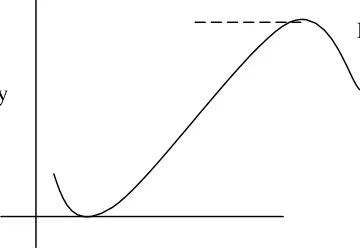
i. J- shaped growth form (Fig 1a) ii. S- Shaped or sigmoid growth form (Fig 1b)
Time Time
Fig. 1a. J- shaped growth form Fig. 1b. S - shaped growth form.
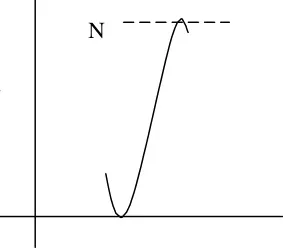
 In the J - shaped growth form, the population density increases in exponential
or geometric fashion; for example 2,4,8,16,32 … and so on until the population runs
out of some resource or encounters some limitation (limit N, Fig 1a). Growth then
comes to a more or less abrupt halt and density declines rapidly. Populations with this
kind of growth form are unstable. Their reproductive rate is high and survival rate is
less and so they are r strategists. Factors other than density regulates the
population.(eg; Aphids).
In the J - shaped growth form, the population density increases in exponential
or geometric fashion; for example 2,4,8,16,32 … and so on until the population runs
out of some resource or encounters some limitation (limit N, Fig 1a). Growth then
comes to a more or less abrupt halt and density declines rapidly. Populations with this
kind of growth form are unstable. Their reproductive rate is high and survival rate is
less and so they are r strategists. Factors other than density regulates the
population.(eg; Aphids).
In the S-shaped growth pattern (Fig 2) the rate of increase of density decreases as the population increases and levels off at an upper asymptote level K, called the carrying capacity, or maximum sustainable density. Their reproductive rate is less and survival rate is more. So they are K strategists. This pattern has more stability since the population regulates itself.(eg Hymenopterans).
The population growth rate or change is worked out using the formula, # Nt = N0e [(b-d)t ] - Et + It
Where Nt = number at the end of a short time period
N0 = number at the beginning of a short time period e = base of natural logarithm = 2.7183 b= birth rate d= death rate t= time period E= emigration I = immigration.
Life table : Life tables are tabular statements showing the number of insects dying over a period of time and accounting for their deaths.
Example of a life table for a lepidoperan insect
Number living Percent
Number dying
Stage beginning of Cause of death reduction
by end of stage
stage during stage Egg 200 10.0 Parasites 20.0 Other 15 Early larva 170 136.0 Dispersal 80 Late larva 34 13.6 Parasites 6.8 Disease 10.2 Other 90 Pupa 3.4 0.3 Parasites 0.5 Other 25 Adult 2.5 0.5 Miscellaneous 20
Number living
Number dying Cause of death by end of stage
Stage
beginning of
Factors influencing population growth.
a) Biotic factors or density dependent factors. b) Abiotic factors or density independent factors.
Biotic factors
- Competition : For at least part of the lifetime the members of an insect species are likely to be competing with one another or with members of another species for limited resources like food, mates, suitable site for oviposition or pupation. Such competition operates whenever the population is increasing and the resources are limited.
a) Intraspecific competition : When members of population of the same species compete for resources we call it intraspecific competition. Examples are as follows
-
Cannibalism in American bollworm larvae
-
Cannibalism in later stage grubs of Chrysopid
-
Crowding in aphids result in alate (winged) form for migration
-
Reduction in fecundity (egg laying) in rice weevil, Sitophilus oryzae during overcrowding
-
Crowding in honeybees leads to swarming
b) Interspecific competition . This is the competition occurring between members of two or more species. Two or more competing species with identical requirements cannot coexist in a same place for a long time. The elimination of one species by another as a result of interspecific competition has come to be known as the competitive exclusion principle or Gause’s principle .
-
For example when flour beetles Tribolium castaneum and Tribolium confusum were grown in the same jar of flour, one species eliminates the other. Under high temperature and RH conditions T. castaneum eliminates T.confusum and vice versa under low temperature and RH conditions.
-
Accidental introduction of oriental fruit fly Dacus dorsalis into Hawai eliminated Mediterranean fruit fly Ceratitis capitata.
- Predators and Parasites
Predators : Predators are free living organisms that feed on other animals, their prey, devouring them completely and rapidly.
-
Predators may attack immatures and adults.
-
More than one individual of prey required for predator to reach maturity
- Major insect predators are birds, fish, amphibians, reptiles, mammals and arthropods
Parasites: An organism that is dependent for some essential metabolic factor on another throughout its all life stages, which is always larger than itself
- A parasite weakens or kills the host while feeding

- Many parasites on asingle host

- Requires only one part of one host to reach maturity
Eg. Virus, fungi, bacteria, protozoa, nematodes and other arthropods.
Parasitoid : An insect parasite of an arthropod that is parasitic in its immature stage killing the host in the process of development and adults are free living.
Interactions between predator and prey are different from the parasite host relationship in that the predator and prey maintain equilibrium more dynamically than the parasite and its host. The parasites I n general when the rate of parasitism is high, cause death and result in elimination of hosts. But the predator never eliminates the prey completely.
Summary Cheat Sheet
-
Population dynamics studies how insect numbers change through natality, mortality, dispersal, age structure, and growth pattern.
-
J-shaped growth is rapid and unstable, while S-shaped growth approaches carrying capacity and shows more self-regulation.
-
Biotic factors such as competition, predators, parasitoids, and diseases strongly influence pest population change.
-
Review core concepts, definitions, and field-level application points from this lesson.
-
Prioritize economic threshold-based decisions and integrated management logic where relevant.
References
1 source
References
Lesson Doubts
Ask questions, get expert answers