🌱 Modes of Reproduction in Crop Plants
Sexual and asexual modes of reproduction and their breeding significance in crop plants.
This lesson covers core principles and exam-focused points from this topic in plant breeding.
Knowledge of the mode of reproduction and pollination is essential for a plant breeder,
because these aspects help in deciding the breeding procedures to be used for the genetic
improvement of a crop species. Choice of breeding procedure depends on the mode of
reproduction and pollination of a crop species.
Reproduction refers to the process by which living organisms give rise to the offspring of similar
kind (species). In crop plants, the mode of reproduction is of two types: viz. 1) sexual
reproduction and 2) asexual reproduction
I. Sexual reproduction
Multiplication of plants through embryos which have developed by fusion of male and
female gametes is known as sexual reproduction. All the seed propagating species belong to this
group.
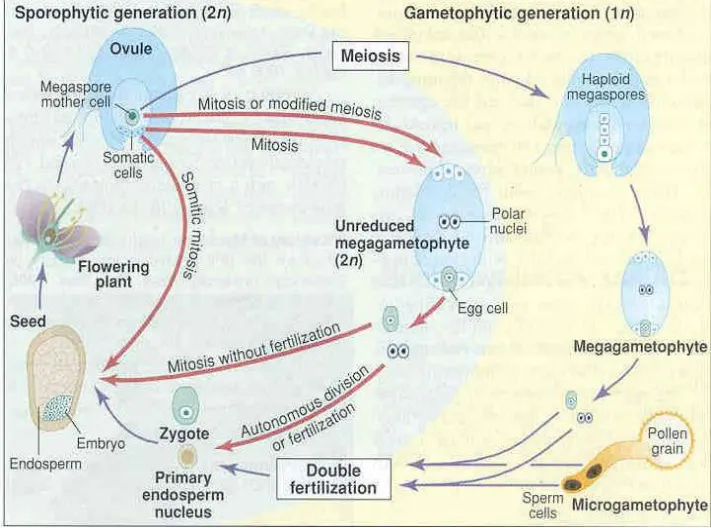
Sporogenesis
Production of microspores and megaspores is known as sporogenesis. In anthers,
microspores are formed through microsporogensis and in ovules, the megaspores are formed
through megasporogenesis.
Microsporogenesis
The sporophytic cells in the pollen sacs of anther which undergo meiotic division to form
haploid i.e., microspores are called microspore (MMC) or pollen mother cell (PMC) and the
process is called microsporogenesis. Each PMC produce four microspores and each microspore
after thickening of the wall transforms into pollen grain.
Megasporogenesis
A single sporophytic cell inside the ovule, which undergo meiotic division to form
haploid megaspore, is called megaspore mother cell (MMC) and the process is called
megasporogenesis. Each MMC produces four megaspores out of which three degenerate
resulting in a single functional megaspore.
Gametogenesis
The production of male and female gametes in the microspores and megaspores is known
as gametogenesis.
Microgametogenesis
This is nothing but the production of male gametes or sperm. On maturation of the
pollen, the microspore nucleus divides mitotically to produce a generative and a vegetative or
tube nucleus. The pollen is generally released in this binucleate stage. The reach of pollen over
the stigma is called pollination. After the pollination, the pollen germinates. The pollen tube
enters the stigma and travels down the style. The generative nucleus at this phase undergoes
another mitotic division to produce two male gametes or sperm nuclei. The pollen along with
the pollen tube possessing a pair of sperm nuclei is called microgametophyte. The pollen tube
enters the embryo sac through micropyle and discharges the two sperm nuclei.
Megagametogenesis
The nucleus of the functional megaspore undergoes three mitotic divisions to produce
eight or more nuclei. The exact number of nuclei and their arrangement varies from one species
to another. The megaspore nucleus divides thrice to produce eight nuclei. Three of these nuclei
move to one pole and produce a central egg cell and two synergid cells on either side. Another
three nuclei migrate to the opposite pole to develop into three antipodal cells.
The two nuclei remaining in the center, the polar nuclei, fuse to form the secondary
nucleus. The megaspore thus develops into a mature female gametophyte called
megagametophyte or embryo sac. The development of embryo sac from a megaspore is known
as megagametogeneis. The embryo sac generally contains one egg cell, two synergids with the
apparent function of guiding the sperm nucleus towards the egg cell and three antipodals which
forms the prothalamus cells and one diploid secondary nucleus.
Fertilization
The fusion of one of the two sperms with the egg cell producing a diploid zygote is
known as fertilization. The fusion of the remaining sperm with the secondary nucleus leading to
the formation of a triploid primary endosperm nucleus is termed as triple fusion . The primary
endosperm nucleus after several mitotic divisions develops into mature endosperm, which
nourishes the developing embryo.
II. Asexual reproduction
Multiplication of plants without the fusion of male and female gametes is known as
asexual reproduction. Asexual reproduction can occur either by vegetative plant parts or by
vegetative embryos which develop without sexual fusion (apomixis). Thus asexual reproduction
is of two types: viz. a) vegetative reproduction and b) apomixis.
Vegetative reproduction refers to multiplication of plants by means of various vegetative plant
parts. Vegetative reproduction is again of two types: viz. i) natural vegetative reproduction and
ii) artificial vegetative reproduction.
Natural vegetative reproduction
In nature, multiplication of certain plants occurs by underground stems, sub aerial stems,
roots and bulbils. In some crop species, underground stems (a modified group of stems) give rise
to new plants. Underground stems are of four types: viz. rhizome, tuber, corm and bulb. The
examples of plants which reproduce by means of underground stems are given below:
Rhizome: Turmeric ( Curcuma domestica), Ginger ( Zingiber officinale)
Tuber: Potato (Solanum tuberosum)
Corm: Arvi (Colocasia esculenta ), Bunda ( C. antiquorum )
Bulb: Garlic ( Allium sativum), onion ( A. cepa)
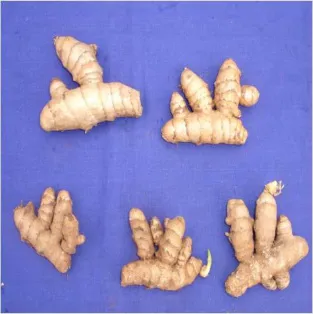
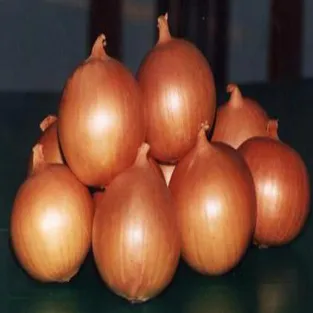
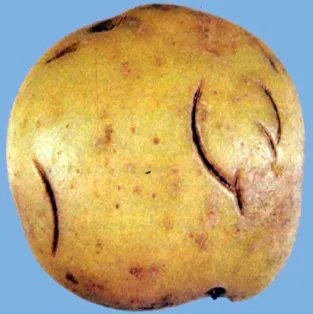
| Col1 | Col2 | Col3 |
|---|---|---|
| Rhizome: Turmeric | Tuber: Potato | **Bulb: Onion ** |
Sub aerial stems include runner, sucker, stolon, etc. These stems lead to vegetative
reproduction in mint ( Mentha sp) rose, strawberry, banana, etc. Bulbils are modified forms of
flower. They develop into plants when fall on the ground. Bulbils are founding garlic.
Artificial vegetative reproduction
Multiplication of plants by vegetative parts through artificial method is known as
artificial vegetative reproduction. Such reproduction occurs by cuttings of stem and roots, and
by layering and grafting. Examples of such reproduction are given below:
Stem cuttings: Sugarcane ( Saccharum sp.) grapes ( Vitis vinifera ), roses, etc.
Root cuttings: Sweet potato, citrus, lemon, etc. Layering and grafting are used in fruit and
ornamental crops.
Apomixis
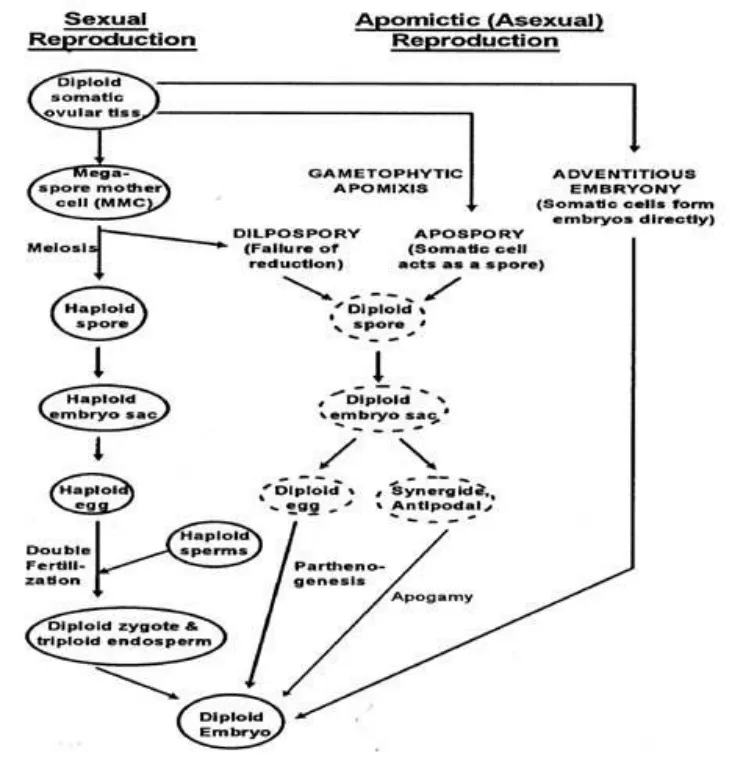
Apomixis refers to the development of seed without sexual fusion (fertilization). In
apomixis embryo develops without fertilization. Thus apomixis is an asexual means of
reproduction. Apomixis is found in many crop species. Reproduction in some species occurs
only by apomixis. This apomixis is termed as obligate apomixis . But in some species sexual
reproduction also occurs in addition to apomixis. Such apomixis is known as facultative
apomixis .
There are four types of apomixis: viz.
- parthenogenesis, 2) apogamy, 3) apospory and 4) adventive embryony.
1. Parthenogenesis. Parthenogenesis refers to development of embryo from the egg cell without
fertilization.
2. Apogamy. The origin of embryo from either synergids or antipodal cells of the embryosac is
called as apogamy.
3. Apospory. In apospory, first diploid cell of ovule lying outside the embryosac develops into
another embryosac without reduction. The embryo then develops directly from the diploid egg
cell without fertilization.
4. Adventive embryony. The development of embryo directly from the diploid cells of ovule
lying outside the embryosac belonging to either nucellus or integuments is referred to as
adventive embryony.
Summary Cheat Sheet
Quick Recall Points
- This lesson focuses on key plant breeding concepts, terminology, and exam-relevant applications.
- Review major definitions, classifications, and method-wise distinctions from the sections above.
- Revise tables and examples from this lesson for fast pre-exam recall.
Exam Traps
- Do not confuse similarly named breeding methods without checking their core selection logic.
- Pay attention to crop-specific examples because the same principle can behave differently by species.
References
1 source • [1]
References
Standard Plant Breeding Class Notes (GPBR211)
BookLesson Doubts
Ask questions, get expert answers