Genetics & Plant Breeding 🧬
Core BSc Agriculture study section covering genetics, seed technology, plant breeding, crop improvement, and plant biotechnology.
Course Structure
What's Inside

Fundamentals of Genetics
Lecture notes covering Fundamentals of Genetics as per ICAR 5th Dean Committee syllabus. Course Code: GPBR 111 | Credits: 3(2+1).
Principles of Seed Technology
Lecture notes covering Principles of Seed Technology as per ICAR 5th Dean Committee syllabus. Course Code: GPBR 112 | Credits: 3(1+2).
Fundamentals of Plant Breeding
Lecture notes covering Fundamentals of Plant Breeding as per ICAR 5th Dean Committee syllabus. Course Code: GPBR 211 | Credits: 3(2+1).
Crop Improvement-I (Kharif)
Lecture notes covering Crop Improvement-I (Kharif) as per ICAR 5th Dean Committee syllabus. Course Code: GPBR 213 | Credits: 2(1+1).
Crop Improvement-II (Rabi)
Lecture notes covering Crop Improvement-II (Rabi) as per ICAR 5th Dean Committee syllabus. Course Code: GPBR 214 | Credits: 2(1+1).
Breeding of Field and Horticultural Crops
Lecture notes covering Breeding of Field and Horticultural Crops. Course Code: GPBR 212 | Credits: 3(2+1).
Principles of Plant Biotechnology
Lecture notes covering Principles of Plant Biotechnology. Course Code: GPBR 311 | Credits: 3(2+1).
Genetics & Plant Breeding
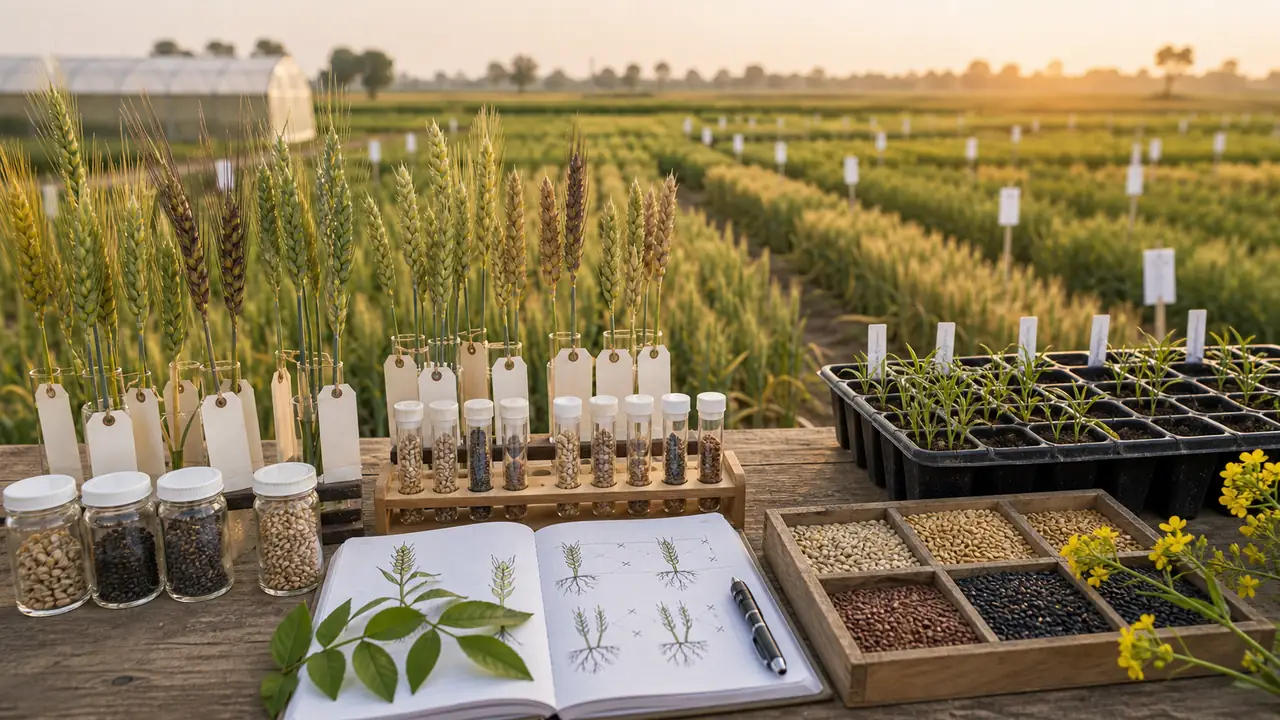
Genetics and plant breeding explain how traits are inherited, how useful variation is identified, and how better crop varieties are developed for yield, quality, resistance, and adaptation. In agriculture, this subject connects basic heredity with practical crop-improvement work used in fields, seed systems, and breeding programs.
Courses included in this section
- Principles of Genetics
- Principles of Seed Technology
- Principles of Plant Breeding
- Breeding of Field and Horticultural Crops
- Crop Improvement I (Kharif)
- Crop Improvement II (Rabi)
- Principles of Plant Biotechnology
Why Genetics & Plant Breeding matters
This subject matters because crop performance starts with genotype. A strong foundation here helps students understand why some varieties yield more, resist pests better, tolerate stress, or suit a specific region. It also gives the logic behind selection, hybridization, seed quality, varietal development, and modern biotechnology tools used in agriculture.
Main learning themes
- laws and principles of inheritance
- genes, chromosomes, variation, and mutation
- seed production, purity, certification, and quality
- selection, hybridization, and breeding methods
- breeding objectives in major field and horticultural crops
- crop improvement strategies for kharif and rabi crops
- basics of plant biotechnology and its breeding applications
How to study this section well
Start with genetics before moving to breeding methods, because breeding decisions make sense only when inheritance is clear. Keep separate notes for definitions, laws, breeding methods, crop-specific objectives, and important examples. Revise crop examples repeatedly because many university and competitive-exam questions ask theory through rice, wheat, and other major crops rather than in abstract form.
Who benefits most from this section
This section is especially useful for BSc Agriculture students building semester fundamentals, ICAR and agriculture exam aspirants revising crop-improvement topics, and learners who want a practical bridge between basic biology and field-level agricultural improvement.
Core takeaway
Genetics explains how traits move across generations, and plant breeding applies that knowledge to create better crops. If students understand inheritance, variation, selection, and crop-specific breeding goals, the rest of this subject becomes much easier to study and recall.
Frequently Asked Questions
Why is genetics and plant breeding important in agriculture?
Genetics and plant breeding are important because they explain how traits are inherited and how better crop varieties are developed for yield, quality, resistance, adaptation, and seed-system performance.
What topics are covered in genetics and plant breeding?
This subject generally covers inheritance, genes and chromosomes, variation and mutation, seed technology, breeding methods, crop improvement, varietal development, and biotechnology applications in crop breeding.
How does genetics help plant breeding?
Genetics helps plant breeding by explaining how traits move across generations, how variation arises, and how breeders can select, combine, and stabilize desirable characteristics in crops.
Why do agriculture students study seed technology along with genetics?
They study seed technology because improved varieties are useful only when high-quality seed can be produced, maintained, tested, certified, stored, and supplied to farmers reliably.
What is the difference between genetics and plant breeding?
Genetics explains the principles of heredity and variation, while plant breeding applies those principles to develop improved crop varieties through selection, crossing, and related methods.
How should students study genetics and plant breeding effectively?
Students should build a strong base in inheritance and chromosome behavior first, then move to breeding methods, seed-quality concepts, and crop-specific examples because the subject becomes easier when the sequence is understood.