🌼 Modes of Pollination
Autogamy, geitonogamy, and allogamy with their role in breeding behavior of crops.
This lesson covers core principles and exam-focused points from this topic in plant breeding.
The process by which pollen grains are transferred from anthers to stigma is referred as
pollination. Pollination is of two types: viz. 1) Autogamy or self pollination and 2) Allogamy or
cross pollination.
I. Autogamy
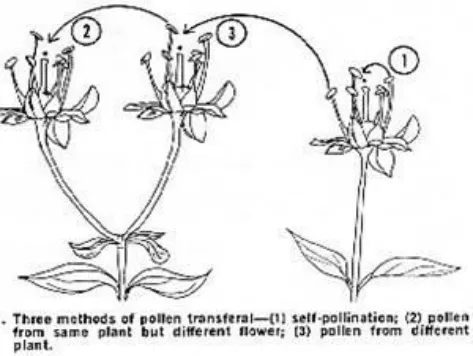
Transfer of pollen grains from the anther to the stigma of same flower is known as
autogamy or self pollination. Autogamy is the closest form of inbreeding. Autogamy leads to
homozygosity . Such species develop homozygous balance and do not exhibit significant
inbreeding depression.
Mechanism promoting self-pollination
Bisexuality
Presence of male and female organs in the same flower is known as bisexuality. The
presence of bisexual flowers is a must for self pollination. All the self pollinated plants have
hermaphrodite flowers.
Homogamy
Maturation of anthers and stigma of a flower at the same time is called homogamy. As a
rule, homogamy is essential for self-pollination.
Cleistogamy
When pollination and fertilization occur in unopened flower bud, it is known as
cleistogamy. It ensures self pollination and prevents cross pollination. Cleistogamy has been
reported in some varieties of wheat, barley, oats and several other grass species.
Chasmogamy
Opening of flowers only after the completion of pollination is known as chasmogamy.
This also promotes self pollination and is found in crops like wheat, barley, rice and oats.
Position of Anthers
In some species, stigmas are surrounded by anthers in such a way that self pollination is
ensured. Such situation is found in tomato and brinjal. In some legumes, the stamens and stigma
are enclosed by the petals in such a way that self pollination is ensured. Examples are
greengram, blackgram, soybean, chickpea and pea.
II. Allogamy
Transfer of pollen grains from the
anther of one plant to the stigma of
another plant is called allogamy or cross
breeding. Allogamy leads to
heterozygosity. Such species develop
heterozygous balance and exhibit
significant inbreeding depression on
selfing.
Mechanism promoting cross-pollination
Dicliny
It refers to unisexual flowers. This is of two types: viz. i) monoecy and ii) dioecy.
When male and female flowers are separate but present in the same plants, it is known as
monoecy . In some crops, the male and female flowers are present in the same inflorescence such
as in mango, castor and banana. In some cases, they are on separate inflorescence as in maize.
Other examples are cucurbits, grapes, strawberry, cassava and rubber. When staminate and
pistillate flowers are present on different plants, it is called dioecy . It includes papaya, date
palm, spinach, hemp and asparagus.
2. Dichogamy (from the Greek dikho -apart and gamous -marriage)
It refers to maturation of anthers and stigma of the same flowers at different times.
Dichogamy promotes cross pollination even in the hermaphrodite species. Dichogamy is of two
types: viz. i) protogyny and ii) protandry. When pistil matures before anthers, it is called
protogyny such as in pearl millet. When anthers mature before pistil, it is known as protandry .
It is found in maize, sugarbeet and several other species.
Heterostyly
When styles and filaments in a flower are of different lengths, it is called heterostyly. It
promotes cross pollination, such as linseed.
Herkogamy
Hinderance to self-pollination due to some physical barriers such as presence of hyline
membrane around the anther is known as herkogamy. Such membrane does not allow the
dehiscence of pollen and prevents self-pollination such as in alfalfa.
Self incompatibility
The inability of fertile pollens to fertilize the same flower is referred to as self
incompatibility. It prevents self-pollination and promotes cross pollination. Self incompatibility
is found in several crop species like Brassica, Radish, Nicotiana, and many grass species. It is of
two types sporophytic and gametophytic .
Male sterility
In some species, the pollen grains are non functional. Such condition is known as male
sterility. It prevents self-pollination and promotes cross pollination. It is of three types: viz.
genetic, cytoplasmic and cytoplasmic genetic . It is a useful tool in hybrid seed production.
Study of floral biology and aforesaid mechanisms is essential for determining the mode
of pollination of various crop species. Moreover, if selfing has adverse effects on seed setting
and general vigour, it indicates that the species is cross pollinated. If selfing does not have any
adverse effect on these characters, it suggests that the species is self-pollinated.
The percentage of cross pollination can be determined by growing a seed mixture of two
different varieties together. The two varieties should have marker characters say green and
pigmented plants. The seeds are harvested from the recessive (green) variety and grown next
year in separate field. The proportion of pigmented plants in green variety will indicate the
percentage of outcrossing or cross pollination.
Significance of pollination
The mode of pollination plays an important role in plant breeding. It has impact on five
important aspects: viz. 1) gene action, 2) genetic constitution, 3) adaptability, 4) genetic purity
and 5) transfer of genes.
Classification of crop plants based on mode of pollination and mode of reproduction
| Mode of pollination and reproduction |
Examples of crop plants |
|---|---|
| A. Autogamous Species | A. Autogamous Species |
| 1. Seed Propagated | Rice, Wheat, Barley, Oats, Chickpea, Pea, Cowpea, Lentil, Green gram, Black gram, Soybean, Common bean, Moth bean, Linseed, Sesame, Khesari, Sunhemp, Chillies, Brinjal, Tomato, Okra, Peanut, etc. |
| 2. Vegetatively Propagated | Potato |
| B. Allogamous Species | B. Allogamous Species |
| 1. Seed Propagated | Corn, Pearlmillet, Rye, Alfalfa, Radish, Cabbage, Sunflower, Sugarbeet, Castor, Red clover, White clover, Safflower, Spinach, Onion, Garlic, Turnip, Squash, Muskmelon, Watermelon, Cucumber, Pumpkin, Kenaf, Oilpalm, Carrot, Coconut, Papaya, etc. |
| 2. Vegetatively propagated | Sugarcane, Coffee, Cocoa, Tea, Apple, Pears, Peaches, Cherries, grapes, Almond Strawberries, Pine apple, Banana, Cashew, Irish, Cassava, Taro, Rubber, etc. |
| C. Often Allogamous Species | Sorghum, Cotton, Triticale, Pigeonpea, Tobacco. |
Genetic consequences of self and cross-pollination
| S.No. | Self-Pollination | Cross-Pollination |
|---|---|---|
| 1 | Self pollination leads to a very rapid increase in homozygosity. Therefore, populations of self – pollinated species are highly homozygous. |
Cross pollination preserves and promotes heterozygosity in a population. Cross pollinated species are highly heterozygous and show mild to severe inbreeding depression and a considerable amount heterosis. |
| 2 | Self pollinated species do not show inbreeding depression, but may exhibit considerable heterosis. |
The breeding methods in such species aim at improving the crop species without reducing heterozygosity to an appreciable degree. |
| 3 | The aim of breeding methods generally is to develop homozygous varities. The inbreeding mechanisams are generally under precise genetic control, but can be influenced by both the genetic background as well as the environment. |
Usually hybrid or synthetic varities are the aim of breeder wherever the seed production of such varities is economically feasible. |
Summary Cheat Sheet
Quick Recall Points
- This lesson focuses on key plant breeding concepts, terminology, and exam-relevant applications.
- Review major definitions, classifications, and method-wise distinctions from the sections above.
- Revise tables and examples from this lesson for fast pre-exam recall.
Exam Traps
- Do not confuse similarly named breeding methods without checking their core selection logic.
- Pay attention to crop-specific examples because the same principle can behave differently by species.
References
1 source • [1]
References
Standard Plant Breeding Class Notes (GPBR211)
BookLesson Doubts
Ask questions, get expert answers