🌿 Clonal Selection
Selection methods used for genetic improvement of asexually propagated crops.
This lesson covers core principles and exam-focused points from this topic in plant breeding.
Some agricultural crops and a large number of horticultural crops are asexually
propagated. Some common asexually propagated crops are sugarcane ( S. officinarum ), potato
( S.tuberosum ), sweet potato ( I. batatas ), Colocasia (Taro), Arum, Dioscorea (yams), Mentha,
ginger ( Zingiber sp .), turmeric ( C. domestica ), banana ( Musa paradisiaca ), etc., almost all the
fruit trees, e.g., mango (Mangifera indica), citrus (Citrus spp.), apples (P. malus), pears
(P.commun is), peaches (P. persica), litchi (Litchi chinensis), loquat (Eriobotrya japonica), etc:,
and many ornamentals and grasses. Many of these crops show reduced flowering and seed set,
'e.g., sugarcane, potato, sweet potato, banana, etc., and some varieties of these crops do not
flower at all. But many of these crops flower regularly and show satisfactory seed set. However
they are propagated asexually to avoid the ill effects of segregation and recombination, both
being the inevitable consequences of sexual reproduction.
Segregation and recombination produce new gene combinations due to which the
progeny differ from their parents in genotype and phenotype. Asexual reproduction, on the other
hand, produces progeny exactly identical to their parents in genotype because the progeny are
derived from vegetative cells through mitosis. The advantage of asexual reproduction is
immediately clear. It preserves the genotype of an individual indefinitely. It must be noted that
this does not depend on the homozygosity of the genotype of an individual. Any genotype is
preserved and. maintained through asexual reproduction. In contrast self-pollination preserves
and maintains only homozygous genotypes giving rise to purelines.
Characteristics of Asexually Propagated Crops
- A great majority of them are, perennial, e.g., sugarcane, fruit trees, etc. The annual
crops are mostly tuber crops, e.g., potato, cassava ( M. utilissima ), sweet potato, etc.
- Many of them show reduced flowering-and seed set. Many varieties do not flower at
all. Only the crops grown for fruit, particularly where good fruit set depends upon
seed formation, show regular flowering and satisfactory seed set.
- They are invariably cross-pollinated.

- These crops are highly heterozygous and show severe inbreeding depression.

- A vast majority of asexually propagated crops are either polyploids, eg., sugarcane,
potato, sweet potato, etc., or have polyploid species or varieties.
- Many species are interspecific hybrid, eg., Banana ( _M. paradisiaca_ ), sugarcane,
Rubus, etc.
- These crops consist of a large number of clones, that is, progeny derived from a
single plant through asexual reproduction. Thus each variety of an asexually
propagated crop is a clone.
Clone
A clone is group of plants produced from a single through asexual reproduction. Thus
asexually propagated crops consist of large number of clones, and they are often known as clonal
crops. All the members of a clone have the same genotype as the parent plant. As a result, they
are identical with each other in genotype. Consequently, the phenotypic differences within a
clone do not have a genetic basis and are purely due to the environmental effects. A selection
within a clone is thus useless. The various characteristic of a.clone are summarised below.
Identical Genotype
All the individuals belongings to a single clone are identical in genotype. This is so
because a clone is obtained through asexual reproduction, which involves mitotic cell division
only. Genetic variation in the progeny of a plant is produced chiefly by segregation and
recombination, which occur during meiosis only. Thus the genotype of a clone is maintained
indefinitely without any change.
Lack of genetic variation
The.phenotypic variation present within a clone is due to the environment only.This is so
because all the individuals belonging to a single clone have the same genotype.
The phenotype of a clone is due to the effects of genotype (G), the environment (E) and
the genotype X 'environment interaction (G x E) the population mean. (µ). Thus the phenotype
(P) of a clone may be expressed as follows.
P = µ + G + E + GE
Thus the phenotypic differences among clones would be partly due to E and GE components.
Hence the efficiency of selection among clones, as among purelines, would depend upon the
precision with which the E and GE components of phenotype are estimated.
Immortality
Theoretically, clones are immortal i.e., a clone can be maintained indefinitely through
asexual reproduction. But clones usually degenerate due to viral or bacterial infection. A clone
may become extinct due to its susceptibility to diseases or insect pests. Further, genetic variation
may arise within a clone changing its characteristics.
Severe Inbreeding Depression
Generally, clones are highly heterozygous and show severe loss in vigor due to
inbreeding.
The phenotypic value of a plant or clone is due to the effects of its genotype (G), the
environment (E) and genotype x environment (G x E) interaction. Of these, only the G effects are
heritable. The environmental and interaction effects are non heritable and cannot be selected for.
Therefore, a selection for quantitative characters based on observations on single plants is highly
unreliable. In fact, plants selected in this way may be no better than a random sample.
Further, a selection for characters like yielding ability, etc. on the basis of unreplicated
clonal plots would often be misleading and unreliable. Therefore, the value of a clone can be
reliably estimated only through replicated yield trials. However, selection for highly heritable
characteristics, such as plant height, days to flowering, color, disease resistance, etc., are easy
and effective even on the basis of individual plants or single plots. Clearly, these situations are
the same as those in the case of sexually reproducing crops.
Selection Procedure
In view of these considerations, in the earlier stages of clonal selection, when selection is
based on single plants or single plots, the emphasis is on the elimination of weak and undesirable
plants or clones. The breeder cannot reasonably hope to identify superior' genotypes at this stage.
In the later stages, when replicated trials are the basis of selection, the emphasis is to identify and
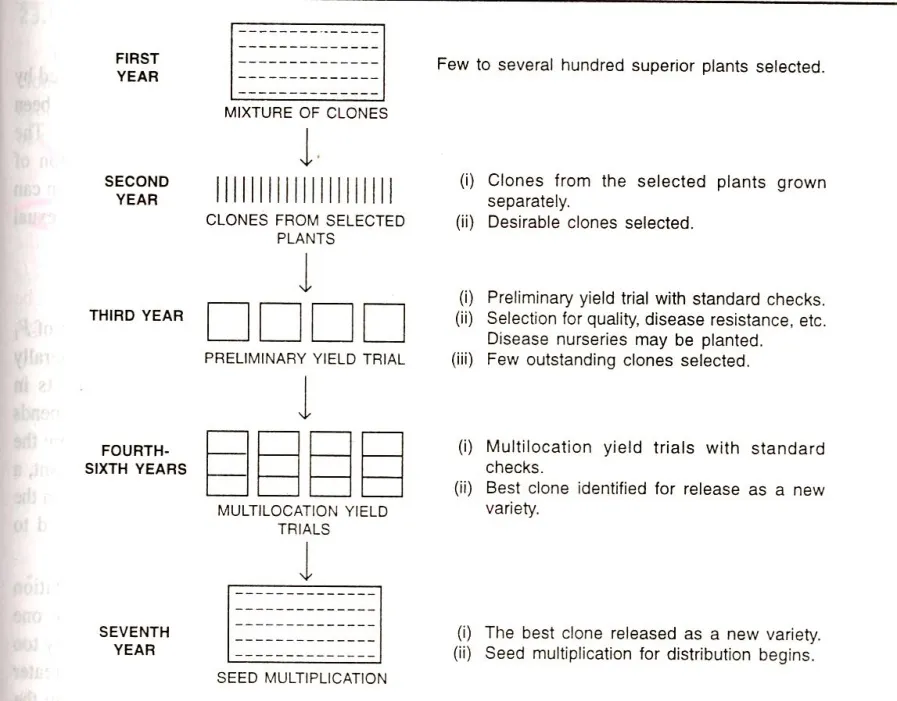
select the superior clones. The various steps involved in clonal selection are briefly described
below and are depicted in Fig.
First Year
From a mixed variable population, few hundreds to few thousand desirable plants are
selected. A rigid selection can be done for simply inherited characters with high heritability.
Plants with obvious weaknesses are eliminated.
Second Year
Clones from the selected plants are grown separately, generally, without replication This
is done in view of the limited supply of the propagating material for each clone, and because of
the large number of clones involved. The characteristics of clones will be more clear now than in
the previous generation when the observations were based on individual plants. The number of
clones is drastically reduced and inferior clones eliminated. The selection is based on visual
observations and on the basis of clonal characteristics. Fifty to one hundred clones may be
selected on the basis of clonal characteristics.
Third Year
Replicated preliminary yield trial is conducted. Suitable, checks included for
comparison. Few superior performing clones with desirable characteristics selected for
multilocation trials. At this stage, selection for quality is also done. If necessary, separate disease
nurseries may be planted to evaluate the disease resistance of selected clones.
Fourth to Sixth Years
Replicated yield trials are conducted at several locations along with a suitable check. The
yielding ability, quality and disease resistance, etc. of the clones are rigidly evaluated. The best
clone that is superior to the check in one or more characteristics is identified for release as a new
variety.
Seventh Year
The superior clone is multiplied released as a new variety.
Merits of Clonal Selection
- It is the only method of selection applicable to clonal crops. It avoids inbreeding
depression, and preserves the gene combinations present in the clones.
- Clonal selection, without any substantial modification, can be combined with
hybridization to generate the variability necessary for selection.
- The selection scheme is useful in maintaining the purity of clones.
Demerits of Clonal Selection
- This selection method utilizes the natural variability already present in the population; it
has not been devised to generate variability.
- Sexual reproduction is a prerequisite for the creation of variability through hybridization
Summary Cheat Sheet
Quick Recall Points
- This lesson focuses on key plant breeding concepts, terminology, and exam-relevant applications.
- Review major definitions, classifications, and method-wise distinctions from the sections above.
- Revise tables and examples from this lesson for fast pre-exam recall.
Exam Traps
- Do not confuse similarly named breeding methods without checking their core selection logic.
- Pay attention to crop-specific examples because the same principle can behave differently by species.
References
1 source • [1]
References
Standard Plant Breeding Class Notes (GPBR211)
BookLesson Doubts
Ask questions, get expert answers