🌾 Rice Varieties and Breeding Techniques
Important released rice varieties and the breeding methods used to develop them.
This lesson covers core breeding concepts and exam-relevant points for quick understanding and revision.
RICE VARIETIES RELEASED USING DIFFERENT BREEDING TECHNIQUES
1. Introduction : All the IRRI Rice varieties from IR 8 to IR 72. Other Examples are Basmati from Punjab, Ponni (mashuri) from Malaysia, CR 1009 (Ponmani) from Orissa.
2. Pure line selection : Co 9. Short duration Co 32. Thiruchengodu Samba - Medium duration Co 19. Chengalpattu Sirumani - Long duration
3. Hybridization and Selection : a) Pedigree method i) Inter varietal:
Co 37 Vaigai TN 1 x Co 29 - Short duration. Co 41 CuL 2410 x IR 22 - Short duration Co 43 Dasal x IR 20 - Medium duration. Co 44 ASD 5 x IR 20 - Medium duration, suitable for late planting. Co 45 Rathu Heenathi x IR 3403 - 207 - 1 - Medium duration, Resistant to blast, BLB and RTV. Ponmani (CR 1009) Pankaj x Jagannath - Long duration. ii) Inter-racial Japonica x indica cross ADT 27 (Norin 10 x GEB 24) Ponni (Mashuri) (Taichung 65 x ME 80) iii) Inter specific crosses Co 31 ( O.perennis x GEB 24) Drought resistance. IR 34 Complex cross, one of the parent is O.nivara b) Back Cross Method of breeding Co 37 male sterile line. Sabarmati and Jamuna. 4. Mutation breeding : a) Spontaneous mutation
GEB 24 - From Athur Kichili Samba known as KONAMANI, fine grain and quality rice.
ADT 41 - Dwarf mutant of Basmati 370. b) Induced mutation :
Jagannath rice from Orissa. Semi dwarf. Parbhani - from Maharastra Prabavathi Satari - Short duration, gamma irradiated AU 1 - from Tamil Nadu.
Heterosis breeding
CORH 1 IR 62829 A / IR 10198 - 66-2 R CORH 2 IR 58025 A / C 20 R ADT RH 1 IR 58025 A / IR 66 R
IMPORTANT RICE VARIETIES SUITABLE FOR TAMIL NADU
Short duration
Name Parentage Duration (Days)
TKM 9 TKM 7 x IR 8 105
Co 37 (Vaigai) TN 1 x Co 29 115
ADT 36 Triveni x IR 20 110
IET 1444 TN 1 x Co 29 115
PY 2 Kannagi x cu 12032 115
IR 50 IR 21153-14 x IR 28 Y 110
IR 36 Multiple cross derivative 120
TPS 1 IR 8 x Katti Samba. 115
PMK 1 Co25 x ADT 31 115
ASD 16 ADT 31 x Co 39 115
ASD 17 Multiple cross derivative 110
ADT 37 BG 280 - 1-2 x PTB 33 105
IR 64 Multiple cross derivative 115
ASD 18 ADT 31 x IR 50 110
ADT 41 Dwarf mutant of Basmati 115
ADT 39 IR 8 x IR 20 125
ADT 20 IR 18348 x R 25869 x IR 58 110
ADT 43 IR 60 x White Ponni 110
TKM-11 C 22 x BJ 1 120
Co 47 IR 50 x Co 43 110-115
Medium duration.
IR 20 IR 262 x TKM 6 135
Bhavani Peta x BPI 76 135
Paiyur - 1 IR 1721 - 14 x IR 1330 - 33 - 2 150
Co 43 Dasal x IR 20 135
Co 44 ASD 5 x IR 20 135
Ponni, White Ponni Taichung 65 x ME 80 140
MDU 2 Co 25 x IR 8 135
ADT 38 Multiple cross derivative 135
ADT 40 RPW 6.13 x Sona 145
Co 45 Rathu Heenathi x IR 3403 - 261 - 1 140
TKM 10 Co31 x C 22 135
TPS 3 RP 31-492 x LMN 140
PY 6 (Jawahar) IR 8 x H4 135
Co 46 T 7 x IR 20 125
Long duration :
Ponmani
(CR 1009, Savithri) Pankaj x Jagannath. 155-160
ADT44 Selection from OR 1128-7-S1 145-150
Rice Hybrids
CoRH 1 IR 62829 A / IR 10198-62-2-R
CoRH 2 IR 58025 A / C 20 R
ADTRH 1 IR58025A / IR 66 R
HYBRID RICE
The utilization of the dwarfing gene (d1) from the mutant variety Dee-Gee-WooGen (DGWG) discovered in Taiwan in 1960s led to the development of Semidwarf, high tillering, nitrogen responsive, high yielding varieties of rice throughout the world. Consequently the yield level of rice in the tropics raised even 8-10 t/ha. Close observation of the yield performance of HYVS had revealed that the realised yield in such varieties are showing a plateauing trend (De Datta, 1990; Pingali et al ; 1990). Among the various strategies proposed to break the yield plateau in rice productivity, exploitation of heterosis through the development of rice hybrids had been proved to be successful. Heterosis in rice was reported by Jones in USA as early in 1926 and Ramaiah in 1933. But the research work on hybrid rice was initiated in 1964, in China by Yuan Long Ping (Father of hybrid Rice). The identification of ‘Wild Abortive’ or ‘WA’ type cytoplasmic male sterility in 1970 was a breakthrough in hybrid rice breeding. In 1971 China accepted Hybrid Rice Research as a national cooperative project and in the year 1976, hybrid rice became a reality in China, for the first time in world, by the release of commercial rice hybrids suited for sub-tropical and temperate zones. Since then many of the rice growing countries had accepted the strategical approach of exploitation of heterosis through the development of commercial rice hybrids. And as such rice hybrids were released in countries like Vietnam (for subtropical zone), Korea (for temperate zone); besides these countries, research on hybrid rice is progressing in countries like Philippines, Indonesia, Malaysia, Thailand, United States, Egypt, Colombia and Brazil. Although research on the commercial utilization of heterosis in rice has made tremendous gains during the last 20 years, it is still in its infancy stage because the high yield potential of hybrid rice has not been fully tapped yet. And hence various approaches are adopted in major rice growing countries of the world to maximize the yield potential advancements of hybrid rice production. Breeding techniques for developing hybrid rice involve the following:
a) Three-line method or CGMS system This system now a days known as CMS system, involving three lines vizcytoplasmic, genic male sterile line (A), maintainer line (B) and restorer line (R) is the most commonly used method in China and outside. Until 1985, more than 95% of the CMS lines used in the commercial indica rice hybrids, were of CMS-WA type which make the hybrid rice vulnerable to biotic and abiotic stresses. And hence attempts to identify new sources of male sterile cytoplasm led to the identification of CMS system like GA (Gambiaca), Di (Disi), DA (Dwarf wild rice), BTC (Chinsurah Boro II) and IP (Ido Paddy 6). Mechanism of male sterility maintenance and hybrid seed production in three-line system given in figure-1. Many years experience had undoubtfully proved that the CGMS system involving sporophytic and gametophytic male sterility is an effective way of developing hybrid rices and will continue to play an important role in the next decade. However there are some constraints and problems in such a system. The most serious is that yields of existing hybrid rice varieties including newly developed ones, have stagnated (Yuan, 1994). They have already reached their yield plateau, and are unable to increase the yield
potential through this approach and hence new methods and materials were adopted. In this regard two-line hybrids are promising ones, to raise the yield ceiling in hybrid rice.
b) Two-line method of rice breeding Two-line hybrids can be evolved through
-
Mechanical means
-
Application of gametocides
-
Use of cytoplasmic male sterility (CMS)
-
Use of genic male sterility (GMS)
-
Use of environmentally induced genic male sterility (EGMS) In rice EGMS system is commonly used. In EGMS systems two kinds of rice lines are made use of viz. PGMS (Photosensitive Genic Male Sterility) and TGMS (Thermosensitive Genic Male Sterility) which had been developed successfully in China. In this system male sterility is mainly controlled by one or two pairs of recessive nuclear genes and has no relation to cytoplasm. Developing hybrid rice varieties with these system has the following advantages over the classical CMS system, as given below.
-
Maintainer lines are not needed.
-
The choice of parents for developing heterotic hybrids is greatly broadened.
-
No negative effect due to sterile cytoplasm
-
Unitary cytoplasm situation of WA will be avoided.
-
In this system the exploitation of heterosis can be achieved by developing intervarietal and intersubspecific F1 hybrids. In 1991, China had released hybrid combinations using this approach, and some of these combinations out yielded the best existing hybrids by 10-20% (Yuan, et al ; 1994) Detailed studies about physiological and ecological requirements of EGMS lines had been made in China and Japan. Work is progressing in India and International Rice Research Institute, in Philippines to identify best suited rice hybrids through this approach, for commercial exploitation. TGMS system is considered useful in tropical and subtropical regions where as PGMS system is useful in temperate regions. Other possible approaches to develop two-line hybrid breeding system includes identification of a genic male sterility system which would revert to male fertility response to application of growth regulators and also the chemical induction of male sterility.
c) One-line method of rice breeding Rice hybrids can be developed and popularised through the following concepts
-
Vegetative propagation
-
Micro propagation
-
Anther culture hybrids
-
Apomictic lines Among the above for large scale cultivation, apomictic lines and anther cultured materials will be economical.
CGMS SYSTEM IN RICE
A line
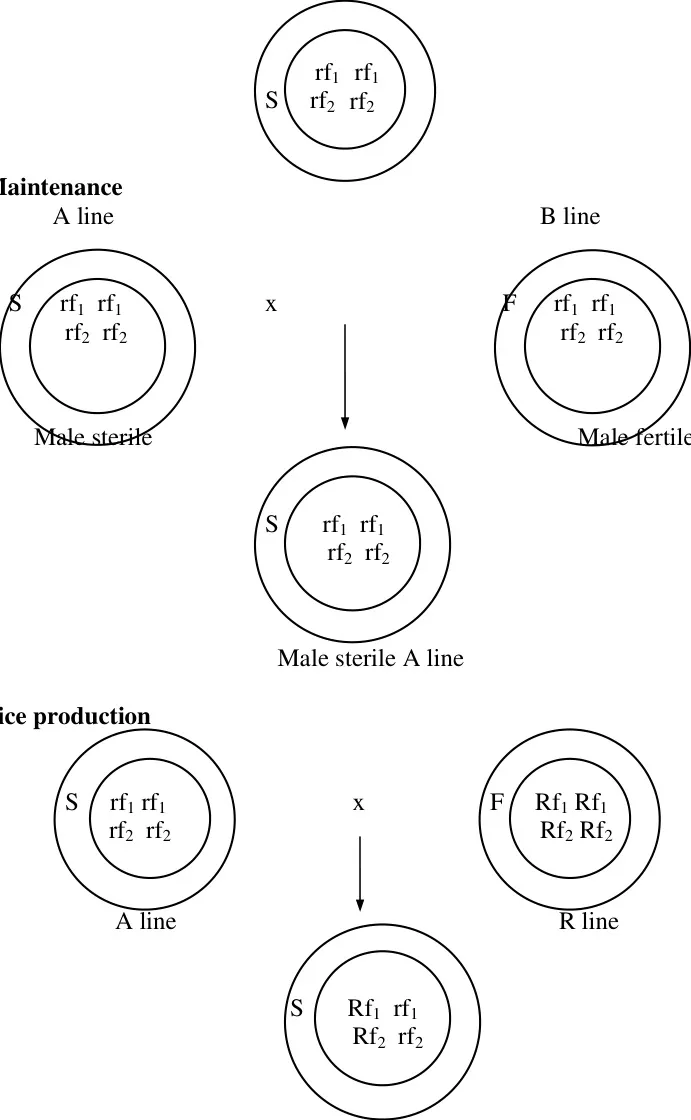
Fertile F1 Hybrid rice
Hybrid rice breeding in Tamil Nadu : Hybrid rice research in Tamil Nadu was started as early as in 1979 at Paddy Breeding Station, Coimbatore before the Chinese achievements were known to others. The first male sterile line identified from a cross between CO 40 / Jeeraga Samba was of Genetic male sterile line which was maintained upto 1984 through stubble planting until Chinese and IRRI, male sterile lines were introduced. New Cytoplasmic Genic Male Sterile Lines were introduced to India as intensification of hybrid rice research at IRRI and its NARS, IRRI took leadership in introducing the CGMS lines such as V20A, V41A, ZS97A, Er-jiu-Nan 1A and Yar-ai-Zhao 2A from Hunan Hybrid Rice Research Centre, China and IRRI developed lines such as IR 46827 A, IR 46828 A, IR 46839 A, IR 46831A and 48483 A. Of these introduced lines Chinese lines were found not suitable and IRRI lines remained unstable for their sterility in Tamil Nadu. However, intensive research on hybrid rice was started during 1989 by ICAR with financial help of UNDP and FAO. This ICAR/ UNDP/FAO collaboration led to the establishment of a network for hybrid rice research among the 10 leading rice research centres of India. Paddy Breeding Station, is one among them. Intensification of hybrid rice research in resulted in the identification of a superior hybrid combination of IR 62829 A / IR 10198-66-2R named as TNRH 1. This hybrid has a duration of 115 days and out yields all the ruling short duration varieties. The variety release committee of recommended this hybrid for general cultivation in November 1993 and Tamil Nadu State Variety Release Committee endorsed the recommendation by releasing it as CORH 1 January 1994 and named it as MGR. has released three hybrids.
Future strategies :
Wide hybridization : Wide hybridization work in rice started as early as in 1934 to incorporate agronomically important genes available in wild species to cultivated varieties. A variety CO 31 was developed by crossing GEB 24 and O.perennis . Though there was a slow down in this approach during mid period between 1940 and 1996, the work on wide hybridization has been intensified with financial support from Department of Biotechnology. The major objective of this programme is to produce male sterile lines with diverse cytoplasmic bases and derivatives with good restoration capacity.
Tissue Culture : Work on rice tissue culture was initiated in 1978 with a major objective of synthesizing dihaploids through anther culture. The programme was successful and resulted in a promising culture from a cross combination of IR 50/ARC 6650. Attempts were made to find out the genotypic responses to tissue culture using wild species of rice and cultivated varieties. In vitro screening for salt tolerance was carried out. Most of these studies were carried out by the post graduate students of this Directorate. A dihaploid line from TNRH 10 rice hybrid is in the evaluation stage. The work is being further strengthened at the Centre for Plant Breeding and Genetics.
Two line breeding for hybrid rice : For synthesizing rice hybrids, attempts to use temperature sensitive genetic male sterility (TGMS) and photoperiod sensitive genetic male sterility (PGMS) are made. To exploit this potential, a separate Hybrid Rice
Research Station has been established with financial support of Tamil Nadu Agricultural Development Programme (TNADP) at Gudalur in Nilgiris along with Coimbatore main centre. Hybrid rice research for salt affected areas of Tamil Nadu has also been programmed and Indian Council of Agricultural Research has already sanctioned a scheme on this line and work is in progress at Agricultural College and Research Institute, Trichy.
Exploring apomixis : Apomixis is an alternative to dihaploids being explored to fix the heterosis in rice. Serious attempts are being made at IRRI. Our maiden attempt in this line helped us to develop protocols and establish our scientists and post graduate students to work in this new area of rice research. Besides this, attempts are being made to exploit potential of cytological techniques and molecular approaches to understand the phenomenon of apomixis.
Molecular marker analysis : Molecular marker analysis is a new and useful tool for the rice breeders. The construction of molecular marker map of rice paved the way for mapping the rice genes to specific locations of rice chromosomes. A marker aided selection laboratory established at present will be utilized for mapping the genes controlling resistance to WBPH, BPH, quality traits and TGMS. A programme to map the favourable. Quantitative Trait Loci (QTLs) available in wild species responsible for yield and their components and transfer them to cultivated varieties is in progress. Finger printing of rice varieties will be another area of interest to catalogue all the accessions of rice, considering the wealth of germplasm available at Paddy Breeding Station, Coimbatore.
Summary Cheat Sheet
| Focus Area | Key Takeaway |
|---|---|
| Core concept | Review the major breeding principles and crop-specific applications from this lesson. |
| Exam prep | Prioritize objectives, methods, and named varieties/species for recall. |
| Quick revision | Re-read headings and key lists to retain high-yield facts. |
References
1 source • [1]
References
Standard Plant Breeding Class Notes (GPBR212)
BookLesson Doubts
Ask questions, get expert answers