🌾 Wheat Breeding
Origin, ploidy, species relationships, and major breeding objectives in wheat.
This lesson covers core breeding concepts and exam-relevant points for quick understanding and revision.
WHEAT - Triticum sp. ( x =7 ) (Gothumai/ Kottampam/Gothi/Godi/Genhu)
Wheat is the most important cereal in the world, giving about one-third of the
total production, followed closely by rice. In temperate regions it is the major source of food. The chief use of wheat is, the flour for making bread.
Chromosome number:
Diploid : 2n = 14 Tetraploid : 2n = 28 Hexaploid : 2n = 42
Place of origin:
Diploid : Asia minor Tetraploid : Abyssinia, North Africas Hexaploid : Central Asia
Classification :
Ploidy level Species Common name Genome
Diploid T.boeticum (T.aegilopoides) Wild einkorn AA (2n=14) 2 species T.monococum Einkorn AA
T.boeticum (T.aegilopoides) T.monococum
Wild einkorn Einkorn
AA AA
Wild Emmer Emmer Macaroni wheat Persian wheat Rivet wheat Polish wheat
Common or bread wheat Club wheat Dwarf wheat Spelt wheat Macha wheat
AA BB AA BB AABB AABB AABB
AABBDD AABBDD AABBDD AABBDD AABBDD
Tetraploid
(2n=28) 7 species
Hexaploid
(2n= 42) 5 species
T.dicoccoides T.dicoccum T.durum T.persicum T.turgidum T.polonicum T.timopheevi
T.aestivum T.compactum T.sphaerococcum T.spelta T.macha
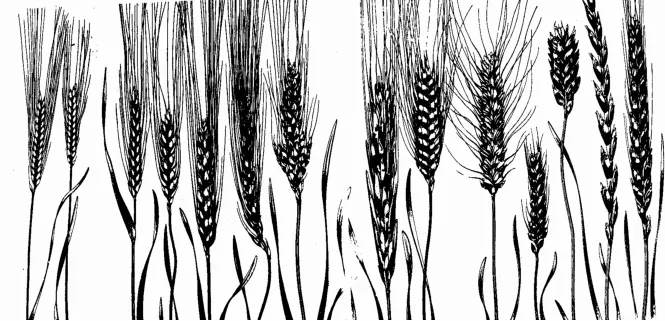
Fourteen species of wheat according to Vavilov (Fig.1): 1.T.boeoticum2.T.mono coccum,3.T.dicoccoides 4.T.dicoccum,5.T.durum, 6.T.persicum,7.T.turgidum 8.T.polonicum, 9.T.timopheevi, 10.T.aestivum, 11.T.sphaerococcum, 12.T.compactum, 13.T.spelta,14.T.macha .
[ 1 2 3 4 5 6 7 8 9 10 11 12 13 ]
Origin of diploid wheat:
(Wild einkorn) T.boeticum ( T . aegilopoides )
Natural mutation and selection
T.monoccocum Cultivated diploid AA (2n = 14)
T. boeoticum is probably the ancester for all the cultivated wheats:
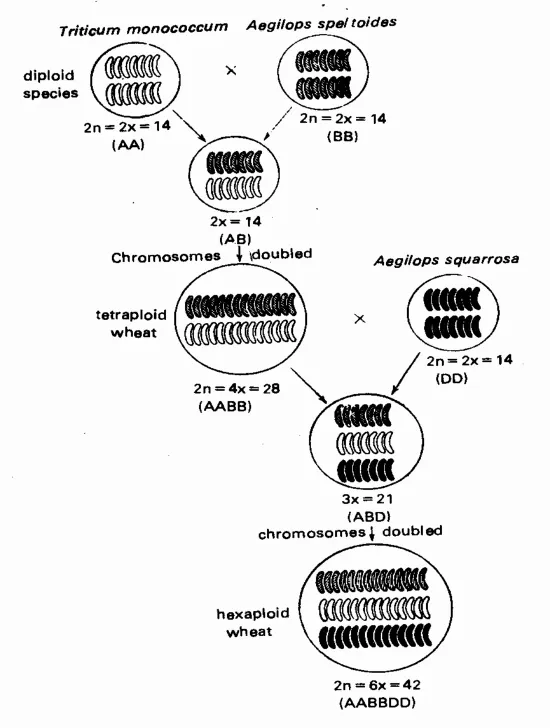
Origin of Tetraploid wheats : Origin of hexaploid wheats (Fig.2):
T.boeoticum x Aegilops spelltoides T.dicoccum x Aegilops squarrosa
AA BB DD
AA BB 2n = 28 2n = 14 2n = 14 2n 14 F1 ABD (2n = 21) F1 Sterile (2n=14) ( AB ) Sterile Natural mutation and Natural doubling Doubling
T.dicoccoides 2n = 28 T.aestivum Wild emmer AABB AABBDD (2n = 42) By natural selection (Cultivated)
T.dicoccum (Emmer wheat) AABB (2n=28) Cultivated Related Species of Triticum : 1.T.boeoticum : forms with one to two seeded spikelets occur. The brittle ears shatter at maturity into individual spikelets armed with awns which provide an effective means of seed dispersal. 2. T.monococcum : Primitive diploid form domesticated, evolved from
T.boeoticum by mutation and selection.. 3. Aegilops speltoides : (2n=14;B genome). It is naturally cross-pollinating. It is the recognized donor of the B genome. 4. T.dicoccoides :It is an amphidiplod form resulting from the hybridization of T.boeoticum and Ae. speltoides . 5. T.dicoccum : The spikes are dense, bearded and laterally compressed, the spikelets are two grained and the grains are retained within the glumes after threshing (speltoid). It is the oldest of the cultivated wheat. 6. T.durum : Free thrashing wheat with naked grains, important of the tetraploid wheats. Grains contain high glutin. 7. Ae. squarrosa : (2n=14; D genome) It is the source of D genome in the cultivated hexaploid wheat, high adaptability. 8. T.spelta : Hexaploid species, considered an amphidiploid from hybridization between T.dicoccoides and Ae.squarosa.
Fig.2. The evolution of hexaploid bread wheat from its wild relatives.
The most important of all the hexaploid wheat is the common bread wheat, T.aestivum grown in all parts of the tropics and sub tropics. This hexaploid wheat from which most modern wheats have been developed. It exhibits an extremely wide range of morphological and physiological variation and ecological adaptation.
Breeding objectives
High yield
High yield depends on a) The number of heads / unit area b) The number of grains / head. c) The average weight of grain
While breeding for high yielding varieties all the above three components must be looked into. Omitting any one of them may not yield results. Further while breeding for high yield it is necessary to combine into a variety a favourable combination of genes influencing all yield process.
2. Breeding non- lodging varieties: This is achieved after the identification of dwarfing gene in Japanese variety Norin 10. Most of our dwarf wheats are two gene dwarfs. E.g. Sonara 63, sonara 64, kalyan sona. Emphasis is now on triple gene dwarfs.
Breeding for disease resistance
Rust is the major disease. Both stem rust and leaf rust are important ones. There are different races of rust. So while breeding for rust resistance horizontal resistance is to be looked into. Back cross method of breeding and development of multi lines are the methods.
Breeding for insect resistance
Hesisan fly is the major pest. Resistance in most varieties is thro’ Antibiosis.
5. Breeding for quality. Different wheat varieties vary greatly in their chemical composition which is considerably influenced by environment. The varieties of hard wheat or bread wheat which have higher gluten content. The soft wheat contain lesser gluten content which is suitable for cake making, pastries. The durum wheats are unsuited for either cakes or bread but they are suitable for making macaroni. So depending upon the use the quality breeding objective is to be fixed.
Methods of breeding : 1. Introduction : Semi dwarf wheat from Mexico, Sonara 63, Sonara 64, Mayo 64, Lerma Roja 64
2. Pure line selection : Earlier varieties like P4, P6, P12 evolved at pusa institute are result of pure line selection from local population.
Hybridisation and selection
a) Inter varietal: A number of successful derivatives were developed at IARI New Delhi and Punjab.
NP 809 - New pusa multiple cross derivative.
However all these varieties were lodging and poor yielder when compared to other countries. Hence the wheat hybridization programme was changed by Dr. M.S. Swaminathan during 1963. Borloug was invited to our country and he suggested for introduction of semi dwarf varieties from Mexico. As a result four commercial spring wheat varieties viz., Sonara 63, Sonara 64 Mayo 64 and Lerma Roja 64 were introduced. However they had red kernel hard wheats. These were utilised in our breeding programme and amber colour wheat varieties like Kalyan Sona, Safed Lerma, Sharbati Sonara were released, these are double gene dwarfs.
b) Inter specific crosses To get Hessian fly resistance. So also for rust resistance.
c) Back cross method of breeding Rust resistance in Chinese spring from Thatcher.
4. Hybrid wheat : At Kansas Agri. Expt. Station USA male sterile lines were identified by crossing T.timophevi x T. aestivum Bison variety By repeated back crossing a male sterile line resembling Bison was evolved. At present USA and Canada are doing work on this.
Mutation breeding
Dr. M. S. Swaminathan did extensive work on this with gamma rays. Sharbati, Sonara with increased protein content was evolved.
Development of multilines
Borlaug developed multilines against rust. MLKS 15 was developed at IARI. Multi line is a mixture of pure lines which are phenotypically similar but genotypically dissimilar. Each line is produced by separate back cross method of breeding. Each line having resistance against a particular race of a disease.
Summary Cheat Sheet
| Focus Area | Key Takeaway |
|---|---|
| Core concept | Review the major breeding principles and crop-specific applications from this lesson. |
| Exam prep | Prioritize objectives, methods, and named varieties/species for recall. |
| Quick revision | Re-read headings and key lists to retain high-yield facts. |
References
1 source • [1]
References
Standard Plant Breeding Class Notes (GPBR212)
BookLesson Doubts
Ask questions, get expert answers