🧬 Nutritional requirements
Nutritional requirements.
This lesson explains the core ideas, methods, and exam-relevant applications for this topic in plant biotechnology. Focus on definitions, process steps, and practical uses for revision.
The composition of medium for the tissue culture is the most important key factor in the
successful culture of plant cells. The medium should be accurately defined of inorganic and
organic chemical additives so as to provide i) the nutrients for the survival of the plant cells,
tissues and organs under culture and ii) the optimal physical condition of pH, osmotic
pressure, etc .
In the culture of plant cells formulating optimum type of medium favorable for in vitro culture
was achieved many years ago. The Knop 's (1865) mineral solution was the widely used
medium by early investigators. Gautherat (1939) developed callus culture medium from
Uspenski and Uspenskaia (1925) nutrient solution. A systematic study of mineral
reqiurements of plant tissue and organs in culture was made by Murashige and Skoog
(1962) followed by the scientists Linsmaier and Skoog (1965), Vasil and Hildebrant
(1966) and Nitsch and Nitsch (1969) resulting in several media to suit particular needs.
Nutrients
A standard basal medium consists of a balanced mixture of macronutrients and
micronutrients (usually salts of chlorides, nitrates, sulphates, phosphates and iodides of Ca,
Mg, K, Na, Fe, Zn and B, a carbon source, vitamins, phytohormones and organic additives.
Among the above mentioned nutrients some are essential and some are optional. The
essential components include inorganic nutrients and organic nutrients like carbohydrates
besides phytohormones and vitamins, organic additives like natural extract and liquid
endosperm are optional.
Inorganic salts
Inorganic nutrients of a plant cell culture are those required by the normal plants. The
optimum concentration of each nutrient for achieving maximum growth rates varies
considerably. The major elements are N, P, K, S, Mg and Ca. Other nutrients such as Co,
Fe, B, Zn, Mo, Cu, I are microelements.
Macroelements
Nitrogen
Of all the mineral nutrients N plays a vital role in growth and differentiation of cultured
tissues. The range of inorganic nitrogen varies from 25 mM to 60 mM according to the
requirements. Nitrogen is generally supplied in the form of NH4 along with NO3.
Ammonium ion as nitrogen source is usually unsuitable, probably because under such
conditions the pH of the medium has a tendency to fall below 5 during culture, resulting in
reduced availability of nitrogen. Cells can be grown with NH4 as the sole N source when
the medium is provided with organic acids such as malate, succinate, citrate or fumerate.
Further, the concentration of NH4-N should not exceed 8 mM. Generally NO3-N can be
used as a sole N source but often there is a beneficial effect if the media contains NH4 -N.
Phosphorus
Phosphorus is usually supplied in the form of phosphates. It is the primary buffering
constituent in tissue culture media. Phosphorus levels greater than 2mM are often inhibitory
to growth of tissues.
Potassium
The optimum concentration of K needed is 20 mM. At low nitrogen concentration presence
of potassium enhances the formation of somatic embryos. The medium supplemented with
potassium nitrate produces more embryos than the medium with ammonium nitrate.
Sulphur
Sulphur is provided in the form of sulphates. Besides, the sulphur containing amino acids
like L-cysteine, L-methionine and glutathione are satisfactory sources for sulphur.
Calcium and Magnesium
The optimal concentration of Ca required is 3mM. An antagonism between Ca and Mg has
been demonstrated and it was found that an increase in the concentration of one element
increased the requirement for the other.
Microelements
The microelements viz ., Fe, Mn, B, Zn, Mo, Cu, I and Co have a profound effect on growth
of tissue in vitro . The availability of the iron is reduced at high pH due to precipitation. To
avoid this, Fe is supplied as chelated EDTA complex. These elements produce toxic effect,
if they are applied at higher level. A good growth of tissue can be achieved when the
concentration of microelements was reduced to 10 per cent of the original level.
Organic nutrients
Carbohydrates
Carbohydrates are used as carbon sources. The standard carbon source is sucrose at a
concentration of 2-5 per cent. Monosaccharides like glucose or fructose can also be used
as carbon sources but are generally less suitable. Sucrose is the best source, since
sucrose is dehydrolysed into usable sugars during autoclaving.
Vitamins
Vitamins are supplemented with medium to achieve the best growth of the tissues. Among
the vitamins only thiamine HCL (B1) seems to be universally required. Other vitamins are
pyridoxine HCL (B6), nicotinic acid (B3) and calcium pantothanate (B5). Specific
requirement of each one varies with the plant species subject to culture.
Phytohormones
These are organic compounds, other than nutrients, which influence growth, differentiation
and multiplication. They required in very minute quantity in the media. The requirement for
these substances varies considerably with the tissue and it also depends on their
endogenous level. There are many commercially available synthetic substances that
mimics the PGR specific to certain species. Testing of various types, concentrations and
mixtures of growth substances during the development of a tissue culture protocol for a new
species is essential before using a new PGR in plant tissue culture.
There are different groups of PGRs commonly used in the media. They are auxins,
cytokinins, gibberellins, ethylene and absicissic acid. Additional substances gaining
recognition as hormones in plant tissue culture are: polyamines, jasmonates, salicylic acid
and brassinosteroids.
Auxin
In nature, the hormones of this group are involved with elongation of stem, internodes,
tropism, apical dominance, abscission, rooting etc. In tissue culture auxins have been used
for cell division and root differentiation. The commonly used auxins in tissue culture are
-
Indole-3-acetic acid (IAA)
-
Indole-3-butyric acid (IBA)
-
Naphthalene acetic acid (NAA)
-
Dichlorophenoxyacetic acid (2, 4-D)
Auxins are usually dissolved in either ethanol or dilute NaOH.
Cytokinins
These hormones are essential for cell division, modification of apical dominance, shoot
differentiation etc. In tissue culture media, cytokinins are incorporated mainly for cell
division, differentiation of adventitious shoots from callus and organ & shoot proliferation.
Commonly used cytokinins are
-
Benzylamino purine (BAP)
-
Isopentenyl adenine (2-ip)
-
Furfurylamino purine (kinetin)
-
Zeatin
Cytokinins are generally dissolved in dilute HCl or NaOH.
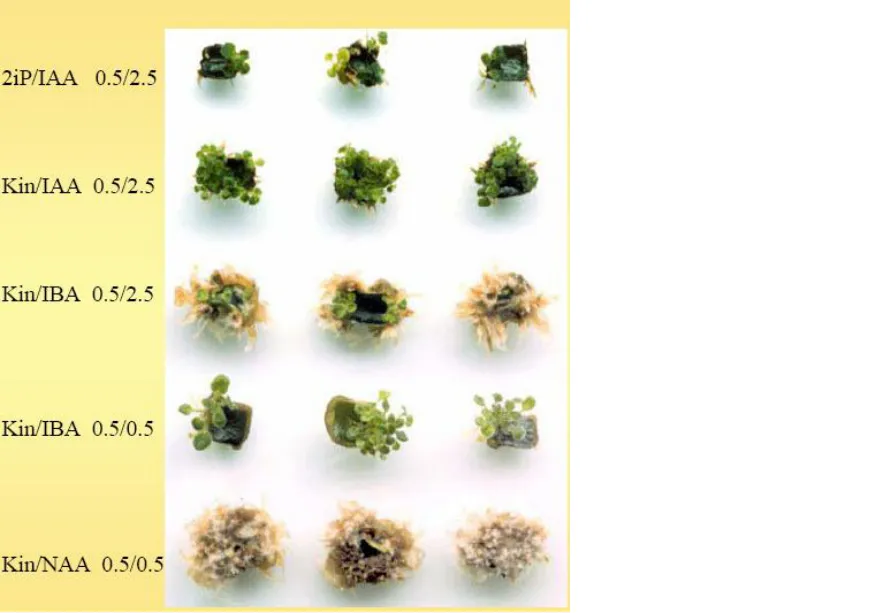
Auxin - Cytokinin Interaction
- High auxin and low cytokinin ratio: Initialize root formation, embryogenesis and
callus formation.
-
Low auxin and high cytokinin ratio: Induce formation of adventitive or axillary shoots.
-
The auxin-cytokinin ratio is also essential for chloroplast formation and other
processes.
Effect of different auxin and cytokinin concentration on tissue development
Gibberellins
Naturally occurring plant hormones involved in internode elongation, enhancement of flower,
fruit and leaf size, germination and vernalization in plants. Among the 20 known gibberellins,
GA3 is used widely. Compared to auxins and cytokinins, gibberellins are used very rarely.
They stimulate normal development of plantlets from in vitro formed adventitious embryos.
They are soluble in cold water.
Ethylene
A gaseous plant hormone involved in fruit maturation, abscission, and senescence. All
kinds of plant tissue cultures produce ethylene and the rate of production increases under
stress conditions. Use of ethylene precursor (2-chloroethylphosphonic acid) in tissue culture
may be promotory or inhibitory for the same process in different species. For example, it
promoted somatic embryogenesis in Zea mays whereas the same process was inhibited in
Hevea brasiliensis.
Abscisic acid
A plant hormone involved in abscission, enforcing dormancy and regulating early stages of
embryo development. It is required for normal growth and development of somatic embryos
and promotes morphogenesis.
Brassinosteroids
It promotes shoot elongation at low concentrations and strongly inhibits root growth and
development. It also promotes ethylene biosynthesis and epinasty.
Jasmonates
Jasmonates are represented by jasmonic acid and it is a methyl ester. Jasmonic acid is
considered to be a new class of plant growth substance. It inhibits many processes such as
embryogenesis, seed germination, pollen germination, flower bud formation, chlorophyll
formation. It is involved in differentiation, adventitious root formation, breaking of seed
dormancy and pollen germination.
Polyamines
There is some controversy as to whether these compounds should be classified with
hormones. They appear to be essential in growth and cell division.
Salicylic acid
It is thought to be a new class of plant growth substances . It promotes flowering, inhibits
ethylene biosynthesis and reverses the effects of ABA.
Organic additives
Amino acids like glutamine, asparagine and nitrogen base like adenine are used as
additives in tissue culture media. The organic acids citrate, malate, succinate and fumerate
are used when the medium has nitrogen in ammoniacal form.
A wide variety of complex natural extracts like coconut water (liquid endosperm) tomato and
orange juices is also used during media preparation. These complex substances posses a
number of amino acids, vitamins, sugars, sugar alcohols, growth regulators and other
unidentified substances with growth promoting qualities. However, these should be avoided
because of their unknown and variable composition. Among the natural extract coconut
water is widely used as a source of cytokinin and various amino acids.
Other complex substances often used in tissue culture media are: casein hydrolysate, yeast
extract and malt extract. Potato extract is also used in China for cereal anther cultures.
Physical form of media
I. Solidified medium
Advantages
-
Explants are easily seen and recovered.
-
No Special aeration required.
-
Shoots grow more orderly.
-
Long term maintenance is possible.
-
Use of simple containers occupy little space
Disadvantages
-
Slower rate of multiplication.
-
Limited surface of explant is in contact with the medium.
II. Liquid medium
Advantages
-
Callus easily break up and shed as cells to establish a fine suspension.
-
Faster rate of multiplication
-
A greater surface of explants is in contact with medium.
-
Toxic metabolites will effectively be dispersed.
Disadvantages
-
Recovery is difficult.
-
Growth is disoriented.
-
Seeds would not germinate.
-
Protocorms and plantlets become brown and dry. Seeds submerged will show
vitrification.
Commonly used tissue culture media
- MS (Murashige and Skoog, 1962) and LS (Linsmaier and Skoog, 1972) media are
used for regeneration of both monocots and dicots.
- B5 ( Gamborg et al ., 1969) developed for culture of soybean cell suspensions but
also has been effectively used for variety of plant regeneration. B5 and its various
derivatives have been valuable for cell and protoplast cultures.
- SH : Schenk and Hildebrandt (1972) introduced this for culture of monocots and
dicots. Widely used for legumes.
- WPM : Lloyd and McCown (1980-1981). This is post MS media. WPM is increasingly
used for propagation of Ornamental shrubs and trees in commercial labs.
- N6 was developed by Chu for cereal anther culture and also used for anther culture
of other species.
- In special cases, NN (Nitsch and Nitsch) was also used.
The physical form of a tissue culture medium, like the combination of nutrients is more
important, since the uptake of nutrients by the tissues, their growth and development are
dependent on it. To maintain the physical form of medium suitable for culturing, care should
be taken to maintain the necessary (1) hydrogen ion concentration. (2) gelling agent and (3)
osmotic pressure of the medium.
Hydrogen ion concentration (pH)
The pH of the medium is usually adjusted between 5.0 and 6.0 prior to the addition of agar
and autoclaving. The extremes of pH should be avoided as this will block the availability of
some of nutrients to the inoculum. A pH of 5.8 is found to be optimum for plant tissue
culture. Generally, pH higher than 6.0 give a very hard medium and a pH below 5.0 do not
allow satisfactory solidification of agar. Further, pH in media changes during growth of plant
tissues and this drift in pH is comparatively low in media with high salt concentration,
because of their greater buffering capacity.
Gelling agents
Generally tissue culture media are solidified with any of the gelling agents. Agar is widely
used for solidification of the medium. The optimum concentration of agar used ranges from
0.8-1.0 per cent (W/V). If the concentration of the agar is increased, the medium becomes
hard and does not allow the diffusion of nutrient into the tissues. Gelatin, silica gel, acryl
amide gel and starch copolymers are also used as substitutes for agar. Sometimes, the
solid media will accumulate the toxic substances namely, oxidised, phenolic compounds
released from tissue and hamper further growth of tissue. To absorb the toxic substances, 1
percent activated charcoal is added to the medium. One disadvantage of adding activated
charcoal is that it would adsorb the growth regulators.
Liquid medium (the medium without any gelling agent) is suitable for suspension culture
and it is superior to other media for the following reasons: 1) does not have impurities as in
the agarified medium where the agar contains impurities, 2) aeration can be provided to the
cells by keeping the suspensions under constant shakings and 3) toxic substances
released from the tissues will not accumulate or localize; the substances get diluted. In
liquid media cultures, filter paper bridges or glass wool can be used to support culture
tissue.
Osmotic pressure
The cell cultured in vitro is mostly osmotically fragile and hence the osmotic pressure of the
medium should be maintained at optimal level. This problem is serious one when liquid
media are used. To adjust the osmotic pressure, stabilizers otherwise known as
osmoticums viz ., sorbitol and mannitol (sugar alcohol) are used. These are non
metabolisable sugars. The soluble sugar like sucrose, fructose, galactose, etc ., is also
effective. The sucrose is added to the medium not only to provide energy but also to
maintain a suitable osmolarity in the medium.
Several modifications have been made in the basic media evolved for various types of plant
tissue cultures and the modifications are ever continuing processes in the field of plant
tissue culture. The reason behind this is that the selection of a particular culture medium for
a particular species is difficult. Considering the difficulties the following approaches may be
taken into consideration to identify a suitable medium for the work. 1) literature survey for
work on similar objectives or near relative species and to try out the media in the reports, 2)
experimentation with several of the well known media incorporating some variables and 3)
conducting broad spectrum experiments involving most of the components(minerals,
carbon source and phytohormones) with different treatments. The suitable combinations
can be identified when the desired response is achieved.
Environmental factors influencing plant tissue culture
-
Genotype or variety of the plant material
-
Explant selection and its size.
-
Medium:
(i) Nutrients,
(ii) Growth regulators and
(iii) Other additives
- Culture Environment:
(i) Temperature,
(ii) Relative Humidity (RH) and
(iii) Light
Questions
- The mineral solution widely used by early investigators was ……………….
a) Knop 's medium b) MS medium
c) White’s medium d) None of the above
- The medium in tissue culture should provide ………….
a) Nutrients for the survival of the plant
cells, tissues and organs under culture
b) Optimal physical condition of pH, osmotic
pressure, etc
c) Both a & b d) None of the above
- The callus culture was first developed by ………….
a) Skoog b) White
c) Gautherat d) None of the above
- The systematic study of mineral requirements of plant tissue and organs in culture was
made by ………….
a) Murashige and Skoog b) Vasil and Hildebrant
c) Nitsch and Nitsch d) All the above
- The mineral nutrient that plays a vital role in growth and differentiation of cultured tissues
is ………….
a) N b) P
c) K d) All the above
- Nitrogen is generally supplied in ……………. form.
a) NH4 b) NO3
c) NO2 d) All the above
- The range of inorganic nitrogen varies between …………….. in the tissue culture
medium.
a) 25 mM - 60 mM b) 250 mM - 600 mM
c) 2.5 mM – 6.0 mM d) 0.25 mM – 0.60 mM
- Phosphorus levels greater than …………. are inhibitory to growth of tissues.
a) 2 mM b) 20 mM
c) 200 mM d) 0.2 mM
- The optimum concentration of K needed is ………….
a) 2 mM b) 20 mM
c) 200 mM d) 0.2 mM
- At low nitrogen concentration presence of ……………….. element enhances the
formation of somatic embryos
a) K b) P
c)Ca d) Mg
- Sulphur is provided in the form of sulphates
a) Sulphates b) Sulphites
c) Both a & b d) None of the above
- The standard carbon source is ……………..
a) Sucrose (2-5 per cent) b) Glucose
c) Fructose d) None of the above
- The standard carbon source is ……………..
a) Sucrose (2-5 per cent) b) Glucose
c) Fructose d) None of the above
- Universally required vitamin in tissue culture medium is ……………..
a) Thiamine HCL b) Pyridoxine HCL
c) Nicotinic acid d) Calcium pantothanate
- Vitamin (s) used in tissue culture medium is/are ……………..
a) Calcium pantothanate b) Pyridoxine HCL
c) Nicotinic acid d) All the above
- The commonly used auxins in tissue culture are ……………..
a) IAA, IBA, NAA, 2,4 D b) BAP, 2-ip, Kinetin, Zeatin
c) GA3 d) All the above
- The commonly used cytokinins in tissue culture are ……………..
a) IAA, IBA, NAA, 2,4 D b) BAP, 2-ip, Kinetin, Zeatin
c) GA3 d) All the above
- The auxins are diluted in ……………..
a) Ethanol b) Dilute NaOH
c) Both a & b d) None of the above
- The cytokinins are diluted in ……………..
a) Dilute HCl b) Dilute NaOH
c) Both a & b d) None of the above
- In tissue culture auxins have been used for ………………….
a) Cell division and root differentiation b) Differentiation of adventitious shoots from
callus and organ & shoot proliferation
c) Normal development of plantlets from
in vitro formed adventitious embryos
d) None of the above
- In tissue culture cytokinins have been used for ………………….
a) Cell division and root differentiation b) Differentiation of adventitious shoots
from callus and organ & shoot
proliferation
c) Normal development of plantlets from
in vitro formed adventitious embryos
d) None of the above
- In tissue culture gibberellins have been used for ………………….
a) Cell division and root differentiation b) Differentiation of adventitious shoots
from callus and organ & shoot proliferation
c) Normal development of plantlets from
in vitro formed adventitious embryos
d) None of the above
- High auxin and low cytokinin ratio favours ………………….
a) Initialize root formation,
embryogenesis and callus formation
b) Induce formation of adventitive or
axillary shoots
c) Chloroplast formation and other processes d) None of the above
- Low auxin and high cytokinin ratio favours ………………….
a) Initialize root formation, embryogenesis
and callus formation
b) Induce formation of adventitive or
axillary shoots
c) Chloroplast formation and other processes d) None of the above
- The auxin-cytokinin ratio is essential for ………………….
a) Initialize root formation, embryogenesis
and callus formation
b) Induce formation of adventitive or
axillary shoots
c) Chloroplast formation and other processes d) All the above
- The naturally occurring gibberellin is involved in ……………….
a) Internode elongation b) Enhancement of flower, fruit and leaf size
c) Germination and vernalization d) All the above
- The gibberellins are soluble in ……………..
a) Dilute HCl b) Dilute NaOH
c) Cold water d) Hot water
- Ethylene is involved in ……..
a) Fruit maturation b) Abscission
c) Senescence d) All the above
- Abscissic acid is involved in ……..
a) Enforcing dormancy b) Abscission
c) Regulating early stages of embryo development d) All the above
- Abscissic acid is required for ……..
a) Normal growth b) P romotes morphogenesis
c) Development of somatic embryos d) All the above
- …….…….. promotes ethylene biosynthesis and epinasty.
a) Brassinosteroids b) Jasmonates
c) Polyamines d) Salicyclic acid
- Jasmonic acid is a ……..
a) Methyl ester b) Ethyl ester
c) Ether d) None of the above
- The optimum pH of the tissue culture is …….……...
a) 5.8 b) 6.0
c) 4.0 d) 7.0
- The substitutes for agar are
a) Gelatin b) Silica gel
c) Acryl amide gel d) All the above
- The osmoticums used in tissue culture medium are
a) Sorbitol and mannitol b) Sucrose
c) Fructose and galactose d) All the above
Summary Cheat Sheet
Quick Recall Points
- Define key terms in one line and revise their use in plant biotechnology.
- Memorize major steps, methods, and applications covered in this lesson.
- Practice exam-style distinctions between related concepts and techniques.
Exam Traps
- Do not confuse similar terms without checking context and biological level.
- Revise process order carefully; sequence-based questions are common.
- Link each method with its most likely application question.
References
1 source • [1]
References
Standard BSc Agriculture Plant Biotechnology notes
BookLesson Doubts
Ask questions, get expert answers