🧬 Anther and microspore
Anther and microspore.
This lesson explains the core ideas, methods, and exam-relevant applications for this topic in plant biotechnology. Focus on definitions, process steps, and practical uses for revision.
Haploid production and uses
Haploids are defined as saprophytes with gametophytic chromosome number and have been
produced in a variety of plant species using a variety of methods.
Although, the significance of haploids in genetics and plant breeding has been recognized for
long time, with the advent of biotechnology it received renewed emphasis, so that the
production of haploids become an important component of biotechnology programmes in
different countries.
Although, haploids could be produced following delayed pollination, irradiation of pollen,
temperature shocks, colchicine treatment and distant hybridization, the most important methods
currently being utilized include
-
Anther or pollen culture and ovule culture and
-
Chromosome elimination following interspecific hybridization (bulbosum technique).
Anther and microspore culture
The impact of haploid production in genetics and plant breeding has long been realized.
However, their exploitation remained restricted because of the extremely low frequency with
which they occur in nature. Spontaneous production of haploids usually occurs through the
process of parthenogenesis (embryo development from unfertilized egg). Rarely, they
reproduce male parent alone. This suggest that their origin through ‘ovule androgenesis’
(embryo development inside the ovule by the activity of the male nucleus alone). In vivo
occurrence of androgenic haploids has been reported in Antirrhinum, Nicotiana etc. the artificial
production of haploids was attempted through distant hybridization, delayed pollination,
application of irradiated pollen, hormone treatments and temperature shocks. However, none of
these methods are dependable. The development of numerous pollen plantlets in anther culture
of Datura innoxia, first reported by two Indian Scientists (Guha and Maheswari) was a major
breakthrough in haploid breeding of higher plants. This technique of haploid production through
anther culture (anther androgenesis or simply androgenesis) has been extended to numerous
plant species including cereals, vegetables, oil and tree species.
The anthers may be taken from plants grown in the field or in pots, but ideally these plants
should be grown under controlled temperature, light and humidity. Often the capacity for haploid
production declines with age of donor plants. Flower buds of the appropriate developmental
stage are collected, surface sterilized and their anthers are excised and placed horizontally on
culture medium. Care should be taken to avoid injury to anthers since it may induce callus
formation from anther walls. Alternatively, pollen grains can be separated from anthers and
cultured on a suitable medium.
Isolation of pollen
The pollen grains are released from the cultured anthers either mechanically. Or the cold
treated anthers cultured on liquid medium burst open after 2-7 days liberating the pollen grains
into the medium. This is called ‘float culture method’ which has proved better than mechanical
isolation of pollen from fresh or pre-cultured anthers.
To improve the efficiency of isolated pollen culture for the production of haploids, Wenzel and
his colleagues introduced the technique of density gradient centrifugation which allows the
separation of embryogenic grains from a mixture of embryogenic and non-embryogenic grains
obtained after crushing the anthers. The anthers of Barley obtained at the proper stage of
development and gently macerated to obtain a suspension of pollen grains. After removing the
debris by repeated filtration and centrifugation, the suspension was layered on 30% sucrose
solution and centrifuged at 1200 g for 5 min. The androgenic, vacuolated pollen grains formed a
band at the top of the sucrose solution. Isolated pollen culture is not only more efficient but also
more convenient than anther culture. The tedious process of dissection of anthers is avoided.
Instead, the entire buds within a suitable size range are crushed and the embryogenic grains
are then separated by gradient centrifugation.
Pathways of development
The early divisions in responding pollen grains may occur in one of the following four ways.
- Pathway I: The uninucleate pollen grain may divide symmetrically to yield two equal
daughter cells both of which undergo further divisions. (Dature innotura)
- Pathway II: In some other cases ( Nicotiana tabacum, Datura metel, Triticale), the
uninucleate pollen divides unequally (as it does in nature). The generative cell
degenerates immediately or after undergoing one or two divisions. The callus/embryo
originates due to successive divisions of the vegetative cells.
- Pathway III: But in some species like Hyoscyamus niger, the pollen embryos originate
from the generative cell alone; the vegetative cell either does not divide or divides only to
a limited extent forming a suspensor like structure.
- Pathway IV: In certain species such as Datura innoxia the uninucleate pollen grains
divide unequally, producing generative and vegetative cells, but both these cells divide
repeatedly to contribute to the developing embryo/callus.
Pollen grains of many crop species, e.g. Tobacco, Wheat, Barley etc., exhibit pollen
dimorphism. Most of the pollen grains are bigger, stain deeply with acetocarmine and contain
plenty of starch. But small portions of the pollen grains are smaller and stain faintly with
acetocarmine; these are called S-grains. These S-grains only respond during anther culture.
The frequency of responding pollen grains can be enhanced over that of S-grains by certain
pretreatments, e.g. chilling. Pollen grains of the cultured anthers show remarkable cytological
changes during the first 6-12 days, called the inductive period. In tobacco, the gametophytic
cytoplasm of binucleate pollen grains is degraded, ribosomes are eliminated and only few
mitochondria and plastids remain. New ribosomes are synthesized following the first sporophytic
division of the vegetative cell.
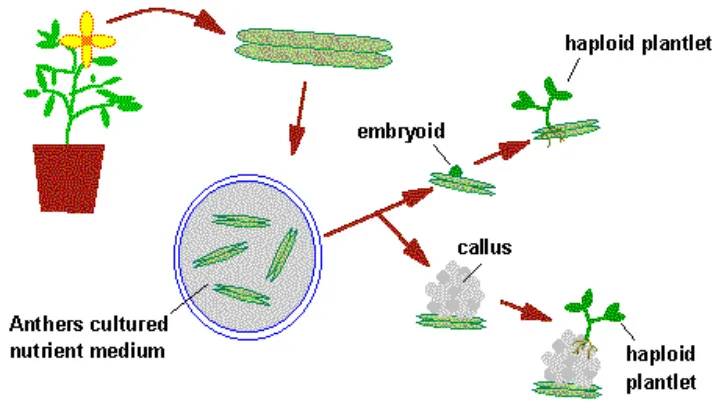
The responsive pollen grains become multicellular and ultimately burst open to release the cell
mass. This cell mass may either assume the shape of a globular embryo and undergo the
developmental stages of embryogeny or it may develop into callus depending on the species.
Regeneration of plants from pollen callus or pollen embryos may occur on the original medium
or it may require transfer to a different medium. The pollen embryo exhibit considerable
similarity with zygotic embryos in their morphology and certain biochemical features. Often the
pollen embryos do not germinate normally. Pollen embryos frequently produce secondary
 embryos on stem surface and all such embryos which produce secondary embryos are haploid
and the others non-haploid. To raise full plantlets from pollen embryos it is necessary to excise
a cluster of the secondary embryos along with a part of the parent embryo and plant them on
fresh medium. They do not germinate if left on the pollen embryo or removed individually.
Anther culture and haploid plants regeneration
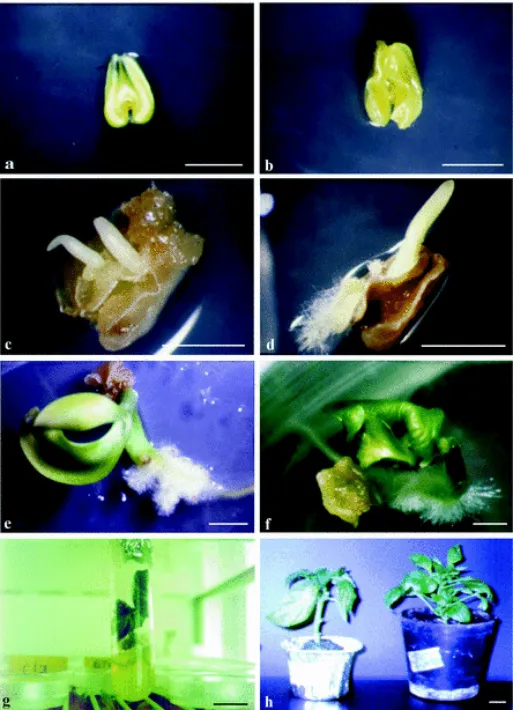
( a ) Anther at the onset of the culture. ( b ) Anther after 6 days in culture. ( c, d ) Embryos
emerging from the anthers after 30 days in culture, showing roots ( c ) and shoots ( d ). ( e - g )
Plantlets with cotyledons ( e ) and with leaves ( f, g ) subcultured in growing medium. ( h ) 80-day
old regenerated haploid plant from anther culture (left-hand side) and a diploid control of the
same age (right-hand side). Scale bars in ( a - d ), 2.5 mm; in ( e - h ), 5 mm.
Factors affecting androgenesis
Physiological status of the donor plants - The age of the donor plants and the
environmental conditions under which it has been grown significantly affects the
androgenic process. Generally, the buds from the first flush of flowers show better
 response than those borne separately. Exposures of donor plants to nutrient and water
stresses reported to promote androgenesis.
Stage of pollen development- The pollen grains around the first mitosis is most
responsive. The uninucleate microspores produce haploids while the binucleate pollen
form plants of higher ploidy.
Anther wall factors- the pollen from one cultivar of tobacco would successfully develop
into an embryo even if transferred into the anthers of another cultivar.
Genotype – hybrids are more androgenic than their parents.
Pretreatment of cultured anthers/pollen grains – application of certain physical
(temperature shock, centrifugation, γ irradiation) and chemical (auxins) treatments to
cultured anthers or pollen grains prior to standard culture room conditions, has proved
essential or promotory for in vitro androgenesis.
Culture medium – addition of etherel (2-chloroethylphosphonic acid), sucrose, agar and
other nutrients specific to certain genotype found to increase the success rate of
androgenesis.
Culture density- the frequency of pollen embryogenesis was enhanced if the anther
culture density was increased from 3 anthers per ml to 12-24 anthers per ml in Brassica
oleracea.
Effect of gaseous environment- the composition of the gas mixture that surrounds the
anthers has profound influence on the number of embryos produced in anther cultures.
The removal of CO2 from the culture vessel resulted in decline in anther culture
response in Nicotiana tobaccum.
Effect of light – Isolated pollen culture is more sensitive to light than anther culture.
Applications
Production of diploids- homozygous lines of the cross pollinating species and hybrids are
highly desirable to increase the efficiency of selection and production of homozygous plants.
The conventional method to produce homozygous plants is lengthy and laborious, requiring
7-8 recurrent cycles of inbreeding. Moreover, this approach is impractical for self
incompatible and male sterile and tree species. On the other hand, homozygous plants can
be obtained in a single generation by diploidization of the haploid. This kind of production of
stable, homozygous dihaploids (DH) in a single generation equivalent to the Fα generation of
pedigree breeding and thus considerably shortens the breeding cycle. Generally, colchicine
is recommended to diploidize the pollen plants. In practice, the pollen derived plants are
immersed in filter sterilized solution of colchicines or applied as lanolin paste or injecting into
the secondary buds or by root feeding. Besides bringing about chromosome duplication,
colchicines treatment may also result in chromosome and gene instabilities. Therefore, the
frequent occurrence of spontaneous duplication of chromosomes in differentiated plant cells
(cortex, pith) and callus cells in long term cultures has also been exploited to raise
homozygous fertile diploids from haploid plants (Figure). In this method, pieces of vegetative
parts such as stem, root or petiole segments are cultured in a suitable medium to induce
callusing. The initial callus may have some diploid cells but their frequency would increase
in repeated subcultures. Such calli are transferred to the plant regeneration medium. Many
of the plants so derived are diploid. However, the ploidy of individual plants must be
confirmed before incorporating them in further experiments.
Normally, in a hybridization programme evaluation of lines is possible only after 4-5 years of
backcrossing (F5 or F6 generations) and it takes another 4-5 years to release a new variety.
By anther culture of F1 hybrids the various genotypes of gametes can be fixed and
evaluated in the first generation. Anther culture can itself generate new recombination and
fix them simultaneously.
Haploids are extremely useful for detecting recessive mutants which may not express
themselves in the heterozygous diploid background and therefore can be easily lost.
Gametoclonal variation –in vitro androgenesis provides a unique opportunity to screen the
gametophytic variation caused by recombination and segregation during meiosis. For
example, a gametoclone of tomato, which bears fruits with higher solid content than the
parent cultivar, has been produced through anther culture.
Mutagenesis- Detection and isolation of recessive mutants in the haploid state and rapid
obtainment of the mutated gene in a homozygous diploid state is a special merit of haploidy
in higher plants. Application of mutagenic treatment at the microspore stage, which is a
single celled structure, has the added advantage of obtaining solid mutants. Through,
microspore mutagenesis, a mutant of Brassica napus with high oleic and low lanoleic acid
content was obtained.
Production of super male of Asparagus officinalis- In A. officinalis, a dioecious crop species,
and an inbred population is produced through sib crosses between pistillate and staminate
plants which yield 50 % males and 50 % females. However, the commercially desirable
features of this crop are uniform male population with spears having low fiber content.
Anther culture was used to produce haploids of this species and this was diploidized to raise
homozygous males. These are called as super-males.
This diagram shows the various stages of anther and isolated pollen culture. The stages of
anther culture from anther to haploid plantlet can be described as follows: a) an unopened
flower bud, 1b) anthers, 1c) the anthers in culture, 1d) and 1e) proliferating anther, 1f) haploid
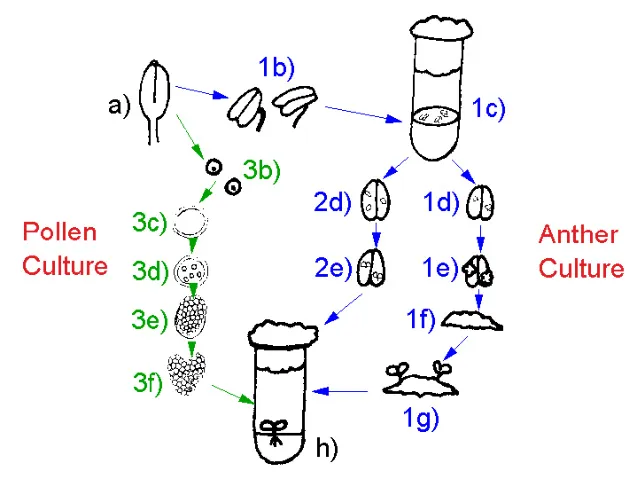 callus, 1g) differentiating callus, h) haploid plantlet. Isolated pollen culture is as follows: a) an
unopened flower bud, 3b) isolated pollen from a cultured anther, 3c) pollen culture, 3d)
multinucleate pollen, 3e) and 3f) pollen embryo.
Limitations
Low Yield- generally 5-8% of the total pollen grains in a responding anther undergo
androgenic development.
70-80% of the embryos are incapable of normal germination due to structural,
physiological and biochemical abnormalities of pollen.
Occurrence of high frequencies of albinos in cereals.
Instability of genetic material during androgenesis.
Microspore culture
The ideal culture system for production of haploids is isolation and culture of microspores after
separation from anther wall tissue.
Reasons
The influence of anther tissue can be detrimental.
Diploid tissue - Connective tissue is growing activity which is competitive with growth of haploid
microspore which is soon submerged by profuse diploid callus. So, variable and numerous
chromosomal alterations are noticed during culture.
Methods
Spontaneous
A combination of pretreatment and incubation is given. - Anthers will dehisce in liquid medium
and produce callus/embryo which will float from somatic tissue. eg. Brassica, cereals,
solanaceae.
Homogenisation and filtration
Pretreated anthers are cultured form 3-4 days gently crushed with a glass rod/syringe piston in
liquid medium to allow the microspores squeezed out. The suspension with anthers and
microspores are filtered through a nylon sieve which allows microspore to pass through. The
filtrate is centrifuged for 5 minutes at 100g. After discarding the supernatant, wash pollen at
least once and re suspend in liquid medium at initial density in petridish and incubate.(e.g.
Solanaceae, rape, sugarcane
Slit technique
Cutting the anther wall to release the microspore calluses/embryos rather than relying on
natural dehiscence but this is a time consuming process (e.g.) tobacco.
Uses of haploids
Production of homozygous varieties in self pollinated crops.
In cross-pollinated crops, the derivation from heterozygous material of pure lines for use as
parents of the intended single cross or double cross hybrids.
The obvious advantage of haploids is that they display mutations with successive effects in
single dose.
Effective fixation by chromosome doubling on transformation.
Double haploid plants are also used in mutagenesis, biochemical, and physiological studies.
Development of pure lines and disease resistant lines for mildew and yellow mosaic- barley
Parthenogenetic haploids in maize
Recovery of sexual inter specific hybrids between wild and domestic species - tomato
Development of pure lines and 100% male plants in asparagus
Complex hybrids for disease resistance in coffee
Questions
- The most important methods currently utilized for haploid production include ……….
a) Anther or pollen culture b) Ovule culture
c) Bulbosum technique d) All the above
- Bulbosum technique is ……..
a) Chromosome elimination b) Chromosome elimination following
interspecific hybridization
c) Chromosome elimination following
intraspecific hybridization
Bulbosum technique is used for ……..
d) None of the above
a) Haploid production b) Triploid production
c) Tetraploid production d) None of the above
- The development of numerous pollen plantlets in anther culture of Datura innoxia was first
reported by ………………
a) Guha b) Maheswari
c) Both a & b d) None of the above
- The process of parthenogenesis is ………………
a) Embryo development from fertilized egg a) Embryo development from unfertilized egg
c) Embryo development d) None of the above
- The capacity for haploid production ………………
a) Declines with age of donor plants b) Increases with age of donor plants
c) Unaffected with age of donor plants d) None of the above
- In pollen culture, isolation of pollen grains from the cultured anthers is by ………………
a) Mechanical method b) Float culture method
c) Both a & b d) None of the above
- Pollen dimorphism is exhibited by ………………
a) Tobacco b) Wheat
c) Barley d) All the above
- In vitro androgenesis is promoted by pretreatment of cultured anthers/pollen grains viz.
………
a) Temperature shock b) Centrifugation
c) γ irradiation d) All the above
- Addition of.............. found to increase the success rate of androgenesis.
a) Ethrel b) Sucrose
c) Nutrients specific to certain genotype d) All the above
Summary Cheat Sheet
Quick Recall Points
- Define key terms in one line and revise their use in plant biotechnology.
- Memorize major steps, methods, and applications covered in this lesson.
- Practice exam-style distinctions between related concepts and techniques.
Exam Traps
- Do not confuse similar terms without checking context and biological level.
- Revise process order carefully; sequence-based questions are common.
- Link each method with its most likely application question.
References
1 source • [1]
References
Standard BSc Agriculture Plant Biotechnology notes
BookLesson Doubts
Ask questions, get expert answers