🧬 Endosperm culture
Endosperm culture.
This lesson explains the core ideas, methods, and exam-relevant applications for this topic in plant biotechnology. Focus on definitions, process steps, and practical uses for revision.
In angiosperms the endosperm is the main nutritive tissue for the embryo. The
endosperm is the product of double fertilization during which out of the two male gametes, one
fertilizes the egg to form zygote and other fuses with secondary nuclei to form triploid
endosperm. Hence, triploid nature of endosperm is the characteristic feature of angiosperms.
Both mature and immature endosperm can be used for culture initiation. A key factor for the
induction of cell divisions in mature endosperm cultures is the initial association of embryo but
immature endosperms proliferate independent of embryo. The endosperm tissue often shows a
high degree of chromosomal variations and polyploidy. Mitotic irregularities, chromosome
bridges and laggards are the other important characteristics of endosperm tissues. Triploids are
usually seed sterile and is undesirable for plants where seeds are commercially useful.
However, in cases where seedlessness is employed to improve the quality of fruits as in
banana, apple, citrus, grapes, papaya etc. the induction of triploid plants would be of immense
use. Triploid plants have more vigorous vegetative growth than their diploid counterparts.
Hence, in plants where the vegetative parts are economically useful, triploids are of good use.
The endosperm is a homogenous mass of parenchymatous tissue lacking in vascular elements.
Since the endosperm tissue lacks in differentiation into specialised tissue and vascular element
their utility in the study of experimental morphogenesis is well appreciated. Attempts to grow
endosperm under in vitro condition dates back to 1930 by the scientist Lampe and Mills. The
young corn endosperm was cultured on the extract of potato or young corn by the above
scientist and slight proliferation of tissue was noticed from the tissues surrounding the embryo.
In 1947, LaRue, successfully cultured the corn endosperm and obtained plantlets with root
shoot axis and miniature leaves. Several investigators, since then, have cultured the endosperm
tissue but invariably have failed to induce organogenesis. However, successfully organogenesis
was achieved from endosperm callus tissue of Ricinus communis, Oryza sativa and Pyrus
malus .
Corn endosperm
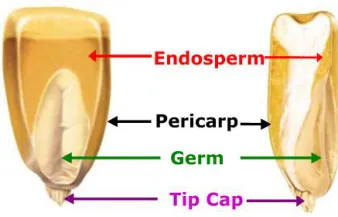
Callus induction from endosperm
During the early period of endosperm culture, there was difficulty in establishing callus induction
from mature endosperm. Of late successfully regeneration of triploid plantlets are being
achieved. The process of regeneration may be direct from the endosperm or via callus stage.
Callus tissue is induced from the endosperm explant in usual manner as with other explant. The
endosperm tissue is homogenous in nature surrounded by a single peripheral layer of
meristematic cells. These meristematic cells undergo repeated periclinal and anticlinal divisions
resulting in increased girth of endosperm tissues and in turn producing callus with nodular
structures on the surfaces or just below the outer most layer. The plants, which have so far
responded favourably, belong to the families of Euphorbiaceae, Loranthatceae and
Santalaceae . With respect to members of first two families the embryo has to be maintained
intact along with endosperm in culture, to induce the callus from the endosperm. In these cases,
immediately after the callus induction from the endosperm the embryo should be removed under
aseptic conditions to avoid the formation of embryo-endosperms callus mixtures. The essentially
of the initial association of the embryo endosperm for inducing proliferation is that during
germination of the embryo, it releases gibberellin - like substances which turn in help in de novo
synthesis of other enzymes responsible for the endosperm proliferation. These substances are
otherwise called `embryo factors'.
The age of endosperm is critical factor influencing proliferation of endosperm tissue. Endosperm
cultured immediately after pollination normally do not proliferate. In crops like rice, maize,
endosperm proliferates 7 to 8 days respectively after pollination. In many cases, endosperm of
cellular nature proliferates more easily than nuclear endosperm or coenocytic endosperm. In
some species the culture of endosperm with their embryo produced favourable condition for the
proliferation of endosperm whereas in species like Taxillus verstitus, culture of endosperm after
cutting it into two species produced better results. In endosperm culture, the proliferation thus
induced occurs at different duration and it is a genotype dependent phenomenon. For example,
the endosperm of Ricinus communis proliferated 10 days after culture whereas the endosperm
of Pyrus malus and Santalum took 15 to 21 days respectively for proliferation.
Morphogenesis of endosperm callus
Straus (1954) stated that the endosperm tissue has passed through approximately 95
transfers and has produced an estimated 15 kilograms of tissue. Not a single example of
complex differentiation was observed during the period. However, both organogenesis and
somatic embryogenesis were observed, in other cases. The first convincing evidence of organ
formation was from Exocarpus cupriformis . The incidence of organogenesis from the above
species was noticed in the form of shoot buds all over the surface of the endosperm. Apart from
the direct organogenesis in the form of buds, the organogenesis may also follow the pathway
via the callus stage. The formation of shoot buds increased with increase in cytokinin
concentration and decrease in auxin concentration. In general, endosperms of all the plant
species showed increased bud formation with response to higher concentration of cytokinin.
The studies on the role of auxin (IAA) and cytokinin (kinetin) revealed that cytokinin alone was
more effective in combination with auxin: there was no differentiation in the absence of
cytokinin, but cytokinin is not always necessary to induce bud formation from normal tissue. But
for endosperm tissues to produce buds cytokinin is required. Presence of organic additives like
tomato juice, coconut milk, casein hydrolysate, yeast extract in the culture medium enhanced
endosperm proliferation and regeneration.
Application of endosperm culture
The cultured endosperm forms an excellent experimental system for physiological and
morphogenetic studies. This system shows great promise in the study of metabolism and
differentiation. The triploidy can be exploited in the crops viz . apple, banana, mulberry,
sugarbeet, tea and watermelon where seeds are not of commercial importance. In some plants
especially in clonally propagated ones triploids are superior to the diploids giving better pulp
woods. Since these plants can be propagated vegetatively seed sterility is not a severe setback.
In the case of conventional method of triploid production, crosses are made between auto
tetraploids and diploids. Sometimes, these crosses may not be successful causing difficulty in
triploid production.
Nature of impairments in embryo development and causes
| Causes | Source | Example |
|---|---|---|
| Normal initial rate of growth followed by retardation in later stage |
Embryo | Oenothera biennis x O. muricta O. biennis x_O.lamarkiana_ |
| Paucity of cell organelles due to lower synthetic capacity of hybrid genome, necrosis and dumping |
Embryo | Hibiscus costatus x H. aculeatus H. costatus x_H. furcellatus_ |
| Hybrid failure due to pollen incompatibility |
Pollen incompatibility |
Pinus pence x_P. cembra_ P. strobus x_P. flexilis_ |
| Disintegration of endosperm soon after fertilization |
Endosperm | Oenothera and_Gossypium_ |
| Vacuolation in endosperm cells at chalazal and not followed by further cell division |
Endosperm | Lycopersicon pimpinellifolium x L. peruvianum |
| Abnormal behaviour of antipodals and preventing nutrient supply to embryos |
Endosperm | Citrus (2x) / Citrus (4x) Gossypium hirsutum x _G. _ arboreum |
| Intrusive growth of somatic tissue causing somatoplastic sterility |
Nucellus | Nicotiana rustica x N. tabacum N. rustica x_N.glutinosa_ |
| Non-differentiation of integumentary cells into connective tissues to connect main vascular bundle with chalazal tissue |
Integuments | Nicotiana hybrids |
Examples of wide crosses
| Wide crosses | Purpose |
|---|---|
| Corchorus capsularis x_C. olitorius_ | Hybrids had fibres with quality of_C. capsularis mand strength of_C. olitorius |
| Hordeum vulgare x_H. bulbosum_ | The hybrids possessed winter hardines and mildew resistance like_H. bulbosum_ |
| Lycopersicon esculentum x_L. peruvianum_ | The hybrids possessed resistance to viruses,molds and nematodes along with good fruit set like_L. peruvianum_ |
| Melilotus officianalis x_M. alba_ | Hybrids resembling M. officinalis in agronomic characters and low coumarin content like_M. alba_ |
| Nicotiana tabacum x_N. resophilia_ | To get plants with resistance to black shank |
| Oryza sativa x_O. officinalis_ | To transfer pest resistance |
| Trifolium pratense x_T. sarosiense_ | To impart perennial plant habit to red clover |
Questions
- Endosperm is …………… in nature
a). Triploid b). Tetraploid c). Monoploid d). Diploid
- Endosperm is product of …………… fertilization
a). Double b). Single c). Triple d). None of the above
- Triploid nature of endosperm is the characteristic feature of
a). Angiosperms b). Gymnosperm c). Pine d). None of the above
- The important characteristics of endosperm tissues are …….…..
a). Chromosomal variations b). Polyploidy
c). Chromosome bridges and laggards d). All the above
- Successfull organogenesis was achieved from endosperm callus tissue of …….…..
a). Ricinus communis b). Oryza sativa
c). Pyrus malus d). All the above
- Endosperm culture is successful in …….…..
a). Euphorbiaceae b). Santalaceae
c). Loranthatceae d). All the above
- Triploidy is exploited in ………….
a). Apple b). Banana
c). Watermelon d). All the above
Additional sources
http://www.youtube.com/watch?v=Gq8NWh98wQs&feature=related - video
http://www.tutorvista.com/content/biology/biology-iii/angiosperm-morphology/fertilization.php
Summary Cheat Sheet
Quick Recall Points
- Define key terms in one line and revise their use in plant biotechnology.
- Memorize major steps, methods, and applications covered in this lesson.
- Practice exam-style distinctions between related concepts and techniques.
Exam Traps
- Do not confuse similar terms without checking context and biological level.
- Revise process order carefully; sequence-based questions are common.
- Link each method with its most likely application question.
References
1 source • [1]
References
Standard BSc Agriculture Plant Biotechnology notes
BookLesson Doubts
Ask questions, get expert answers