💚 Cardamom
Cultivation requirements, varieties, shade management, and curing of cardamom for exam revision.
Cardamom is a premium shade-loving spice crop of humid tropics, and this lesson restructures its production practices for concise exam preparation.
(Elettaria cardamom, Zingiberaceae)
Cardamom, popularly known as Queen of Spices is native to the evergreen rainy forests of Western Ghats in South India. It is cultivated in about 1, 00,000 ha mainly confined to the Southern States viz; Kerala, Karnataka and Tamil Nadu accounting for 60,31 and 9% of the total area respectively. Our annual production is about 40000 metric tonnes and nearly 40% of which is exported to more than 60 countries earning a foreign exchange of nearly 60 million rupees. Cardamom is used for flavouring various preparations of food, confectionary, beverages and liquors.
Botany
Cardamom is an herbaceous perennial having underground rhizomes. The aerial pseudostem is made of leaf sheaths. Inflorescence is a long panicle with racemose clusters arising from the underground stem, but comes up above the soil. Flowers are bisexual, fragrant, fruit is trilocular capsule. Flower initiation takes place in March – April and from initiation to full bloom, it takes nearly 30 days and from bloom to maturity, it takes about 5 to 6 months. Honeybee is the principal pollinating agent and it increases the fruit set considerably when compared to flowers prevented from bee visits. Cardamom flowers remain open for about 16 to 18 hours and stigma receptivity and pollen viability are maximum during morning hours.
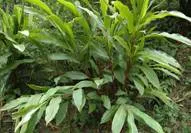 Plant |
 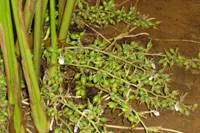 Inflorescence |
 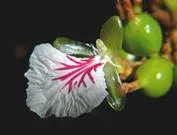 Flower
---|---|---
Flower
---|---|---
Four to five beehives per ha should be maintained and pesticides spraying should be maintained and pesticides spraying should be carefully monitored to avoid any damage to the bees. Large cardamom or Nepal cardamom or Great Indian cardamom is the dried fruits of Amomum subulatum. It is the native of Eastern Himalayan region and is now cultivated in Sikkim, Darjeeling and Assam hills in about 23000 ha in India with an annual production of 3250 tonnes. About 150 tonnes are annually exported earning around Rs 70 lakh. It is a perennial crop, propagated from the seeds or cut bits of the rhizome. It starts bearing in 3 to 5 years after planting and the economic age of the plantation is 12 to 15 years. The fruits are about2.5 cm long, ovoid and triangular in shape brown or pink in colour when ripe. They contain 40 to 50 seeds. Average yield is 300 to 1000 kg from 4th or 5th year.
Climate and Soil
The natural habitat of cardamom is the evergreen forests of the Western Ghats. It is grown in the areas where the annual rainfall ranges from 1500 to 4000 mm, with a temperature range of 10 to 35 C and an altitude of 600 to 1200 m above MSL. Rainfall distribution should be good and summer showers during February – April are essential for panicle initiation, otherwise it will affect the yield. With the denudation of the forests in the Western and Eastern Ghats, the favourable ecosystem has been affected destabilizing the macroclimate and rainfall in the cardamom growing tracts, resulting in poor growth and yield.
Varieties
Based on the size of the fruit, two varieties are broadly recognized via; Elaterid cardamom var. major consisting of wild indigenous types and var. minor comprising the cultivated types via; Mysore, Malabar and Vazhukka (natural breed between Mysore and Malabar). These types are identified mainly based on the nature of panicle and shape and size of fruits as follows.
Particulars | Mysore type | Malabar type | Vazhukka
---|---|---|--- Plant stature Panicle Capsule Adaptability | Robust Erect Bold, elongated Higher altitudes (900-1200 m MSL) in Kerala | Medium sized Prostrate Round or oblong Lower latitudes (600-900m MSL) | Robust Semi-erect Round to oblong Wide range
Recently a number of improved cultivars have been released for cultivation.
New cardamom varieties
| Name | Details
---|---|---
Summary Cheat Sheet
| Topic | Key exam point |
|---|---|
| Common title | Queen of Spices |
| Family | Zingiberaceae |
| Crop type | High-value shaded perennial spice crop |
| Important groups | Mysore, Malabar, and Vazhukka |
| Climate need | Humid environment with regulated shade and adequate drainage |
| Yield drivers | Quality planting material, spacing, and shade regulation |
| Postharvest key | Proper curing is essential for aroma, color, and grade |
| Disease caution | Excess shade and poor aeration favor disease incidence |
| Market point | Quality is strongly influenced by curing and spike health |
| Exam trap | Cardamom is defined by shade management; unmanaged shade reduces productivity and quality |
References
2 sources • [1] [2]
References
Lesson Doubts
Ask questions, get expert answers