🐃 Definition of Breed and Breed Classification
Meaning of breed and the basis for classifying important cattle and buffalo breeds.
This lesson covers core livestock production and management concepts for practical farm application and exam-oriented preparation.
Definition of breed
Class 4 :Definition of breed-classification of indigenous, exotic cattle and buffaloes -Breed characteristics of Sindhi, Kangayam and Umblacherry, Jersey, Holstein Friesian, Murrah and Surti. Breed: Definition : Denotes and established group of animals / birds having the similar general
body shape, colour, structure and characters which produced offspring with same characters
I . Cattle - 1. Indigenous 2. Exotic
Indigenous Breeds are classified under three groups based on utility / purpose.
a. Milch - Example- Sindhi, Sahiwal, Gir and Deoni
b. Dual - Example- Hariyana, Ongole, Tharparkar, Kankrej
c. Draught – Example- Kangayam, Umblacherry, Amritmahal, Hallikar
- Exotic – Milch – Jersey, Holstein Friesian
Red Sindhi
Also Known By: Malir (Baluchistan), Red Karachi, Sindhi
The Red Sindhi originated in the Pakistani state of Sind but due to its hardiness, heat
resistance and high milk yields they have spread into many parts of India and at least 33
countries in Asia, Africa, Oceania and the Americas.
Under good management
conditions the Red Sindhi averages
over 1700 kg of milk after suckling
their calves but under optimum
conditions there have been milk
yields of over 3400 kg per
lactation.
The average height of a Red Sindhi cow is 116 cm with a body weight of 340 kg. Bulls
average 134 cm in height and a body weight of 420 kg. They are normally a deep, rich
red color but this can vary from a yellowish brown to dark brown. Males are darker than
females and when mature may be almost black on the extremities, such as the head, feet
and tail.
Red Sindhi in Australia
Red Sindhi cattle arrived in Australia in 1954 from Pakistan, as a gift to the Australian Government. While traditionally considered a milking breed they have been successfully used in crossing systems with British breeds to produce tropical beef types. In Australia,
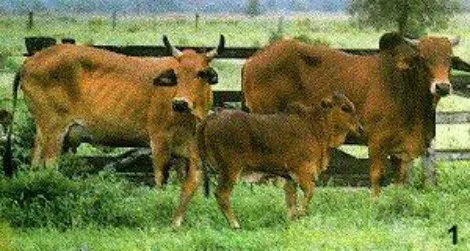 they have been an adaptable, hardy breed, good foragers and have a high degree of
resistance to heat and ticks.
they have been an adaptable, hardy breed, good foragers and have a high degree of
resistance to heat and ticks.
JERSEY
The Jersey breed originated on the Island of Jersey, a small British island in the English Channel
oldest dairy breeds, having been reported by
authorities as being purebred for nearly six
centuries.
The breed was known in England as early as
1771 and was regarded very favorably
that early date, the cattle of Jersey island were
commonly referred to as Alderney cattle although the cattle of this island were later referred to
only as Jerseys. Jersey cattle were brought to the United States in the 1850's.
Adaptable to a wide range of climatic and geographical conditions, outstanding Jersey herds are
found from Denmark to Australia and New Zealand, from Canada to South America, and from
South Africa to Japan. They are excellent grazers and perform well in intensive grazing
programs. They are more tolerant of heat than the larger breeds. With an average weight of 900
pounds, the Jersey produces more pounds of milk per pound of body weight than any other
breed. Most Jerseys produce far in excess of 13 times their bodyweight in milk each lactation.
The modern Jersey breed is unexcelled in dairy type. Breeders in the United States commonly
referred to two distinct types of Jerseys in the past, these being the Island and the American; this
distinction is not commonly made at present. It should be recalled that this is a different usage of
the word "type" than is usually implied and refers to the general size and quality of the animal
rather than to its use for dairy purposes. The Island-type Jerseys excelled in refinement and those
qualities that were deemed necessary to win in the show ring. Refinement and beauty of such
cattle in mature form led to the marked superiority of cattle imported from the island of Jersey or
their direct descendants in winning most of the major awards of the American show ring. The so
called American-type Jerseys were noted much more for production than for beauty. Cattle
referred to by this description are usually larger, a bit coarser, and have been bred for years for
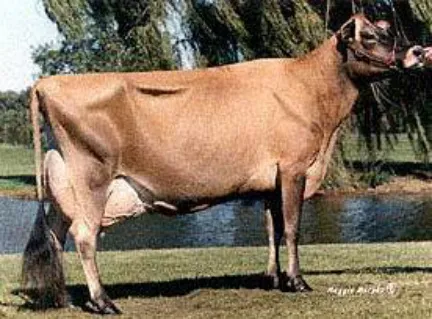 those qualities that suit them for milk and butterfat production. Some have referred to them as
the "Farmer's" Jersey. Usually after two or three generations in the United States in the hands of
the ordinary feeder, the refinement of the Island cattle gives way to the larger and less refined
American kind.
In recent years there has been less concern about these type variations; no doubt the program of
type classification has tended to reduce the extremes. Additional emphasis on milk production
and less stress on butterfat production had, no doubt, resulted in general acceptance of Jersey
cows with more size and scale. Recent importations of Jerseys have consisted of larger cattle
than many previously brought to the United States. Their offspring have not only been
acceptable in type but have also been used advantageously in improving production.
Cows show very marked refinement about their heads and shoulders, carry long, straight top
lines, and usually carry out long and level at the rump. For their size, they are usually deep in
the body and full and deep in the barrel. There is no more appealing dairy animal than the well
balanced Jersey cow, and although usually somewhat more nervous in disposition than the other
dairy cows, she is usually docile and rather easy to manage. Jersey cows usually have an extreme
weight range of between 800 and 1200 pounds, but medium-sized cows are usually preferred.
Jersey bulls, while small as compared to the other dairy breeds, are extremely masculine. They
are quite muscular about their crests and shoulders and are considerably less refined throughout
than are the females. The same general qualities of straight lines and diary conformation as are
found in the cows are desired in bulls. They usually range in weight from 1200 to 1800 pounds,
but as in the females, medium weights are usually preferred. Jersey bulls are known for having
the least docile temperament of the common breeds of cattle. It is folly to trust any dairy bull and
particularly Jerseys past eighteen months of age.
Modern Jerseys may be of a wide range in color. There is little preference today between the
solid and broken colors although most breeders slightly prefer the cattle with an unbroken color
pattern. Most prefer the dark tongue and switch, but this is more a matter of an identification
point than a point of discrimination. The color in Jerseys may vary from a very light gray or
mouse color to a very dark fawn or a shade that is almost black. Both the bulls and females are
commonly darker about the hips and about the head and shoulders than on the body. Most
breeders slightly prefer the medium shades of color to the extremes, but nearly all of them realize
that type and producing ability are far more important than the shade of color or whether the
color is solid or broken.
Holstein
Origin of the Breed
The Holstein cow originated in Europe. The major historical developement of this breed
occured in what is now the Netherlands and
more specifically in the two northern
provices of North Holland and Friesland
which lay on either side of the Zuider Zee.
white animals of the Batavians and
Friesians, migrant European tribes who
settled in the Rhine Delta region about
2,000 years ago.
For many years, Holsteins were bred and strictly culled to obtain animals which would
make best use of grass, the area's most abundant resource. The intermingling of these animals
evolved into an efficient, high-producing black-and-white dairy cow.
Imports to America
After the New World was settled, and markets began to develop for milk in America,
dairy breeders turned to Holland for their seed stock.
Winthrop Chenery, a Massachusetts breeder, purchased a Holland cow from a Dutch
sailing master who landed cargo at Boston in 1852. The cow had furnished the ship's crew
with fresh milk during the voyage. She proved to be such a satisfactory producer, that
Chenery made later importations of Holsteins in 1857, 1859 and 1861. Many other breeders
soon joined the race to establish Holsteins in America.
After about 8,800 Holsteins had been imported, cattle disease broke out in Europe and importation ceased.
Americans Build Their Own Breed
 In the late 1800's there was enough interest among Holstein breeders to form associations
for the recording of pedigrees and maintenance of herdbooks. These associations merged in
1885 to found the Holstein-Friesian Association of America, the Holstein Association.
In the late 1800's there was enough interest among Holstein breeders to form associations
for the recording of pedigrees and maintenance of herdbooks. These associations merged in
1885 to found the Holstein-Friesian Association of America, the Holstein Association.
Characteristics of Holsteins
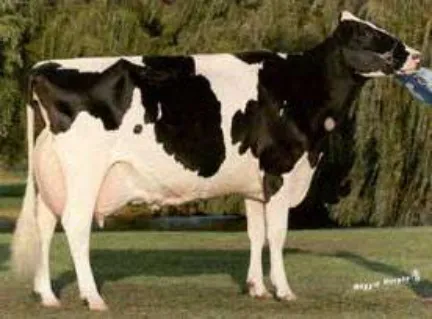
Holsteins are most quickly recognized by their distinctive color markings and outstanding milk production.
Physical Characteristics
Holsteins are large, stylish animals with color patterns of black and white or red and white.
A healthy Holstein calf weighs 90 pounds or more at birth. A mature Holstein cow weighs about 1500 pounds and stand 58 inches tall at the shoulder.
Holstein heifers can be bred at 15 months of age, when they weigh about 800 pounds. It is desirable to have Holstein females calve for the first time between 24 and 27 months of age. Holstein gestation is approximately nine months.
While some cows may live considerably longer, the normal productive life of a Holstein is six years.
Milk Production
Average production for all Holsteins enrolled in official U.S. production-testing programs in 1987 was 17,408 pounds of milk, 632 pounds of butterfat and 550 pounds of protein per year.
Kangayam
The Kangayam cattle conform largely to the Southern Indian Mysore type, thought there
is evidence of the blood of the gray-white Ongole cattle in their composition. Possibly this
mixture has given the breed its larger size in comparison with other cattle of the Mysore type.
This breed, in its native area, is also known by other names of Kanganad and Kongu though
the name Kangayam is well-known. These cattle are bred in the southern and southeastern
Kangayam cattle, one small and the other large.
The smaller variety is found to be more
numerous in the Kangayam, Dharampuram,
Udmalpet, Pollachi, Paddadam and Erode
 areas of Karur, Aravakurchi and Dindigul subdivisions. The breed is found in its pure form in
the herds of some large breeders, notably the Pattagar of Palayakottai, who is supposed to
have one of the best herds of the breed in the country.
Characteristics
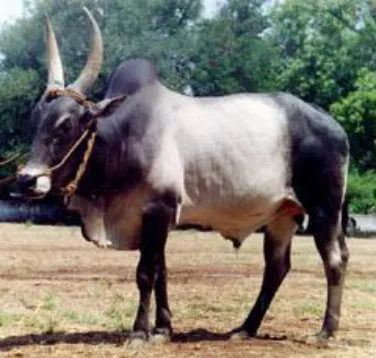
Both varieties of this breed are strong and active, with compact bodies and short, stout
legs with strong hooves. Horns in the smaller variety spread apart nearly straight, with a
slight curve backwards. In the larger variety, the horns are much longer, curve outwards and
backwards and almost complete a circle at the point where they approach the tips. The head
is of moderate size with only slightly prominent forehead. The head is more proportionate to
the body with a straighter profile than in most of the Mysore type cattle. The ears are small,
erect and pointed. The eyes are dark and prominent with black rings around them.
The neck is short and thick. The back is short, broad and level. The body is compact, with
well sprung ribs. The quarters are slightly drooping. The dewlap is thin and extends only up
to the sternum. The sheath is well tucked up to the body. The hump in bulls, though well
developed, is firm. The hair is fine and short and the skin is dark in pigment and fine in
texture. The tail is of moderate length with a black switch reaching well below the hocks.
Kangayam color is usually gray or white. The males generally are gray with black or very
dark gray coloring on the head, neck, hump and quarters. In the cows, the prevailing color is
white and gray with deep markings on the knees, and just above the fetlocks on all four legs.
The calves are light or dark brown with gray or white on the inside of the thighs, ears and
forelegs, and occasionally with gray or white rings on the pasterns and fetlocks. At two years
the heifer turns gray or dark gray and retains this color but with advancing age after maturity
the color fades and becomes white. Male calves become dark gray or iron gray with black
shading over the head, neck, hump, dewlap, fore and hind quarters. With maturity the black
shading becomes intensified. Castrated males, however, show fading of the color.
Kangayam cattle are of moderate size, active and powerful, and are highly prized
draft animals. The cows are generally poor milkers but there are encounters of fair producing
abilities.
II. Buffalo – Murrah, Surti
Murrah ;
The breed tract is Rohtak,Hisar and Jind of Haryana.The breed characterstics are massive body,
neck and head comparatively long, horns short and tightly curled, Udder well developed, hip
broad and fore – and hind quarters drooping. The tail is long reaching the fetlock s. The colour is
usually jet black, with white markings on tail, and face and extremities sometimes found. The
bullocks are good draught animals though slow and powerful. The average milk production per
lactation is 1,500to 2,500 kgs. and the heretability of this trait is 0.2-0.3.The age at first calving
is 45 – 50 months in villages but in good herds it is 36 – 40 months in intercaliving period is 450
- 500 days.
Surti : The breeds tracts of this breed is Kaira and Baroda districts of Gujarat. The body is well
shaped and medium sized. The barrel is wedge shaped. The head is long with prominenet eyes.
The horns are sickle shaped. moderately long and flat. The back is straight and tail is farily
long. The colour is black or brown the peculiarity of breed is two white collars one round the
jaw and the other at the brisket. The milk yield ranges from 900 – 1300 Kgs. The age at first
calving is 40 to 50 months with an intercalving period of 400 – 500 days. The heritability of the
trait is 0.2 to 0.3. the peculiarity of breed is very high fat percentage in milk (8 to 12%). The
bullocks are good for light work.
Summary Cheat Sheet
| Topic | Key Point |
|---|---|
| Breed meaning | Group of animals with common origin and identifiable characters that are transmitted to offspring |
| Main cattle classes | Indigenous breeds and exotic breeds |
| Indigenous examples | Red Sindhi and other native Indian breeds |
| Exotic example | Holstein is a classic high-yielding exotic dairy breed |
| Breed importance | Helps in selection, breeding policy, and matching animals to production goals |
| Holstein note | Known mainly for high milk production and dairy specialization |
| Indigenous strength | Better adaptation to local climate, disease stress, and management limitations |
| Exotic strength | Higher production potential under good feeding and management |
| Selection base | Physical characters, productivity, and adaptability are all relevant |
| Exam trap | Breed definition is about inherited group identity, not just colour or body size |
Lesson Doubts
Ask questions, get expert answers