🧬 Breeding Methods and Their Importance
Role of selection, crossbreeding, and artificial insemination in livestock improvement.
This lesson covers core livestock production and management concepts for practical farm application and exam-oriented preparation.
Breeding- importance
Class 5 :Breeding- importance of cross breeding. Signs of estrous cycle-Artificial
insemination-merits and demerits.
CROSS BREEDING:
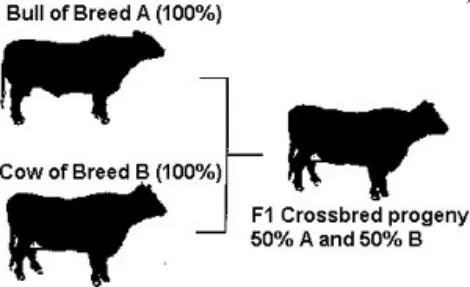
This is mating of animals from the two different established breeds
Eg.: Jersey (b) x Kangayam (c) : Jersey (c) x
Holstein Friesian (b). The cross bred animals
will exhibit the mixture of qualities of both the
parents breeds. The progeny will improve in
production performance and will exhibit
marked disease resistance characteristics of
the native breed and is well adpated to with
stand local climatic condition. 62.5% of exotic blood & 37.5% local blood – ideal .
Jersey x local breed.- F1- 50% ND(c) x J (75%) + 25% ND – F1 50 J 50 ND x 100 J (B) So cross
breeding is also taken up to evolve new breed.
Age at maturity Economic traits
1.Age at 1 [st] calving : Age in days of the cow or buffalo on the date of 1 [st] calving.
- Lactation Length : Days in milk from the date of calving to the final drying off or
or cessation of milk (305 days)
- Lactation Yield : Milk yield in Kgs from the date of calving to the date of
drying (corrected to 305 days)
-
Dry period : Days from the date of drying to the date of calving
-
Inter calving period : Days from the date or one calving to the date of next
calving (1 [st],2 [nd] )
6.Peak yield : The highest daily yield in Kgs during lactation period
- Average Fat% : Average Fat %
8.Service period :The interval between calving and subsequent service resulting
in conception
9.Breeding efficiency : Measured as the No. Services/Conception
 Breeding : Production of off springs / young ones
Scientific breeding is needed to get better performance in livestock – milk – meat – wool – Egg
Inbreeding : mating of closely related animals in the same breed such as brother – sister mating
ii. parents off spring mating- when the mates have common ancestors -with in 4 generations
this results in inbreeding
Advantage : A pure line of a particular breed can be maintained
Dis advantage : Loss of vigour, size, production fertility problems
Out breeding : Mating of unrelated animals in the same breed but with no common ancestor for a
minimum of 4-6 generations.
Grading : Grading is a farm of out crossing, where in bulls of a distinct breed are bred on non
descript cows from generation to generation, so that in course of time a populations essentially
resembling the breed from which the Bulls are used.
Non descript cow x Jersey Bull
F1 50% ND + 50% Jersey x Jersey Bull
F2 25% ND + 750% Jersey x Jersey Bull
F3 12.5% ND + 87.5% Jersey x Jersey Bull
After 5-6 generations the off springs will have 96.9 & 98.3% of the hereditary characters of
„Pure Breed‟
So grading is a process by which a few „Pure Breed‟ sires can rather quickly transform
local variety of animals into a „Group‟ resembling the pure breed.
| Economic Traits | Col2 | Col3 | Col4 |
|---|---|---|---|
| Particulars | Local | Exotic | Cross breed |
| Birth weight | 20Kg | Jersey – 25-30kg. Friesian – 30-35kg. |
Jersey – 25-30kg. Friesian – 30-35kg. |
| Age at maturity |
33 Months | 15 months | 18-24 months |
| Age at 1 |
42 months | 24 months | 30 months |
| Lactation yield | 12000 Kg. | 3000-6000Kg. | 2100-2400 |
| Lactation period | 180-210 Days | 305 days | 240 – 270 days |
|---|---|---|---|
| Dry period | 90-120 days | 60 days | 75 days |
| Inter calving period | 18 months | 12-13 months | 13-14 months |
Oestrus cycle
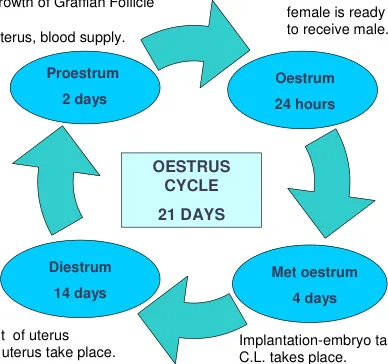
Proestrum: ( 2 days) Period of building up growth of graffian Follicle which helps for the
nourishment of ovum fluid contains hormone called „oestrogen‟. It causes changes in uterus,
blood supply.
Oestrum: ( 1 day) During which the female is ready to receive male.
Metoestrum : ( 4 days) Implantation of the embryo takes place C.L. takes place. Prevents the
growth of graffian follicle thereby arrests oestrus cycle.
Diestrum : ( 14 days)Further development of uterus takes place. If the animal has not
conceived involution of uterus take place.
Symptoms of Heat :
1.Off feed 2. Drop in milk yield 3. restless and excited 4. Bellowing 5. Oedema / swelling of
genitalia 6. frequent utination 7. Transparent mucous discharge 8. cow/buffalo which are in heat
will mount on other animals and allows mounting of other animals.
OPTIMUM TIME FOR CROSSING
Egg/ova from ovary – released about
12-18 hours after the onset of symptoms of
heat. Ovum will survive upto 16 hours
after the release. Sperm live for 12-14
hours.
Morning signs of heat are exhibited – AI
done in the evening : 12 hours delay.
Proestrum : This marks the animal –
coming in heat.
GF – Ovary – growing – increased
Oestrogen
DR GOKUL
Prevents the growth of graffian follicle arrests oestrus cycle.
secretion of follicular fluid – Estradiol - increase No.of Cilia – increased Vascularity of uterus
- increase in thickness ofEpithlial wall of vagina .
The vaginal wall adjustemnt is well filled to prevent possible damage to the wall when coitus
occurs.
Oestrum : This is the period of desire.
„Graffian Follicle‟ – Ripe or very turgid
This period is brought to an end by the rupture of the follicle (or) ovulation. Vulva becomes
swollen. Vulva and Vagina – congested
Met Oestrum : This is the period when the organ returns to normal non congested condition.
During this period the cavity of the GF from which ovum has been expelled becomes
recognized and forms a new structure known as C.L.
-
It prevents the maturation of further graffian follicle
-
It is essential for the implantation of the fertilized egg.
-
It is intimately concerned which the development of mammary gland.
Diestrum :Longest part of estrus cycle Implantation – uterine milk –for the nourishment of the embryo prior to implantation. Absence of pregnancy. – returns to normal and thus the cycle continues.
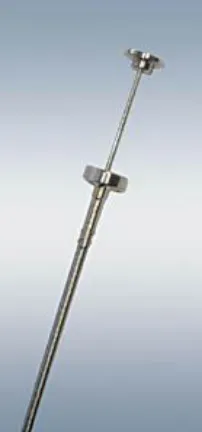
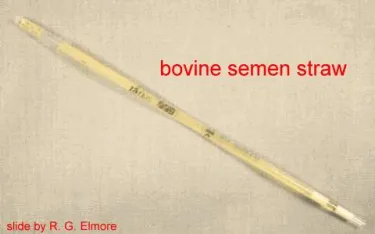
ARTIFICIAL INSEMINATION. Artificial insemination is the deposition of male reproductive cells (sperm) in the female tract by mechanical means rather than “Natural Service” ADVANTAGES : 1.Increases usefulness of superior sires to extra ordinary degree. 2.Services of Superior Sires are greatly extended.
animals/year but under Artificial Insemination the amount of
semen secreted by the animal can be used to satisfy the
requirements of 1000 animals per year
DILUTION OF SEMEN
Average of Sperm/mL : 1000 million
 Total volume of semen/2 ejaculate :6 mL
: (i.e.) 6000 million sperms.
No. of motile Sperms : 90 %
.: Total number of motile sperms : 5400 million.
Expected wastage during processing : 10 %
(i.e.) filling and sealing
Net no.of sperms available : 5400-540= 4860
Minimum No. of sperms required / dose : 30 Million.
.: @ this rate no. of doses that could be prepared : 4860 /30 = 160 doses
So, total no. of doses that can be prepared / week : 160 x 52 weeks = 8320 doses.
Frozen semen required / dose : 1 mL.
3.No need to maintain Breeding Bull.The frozen semen can be stored in the Liquid Nitrogen 196 [0] C.
4.Semen can be quickly and easily transported by air to different continents.
5.Spreading of diseases is absolutely- NIL.
6.Overcomes the difficulty of size and weight between Dam and Sire.
7.Increase the rate of Conception because in the artificial insemination the semen is being
deposited in the mid cervix .
8.Outstanding animals located apart can be mated.
9.Helps in better record keeping.
10.Old and heavy sizes bulls,injured / disabled sires can be used.
MERITS:
1.Semen can be stored in the frozen state, so progeny
can be obtained even after the transfer, WHY even
after death of bull-15-20 years.( atomic, radioactive,
X-ray unit)
2.Semen is expanded and no. of animal can be
crossed.
3.Frozen semen can be transported to destination once in a month from the semen bank.
DISADVANTAGES.
1.Some bulls semen may not freeze well.
 2.If inferior bull semen is frozen and used –Extensive damage is caused.
3.Maintenance of frozen semen bank is not economical for a small area of operation.
4.Requires well trained technical personnel‟s and special equipments and hygienic measures are
to adapted in preparation.
5.Improper cleaning of instruments and unsanitary condition may lead to lower fertility and may
be nucleus for the spreading of diseases.
2.If inferior bull semen is frozen and used –Extensive damage is caused.
3.Maintenance of frozen semen bank is not economical for a small area of operation.
4.Requires well trained technical personnel‟s and special equipments and hygienic measures are
to adapted in preparation.
5.Improper cleaning of instruments and unsanitary condition may lead to lower fertility and may
be nucleus for the spreading of diseases.
Summary Cheat Sheet
| Topic | Key Point |
|---|---|
| Main theme | Importance of breeding, crossbreeding, estrus signs, and artificial insemination |
| Breeding objective | Improve productivity, fertility, and adaptability of livestock |
| Crossbreeding use | Combines desirable traits of two breeds and may improve performance |
| Economic traits | Production, reproduction, growth, and utility traits are major selection targets |
| Estrus meaning | Period when female accepts the male for mating |
| Estrus importance | Timely heat detection is essential for successful breeding or AI |
| AI meaning | Artificial insemination allows use of selected male germplasm without natural mating |
| Maturity note | Age at maturity affects reproductive planning and farm economics |
| Main management need | Good breeding needs records, heat observation, and proper timing |
| Exam trap | Crossbreeding improves performance only when planned; it is not random mixing of breeds |
Lesson Doubts
Ask questions, get expert answers