🥛 Milk, Clean Milking, and Adulteration
Definition of milk, principles of clean milking, and common preservatives and adulterants.
This lesson covers core livestock production and management concepts for practical farm application and exam-oriented preparation.
Milk-Definition — clean
milking. Preservatives and common adulterants of milk.
Milk is the lacteal secretion of the mammary glands of animals. It is obtained generally
from the cow or the buffalo during the period following at least 72 hours after calving or until the
milk is colostrum free. Milk is a white opaque fluid in which fat is present as an emulsion,
protein and some mineral matters in colloidal suspension, and lactose together with some
minerals and soluble proteins in true solution.
Milk
Fat solids – non- fat
Total fat Associated substances
Several glycerides
Phospholipids Cholesterol Carotene Vit.A,D & E
Solids not –fat
Lactose Nitrogenous Mineral matter Other constituents
Protein Non-protein Phosphates, Dissolved Bacteria Vitamin
nitrogen citrates and gases Thiamine,
chlorides of riboflavin,
K,Na,Ca,Mg: nicotinic acid,
traces of Cu, I Pyridoxine,
Fe, chromium, choline,
inositol,
cobalt, manganese folic acid
Zinc. pantothenic
acid,
Vitamin B12,
ascorbic acid.
Average composition of milk of different mammals (in per cent)
| Species | Water | Fat | Protein solids | Total | SNF | Lactose | Ash |
|---|---|---|---|---|---|---|---|
| Human | 87.43 | 3.75 | 1.63 | 12.57 | 8.82 | 6.98 | 0.21 |
| Cow | 86.61 | 4.14 | 3.58 | 13.19 | 9.25 | 4.96 | 0.71 |
| Buffalo | 82.76 | 7.38 | 3.60 | 17.24 | 9.86 | 5.48 | 0.78 |
| Goat | 87.00 | 4.25 | 3.52 | 13.00 | 7.75 | 4.27 | 0.86 |
| Sheep | 80.71 | 7.90 | 5.23 | 19.29 | 11.39 | 4.81 | 0.90 |
| Camel | 87.61 | 5.38 | 2.98 | 12.39 | 7.01 | 3.26 | 0.70 |
| Mare | 89.04 | 1.59 | 2.69 | 10.96 | 9.37 | 6.14 | 0.51 |
| Ass | 89.03 | 2.53 | 2.01 | 10.97 | 8.44 | 6.07 | 0.41 |
Average composition of milk of some important milch breeds of cows (per cent)
| Breed | Total solids | Fat | Protein | SNF | Lactose | Ash |
|---|---|---|---|---|---|---|
| Red Sindhi | 13.66 | 4.90 | 3.42 | 8.76 | 4.81 | 0.70 |
| Jersey | 14.91 | 5.37 | 3.73 | 9.54 | 4.93 | 0.70 |
|---|---|---|---|---|---|---|
| Friesian | 12.26 | 3.40 | 3.13 | 8.86 | 4.86 | 0.67 |
| Crossbred | 13.13 | 4.50 | 3.37 | 8.63 | 4.92 | 0.67 |
Clean Milk production :
Both pre-and post-secretory management of milk at the farm level should be focussed
upon for controlling the quality of milk. The post-secretory changes in milk are of paramount
importance. Some of the vital factors responsible for good milk production that deserve
immediate attention are type of farming, type of milk, impact on environment, farm waste
disposal facilities, milking practices, procurement systems and inconsistent price policy and
farmers’ education/training programmes.
Milk once secreted becomes the target for transformation by a variety of host organisms
at the farm itself. Hence, proper care must be taken regarding preservation of milk, protection of
milk constituents, protection against high temperatures and natural calamity. Strict protocols are
to be observed and implemented both in hand and machine milking. The microbiological quality
deserves special attention for stringent export requirements for milk products in global market.
The custodian of milk should never compromise on quality.
Rural milk collection
In India, milk production is a subsidiary activity to agriculture in contrast with organized
dairy in western countries. Farmers and landless labourers mostly maintain 1-5 milch animals.
As a result, small quantities of milk are produced in a scattered manner. Milk procurement
models from western countries, such as bulk cooling, bulk transportation etc. are not applicable
due to this reason, under Indian conditions. Collection of small amounts of milk scattered over
long distances, therefore, posses a formidable challenge in maintaining the quality attributes and
keeping costs down.
A systematic approach to rural milk collection suitable for tropical climatic and techno
economic conditions prevailing under in India has been developed based on the indigenous
experience gained over past few decades. In the first phase, extensive surveys are undertaken in
the milk shed areas, where milk plant is to be established. The second phase involves “route
planning” taking into account availability of quantities of milk, access to roads for plying
vehicles and distance from the site of dairy plant. Then zones are identified, representing equal
costs of collection and transportation. In the third phase, planning is done for locating the
primary collection centres as well as chilling centres, where, milk can be cooled to 4 [o] C before
transporting to the milk plant. Milk may be collected from individual procedures either by the
contractor or by forming village level cooperative societies.
At the village level, milk brought by the individual farmers is first tested for quality. As
soon as the milk supply reaches collection centres, it is weighed and a representative sample is
drawn for quality grading. The common tests carried out at the point of milk collection are taste
and smell, sediment, fat and SNF contents and acidity test. These quick tests generally form the
basis for acceptance or rejection of milk supplied. In India it is common to pay the producer on
the basis of the quantity of fat, while the minimum standard for SNF is set for accepting milk.
All the milk so collected is generally filled in cans to enable transportation to the chilling centre
or directly to the milk plant. Care should be exercised to bring the milk for chilling/processing
within 3 hours of milking otherwise serious deterioration of milk takes place, which affects the
quality of products.
Transportation :
In the Indian context, most of the milk is transported from rural collection centres to the
dairy plant depending upon the volumes of milk handled.
-
Cans for handling up to 2,000 litre of milk per day.
-
Tankers for handling between 2,000 and 5,000 litre per day.
-
Rail tankers for handling 10,000 litre or more for ling distance transportation as in the
National milk grid.
Grading of milk at collection centres
Following criterion, based or organoleptic tests may be used for grading of milk at the
rural milk collection centre.
Flavour : 45
Sediment : 10
Cleanliness of container and closure : 5
Temperature : 5 [o] C
Milk reception at chilling centre
In a distant milk plant, rurally collected milk is first brought to a common chilling centre.
In view of the high ambient temperatures prevailing in the tropical climatic conditions in India, it
is imperative to chill and milk to 4 [o] C and transport it at the same temperature to the milk
processing plant. The chilling centre may be operated by dairy plant directly or by the
contractor, in accordance with the prevailing situations. The collection of milk from the chilling
centre usually takes place once a day. At the chilling centre, milk is promptly chilled to 4 [o] C and
stored in large tanks of 2,000-10,000 litre capacity. Chilling centre operation is economical only
when about 30,000 litre of milk is handled per day. It is then transported, though tankers, to
dairy processing unit.
Following equipment are used for chilling of milk:
Surface cooler : (Direct expansion type, ice bank and brine)-for handling up to 5,000 litre of
milk.
Plate cooler : This is suitable for handling more than 30,000 litre of milk.
Grading of milk at chilling centre.
Smell : 45
30 MBR test : 35
Sediment : 10
Container/Closure : 5
Temperature : 5 [o] C
Titrable acidity, clot on boiling test, alcohol test, and alcohol alizarine test may be done
on suspected samples of milk for confirmation.
Milk reception at dairy plant
The milk at the dairy plant is received either in cans or road/rail tankers. There are
separate reception docks where milk is received through tankers and cans. Milk reception dock
is designed for unloading the cans directly on the platform. Milk cooled in cans is brought to
the dairy in trucks/lorry from where the cans are unloaded onto a conveyor
The milk from each can is automatically or manually emptied into a weighing bowl, that
indicates the quantity, which is recorded by the operator. The empty cans are further conveyed to
can washer where they are automatically washed with detergent and hot water and steam
sterilized to be made ready for next collection trip. The milk from chilling centre is usually
transported in tankers to the dairy. Milk received by tanker can be measured by weight or by
volume. Generally the milk from the tanker is measured by volume. A flexible line is connected
between the tanker milk delivery pump and flow meter installed at the reception dock. The milk
is pumped through the flow meter into large vertical storage tank (25,000-1,50,000 litre capacity)
called ‘Silo’. The flow meter continuously indicates the volume of milk received. Alternatively,
the tanker can be weighed before and after unloading to know the amount of milk received at the
dairy. This is also possible by using special tanks fitted with load cells that supply electric
signal, which is proportional to the weight of the tank. The weight of the contents in the tank can
be recorded after all the milk is delivered. The milk is then pumped into the silo.
Preservation of raw milk.
In order to produce milk products conforming to international quality standards, it is
important that the milk is collected, transported and cooled immediately under strict hygienic
conditions. Ideally, all the milk reaching to the dairies should be bulk cooled.
Under tropical conditions, it would be beneficial to have access to methods, other than
refrigeration, for retarding the bacterial growth in raw milk during collection and transportation
to the dairy plants. However, whatever method is adopted it should not have harmful or
toxicological effects. Further, the main objective of the method should be to maintain food
safety and not otherwise. One of the methods, which has some merit and is worth considering, is
LP system (Lactoperoxidase/thiocynate/hydrogen peroxide system). The LP system is an
indigenous anti bacterial system in milk and human saliva. The enzymes lactoperoxidase is
present in cow and buffalo milk in relatively high concentrations. The anti bacterial effect of the
LP system is mediated by short-lived oxidation products of thiocynate. To activate the LP system
is milk, adequate concentrations of thiocynate and hydrogen peroxide are added. The optimum
way of applying LP activation has to be decided from case to case basis, but it is quite feasible
that the required concentration of hydrogen peroxide, the thiocynate are converted in the form of
tablet which is sufficient for one can of milk. It is very important that preservation of raw milk
by LP system is controlled at the society level and the individual farmers do not have direct
access to such chemicals.
Adulteration : Adulterants in milk
Definition : Addition or removal of legally prohibited substances from the milk with the view to
increase quantity and reduce the quality to make extra profit.
Common adulterants :
-
Addition of water
-
Removal of fat.
-
Addition of starch
-
Addition of milk powder
-
Addition of carbonate and bicarbonate.
The practice of adulteration of milk is a reality. It is paradoxical that human instinct for
greed so far as to touch the precious food meant to protect the health of vulnerable groups of
infants, children and the elderly. Some of the known adulterants are water, salt, sugar, wheat,
starch, washing soda, formalin, urea, hydrogen peroxide etc. Some are used for increasing
volume and SNF content of milk while others as preservatives to extend shelf life.
Detection of adulterants
Detection of water : water is a most common adulterant and its presence can be detected
by testing the freezing point of milk. The official method of AOAC assumes a freezing point
for normal milk of –0.550 [o] C
0.55-xt
Percentage added water = –––––––– x 100 where x is freezing point depression.
0.55
A tolerance of 3% is allowed which is equivalent to specifying a minimum freezing point
depression for authentic milk of 0.5335 [o] C. The presence of water can also be checked by the use
of lactometer.
Detection of neutralizer in milk
Difference in coagulation behaviors of milk in the presence of alcohol. Add 5 ml of
distilled alcohol (95%) to 5 ml of milk sample, mix the contents thoroughly by shaking and
observe the coagulation behaviour of the sample. Appearance of fine and uniform sized flakes
indicates the presence of added neutralizers in milk whereas appearance of bigger and unevenly
sized flakes indicates their absence.
Rosalic acid test:
Add 4 drops of freshly prepared alcoholic solution of 1% Rosalic acid to the above
mixture and mix gently. Appearance of pink colour at the junction of mixture and Rosalic acid
indicates the presence of either sodium hydroxide potassium hydroxide or calcium hydroxide
added to milk, and that of rose red colour indicates the presence of sodium carbonate or sodium
bicarbonate. The appearance of brownish colour indicates the absence of any of these
neutralizers.
This test can detect the addition of sodium hydroxide, potassium hydroxide and calcium
hydroxide in milk up to 15-20 mg/100ml and sodium carbonate, sodium bicarbonate and
potassium carbonate up to 25-30 mg/100ml. The higher amounts of the neutralizer can be
detected from the appearance of pink rose red colour even after thorough mixing. The presence
of neutralizers can also be detected by testing ash content.
Detection of starch:
Place in a test tube about 3ml of well-mixed sample. Boil it by holding the tube over a
flame. Allow cooling to room temperature. Add a drop of 1% iodine solution. Presence of starch
is indicated by the appearance of a blue colour that disappears when the sample is boiled and
reappears on cooling,
Detection of gelatin:
Gelatin produces a yellow precipitate with picric acid solution. While cloudiness shows
smaller amount and yellow precipitate a large amount of gelatin in milk.
Detection of cane sugar:
To about 15ml of milk in a test – tube add 1 milliliter of concentrated hydrochloric acid
and 0.1g of resorcinol and mix. Place the tube in boiling water-bath for 5 minutes. In the
presence of cane sugar red colour is produced.
Detection of saccharin:
Curdle an aliquot of the diluted sample (about 25ml) with dilute acetic acid. Shake well
and filter. Acidity the clear filtrate with 2ml of concentrated hydrochloric acid and extract with
25ml portion of ether. Draw of adequate layers and wash the combined ether extract with 3
successive portions of 5ml of water. Evaporate the ether extract on water bath and add a drop or
two of water, mix well with glass rod and taste little. Characteristic sweet taste indicates the
presence of the saccharin.
Detection of glucose or monosaccharides (Barfoed’s test) :
The reagent is prepared by dissolving 6.5 of crystallized copper acetate in 100 ml of 1%
acetic acid solution. For the test heat 5ml of Barfoed’s reagent in boiling water for 3 ½ minutes.
Production of red precipitate of cuprous oxide indicates the presence of monosaccharides.
Detection of sodium chloride :
Take 2 ml of milk and add 0.1ml of 5% potassium chlorinate and 2ml of 0.1 N silver
nitrate. Appearance of red precipitate indicates the presence of sodium chloride.
Detection of urea in milk :
Take 2ml of milk and add 2ml of p-dimethyl amino benzaldehyde reagent (1.6% in ethyl alcohol
containing 10% HCI). Development of distinct yellow colour denotes the presence of urea. The
pure milk samples show a faint pink colour which should be ignored due to the presence of
natural urea (up to 50mg/100ml.) This test should be carried out with the control sample. A
sample paper strip method has also been developed using the above principle.
Detection of formalin:
Take 5 ml of milk sample in test – tube and add 5ml of concentrated sulfuric acid
containing traces of ferric chloride. Formation of purple ring at the junction indicates presence
of formaldehyde in milk.
Detection of hydrogen peroxide :
The presence of hydrogen peroxide can be detected by an intense blue colour developed
on addition of 2 drops of paraphenylene diamine hydrochloride to 10ml of milk.
Detection of buffalo milk in cow milk:
The presence of buffalo milk in cow milk can be detected by Hansa test, which is based
on immunological assay. A drop of supected milk after dilution with water (1:4) is treated with a
drop of antiserum obtained by injecting buffalo milk proteins into rabbits. The characteristic
precipitation reaction indicates the presence of buffalo milk.
Detection of added colour:
The chief colouring materials which are considered here are some natural colouring
material like annatto, turmeric of coal-tar dyes. Some of these dyes are permitted only in some
products. While the use of annatto is prohibited in milk, its use in permitted in butter. To detect
annotto the milk fat is shaken with 2% sodium hydroxide and the mixture is poured on filter
paper. The filter paper absorbs the colour, which remains even after washing with water. When
the stain is treated with a drop of 40% SnC1 [2] and dried, a purple colour indicated the presence of
annatto. Turmeric is detected when the colour adequous or alkali, extracted is treated with HCL.
The resulting orange colour is treated with H3BO3 crystals, a red colour indicates the presence of
turmeric.
Coal-tar dyes adhere to animal fibres more firmly than natural colour. The curd of pure
milk is white when extracted with ether but one containing coal-tar dyes remains orange or
yellow; this when treated with concentrated hydrochloric acid becomes pink.
Detection of pulverized soap :
Soaps are generally defined as sodium and potassium salt of fatty acid. Therefore, to
detect the presence of pulverized soap, iodine value refractive index, fatty acid composition, salt
ratio and ash content are excellent methods. The presence can be judged by qualitative method.
For example, in 10ml milk, 10ml hot water is added followed by 1-2 drops of phenol-phathlene
indicator solution. Development of pink colour indicates the presence of soap in milk.
Detection of vegetable fat:
The adulteration of vegetable fat in milk can easily be detected by the following methods.
In case of synthetic milk, the fat is extracted either by Rose-Gottleib method or fat extracted in
butyro-meter can also be used.
- Fatty acid composition : Milk fat is characterized by lower chain fatty acids. for example
butric capric, capralic, etc. whereas most of the vegetable fats do not contain these fatty
acids. Therefore, the adulteration of the vegetable fat can easily be detected by analyzing the
fatty acid profile by gas chromatography.
- Detection by measuring different physico-chemical properties: The adulteration of vegetable
fat can also be detected by measuring various physico-chemical properties. For example,
refractive index, RM and Polenske values iodine value. etc.
- Hydrogenated vegetable oils like vanaspati is a common adulterant in milk fat. Its presence
in milk fat can be detected by the fact that sesame oil is added in vanaspati as per the law.
The presence of sesame oil can be tested by Baudoin test.
Detection of adulteration by using kits: with the advancement in analytical chemistry, several
test kits for testing chemical adulterants antibiotic residues, aflatoxins, pesticides, etc have been
developed. In India, The National dairy Research Institute, Karnal, and Central Food
Technological Research Institute, Mysore, have developed rapid detection kits for chemical
adulterants and environmental contaminants respectively. Similarly for detection of mastitis,
simple strip test has been developed and is being used under field conditions. Further, M/s Gist
brocades. The Netherlands, have developed Delvotest Kit for testing presence of antibiotics and
sulpha residues in milk.
Preservatives:
For testing of samples it is essential milk must be kept sweet (without decomposition)
while the sample is being assembled. This is accomplihsed by use of a preservative. It is a good
plan to place the preservative in the empty bottle before milk is added. A wide-mouthed glass
bottle with a rubber stopper has been found to be the most reliable and practical container for
keeping composite samples of milk or cream. The common preservatives used are; (i) Mercuric
chloride or corrosive sublimate. This is very poisonous. It may be added in the form of tablets,
which are coloured (usually bright red) to prevent the milk being mistaken for food. (ii)
Formalin. This is a 40 per cent solution of formaldehyde. Being in liquid form, it is very
convenient to handle. However, it interferes with the fat test. (iii) Potassium dichromate. This is
not as effective as the above two, but it is easy to handle in dairy plants because it is avialble in
tablet form.
Clean milk production :
Definition : Milk is defined as whole, fresh,
clean lacteal secretion – complete milking of
healthy milch animals excluding that
obtained 15 days before or 5 days after

a hand disinfecta nt
cluster
rinse
a post- milking teat dip/spra y

pre-milking
teat dip/spray
SNF.
Clean milk:
Advantages :
- Protects the health of calves

pre-milking udder and teat wash


-
Protects the health of consumers especially infants, growing children and aged people.
-
The cleaner the milk longer in its keeping quality and flavour.
-
Consumer will demand milk when confidence is developed on its wholesomeness.
5.Sour and off flavoured milk – not readily marketable
Disadvantages.
-
Keeping quality of milk is poor.
-
Nucleus for spreading of diseases-sore throat, brucellosis.
-
Health of the calves are affected – chances for increased calf mortality.
-
Disposal of poor milk is difficult.
PRINCIPLES OF MILKING
Milking is defied as the critical and
laborious process which involves hormonal
reflex. The art of milking performed within 5-8
minutes. Normally milking is done twice a day.
The cattle and buffaloes are exclusively maintained for milk production.Though the primary
objective is to produce milk,. the amount of milk produced by the indigenous breeds are very low
compared to the amount of milk secreted by the exotic animal which are very high and which is
more and above the requirement of calf. If the calf is allowed to suckle the complete quantity of
milk it leads to digestive disturbances, enteritis, etc., usually milk is fed to calves depending
upon the body weight of the calf the rate of1/10 of the body weight during first week and 1/15
the body weight during the second week.
Though milking is a laborious process, under present circumstances new innovation has
been made to extract the milk from the udder. They are said to be mechanical milkers or milking
machines. The pulsation and intermittent vacuum and pressure are basic concepts of the milking
machines. The advantages of the milking machines are that a large quantity of milk can be
harvested in a shorter duration with the help of unskilled personnel. The major portion of the
work of a dairy man is from milking to disposal of the milk. Nearly 65% of the time is to be
devoted for the management in connection with milking and marketing of milk.
PRINCIPLES OF REMOVING MILK:
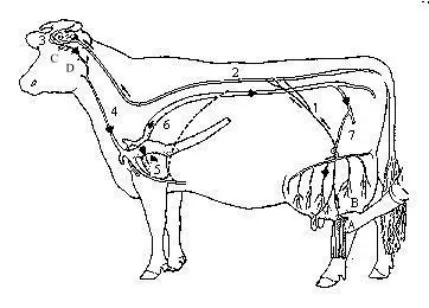 3 PRINCIPLES
-
Natural Technique (calf suckling)
-
Manual Technique (hand milking)
-
Mechanical Technique (machine milking)
Natural Technique:
This method calf is able to draw the milk from the udder. To extract the milk the calf
presses the teat with the tongue and pallet on the other side. The tongue encircles the teat and
vacuum is created in the mouth by separating the jaws and retracting the tongue nearly 100
200alternating cycles may be observed per minute. A calf’s suckling is the best method of
evacuating the milk with least damage to the delicate tissue of mammary gland .The art of
milking is a cycle
Active Phase
Restive Phase
ACTIVE PHASE:
a) Creation of vacuum in the teat canal
b) Pressure is applied over the teat canal
c) The base of the teat is apparently occluded with the help of the tip of the tongue with the
idea to prevent the back flow of the milk into the gland cistern when the pressure is
applied which is followed by restive phase
RESTIVE PHASE:
At this stage 20mm Hg pressure is created at the teat end .in the phase both active and restive
phase are alternated and it has been scientifically proved that the amount of pressure applied over
the teat canal by calf is 535mm Hg pressure whereas in the case of hand milking the pressure is
310mm of Hg.
In the mechanical milking pressure on the teat is with the range of 350 mm-400mm Hg.
In the case of buffalos 400mm of Hg of pressure is applied but in the case of cattle it can be
restricted to360-380mm of Hg .It has been proved that cycling rate during nursing is twice as
fast as hand or machine milking .Thus the difference along with increased cycling rate facilitates
and explains the removal of milk from the udder at a faster rate by a calf when compared to hand
or machine milking
Hand milking: It is commonly practiced in the harvesting of milk .In order of milking of various
teats also differ.
-
Teats crosswise left four and right hind or right four and left hind.
-
Fore quarters teat together
-
Hind quarters teat together
-
Teats appearing more distended should be milked first. The milk should only be squeezed
and not drawn
STRIP CUP:
It is a device with four circular plates for each quarter which has the quantity of milk
normally first few strip of milk are drawn in the respective circles to asses the physiological
status of the udder. If there is any change in color, consistency appearance, etc., the milk should
be drawn at the end so as to prevent spreading the disease from one quarter to other.
Prevention of Kicking of the cow:
-
Application of milk man’s rope.
-
Anti cow kicker.
METHODS OF MANUAL MILKING.
- Fisting 2.Knuckling, 3.Stripping
1. FISTING. In this method the whole teat is held first with the thumb and the index finger
encircling the base of the teat. The base of the teat is closed by the ring formed by the finger, so
that the milk that is trapped in the teat canal cannot slip back into the
gland cistern. Simultaneously the teat is squeezed between the hollow of
the palm and with the middle, ring and index finger. The process is
repeated in succession. It is the best method of hand milking though
most of the milkmen follow knuckling method.
KNUCKLING METHOD
Many milkers tend to bend their thumb against the teat canal and drag the milk out. This practice
should be avoided as it is injurious to the teat.
3.STRIPPING
 This method is followed where the length of the teat is small; it is normally practiced towards the
end of milking in order to evacuate the milk completely. The last drawn milk is called stripping
which is rich in fat content. The process of stripping should be done in quick succession
otherwise the animal will become stripper where the letting down of milk is delayed.
TYPES OF HAND MILKING
1. DRY AND 2.WET
In most of the place wet milking is practiced. The milkman moistens the hand with certain type
of emollients like castor oil, or few strips of milk or even their own saliva. This should be
avoided for the sake of cleanliness. If wet milking is practiced, the teats will look harsh and
there is every possibility of development of cracks. Both the hands can be used for milking in
continuous milking .The maximum flow of milk from the udder is usually referred to a letting
down and it is a highly inherited character, cows possessing a teat with a small orifice is very
difficult for milking and there is leaking teat when the teats are pressed. Both the narrow orifice
and leaky teat animals are to be culled.
FREQUENCY OF MILKING:
It depends upon quantity of milk yield. Under normal circumstances the quantity of milk is less
than 10 litres/day – 2 times milking is followed when more than 10 litres three times milking is
followed. It has been observed and proved that three times milking improves milking 10-15%.
The factors that are to be considered during milking.
- Avoid excitement of the animal during and prior to milking. If the animal is excited then there
is
release of adrenaline and it will cause vasoconstriction.
-
Prepare and collect all the milking equipments prior to milking.
-
Milking operation should be continuous one.
-
As far as possible exact time of milking is to be followed.
-
Prepare the cow for milking.
-
Complete the milking within 5-7 minutes.
-
Use both hands for milking.
-
Use correct method and type of milking.
-
Weaned animals should not be milked with the calves nearby.
-
Provide concentrate mixture at the time of milking.
-
Remove the first few stripping for any possible abnormalities of milk.
-
Group the animals 2 hours prior to milking.
-
More than one milkman should milk a cow during the lactation so that any change in
milkman will
not affect / cause any problem in milking especially in the letting down process of lactating
animals.
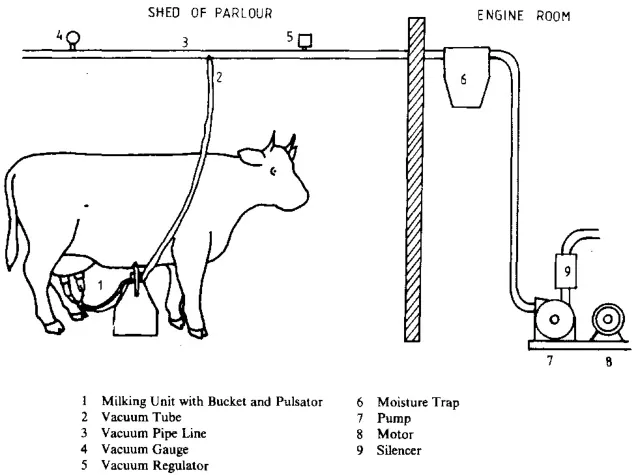
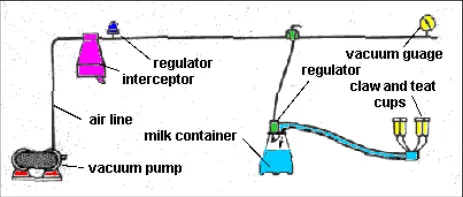
MACHINE MILKING :
A calf and the machine do the harvesting of milk in a similar fashion. The function of the
tongue, dental pallet and jaw movement of the calf is done by the inflation tube, pulsator and
vacuum pump. Milk removal is largely dependent upon the differential pressure
across the teat canal. The total differential pressure created by the milking machine is
approximately 352 mmHg, in the case of cattle and 400 mm Hg.in the case of buffaloes. The
pressure facilitates the expulsion of milk from the canal.
MERITS.
-
Easy method of extracting milk.
-
Does not require any skill.
-
Keeping quality of milk is high.
-
Chances of spreading of disease of the milk man to udder through milk are negligible.
-
Time consumed is less. One or two animals can be milked simultaneously and the
maximum of eight animals can be milked at a time.
DEMERITS:
-
Cost is high
-
electricity is essential.
One milking machine for – 10 animals yielding 10 litres / day will be economical to
maintain.
Summary Cheat Sheet
| Topic | Key Point |
|---|---|
| Milk definition | Milk is the normal mammary secretion obtained by complete milking of a healthy animal |
| Clean milk | Milk drawn under hygienic conditions without visible contamination |
| Major solids | Fat and solids-not-fat (SNF) are the key milk components |
| Collection chain | Rural collection, chilling centre reception, and dairy plant reception are major handling stages |
| Grading basis | Cleanliness, acidity, fat, SNF, and general quality are important |
| Adulteration topic | Adulterants and neutralizers are major milk-quality concerns |
| Detection need | Adulterant testing is essential for quality assurance |
| Hygiene rule | Clean udder, utensils, and handlers are central to clean milk production |
| Processing relevance | Good raw milk quality is essential before chilling or pasteurization |
| Exam trap | Clean milk does not simply mean filtered milk; it means hygienically produced uncontaminated milk |
Lesson Doubts
Ask questions, get expert answers