📦 Feed Conversion Ratio and Egg Marketing
Meaning of FCR and the basics of egg grading, marketing, and distribution.
This lesson covers core livestock production and management concepts for practical farm application and exam-oriented preparation.
Feed Conversion Ratio
Class 31 : Feed Conversion Ratio / dozen eggs or kilogram of meat. Marketing channels in
poultry-Integration.
Egg marketing : The wholesale rade of eggs in big cities, where potential demand exists, is in the
hands of a few traders who have monopolized this trade for their own advantages. Egg prices
vary from one market to another and from one season to another. In summer, the egg prices
crash down to a level which is sometimes less than the cost of production, even though the retail
price does not vary proportionately. Therefore proper attention has to be given to the problem of
most efficient disposal of market eggs.
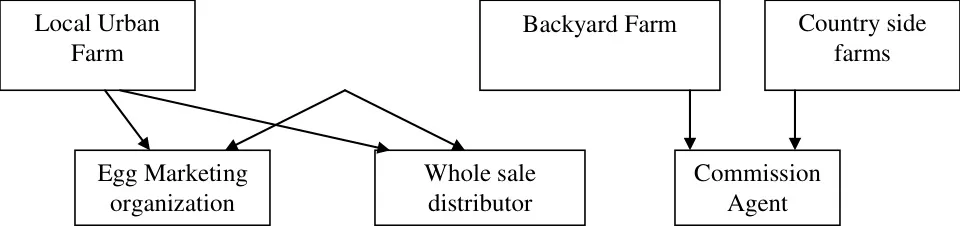
Distribution channel.
The eggs are distributed through different channels, viz. producers to consumers, producers via
retailers to consumers, producers via assesmblers to consumers, wholesalers, retrailers to
consumers, and producers to consumers via co-op societies/egg marketing organizations. Eggs
should be distributed through relatively shorter channels to speed up supply and avoid delay and
repeated handling.
Marketing agencies.
Marketing of eggs is primarily handled by traders and commission agents. The NAFED
regulates price stabilization activities. The NECC nowadays plays vary important role in
Government
Farm
stabilizing egg prices.
MARKETING OF BROILERS
Marketing plays a vital role in overall development of any economic unit, since marketing
consists of the performance of business activities that direct the flow of goods and services from
the producer to the consumer or user for the transfer of title of the ownership of goods .In broiler
marketing,the producers/farmers and buyer are brought together.
Market is a place wherein the exchange of goods or the change of title of goods takes place.
Broiler marketing Covers the job of
- assembling of birds from the area of production
2. converting them into cut that are in demand by the final consumers and
3. placing these products in the hands of such at the desired place, at the right time and in
quality.
 Thus the marketing of broilers includes all the intermediaries from the producer to the final
consumer in the channel of marketing.
The large farms which had their own retail outlets, made more profit due to better sale price
per kilogram live weight. In Tamilnadu 41.98% of farmers resorted to direct marketing,
45.68% through middleman and 12.34 % resorted to both direct and through middlemen.
MARKETING INTERMEDIARIES
Marketing Intermediaries are institutions that facilitates flow of goods and services
between poultry industry and its final market. They include wholesaler, agents (brokers),
transporting companies, warehouses and retailers.
CURRENT MARKETING SYSTEM.
At present in Tamilnadu, broilers are marketed through i. Wholesalers ii. Retailers with cold
storage (deep freezer facilities ),iii Retailers without cold storage facilities, iv. Chain storage
v.Hotels and restaurants
Retailer with cold storage
These retailers sell broiler and layer chicken regularly either as fresh or frozen
depending on the facilities and demand from the consumers. These retailers also stock
other animal products in addition to chicken products Many retailers have
slaughtering facilities at their premises. Some retailers
purchase dressed chicken from wholesalers and sell them after packing
with a margin. The higher income and middle income groups of consumers
prefer to purchase these frozen /chilled chicken as they are kept in hygienic condition
.RETAILER WITHOUT COLD STORAGE FACILITIES.
These retailers mostly purchase live broiler from wholesalers / producers and stock the live birds
in their premises .As and when the consumers demand,the live birds are dressed and sold as
fresh and remaining birds are kept for subsequent days sale -since most of the consumers of
middle and lower middle class people like only fresh chicken rather than frozen or chilled .
Now a days these retailers even started selling portion of chicken.
CHAIN STORES
There are many organizations having branches situated at different localities of the same city and
different towns ranging from 3to 6 branches with cold storage facilities. All the branches of each
organization are under central ownership and control .It is a compromise between large scale and
small scale organizations. The management, purchase, processing and controls are centralized
while sales are decentralized and carried out on a small scale. The chain stores obtain their
supplies directly from producers instead from wholesalers. They buy in lots and perform the
work of wholesalers in respect of transport, warehousing, risk bearing and financing .Chain
stores are strictly retailers enterprise to eliminate the wholesalers.
MARKETING CHANNEL
Marketing Channels simply mean the paths or routes through which produce from the producer
reach the ultimate destination ( consumers). There are five different marketing channels being
identified in broiler marketing in Tamilnadu.
1.Producers----- Wholesaler--------Retailer-------Consumer.
-
Producers----- Wholesaler -------Consumer.
-
Producers-----Chain store -------Consumer.
-
Producers -------Consumer.
5.Producer------Integrator/Commission Agent------Wholesaler-----Retailer----Consumer.
The first channel is more commonly observed in all the cities. The wholesaler purchase the live
birds from farm itself on live weight basis and transport in their own transport vehicle and sell to
retailers either live or dressed and the retailer in turn sell the product to consumers. In general
live birds are preferred over dressed chicken in the city, accordingly large number of live birds
are sold to retailers. The wholesaler take the risk of transport, storage losses due to shrinkage
and mortality.
In the second channel retailer procure the birds from the farm and sell to the consumer either
dressed or live.
In the third channel, the chain store procure birds from the farm and sell them after processing
to consumers.
In the fourth channel, the birds are either sold as live or dressed and in this the producer is able
to get 100 percent of consumers rupee since there are no intermediary.
The fifth channel, operates mostly outside the state and in the districts where the integration of
poultry farming is gaining momentum.
CONSTRAINTS OF MARKETING.
-
Increase cost of feed.
-
Variable quality of poultry feed.
-
Presence of many poultry diseases(Panic sales with low price).
-
Seasonal fluctuation in poultry meat prices.
-
Unorganized market infrastructure.
-
Non-adherence to quality and safety standards(Bio Security Measures).
-
Lack of Vertical integration.
-
Little efforts for manufacturing value added products.
-
Due to unplanned growth in poultry industry, mushroom growth of small hatcheries
without adequate hatchery hygienic practices.
-
Unexpected arrival from other states.
-
Chicken meat is more perishable than egg and thus requires an immediate sale.
-
Lack of consumer preference.
-
Transportation of dressed chicken carcasses in refrigerated trucks to marketing centers is
costly affair.
- Defective processing, storage and distribution of dressed carcasses
INTEGRATION IN BROILER INDUSTRY.
An integrated marketing in broiler industry covers al the aspects of production i.e. from
breeding to marketing of the final product. Two kinds of integration exist in marketing:
- Vertical integration: When more than one stages of producing and marketing a poultry
product are controlled by the same individual or company,e.g. A hatchery supplying
chicken and marketing the farmer’s final product.
- Horizontal integration: Two or more companies at one level join together to follow a
new marketing opportunity.
A completely integrated production and marketing system can also be organized under the
management of a grower ; wholesale processing co-operative, hence called cooperative
integration.
Poultry industry provides dramatic examples of the integration of farm production and
marketing activities. Poultry production itself is a highly integrated operation combining
specialized breeding, hatchery, grained farming and feed mixing, packing operations and
marketing firms.
There are 3 types of production- marketing integration in poultry industry.
- Owner Integration: The integration of product and marketing is controlled by an
individual or a single firm.,i.e., the facilities for the meat production is under the ownership
and the meat are marketed by him to retailer or consumer.
- Contract marketing: Buyers sets minimum standards for the meat to be produced by the
producer. Here the meat producer bears price uncertainties in addition to production cost. But
the quality of meat and the time of delivery are specified and assured.
3.Contract production: Here the producer is asked to grow the birds for the specific
distributor-under closely supervised conditions and for a guaranteed return, i.e., the integrator
supplies inputs like chick, feed, field supervision, etc., and the grower using his sheds, water
and labour grows the birds and returns after getting specified amount plus incentive for
superior feed conversion efficiency.
MARKETING INTEGRATION IN BROILER
Broiler farming in India is following the path towards integration. The integrator is involved in
all the above steps, which may or may not include supply of chicks to independent commercial
farmers. In some parts of the country, a trend towards integration on part of dealers has
started. The broiler dealer who were already operating at the middle of the above pathway by
purchasing grown birds from commercial farms is now going into forward and backward
integration.
i.Forward integration : It includes some sophistication in his dressing plant and extending
his reach to retail and institutional outlets.
ii. Backward Intrgration : It involves the following steps:
a. Setting up his own /contract commercial farm.
b. Becoming chick agent for the hatchery to supply chicks to farms.
c. Setting up of a feed plant to supply feed to farmers.
d. Setting up of hatchery, purchasing of eggs and producing day old chicks for his farmers.
e. setting up a breeding farm to supply the hatchery
Normally, in broiler industry, the chicken reaches the consumer through : 1. Breeder
2.Hatchery 3. Commercial growers. 4. Processor 5. Wholesaler and finally 6. Retailer at each
step, overheads and profits are added making retail price very high for the consumer thus losing
competitiveness in business .But in the integrated operation, it does not take the profit at each
stage into account, but only from the sale of the end product. Hence, there is an urgent need for
integration in the broiler industry.
Advantages:
- In broiler industry a farmer spends Rs 25 /= for production of one kg.of meat. While
marketing entrusts only to the wholesalers. So the farmer is able to sell his broilers 2 to 5 rupees
per kg than the actual market price. But in integrated marketing, the fluctuation in market
price and considerable amount of profit to middlemen will not arise.
2.In integrated marketing, a farmer does not involve directly in marketing. So he need not
maintain different age groups of birds in his farm. He can rather switch to “All –in-All-out”
system of rearing. Hence, he attains profit as a whole in a single spell itself.
- As chicks, feed and vaccines and other inputs are provided by the integrator the farmer needs
to put only a lesser investment.
- Variation in consumers’ demand and market prices depending upon season will not affect the
farmer.
- Timely attention with respect to the diseases prevention is provided by the integrator himself
which reduces loss.
6.There is change of shift in broiler units from urban area to rural areas, as the integrated
marketing makes the farmers not to trust the wholesaler for the marketing their birds. Moreover,
the cost of land and labour are comparatively very cheap in rural areas.
Benefits to Integrators.
- The chicks produced in hatcheries are better channeled through farmers to market. Further,
the hatchery receives the cost of chick from the farmer at a specified period and marketing is
well organized.
2 Since, the feed is prepared as a lot, production cost of feed is also reduced to the integrator.
- Integrator can decide over the market place of broiler meat as most of the rearing units are
in the hands of integrators.
Summary Cheat Sheet
| Topic | Key Point |
|---|---|
| FCR meaning | Feed Conversion Ratio is feed consumed per unit live-weight gain or production |
| Importance | Lower FCR indicates better feed efficiency |
| Broiler relevance | FCR is a key economic indicator in broiler farming |
| Marketing link | Efficient production supports better market performance and integration |
| Marketing chain | Intermediaries, chain stores, and channels influence poultry product movement |
| Production economics | Feed cost and FCR strongly affect profitability |
| Integration meaning | Marketing integration improves coordination from production to sale |
| Farm decision use | FCR helps compare batches and management quality |
| Broiler focus | Particularly important in commercial meat-bird systems |
| Exam trap | Good body weight alone is not enough; FCR determines how efficiently it was achieved |
Lesson Doubts
Ask questions, get expert answers