🌿 Respiration
Respiration.
This lesson provides exam-focused context on key concepts in crop physiology and connects the section topics for quick revision.
Types of respiration
Degradation of organic food for the purpose of releasing energy can occur with or
without the participation of oxygen. Hence, respiration can be classified into two types;
aerobic and anaerobic respiration.
Aerobic respiration
Aerobic respiration takes place in the presence of oxygen and the respiratory substrate
gets completely oxidized to carbon dioxide and water as end products.
C6H12O6 + 6O2 → 6CO2 + 6H2O + Energy (686 kcal)
(Glucose)
This type of respiration is of common occurrence and it is often used as a synonym of
respiration.
Anaerobic respiration
It takes place in the absence of oxygen and the respiratory substrate is incompletely
oxidized. Some other compounds are also formed in addition to carbon dioxide. This type of
respiration is of rare occurrence but, common among microorganisms like yeasts.
C6H12O6 → 2C2 H5OH + 2CO2 + 56 kcal
Glucose Ethanol
Respiratory substrate
A respiratory substrate is an organic substance which can be degraded to produce
energy which is required for various activities of the cell. The respiratory substrates include
carbohydrates, fats, organic acids, protein etc.
Carbohydrates
The carbohydrates constitute the most important respiratory substrate and the
common amongst them are starch, sucrose, glucose and fructose. The complex carbohydrates
are first hydrolyzed to simple sugars and then they are utilized.
Starch → Disaccharides → Hexoses
Fats
The fats are important storage food in seeds. Nearly 80 per cent of the angiosperms
have fats as the main storage food in their seeds. At the time of seed germination, large
amount of fats are converted into carbohydrates while the remaining fats are utilized in
respiration. Fats are first broken down to glycerol and fatty acids. The fatty acids are broken
down to acetyl coenzyme by β-oxidation. The acetyl coenzyme enters Kreb’s cycle for
further degradation and releases energy. Glycerol can directly enter the respiratory channel
via glyceraldehyde.
Organic acids
Organic acids normally do not accumulate in plants to any appreciable extent except
in the members of the family, Crassulaceae. Organic acids are oxidized under aerobic
conditions to carbon dioxide and water.
Proteins
Under normal conditions, proteins are used up as respiratory substrate only in seeds
rich in storage proteins. In vegetative tissues, proteins are consumed only under starvation.
The proteins are hydrolyzed to form amino acids. Later, the amino acids undergo
deamination forming organic acids and the organic acids can enter Kreb’s cycle directly.
Mechanism of Respiration
-
Glycolysis
-
Aerobic breakdown of pyruvic acid (Kreb’s cycle)
-
Electron Transport System/ Terminal oxidation / oxidative phosphorylation
-
Pentose phosphate pathway
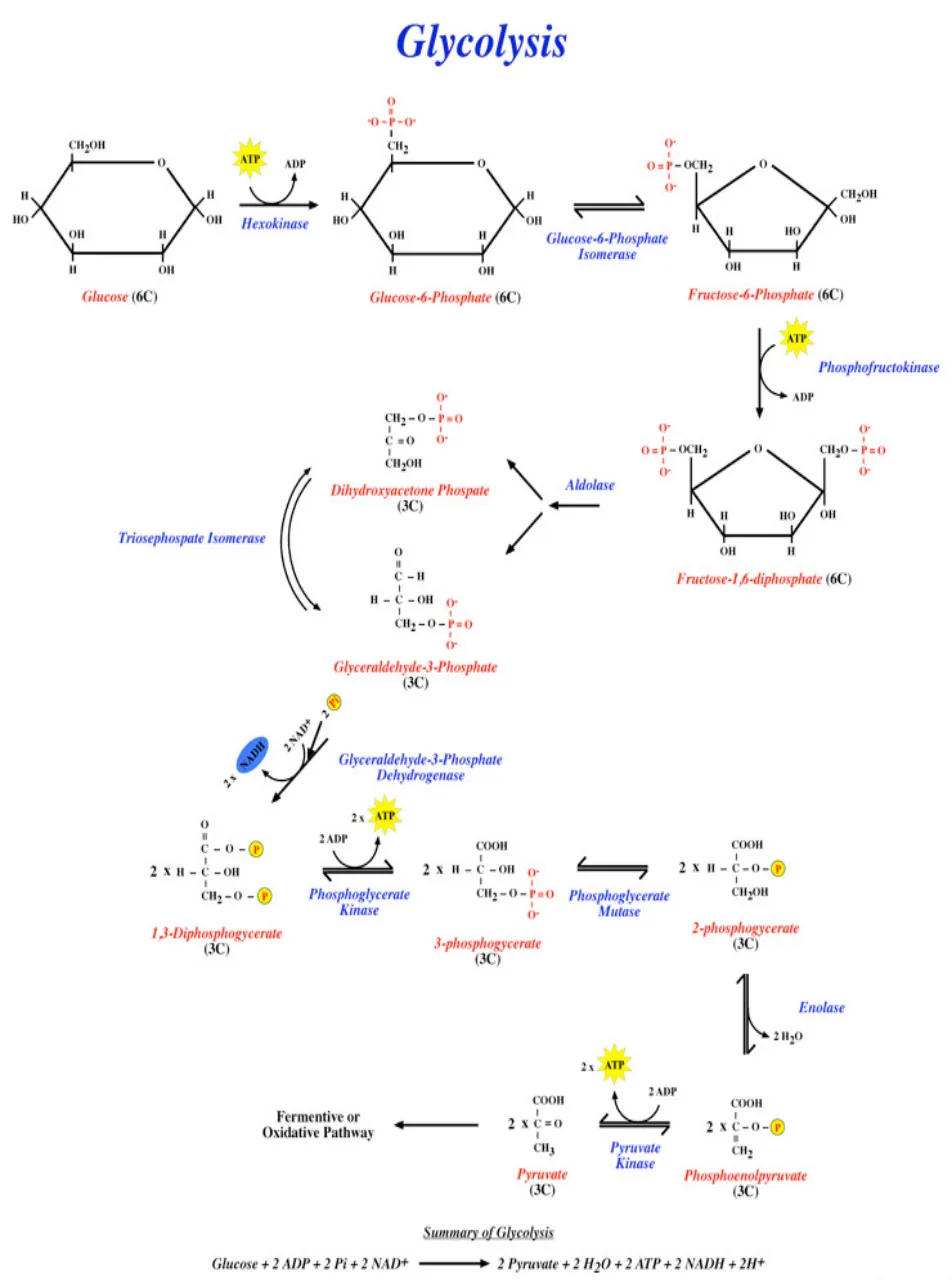
A. GLYCOLYSIS / EMBDEN – MEYER HOF – PARANAS (EMP) PATHWAY
Glycolysis can take place even in the absence of O2. One molecule of the 6 carbon
compound, glucose is broken down through a series of enzyme reactions into two 3-carbon
compounds, the pyruvic acid. Glycolysis takes place in the cytoplasm and it does not require
oxygen. Hence it is an anaerobic process.
- Glucose molecules react with ATP molecules in the presence of the enzyme
hexokinase to form glucose -6- phosphate.
Glucose + ATP → Glucose -6- phosphate + ADP
- Glucose-6-phosphate is isomerised into fructose-6-phosphate in the presence of
phospho hexose isomerase.
Fructose + ATP → Fructose -6- phosphate + ADP
- Fructose-6-phosphate reacts with one molecule of ATP in the presence of phospho
hexo kinase forming fructose 1, 6-disphosphate.
Fructose – 6- phosphate + ATP → Fructose -1,6- biphosphate + ADP
- Fructose 1, 6 diphosphate is converted into two trioses, 3-phospho glyceraldehyde
and dihydroxy acetone phosphate in the presence of aldolase.
Fructose -1,6- biphosphate → 3-phospho glyceraldehyde+ DHAP
- 3-phosphoglyceraldehyde reacts with H3PO4 and forms 1,3-diphosphoglyceraldehyde
where, the reaction is non –enzymatic.
- 1, 3-Diphosphoglyceraldehyde is oxidized to form 1,3- diphosphoglycerate in the
presence of triose-phosphate dehydrogenase and coenzyme NAD [+] . The NAD [+] acts as
hydrogen acceptor and reduced to NADH [+] + H [+] in the reaction.
Glyceraldehde -3- phosphate + NAD + Pi → 1,3- diphosphoglycerate + NADH
- 1, 3-Diphosphoglycerate reacts with ADP in the presence of phosphoglyceric
transphorylase (kinase) to form 3 phosphoglyceric acid and ATP.
1,3- diphosphoglycerate + ADP → 3, Phosphoglycerate + ATP
- 3, Phosphoglycerate → 2, Phosphoglycerate acid is isomerized into 2
phosphoglyceric acid in the presence of the enzyme, phospho glycero mutase
3, Phosphoglycerate → 2, Phosphoglycerate
- 2 phosphoglyceric acid is converted into 2-phosphoenolpyruvic acid in the presence
of enolase.
2, Phosphoglycerate → Phosphoenol pyruvate + H2O
- 2 phospho enol pyruvic acid reacts with ADP to form one molecule each of pyruvic
acid and ATP in the presence of pyruvate kinase.
Phosphoenol pyruvate + ADP → Pyruvate + ATP
Glycolysis or EMP pathway is common in both aerobic and anaerobic respiration.
The overall glycolytic process can be summarized as follows
C6H12O6 + 2ATP + 2NAD + 4ADP+2H3PO4
↓
2 CH3COCOOH + 2ADP + 2NADH2 + 4 ATP
Pyruvic acid
- Thus there is a gain of 4-2 = 2 ATP molecules per hexose sugar molecule oxidized
during this process.
- Besides this, 2 molecules of reduced coenzyme NADH2 are also produced per
molecule of hexose sugar in glycolysis.
- During aerobic respiration, these two NADH2 are oxidized via the electron transport
chain to yield 3 ATP molecules each. Thus 6 ATP molecules are formed.
Summary Cheat Sheet
- Review each concept section above in sequence to connect definitions, processes, and applied crop-physiology outcomes.
- Focus on high-yield terms, pathways, and condition-dependent responses for exam-ready recall.
- Use the listed examples, comparisons, and cycles as rapid-revision anchors before practice questions.
References
1 source
References
Lesson Doubts
Ask questions, get expert answers