🌿 Krebs— Cycle / Citric Acid
Krebs— Cycle / Citric Acid.
This lesson provides exam-focused context on key concepts in crop physiology and connects the section topics for quick revision.
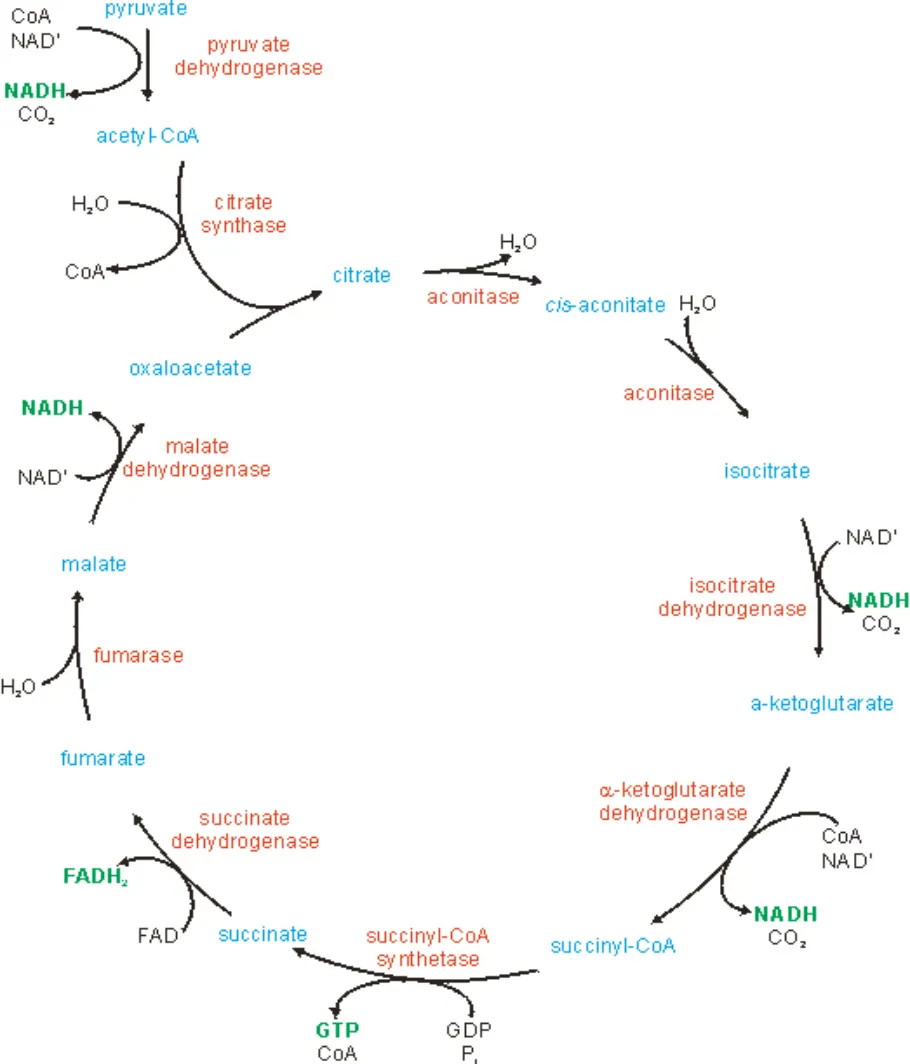
KREBS’ CYCLE / CITRIC ACID CYCLE /TCA CYCLE
The pyruvic acid produced in glycolysis enters into Krebs’ cycle for further
oxidation. Krebs’ cycle is also known as citric acid cycle or Tri carboxylic acid (TCA) cycle.
This aerobic process takes place in mitochondria where necessary enzymes are present in
matrix.
- Pyruvic acid reacts with CoA and NAD and is oxidatively decarboxylated. One molecule
of CO2 is released and NAD is reduced. Pyruvic acid is converted into acetyl CoA.
Pyruvate dehydrogenase
- Acetyl-CoA condenses with oxaloacetic acid in the presence of condensing enzyme and
water molecule to form citric acid. CoA becomes free.
Condensing enzyme
Citric acid + CoA Acetyl CoA + Oxaloacetic acid
- H2O
- Citric acid is dehydrated in the presence of aconitase to form cis – aconitic acid
Aconitase
Citricacid
- H2O
- Cis-aconitic acid reacts with one molecule of water to form Isocitric acid
Cis-aconitic acid + H2O
- Iso-citric acid is oxidized to oxalo succinic acid in the presence of Isocitric
dehydrogenase. NADP is reduced to NADPH2 in the reaction.
IC dehydrogenase
Isocitric acid + NADP
- Oxalo succinic acid is decarboxylated in the presence of oxalo succinic decarboxylase to
form α - ketoglutaric acid and a second molecule of CO2 is released.
Oxalosuccinic
α-ketoglutaric acid + CO2 Oxalosuccinic acid
Decarboxylase
- α - ketoglutaric acid reacts with CoA and NAD in the presence of α - ketoglutaric acid
dehydrogenase complex and is oxidatively decarboxylated to form succinyl CoA and a third
mole of CO2 is released. NAD is reduced in the reaction.
α-keto glutaric acid + CoA
NAD NADH2
- Succinyl CoA reacts with water molecule to form succinic acid. CoA becomes free and
one molecule of GDP (Guanosine diphosphate) is phosphorylated in presence of inorganic
phosphate to form one molecule of GTP.
H2O
Succinyl-CoA + GDP + ip
GTP may react with ADP to form one molecule of ATP
GTP + ADP → ATP + GDP
- Succinic acid is oxidized to fumaric acid in the presence of succinic dehydrogenase and
co enzyme FAD is reduced in this reaction.
Succinic acid dehydrogenase
Succinic acid + FAD
- One mole of H2O is added to Fumaric acid in the presence of fumarase to form malic
acid.
Fumarase
Fumaric acid + H2O
- In the last step, malic acid is oxidized to oxaloacetic acid in the presence of malic
dehydrogenase and one molecule of coenzyme i.e. NAD is reduced.
Malic dehydrogenase
Malic acid + NAD
KREBS CYCLE or TCA CYCLE
Pentose phosphate pathway (ppp) / Hexose mono phosphate (hmp) shunt/
P hosphogluconate pathway / Warburg and Dicken’s pathway
The pentose phosphate pathway occurs in the cytoplasm outside the mitochondria and
it is an alternative pathway to glycolysis and Kreb’s cycle. The presence of some compounds
like iodoacetate, fluorides, arsenates etc. inhibit some steps in glycolysis and that leads to the
alternate pathway. This pathway was discovered by Warburg and Dicken (1938). This
pathway does not produce ATP but it produces another form of energy called reducing power
in the form of NADPH. It is not oxidized in the electron transport system but, it serves as
hydrogen and electron donor in the biosynthesis of fatty acids and steroids. The pentose
phosphate pathway consists of two distinct phases. In the first phase, hexose is converted into
pentose and in the second phase, pentose is reconverted in to hexose.
In the process, oxidation of glucose 6 phosphate leads to the formation of 6
phosphogluconic acid (pentose phosphate). Since glucose is directly oxidized without
entering glycolysis, it is called as direct oxidation.
6 Glucose 6 phosphate +12 NADP 5 Glucose 6 Phosphate + 12 NADPH2+ 6 CO2
acid pathway. Although ATP is not produced, NADPH is produced and serves as hydrogen
and electron donor in the biosynthesis of fatty acids and steroids. The pathway is also called
as phosphogluconate pathway as the first product in this pathway is phosphogluconate.
OXIDATIVE PHOSPHORYLATION
C. TERMINAL OXIDATION OF THE REDUCED COENZYMES / ELECTRON
TRANSPORT SYSTEM AND OXIDATIVE PHOSPHORYLATION
The last step in aerobic respiration is the oxidation of reduced coenzymes produced in
glycolysis and Krebs’ cycle by molecular oxygen through FAD, UQ (ubiquinone),
cytochrome b, cytochrome c, cytochrome a and cytochrome a3 (cytochrome oxidase).
Two hydrogen atoms or electrons from the reduced coenzyme (NADH2 or NADPH2)
travel through FAD and the cytochromes and ultimately combines with 1/2O2 molecule to
produce one molecule of H2O. This is called as terminal oxidation .
The terminal oxidation of each reduced coenzyme requires 1/2O2 molecule and 2H
atoms (i.e. 2 e [- ] + 2H [+] ) to produce one H2O molecule. Except for flavoproteins (like FAD)
and ubiquinone (UQ) which are hydrogen carriers, the other components of electron transport
chain (cytochromes) are only electron carriers i.e. they cannot give or take protons (H [+] )
During the electron transport, FAD and the iron atom of different cytochromes get
successively reduced (Fe [++] ) and oxidized (Fe [+++] ) and enough energy is released in some
places which is utilized in the photophosphorylation of ADP molecules in the presence of
inorganic phosphate to generate energy rich ATP molecules. Since, this oxidation
accompanies phosphorylation; it is called as oxidative phosphorylation .
One molecule of ATP with 7.6 Kcal.energy is synthesized at each place when
electrons are transferred from
-
Reduced NADH2 or NADPH2 to FAD
-
Reduced cytochrome b to cytochrome c
-
Reduced cytochrome a to cytochrome a3
Thus, oxidation of one molecule of reduced NADH2 or NADPH2 will result in the formation
of 3 ATP molecules while the oxidation of FADH2 lead to the synthesis of 2 ATP molecules.
According to the most recent findings, although in eukaryotes terminal oxidation of
mitochondrial NADH / NADPH results in the production of 3 ATP molecules but that of
extra mitochondrial NADH / NADPH yields only 2 ATP molecules. Therefore, the two
reduced coenzyme molecules (NADH) produced per hexose sugar molecule during
Glycolysis will yield only 2x2:4 ATP molecules instead of 6 ATP molecules. Complete
oxidation of a glucose molecule (hexose sugar) in aerobic respiration results in the net gain
of 36 ATP molecules in most eukaryotes.
One glucose molecule contains about 686 Kcal. Energy and 38 ATP molecules will
have 273.6 Kcal energy. Therefore about 40% (273.6/686) energy of the glucose molecule is
utilized during aerobic breakdown and the rest is lost as heat. Since huge amount of energy is
generated in mitochondria in the form of ATP molecules, they are called as Power Houses of
the cell .
ATP molecules contain energy in terminal pyrophosphate bonds. When these energy
rich bonds break, energy is released and utilized in driving various other metabolic processes
of the cell.
Differences between oxidative phosphorylation and Photophosphorylation
| 1 | It occurs during respiration | Occurs during photosynthesis |
|---|---|---|
| 2 | Occurs inside the mitochondria (inner membrane of cristae) |
Occurs inside the chloroplast (in the thylakoid membrane) |
| 3 | Molecular O2 is required for terminal oxidation |
Molecular O2 is not required |
| 4 | Pigment systems are not involved | Pigment systems, PSI and PSII are involved |
| 5 | It occurs in electron transport system | Occurs during cyclic and non cyclic electron transport |
| 6 | ATP molecules are released to cytoplasm and used in various metabolic reactions of the cell |
ATP molecules produced are utilized for CO2 assimilation in the dark reaction of photosynthesis |
Efficiency of respiration
The total energy content of one molecule of glucose is 686 Kcal. Out of this energy,
available free energy is 673.6 Kcal and the energy content of ATP molecule is calculated as
7.3 Kcal. The efficiency of respiration may be expressed as follows.
Kcal of energy conserved in ATP
Efficiency of respiration: ---------------------------------------- x 100
Total free energy available
38 x 7.3 Efficiency of aerobic respiration : ------------x 100: 41 % 673.6
2 x 7.3 Efficiency of anaerobic respiration: ------------x 100: 31 %
2 x 7.3 Efficiency of fermentation : ------------x 100: 36.5 %
Respiratory quotient
The ratio of the volume of CO2 released to the volume of O2 taken during respiration
is called as respiratory quotient and is denoted as RQ
Volume of CO2 RQ =
Volume of O2
Value of RQ
The value of RQ depends upon the nature of the respiratory substrate and the amount
of O2 present in respiratory substrate.
- When carbohydrates such as hexose sugars are oxidized in respiration, the value of RQ is
1 or unity because volume of CO2 evolved equals to the volume of O2 absorbed.
Glucose
volume of CO2 6 RQ = =
volume of O2
=
= 1 or unity
- When fats are the respiratory substrate, the value of RQ becomes less than one because
fats are poorer in O2 in comparison to carbon and they require more O2 for their oxidation,
Tripalmitin
volume of CO2 102 RQ = =
volume of O2
=
= 0.7
(Fats are oxidized in respiration usually during the germination of fatty seeds).
- When organic acids are oxidized in respiration, the value of RQ becomes more than one.
It is because organic acids are rich in O2 and require less O2 for their oxidation.
Malic acid
RQ = volume of CO2 = 4
= 1.3
volume of O2
Energy budgeting
Stages Gain of Consumption Net gain of
| Col1 | ATP | of ATP | ATP |
|---|---|---|---|
| Glycolysis | |||
| 1) Glucose Glucose 6 PO4 | 1 | ||
| 2) Fructose 6 PO4 Fructose 1,6 di PO4 | 1 | ||
| 3) 1,3 diphosphoglyceraldehyde 1,3 diphospho glyceric acid |
6 | ||
| 4) 1,3 diphospho glyceric acid 3 phosphoglyceric acid |
2 | ||
| 5) 2 phosphoenol pyruvic acid Pyruvic acid |
2 | ||
| Total | 10 | -2 | 8 |
| Kreb’s cycle | |||
| 6) Pyruvic acid Acetyl CoA | 3 | ||
| 7) Isocitric acid Oxalosuccinic acid | 3 | ||
| 8) ketoglutaric acid Succinyl CoA | 3 | ||
| 9) Succinyl Co A Succinic Acid | 1 | ||
| 10) Succinic acid Fumaric Acid | 2 | ||
| 11) Malic acid Oxaloacetic acid | 3 | ||
| Total ATP mol. produced per Pyruvic acid | 15 | 15 | |
| Total ATP mol. produced for 2 Pyruvic acids | 15 x 2:30 | 30 | |
| Grand Total | 40 | -2 | 8+ 30 = 38 |
FACTORS AFFECTING RESPIRATION
A. External factors
Temperature
Temperature has profound influence on the rate of respiration. Optimum temperature
for respiration is about 30°C, minimum 0°C and maximum about 45°C. At low temperature,
the respiratory enzymes becomes inactive, consequently the rate of respiration falls. It is due
to this fact that the quality of fruits and vegetables stored at low temperature does not
deteriorate. At very high temperature, respiration slows down and may even be stopped due
to denaturation of the respiratory enzymes.
Oxygen
In complete absence of O2, anaerobic respiration takes place while aerobic respiration
stops. In higher plants, the anaerobiosis produces large amount of alcohol which is toxic to
plants. If some amount of O2 is available, anaerobic respiration slows down and aerobic
respiration starts. The concentration of O2 at which aerobic respiration is optimum and
anaerobic respiration is stopped, is called as extinction point.
It is observed that under anaerobic conditions, much more sugar is taken up per
quantity of yeast present than it is consumed in the presence of oxygen. The inhibition on the
rate of carbohydrate breakdown by oxygen is called as Pasteur’s effect .
Carbon dioxide
Higher concentration of CO2 in the atmosphere especially in the poorly aerated soil
has retarding effect on the rate of respiration.
Inorganic salts
If a plant or tissue is transferred from water to salt solution, the rate of respiration
increases (called as salt respiration ).
Water
Proper hydration of cells is essential for respiration. Rate of respiration decreases
with decreased amount of water, so much so, that in dry seeds, the respiration is at its
minimum. It is because in the absence of a medium, the respiratory enzymes become
inactive.
Light
The effect of light is indirect on the rate of respiration through the synthesis of
organic food matter in photosynthesis.
- Wound or injury
Injury or wounds result in increased respiration as the plants in such a state require
more energy which comes from respiration. The wounded cells become more meristematic to
form new cells for healing the wound.
Internal factors
Protoplasmic factors
The amount of protoplasm in the cell and its state of activity influence the rate of
respiration.
- The rate of respiration is higher in young meristematic cells which divide actively and
requires more energy. Such cells have greater amount of protoplasm and no vacuoles.
- In old mature tissues, the rate of respiration is lower because of lesser amount of
active protoplasm
Concentration of respiratory substrate
Increased concentration of respirable food material brings about an increase in the
rate of respiration.
Under starvation conditions, such as in etiolated leaves, the rate of respiration slows
down considerably. If such etiolated leaves are supplied with sucrose solution for few days
even in dark conditions, the rate of respiration increases.
Differences between Photorespiration and Dark respiration
| Col1 | Photorespiration | Dark /Mitochondrial respiration |
|---|---|---|
| 1 | It occurs in the presence of light | It occurs in the presence of both light and dark. |
| 2 | The substrate is glycolate | The respiratory substrate may be carbohydrate, fat or protein. |
| 3 | It occurs in chloroplast, peroxisome and mitochondria |
The process occurs in the cytoplasm and mitochondria |
| 4 | It occurs in temperate plants like, wheat and cotton ( mainly in C3 plants) |
It occurs in C4 plants ( maize and sugar cane) |
| 5 | It occurs in the green tissues of plants | It occurs in all the living plants( both green and non green ) |
| 6 | The optimum temperature is 25- 35ºC | It is not temperature sensitive |
| 7 | This process increases with increased CO2 concentration. |
This process saturate at 2-3 percent O2 in the atmosphere and beyond this concentration there is no increase. |
| 8 | Hydrogen peroxide is formed during the reaction |
Hydrogen peroxide is not formed. |
| 9 | ATP molecules are not produced, | Several ATP molecules are produced. |
| 10 | Reduced coenzymes such as NADPH2, NADH2 and FADH2 are not produced. |
Reduced coenzymes such as NADPH2, NADH2 and FADH2 are produced. |
| 11 | One molecule of ammonia is released | No ammonia is produced |
| Col1 | per molecule of CO released. 2 |
Col3 |
|---|---|---|
| 12 | Phosphorylation does not occur | Oxidative phosphorylation occurs. |
Differences between respiration and photosynthesis
| Col1 | Respiration | Photosynthesis |
|---|---|---|
| 1 | It is catabolic process resulting in the destruction of stored food |
It is an anabolic process resulting in the manufacture of food. |
| 2 | Light is not essential for the process | Light is very much essential |
| 3 | Oxygen is absorbed in the process | Oxygen is liberated |
| 4 | Carbon dioxide and water are produced |
Carbon dioxide is fixed to form carbon containing compound |
| 5 | Potential energy is converted into Kinetic energy |
Light energy is converted into chemical energy (potential energy) |
| 6 | Glucose and oxygen are the raw materials |
Carbon dioxide and water are the raw materials |
| 7 | Energy is released during respiration and hence it is an exothermic process. |
Energy is stored during photosynthesis and hence it is an endothermic process |
| 8 | Reduction in the dry weight | Gain in the dry weight |
| 9 | Chlorophyllous tissues are not necessary |
Chlorophyllous tissues are essential for the process |
Differences between aerobic respiration and fermentation
| Col1 | Aerobic respiration | Fermentation |
|---|---|---|
| 1 | It occurs in all living cells of the plants throughout the day and night |
Occurs outside the plant cells and in certain microorganisms |
| 2 | It takes place in the presence of oxygen | Absence of oxygen |
| 3 | The end products are CO2 and H2O | End products are CO2 and alcohol or other organic acids |
| 4 | It is not toxic to plants | It is toxic to plants |
| 5 | Complete oxidation is food material is | Incomplete oxidation is observed |
| Col1 | observed | Col3 |
|---|---|---|
| 6 | Large amount of energy (673 kCal) is released per glucose molecule |
Very small amount of energy (21 kCal) is released per glucose molecule |
| 7 | The complete oxidation yields 38 ATP molecules |
The incomplete oxidation in fermentation yields only two ATP molecules |
| 8 | The enzyme, zymase is not required but many other enzymes and coenzymes are required |
Zymase is required in the case of carbohydrates |
Summary Cheat Sheet
- Review each concept section above in sequence to connect definitions, processes, and applied crop-physiology outcomes.
- Focus on high-yield terms, pathways, and condition-dependent responses for exam-ready recall.
- Use the listed examples, comparisons, and cycles as rapid-revision anchors before practice questions.
References
1 source
References
Lesson Doubts
Ask questions, get expert answers